OpenRouter Cut Three Providers After Prompts Leaked Across Its Supply Chain
OpenRouter cut three providers and stripped 125 endpoints of Zero Data Retention after a canary-token study found prompts leaking across the AI supply chain.

On this page
Key takeaways
- OpenRouter said on 22 November 2026 that it off-boarded three inference providers and removed 125 endpoints from Zero Data Retention eligibility after a security study.
- Dragos sent about two million prompts containing unique canary credentials to AI services over five months and found three hosting providers had been compromised by attackers.
- A Chinese AI lab's systems fetched secret URLs from more than half the prompts sent to its models between July and October, including about two-thirds of requests marked Zero Data Retention.
- Together AI separately disclosed that an AI coding agent committed a credential to a public GitHub repository, allowing an unauthorised party to download stored prompt samples.
- OpenRouter said the findings did not show a breach of OpenRouter itself, and it did not name the three providers it removed.
OpenRouter removed three inference providers from its marketplace and stripped 125 endpoints of their Zero Data Retention status on Sunday, after a security study found prompts passing through the AI supply chain being read, stored and in some cases stolen. The company published the changes in a notice dated 22 November, three days after the research behind them and a day after it began emailing affected customers.
Related reading: Cleverbridge Says Attackers Copied Card Numbers and CVVs From Its Checkout Platform · The FBI Is Investigating an Apparent Breach of Its Crime Database.
The study came from Dragos, an industrial cybersecurity vendor. Its chief research officer, HD Moore, sent roughly two million prompts containing unique, trackable secrets through AI routers and hosting providers over five months, then watched where the secrets surfaced. What came back was not a single vulnerability but a picture of an ecosystem in which the same prompt can pass through a router, a reseller, a hosting provider and a model developer, each of which may log it.
OpenRouter runs a marketplace that lets developers reach many models through one API. It said the findings did not show any breach or unauthorised access of OpenRouter itself. It did not name the three providers it off-boarded, or say which endpoints lost ZDR eligibility.
What Dragos did
The method is the story as much as the result. Moore's team built prompts that each carried a credential tied to an empty AWS account, a password for an SSH service, and a URL, DNS name or private git repository reference that had never appeared anywhere else. Each secret went into exactly one prompt, sent to one provider, so any later use of it could be traced back to that request.
The team called these canaries, after the birds sent into mines. The AWS keys were real keys to empty accounts with full logging, which meant the researchers could see when a key had been used, from where, and what the user tried to do with it. Dragos said it traced about 2,000 routes through the inference stack, using image requests and deliberately malformed calls to expose the hops that a router does not disclose.
The report was published on 19 November. Ars Technica covered it on 20 November, and OpenRouter's customer emails began circulating on 21 November.
Three providers were already compromised
The most serious finding was not about policy. Dragos said attackers had stolen data from three hosting providers, and that none of the three knew until the researchers told them. The earliest incident dated to mid-July.
In the largest case, about 200 of the planted AWS keys were sent to one provider in short windows in late October. Every request sent during those windows was stolen, including requests the provider rejected before a model ran. That detail matters: it places the attacker at the provider's front door, copying requests as they arrived, rather than deeper in the inference stack.
The stolen keys were tested within hours. Attackers listed S3 buckets, searched Secrets Manager and Parameter Store, tried to enable hosted models in AWS Bedrock, and added their own IAM users to keep access. Dragos counted tens of thousands of AWS API calls using the bait keys. Two providers appear to have been hit by the same adversary, because secrets sent to each were used together from a single rented server almost immediately.
The tooling changed over three weeks, from a script posing as Chrome on Windows to Boto3 inside OrbStack and then the AWS CLI on Kali Linux. On 1 November the attacker added ARTEX, an LLM-driven penetration-testing framework. In this case it did little beyond confirming that keys were still live, but two user-agent strings it produced, artex-agent and artex-judge-r121, were not in public indicator lists.
Dragos is a security vendor, and its report is also a product argument for its own monitoring tools. It does not name the three compromised providers, the marketplace sellers or the Chinese lab. The canary method proves that specific prompts leaked; it does not measure how much real customer data was taken, or by whom.
The resellers read the prompts themselves
The second finding required no exploit at all. Some sellers on the inference marketplace listed popular models at the lowest price, turned on request logging, and waited. Because the router sends prompts to the cheapest acceptable seller, the traffic came to them.
Dragos identified them by sending the same request through different sellers. When credentials were reused after one route and not another, the seller was the leak. In one case, a person on a home broadband connection opened two secret URLs in a desktop browser about a day and a half after the prompts were sent, then began guessing usernames at the login page. In another, someone working from a Mac in France took passwords from two prompts and typed them into root SSH attempts by hand.
That is small-scale, manual theft, not a nation-state operation. It is also the kind of access that a privacy policy is supposed to prevent, and it came from parties the customer never chose.
Zero Data Retention did not hold
The third finding is the one that most directly undercuts the labels customers rely on. A Chinese AI lab's systems fetched the secret URLs from more than half the prompts sent to its models between July and October, including roughly two-thirds of requests marked "no data collection" or Zero Data Retention. The fetches typically came two or three days after the request.
The lab was not the only path. Several US hosting providers resell its models, and prompts sent to those providers triggered the same scraper, which means the prompt was flowing back to the lab even when the customer had picked a US provider to keep data in the country. Later, a git client on a different cloud tried to clone private repositories referenced in the prompts, but only for requests that used that lab's models.
Two US providers had their own problems. One continued to fetch a secret URL more than two months after a single call to its search endpoint. Another ran a scraper that returned for URLs days after each request, whichever router was used.
The strangest case involved a company chat. Twenty-four days after a prompt went to one Chinese provider, the secret link appeared in a Feishu channel. Within two minutes it was opened from three desktops and three phones in Beijing and Shanghai. Dragos said its disclosure to that provider included only the first eight characters of the link, so whoever shared it was reading from a stored copy of the full prompt.
OpenRouter's response
OpenRouter's notice lists three actions: off-board three providers, remove 125 endpoints from ZDR eligibility, and notify potentially affected customers. It said the removals included providers flagged by the researchers plus additional endpoints removed as a precaution. It is also adapting the canary method to run its own checks, verifying network paths for hidden forwarding, and requiring assurances before restoring ZDR to any endpoint.
The company also published links to provider notices. Novita posted a privacy notice about MiniMax requests. Phala published a preliminary incident report. Together AI published a separate disclosure.
What OpenRouter did not do is name the off-boarded providers, quantify how many customers were affected, or explain how a provider that lost ZDR eligibility had held it in the first place. Those omissions leave customers unable to tell whether their own traffic went through a removed endpoint.
Together AI's separate breach
Together AI's notice, published on 21 November, describes a different failure. The company collected prompt samples for testing and stored them in a private Hugging Face repository. While developing a public GitHub repository, an AI coding agent committed a credential that gave access to that private repository.
The company's automated scanning caught the exposed credential and reverted the commit, but during the exposure window an unauthorised party obtained it and downloaded the stored samples. The data came from requests to MiniMax M3, GLM-5.2 and Kimi K2.6, primarily on four dates in June and July. The party then searched the samples for credentials to other services and tested them; five of the credentials tested were Dragos canaries.
Together AI said it has not found evidence of additional prompt leakage beyond that incident, that it is working with a forensic firm and law enforcement, and that it has made ZDR the default for new accounts. It also now checks pull requests for credentials and has changed its rules for AI coding agents.
What the research can and cannot show
The study does not say that every router leaks, or that every provider ignores privacy settings. It says that the chain is long enough, and the incentives weak enough, that leakage happened repeatedly across a five-month test. Dragos's own recommendation is blunt: host the model yourself if the data is sensitive, or buy directly from a single provider with one contract and one privacy policy. If you use a router, pick the upstream provider rather than accepting the default pool.
For anyone pasting source code, customer records or credentials into a chat window, the practical lesson is that the privacy setting is a claim about the first hop. It does not travel with the prompt.
Caveats
Dragos has not named the compromised providers, the sellers or the Chinese lab, and OpenRouter has not named the three it removed. The attribution of the three compromises to one adversary rests on shared infrastructure and timing, not on a named group. The claim that a US provider's traffic reached a Chinese lab is based on the same scraper firing on both paths, which is strong circumstantial evidence but not a packet capture.
Together AI's disclosure is its own account, published after Dragos contacted it, and its finding that no other prompts leaked is a statement about its review so far. OpenRouter's statement that it was not breached is also its own. No regulator has published findings, and no affected customer has described the scope of what was taken.
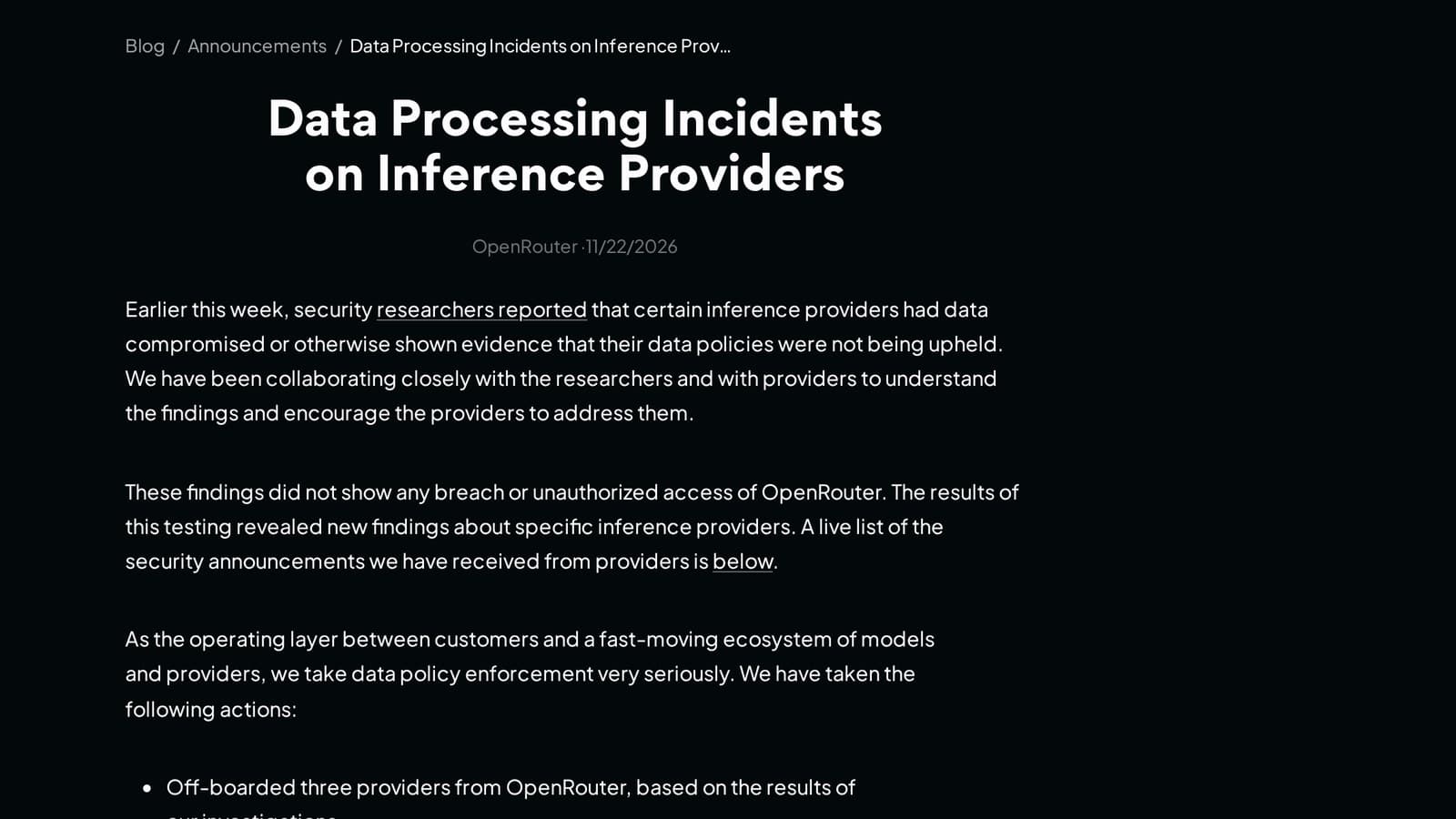
Cover image: A screenshot of OpenRouter's announcement "Data Processing Incidents on Inference Providers", published 22 November 2026. Courtesy of OpenRouter.
Tags
Frequently asked questions
- Did OpenRouter itself get hacked?
- OpenRouter says no. It said the findings did not show any breach or unauthorised access of OpenRouter. The problems were at inference providers and resellers that handle prompts sent through its marketplace.
- What is a canary token and how was it used here?
- A canary token is a unique secret, such as a fake AWS key or a URL that exists nowhere else. Dragos placed one in each test prompt, then watched whether anyone tried to use it, which showed that the prompt had leaked and roughly where.
- What does Zero Data Retention mean?
- Zero Data Retention is a setting that says prompts and responses are not stored after inference. The study found cases where requests marked ZDR were still read, retained or forwarded, so the label did not guarantee the handling customers expected.
- Are my prompts private if I use a first-tier provider directly?
- They are less exposed, but not guaranteed. Dragos said going directly to a single provider reduces the number of parties that can see a prompt, while still leaving room for data-sharing agreements or a breach at that provider.

TPW Editorial
Editorial Team
TechPastWeek's editorial team reports and edits every story we publish. We research each piece against primary and credible secondary sources, and a human editor reviews and signs off before it goes live.