
Attackers Used GL.iNet's Own Cloud Service to Backdoor Routers and KVM Devices
Attackers used a flaw in GL.iNet's GoodCloud service to install malware on routers and KVM devices. The vendor has no count and its check can miss infections.

On this page
Key takeaways
- GL.iNet said on 20 November 2026 that an unauthorised party exploited a vulnerability in its GoodCloud remote management service to install malware on some routers and KVM devices.
- The company fixed the cloud flaw and blocked the attack path, then published security firmware for dozens of router and KVM models on 22 November; the firmware removes the malware without a factory reset.
- RemoteToHome Consulting examined 199 routers it manages and found 166 affected by the November attack, an older backdoor or both, including 24 with root-level reverse shells.
- GL.iNet's published check looks for a process named crond -i /tmp/.log; it was absent on all 199 routers RemoteToHome examined, including 24 with live reverse shells, and GL.iNet now points users to a community scanner.
- GL.iNet has not said how many devices were infected, how the cloud flaw was exploited, or whether data was taken from devices or the computers attached to infected KVMs.
GL.iNet confirmed on 20 November that an unauthorised party had exploited a vulnerability in its GoodCloud remote management service to install malicious software on some of its routers and KVM devices. The company published an advisory the same day, shipped security firmware for dozens of models on 22 November, and updated the notice again on 23 November. It has not said how many devices were infected or how the attackers got through its cloud.
Related reading: CISA Flags Active Exploitation of the MailAssure Flaw N-able Found During Its Breach · Cleverbridge Says Attackers Copied Card Numbers and CVVs From Its Checkout Platform.
The disclosure matters beyond one vendor's user base. GL.iNet sells travel routers, home routers and remote keyboard, video and mouse devices that are popular with travellers, network administrators and people who run OpenWrt. A compromised router sits at the edge of a home or office network. A compromised KVM can reach the computer plugged into it.
BleepingComputer reported the exploitation on 22 November, after customers and researchers began sharing samples. Cybernews followed on 23 November with a field survey from a security consultancy that manages GL.iNet hardware.
What GL.iNet says happened
The company's security notice says it identified a vulnerability in its cloud remote management services on 20 November. An unauthorised party used it to access "some" GL.iNet routers and KVM devices and install malicious software.
GL.iNet says it fixed the flaw in its cloud, blocked the access used in the incident, and stopped new infections through that path. It also says the cloud fix does not clean devices that were already infected. Owners have to install new firmware for their exact model.
The advisory lists router firmware for models including the GL-MG1300, GL-MT3000, GL-MT6000, GL-E5800, GL-BE3600, GL-BE9300, GL-BE14000, GL-BE6500, GL-MT3600BE, GL-MT5000, GL-BE10000, GL-AX1800, GL-AXT1800, GL-SFT1200, GL-X3000, GL-XE3000, GL-MT2500, GL-X2000 and their variants. The KVM list covers the RM1, RM1V2, RM10, RM10RC, RM1PE and RM4PE at version 1.10.3 or later, and the RMQ1 at 1.8.7 or later.
The company says the security firmware removes the malware identified in the incident without a factory reset and lets owners keep their existing settings. It also says it will email customers it identifies as affected at the address linked to their GL.iNet cloud account.
The check GL.iNet published
The advisory gives owners a way to look for one known infection. On a router, open LuCI, go to Status and Processes, and search for crond -i /tmp/.log. On a KVM, open the device terminal and run ps -a | grep tmp on an RMQ1 or ps -aux | grep tmp on the other models. A line that shows only the grep command is not a match.
That indicator is specific, and it is also narrow. BleepingComputer examined a malicious installer that disguises its process as crond -i /tmp/.log, replaces the legitimate netstat utility with a modified script that hides connections to one attacker address, and installs SSH keys for remote access. The script recognises multiple GL.iNet models, downloads executables named gl-helper and gb from hardcoded servers, and establishes persistence through startup scripts and scheduled tasks.
The installer also contains Chinese-language comments describing its persistence and reporting functions, according to BleepingComputer. That points to a Chinese-speaking author. It does not establish who ran the campaign or whether a state or criminal group was involved.
GL.iNet now links to a community-developed scanner that checks for additional malware files, modified system utilities and configuration changes. The company describes the tool as independent and says it does not review, maintain or support it. The scanner's developers warn that it cannot detect every infection either.
What researchers found on real devices
RemoteToHome Consulting, a security firm that manages GL.iNet routers, published a field survey after the advisory. It examined 199 routers that it owns or manages, almost all with GoodCloud enabled and all online when checked. It found 166 that were affected by the November attack, an older backdoor or both.
The breakdown is blunt. Twenty-four devices had root-level reverse shells, 49 carried an older persistent backdoor, and 93 showed evidence that attacker-supplied commands had run. The company says the sample is not random and should not be read as an infection rate for all GL.iNet customers.
More troubling for owners, RemoteToHome said GL.iNet's published indicator was not running on any of the 199 routers it checked. That includes the 24 devices with live root shells. The vendor's check is a starting point, not a clean bill of health.
The reverse shells used the Linux nc utility to open outbound connections to 170.39.226[.]219, according to BleepingComputer. A separate forum report from the owner of a compromised GL-RM1 KVM showed the device downloading a malicious ni.sh script and other payloads from 66.245.219[.]252 on 19 November. The owner said the device then contacted roughly 1,800 residential IP addresses a day and repeatedly called the TRON blockchain API. The purpose of those connections is unclear, and there is no confirmation that the devices were being used as residential proxies or as part of a larger botnet.
Some malicious files had timestamps from December 2025, which suggests that some devices may have been compromised for months. GL.iNet has not linked those older infections to the November incident, and the researchers say the older backdoor may be a separate campaign.
The strongest numbers here come from one consultancy's own fleet, not from GL.iNet. The vendor has not published an affected-device count, a list of compromised models, the access route, or a forensic report. The 166-of-199 figure describes routers that RemoteToHome manages, almost all with cloud management switched on. It is not a global infection rate.
The cloud client is the weak point
The common thread is the management channel. GL.iNet's GoodCloud service lets owners reach routers and KVMs remotely, and the client that connects a device to that service runs with root privileges. That design turns a cloud-side flaw into a device-side compromise.
RemoteToHome said it identified a possible command injection in GL.iNet's GoodCloud client, in a handler used for AstroWarp and SD-WAN features. The handler passes values supplied by the cloud into shell commands that run as root without adequate validation, according to the researchers. GL.iNet has not confirmed that this specific flaw was used in the attacks.
Cybernews reported that the routers had been vulnerable since December 2024 because the cloud client did not check a value in a cloud message and ran commands that arrived over the channel. That account is attributed to the researchers, not to GL.iNet.
The pattern is familiar from other cloud-managed devices. A vendor builds a convenience layer that can push configuration and commands to thousands of devices. The layer becomes a high-value target because one flaw can reach every device that trusts the service. The same architecture that makes remote support easy makes mass compromise easy.
Why routers and KVMs are worth attacking
A router is a position, not a prize in itself. It sees traffic, resolves names, holds credentials and often sits between a home network and the internet. An attacker who controls it can redirect requests, inject content, harvest sessions or use the connection as a relay.
A KVM is more direct. It gives remote keyboard, video and mouse access to a computer, often a server or a workstation. If the KVM is compromised, the computer on the other side may be reachable too. GL.iNet says it is investigating whether computers connected to infected KVM devices were affected. That question is still open.
The economics also favour routers. They are always on, rarely patched, and often shipped with remote management enabled by default or switched on during setup. A fleet of compromised routers can provide residential IP addresses for fraud, scraping or evasion, which is more valuable than the raw compute inside the devices.
What owners should do
GL.iNet's advice is to install the latest security firmware for the exact model, even if the official check finds nothing. Owners who suspect a compromise should preserve evidence before resetting a device, avoid restoring a backup taken from the infected unit, and rotate credentials and access keys that may have been exposed.
The community scanner's documentation goes further. It warns that a firmware upgrade that keeps settings may preserve passwords, SSH keys and configuration files that an attacker could use to regain access. It recommends installing with "keep settings" off and not restoring a backup from the same device.
For KVM owners, the connected computer should also be checked for unfamiliar programs, browser extensions, user accounts, startup items, scheduled tasks and unusual network activity. GL.iNet's advisory says to run a full scan with current security software.
Caveats
GL.iNet has not said how many customers were affected, which models were hit, how the cloud flaw was exploited, or whether information was taken from compromised devices. It has not named an attacker. It has not published a timeline beyond the 20 November identification and the 22 November firmware release.
The company also has not explained why its initial indicator was so narrow, or whether the cloud service logged the commands that attackers sent to devices. Those logs would help owners tell whether a device was touched even if the visible indicator is absent.
The absence of a count is not unusual in a fast-moving vendor incident. It is still a problem for readers. Without a number, an owner cannot judge the odds that their device was in scope, and a security team cannot decide how far to cast an incident response.
The next useful signals are a CVE identifier, a CISA advisory, a fuller GL.iNet timeline and independent analysis of the cloud client. Researchers are still tracing the older backdoor and the December 2025 timestamps. A second round of firmware, or a recall of the first, would also change the advice.
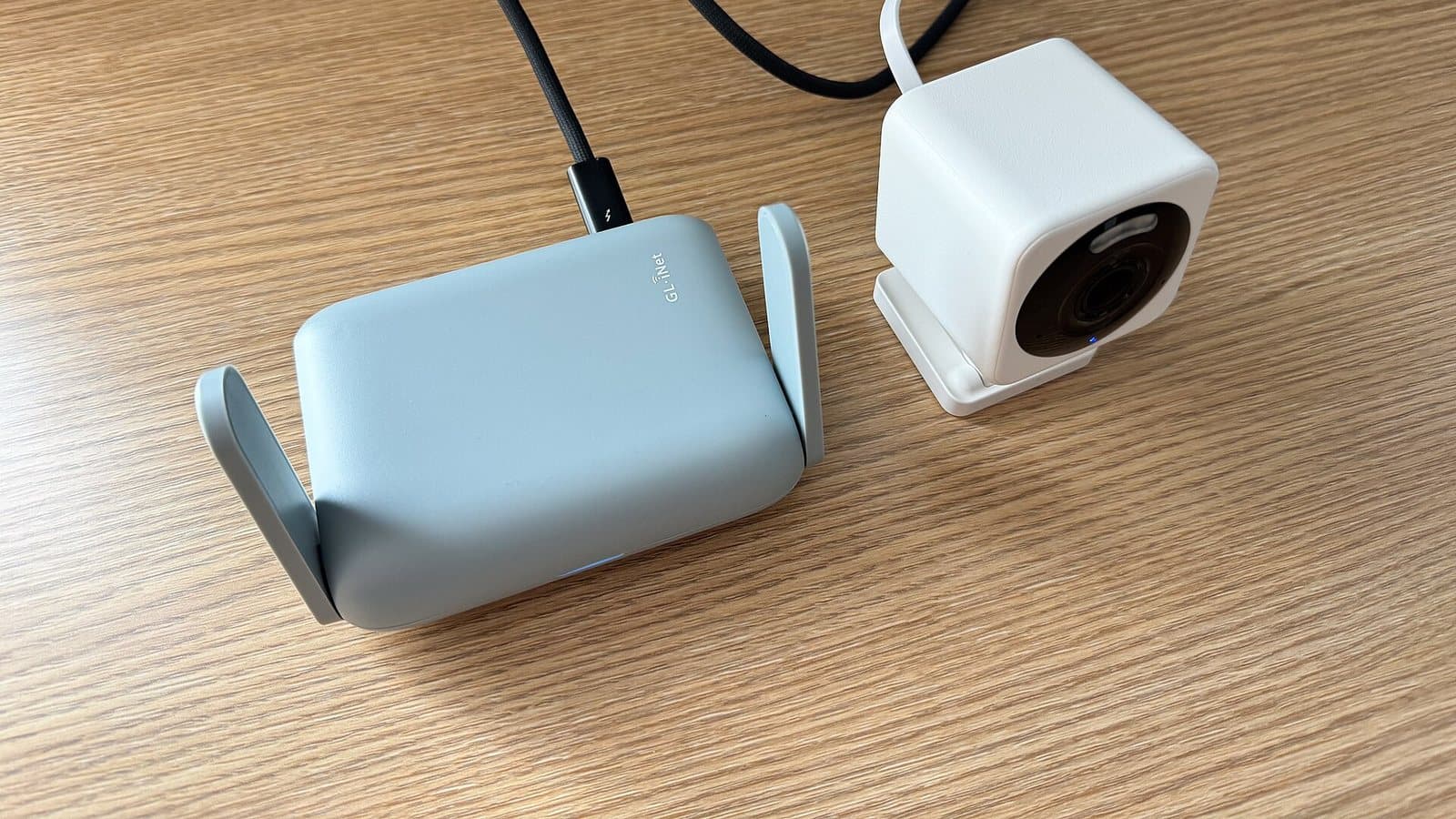
Cover credit: a GL.iNet travel router and a Wyze camera on a hotel-room desk, photo by Tony Webster, CC BY 2.0, via Wikimedia Commons.
Tags
Frequently asked questions
- Which GL.iNet devices are affected?
- GL.iNet lists specific router and KVM models with minimum firmware versions in its advisory, including the GL-MT3000, GL-MT6000, GL-BE3600, GL-AX1800 and Comet RM1 and RM10 families. It says an unlisted model is not necessarily safe, so owners should check the Download Center for their exact model.
- How do I check whether my GL.iNet router is infected?
- Look for a running process whose details contain the exact string crond -i /tmp/.log, either in LuCI under Status and Processes or over SSH with ps. If it appears, GL.iNet says to assume the device is infected and install the latest security firmware for that model.
- Does the security firmware remove the malware?
- GL.iNet says the new firmware removes the malware identified in this incident without a factory reset and lets owners keep their settings. Researchers warn that keeping settings can preserve malicious configuration or keys, so a clean install is safer if compromise is suspected.
- Is this the same as the older infections from December 2025?
- Not necessarily. Some malicious files found on GL.iNet devices had timestamps from December 2025, but GL.iNet has not linked those older infections to the November incident, and researchers say the older backdoor may be a separate campaign.

TPW Editorial
Editorial Team
TechPastWeek's editorial team reports and edits every story we publish. We research each piece against primary and credible secondary sources, and a human editor reviews and signs off before it goes live.