
CISA Flags Active Exploitation of the MailAssure Flaw N-able Found During Its Breach
CISA added the MailAssure SSRF, CVE-2026-134624, to its exploited-vulnerabilities catalog on 23 November, after N-able found it during a breach inquiry.

On this page
Key takeaways
- CISA added CVE-2026-134624, a 9.3-rated SSRF in N-able MailAssure and SpamExperts, to its Known Exploited Vulnerabilities catalog on 23 November 2026.
- Federal civilian agencies have until 26 November to apply the fix, and CISA's enrichment record marks exploitation as active but not automatable.
- N-able fixed the flaw in build 20261121.1943 and restored the MailAssure and SpamExperts Hosted Cloud dashboard and APIs on 21 November at 23:45 UTC.
- N-able says the intrusion was confined to one hosted server and that it found no evidence customer data or mailboxes were accessed; it has not said the flaw was the entry point.
- The same KEV update added the MONAI Label zero-day that Amazon says AI agents exploited, which TechPastWeek covered on 21 November.
The U.S. Cybersecurity and Infrastructure Security Agency added a critical flaw in N-able's MailAssure email filtering service to its Known Exploited Vulnerabilities catalog on 23 November 2026, two days after N-able restored the hosted platform where the flaw was found. The entry, CVE-2026-134624, carries a CVSS 4.0 score of 9.3 and a remediation deadline of 26 November for federal civilian agencies.
Related reading: Attackers Used GL.iNet's Own Cloud Service to Backdoor Routers and KVM Devices · Cleverbridge Says Attackers Copied Card Numbers and CVVs From Its Checkout Platform.
The CISA alert says the addition rests on "evidence of active exploitation." It does not name a victim, an attacker or a campaign. N-able published the CVE on 22 November, at the end of a week in which MailAssure and SpamExperts Hosted Cloud lost their management dashboard and APIs across the Americas, Europe and Asia-Pacific.
That timing has invited a simple reading: the bug was how the intruders got in. N-able has not said that. The company found the vulnerability while investigating the incident, fixed it, and left the question of initial access to a root cause analysis it says will arrive within two weeks.
What CISA added, and what the listing does not say
CISA added two flaws in the same update. The other is the MONAI Label path traversal that Amazon's threat intelligence team says autonomous AI agents found and used to take root on a university server. CISA gave both a 26 November deadline under BOD 26-04, the directive that sets patch timelines for federal civilian agencies.
The KEV catalog is a statement about exploitation, not attribution or scope. A listing means CISA has evidence that someone, somewhere, exploited the flaw. It does not say the exploitation happened in N-able's own environment, and it does not identify the operator. CISA's enrichment data on the CVE record adds a little texture: its SSVC assessment marks exploitation as active, technical impact as total, and automatable as no.
That last value fits the bug. Exploiting it requires an authenticated API user with the right privileges, which is a meaningful barrier and the reason CISA marks it as not automatable. The score stays high because the CVSS 4.0 vector gives the attacker high confidentiality and integrity impact on both the vulnerable system and whatever lies beyond it, while availability is untouched.
The bug is a pivot primitive
N-able's advisory describes a server-side request forgery in the connection check MailAssure runs for LDAP synchronization when a relay is configured. Before build 20261121.1943, the check did not restrict its destination. An authenticated API user could point the server at any internal host and port, learn which ones answered, and send crafted data to the services behind them.
The advisory does not claim code execution, and no exploit code is linked from the CVE record. The damage in an SSRF of this shape is reach. MailAssure sits at the edge of a mail environment, with routes into directory services, internal APIs and management networks that are not meant to accept requests from the internet. A bug that turns the filtering server into a probe gives an attacker a map of that interior and a way to talk to it.
The API requirement matters because MailAssure is built for integrations. Managed service providers connect it to billing, ticketing, directory sync and reporting tools, and those connections need API credentials. A stolen or over-privileged token turns the authentication barrier into a formality.
Five days without the management plane
The service disruption began on 16 November. N-able first attributed it to "a combination of platform configuration and service dependencies," then confirmed on 18 November that a cyberattack was behind it. The company said the incident was isolated to a single web server, where an unauthorized party "may have been able to access certain credentials stored on the platform."
Its containment steps were broad. N-able took the server offline, rotated internal platform credentials, revoked customers' existing API tokens, invalidated OAuth tokens and reset passwords for local users. Inbound and outbound mail filtering kept running throughout, according to the company. The dashboard, APIs, quarantine, logging and mailbox synchronization did not.
Access came back on 21 November at 23:45 UTC, according to N-able's timeline. The company's 22 November update says it has seen no evidence of exploitation beyond the single server and no sign that customer data was compromised, including access to tenants' mailboxes. An independent digital forensics and incident response team is supporting the investigation. N-able says a formal root cause analysis will follow within two weeks.
Those assurances are the company's own. No forensic report or customer count has been published. N-able has also said the MailAssure incident is unrelated to the N-central zero-day disclosures that forced it to take its hosted remote monitoring platform offline on 9 November, which TechPastWeek covered at the time.
Why an MSP email console is a concentrated target
MailAssure and SpamExperts are not consumer spam filters. Managed service providers use them to run email security for many client domains from one console, with shared quarantine, archiving and routing controls. N-able's product page says the filtering engine draws on data from more than 23 million mailboxes, a company figure that describes scale rather than this incident.
That architecture is the point. A single administrative account can reach the mail settings of every tenant the provider manages. The same concentration that makes the product efficient for an MSP makes a compromised console valuable to an attacker looking for a way into several downstream organizations at once. Email gateways also hold message metadata, quarantine contents, archived mail and the routing rules that decide what gets delivered.
The pattern is familiar from the N-central case. Both products are management planes sold to the same channel, and both incidents took away the console customers use to run them. The products are separate and N-able says the incidents are not connected. The common thread is the business model, in which a vendor operates infrastructure that sits above customer networks.
What customers have to do
For hosted MailAssure and SpamExperts customers, there is no patch to install. N-able says the hosted platform is already fixed. The work is on the customer side: replace the API and OAuth tokens N-able revoked, and update every script, integration and monitoring check that used them. N-able says it emailed partners guidance specific to their configuration.
SpamExperts Local Cloud is a different case. It runs on customer hardware, with software updates on a weekly schedule, and N-able's incident statements describe the Hosted Cloud service. Operators of local installations should confirm they are on build 20261121.1943 or later. N-able has not said publicly whether Local Cloud installations were exposed.
Beyond the patch, the advisory's description suggests where to look. Relay and LDAP synchronization settings are worth reviewing for changes nobody made. Outbound connections from the MailAssure host to internal addresses are worth checking against a known baseline. API users with relay privileges deserve a fresh review, particularly any token created before 21 November.
Federal agencies have until 26 November. Private organizations are not bound by the KEV deadline, but CISA encourages them to treat the catalog as a priority list. For anyone still running an affected MailAssure build, the patched version is the only fix available.
The other half of the same alert
The MONAI Label entry is the more unusual of the two. CVE-2026-133968 is a 9.8 path traversal that lets an unauthenticated attacker write files outside the datastore and potentially run code. Amazon's account says its Cairn agents went from mapping the application's API to writing files in about 11 minutes, then used a Python startup file to get a root shell on a university machine. The project merged a fix in October, but the advisory published on 18 November listed no patched version.
The two entries make an odd pair for a single KEV update: one needs a privileged API token, the other needs no credentials at all; one was exploited by an autonomous agent, the other has no public account of who used it. They meet the same evidentiary bar; nothing in the alert links them to one campaign. TechPastWeek's report on the MONAI campaign covers the agent behaviour in detail.
Caveats
The largest gap is the entry point. N-able has not said how the attackers got into the MailAssure environment, whether they used CVE-2026-134624, or whether credentials exposed on the web server were taken. A KEV listing records exploitation of the vulnerability, not the path into this network.
N-able has not published the number of customers or mailboxes affected, the attacker's identity, or a timeline for when the credentials were exposed. Its statements that the incident was confined to one server and that no customer data was accessed are company findings, not independently verified ones. The CVSS score is the vendor's own assessment as the CVE numbering authority.
The Local Cloud question is unresolved. N-able's updates address the hosted service, and whether on-premises SpamExperts installations were vulnerable, or reached, is not something the company has said.
What to watch
N-able's root cause analysis is the next document that could settle the entry-point question. It is due within two weeks of the 22 November update, which puts it in the first week of December. The KEV deadline arrives sooner, on 26 November, and applies to federal agencies whether or not the breach question is settled.
The other signal is scanning. A KEV listing often brings opportunistic probes against MailAssure's public login and API endpoints. N-able says it has continued monitoring since remediation and found no further malicious activity. Customers still run the integrations and local installations the incident touched.
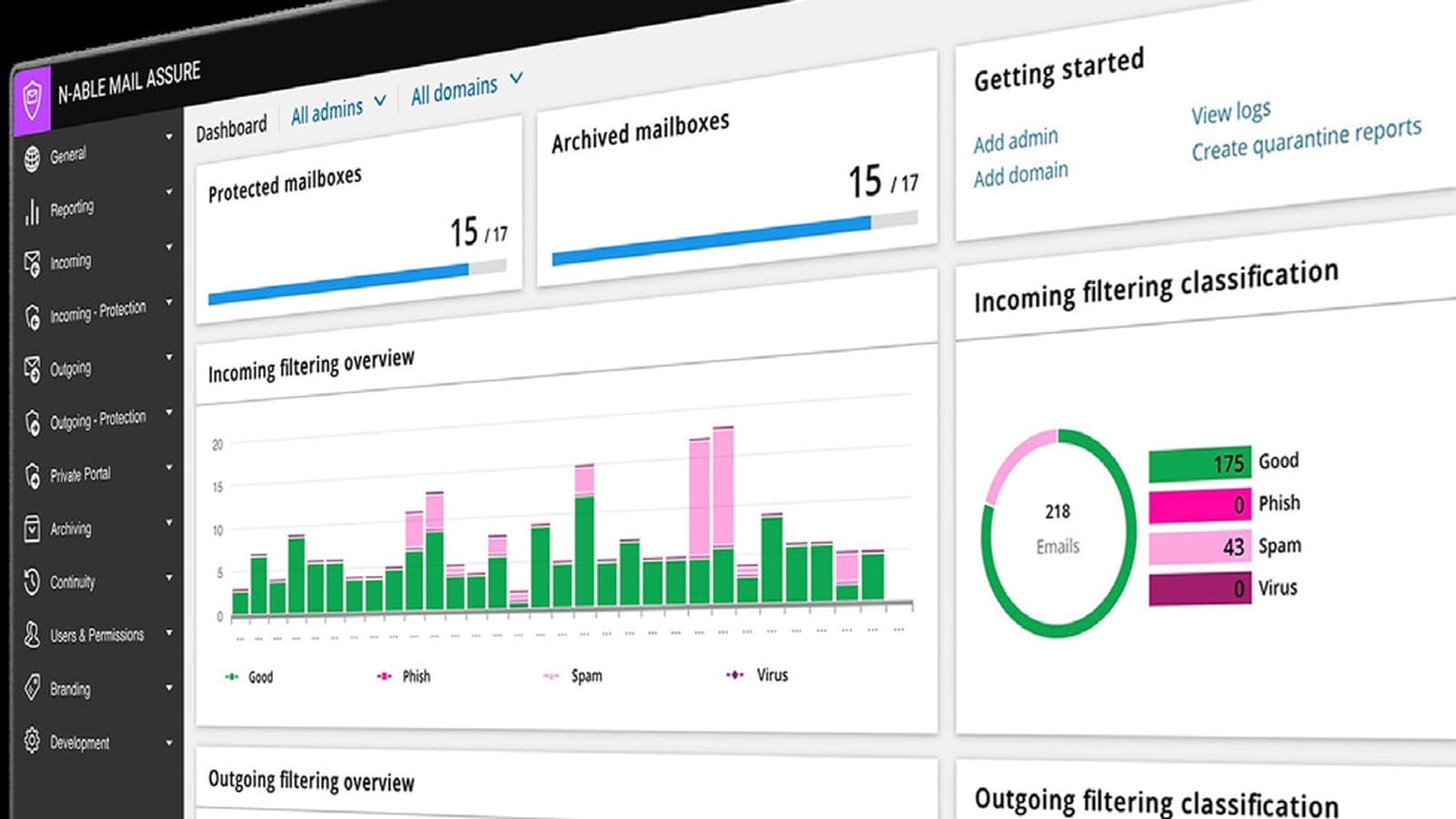
Cover image: the N-able Mail Assure dashboard, from N-able's Mail Assure data sheet, courtesy of N-able.
Tags
Frequently asked questions
- What is CVE-2026-134624?
- It is a server-side request forgery flaw in N-able MailAssure and SpamExperts, fixed in build 20261121.1943. An authenticated API user could make the server connect to arbitrary internal hosts and ports, which allowed the user to map reachable services and send crafted data to them.
- Did this flaw cause the MailAssure breach?
- N-able has not said so. The company found the flaw during its investigation into the November incident and published the CVE afterwards, but it has not described the flaw as the attackers' entry point. CISA's catalog listing says exploitation has been observed somewhere, not that it explains this breach.
- Do hosted MailAssure customers need to install a patch?
- No. N-able says the hosted platform is already patched. Customers do need to replace the API and OAuth tokens that N-able revoked, and update any scripts or integrations that used them.
- Does the flaw affect SpamExperts Local Cloud?
- N-able's incident statements describe the Hosted Cloud service. SpamExperts Local Cloud runs on customer hardware, and operators should confirm their servers are on build 20261121.1943 or later.

TPW Editorial
Editorial Team
TechPastWeek's editorial team reports and edits every story we publish. We research each piece against primary and credible secondary sources, and a human editor reviews and signs off before it goes live.