Ladybird's First Alpha Puts a Fourth Browser Engine on the Desktop
Ladybird released its first alpha for macOS and Linux on 23 November, offering an engine built from scratch and a long list of sites that still break.

On this page
Key takeaways
- Ladybird released its first public alpha for macOS and Linux on 23 November 2026, with downloads that no longer require building the browser from source.
- The browser uses an engine written from scratch, not a fork of Blink, WebKit or Gecko, which are the three engines behind today's major browsers.
- Founder Andreas Kling says the browser around the engine is 'modest, but functional', that some sites will not work, and that the project makes 'no promises about security today'.
- The alpha adds automatic updates, in-browser bug reporting, WebDriver support and the Firefox DevTools protocol for testing.
- Ladybird is run by a 501(c)(3) nonprofit funded by donations and sponsors, with no default search deal; a Windows version is planned for a later stage.
Ladybird released its first public alpha on 23 November, putting a browser with its own rendering engine into the hands of ordinary macOS and Linux users for the first time. The project had targeted 2026 for the milestone, and it arrived with five weeks to spare. Until now, trying Ladybird meant cloning a repository, installing a compiler and waiting through a build. The alpha is a download from the project's site, and it updates itself.
Related reading: ServiceNow's Stock Fell 27% as AI Fears Came for the Software Trade · Cloudflare Acquires Deno to Make Workers Self-Hosting.
"Hello friends! Ladybird is now in alpha," founder Andreas Kling wrote in the project's announcement. "The engine is our own, built from the ground up, and not a fork. The browser around it is modest, but functional."
That last sentence is the honest summary. Ladybird is not competing with Chrome on features, extensions or site compatibility. The competition is about a narrower question: whether the web can still support a new browser engine built by a small team that does not depend on Google's code or advertising business.
A fourth engine, which almost never happens
Most people use a browser built on one of three engines. Google's Blink powers Chrome, Microsoft Edge, Opera, Brave and most Chromium-based browsers. Apple's WebKit powers Safari, and every browser on iOS is required to use it. Mozilla's Gecko powers Firefox.
The most recent engine to reach wide use was Blink, which Google forked from WebKit in 2013. A from-scratch engine is rarer still. Before that, Apple forked WebKit from KDE's KHTML for Safari in 2003, and Gecko arrived with Netscape 6 in 2000. The Verge called Ladybird the first new browser engine in years.
The concentration matters because browser engines decide which web features work, how quickly standards ship, and what kinds of extensions and ad blockers are possible. They also set the limits on what a browser can block, which is why ad blocking works differently on Safari, Firefox and Chrome. When one engine dominates, sites are tested against it first, and the others follow. A fourth engine does not fix that on its own, especially at alpha quality. It does create an alternative that is not owned by a platform company with a stake in the answer.
What the alpha actually does
Ladybird's engine is split into LibWeb for rendering, LibJS for JavaScript and LibWasm for WebAssembly. The browser shell uses Qt. The project is licensed under the BSD 2-Clause licence and developed in C++ and Rust.
The alpha adds the things a browser needs before people can use it outside a build environment: automatic updates on a rolling channel, crash reports that a user can review before sending, and in-browser bug reporting. For developers, it supports WebDriver for automated testing and the Firefox DevTools protocol, which means existing test and debugging tools can attach to it.
It also comes with warnings. "This is an alpha, so some websites won't work, and it will crash sometimes," Kling wrote. The project makes "no promises about security today" and asked security researchers to report vulnerabilities rather than assume the browser is safe to use for sensitive accounts.
Those caveats are not boilerplate. A browser engine is one of the largest attack surfaces in consumer software. Chrome, Safari and Firefox spend heavily on sandboxing, fuzzing and paid vulnerability research. Ladybird is a much smaller project asking users to treat the alpha as a test, not a daily driver.
The Rust rewrite, with AI help
Ladybird began as part of SerenityOS, Kling's from-scratch operating system project. It became its own project in 2024. Since then the team has been moving performance- and safety-sensitive parts of the codebase from C++ to Rust.
In February 2026, the project ported the front end of LibJS, including its lexer, parser, scope collector and bytecode generator, to roughly 25,000 lines of Rust in about two weeks. Kling has said the work used AI coding tools, including Claude Code and Codex, and the port was enabled by default. Simon Willison documented the alpha and noted how heavily the project has leaned on coding agents this year.
That is a notable detail for two reasons. It shows how quickly a small browser team can now rewrite infrastructure that would once have taken months. It also raises a question the project will have to answer in public: how much of a security-sensitive engine should be produced with AI assistance, and how is that code reviewed? Ladybird's answer so far is process, not prohibition. The project publishes monthly engineering updates, tracks its Web Platform Test scores, and has kept the Rust migration incremental.
Who pays for it
Ladybird is run by the Ladybird Browser Initiative, a US 501(c)(3) nonprofit. Chris Wanstrath, the GitHub co-founder, put $1 million into the project when the nonprofit was set up in 2024. Shopify was its first corporate sponsor, with $100,000 in 2023, and the project says it takes no default search deal and does not monetise users. The project has attracted more than 1,200 contributors, according to The Stack.
That funding model is the point. Every major browser engine today is financed by a company with another business: Google sells ads, Apple sells devices and services, Mozilla depends on search revenue. Ladybird's pitch is that a browser can be funded like a public institution instead.
The model has limits. Donations and sponsorships do not scale like an advertising business, and a browser engine is expensive to maintain. The project's published roadmap points to a beta in 2027 and a stable release in 2028, both targets rather than commitments. The gap between an alpha that loads Wikipedia and a browser that handles banking, video calls and corporate single sign-on is where most new engines have failed.
There is a governance question too. The project is open source, but The Stack reported in 2026 that Ladybird had stopped accepting public pull requests, narrowing how outsiders can contribute. Independence from Google is not the same thing as openness to a community, and the project will face both tests.
Why an independent engine is hard to kill
The hardest problem for a new browser is not rendering a page. It is the long tail. Banks use device fingerprinting and anti-fraud scripts. Enterprise apps depend on specific JavaScript behaviour and browser APIs. Video is its own test: Netflix and other streaming services rely on DRM systems that a new browser has to license and integrate before playback works at all. Each of those is a reason a site can tell a user to come back with Chrome.
Ladybird's answer is incremental: improve the engine, publish the test numbers, and let developers try their own sites and report what breaks. The alpha's bug-reporting tools and WebDriver support are aimed at exactly that loop. The project is asking web developers to treat it as a compatibility target, not a product to switch to.
That is how engines improve. It is also slow. Firefox has spent two decades building compatibility and still encounters sites that assume Chromium. A new engine with a fraction of the resources should expect a longer road.
The security question
The most important sentence in the announcement may be the one about security. "We make no promises about security today," Kling wrote, according to coverage of the release. Security work is explicitly unfinished, and the team is small.
For early adopters, that is an acceptable trade if they use it to test sites and nothing else. For anyone tempted to log into email or a bank account, it is a clear reason to wait. The project is asking for vulnerability reports, which is the right posture for an alpha, but it is not claiming the browser is ready for the threat model of a daily driver.
What to watch
The next milestones are a Windows build, a beta, and evidence that the engine can handle the sites people actually use. The project's monthly updates and Web Platform Test counts are the best public measure of progress. A browser engine is a multi-year project, and the alpha is the first point at which outsiders can judge it without compiling it themselves.
For the wider web, the interesting question is not whether Ladybird replaces Chrome. It will not, certainly not in 2027. The question is whether a small, nonprofit engine can stay viable long enough to act as a check on the three engines that dominate the platform. The alpha is the first public evidence either way. It also crashes, and the project says so.
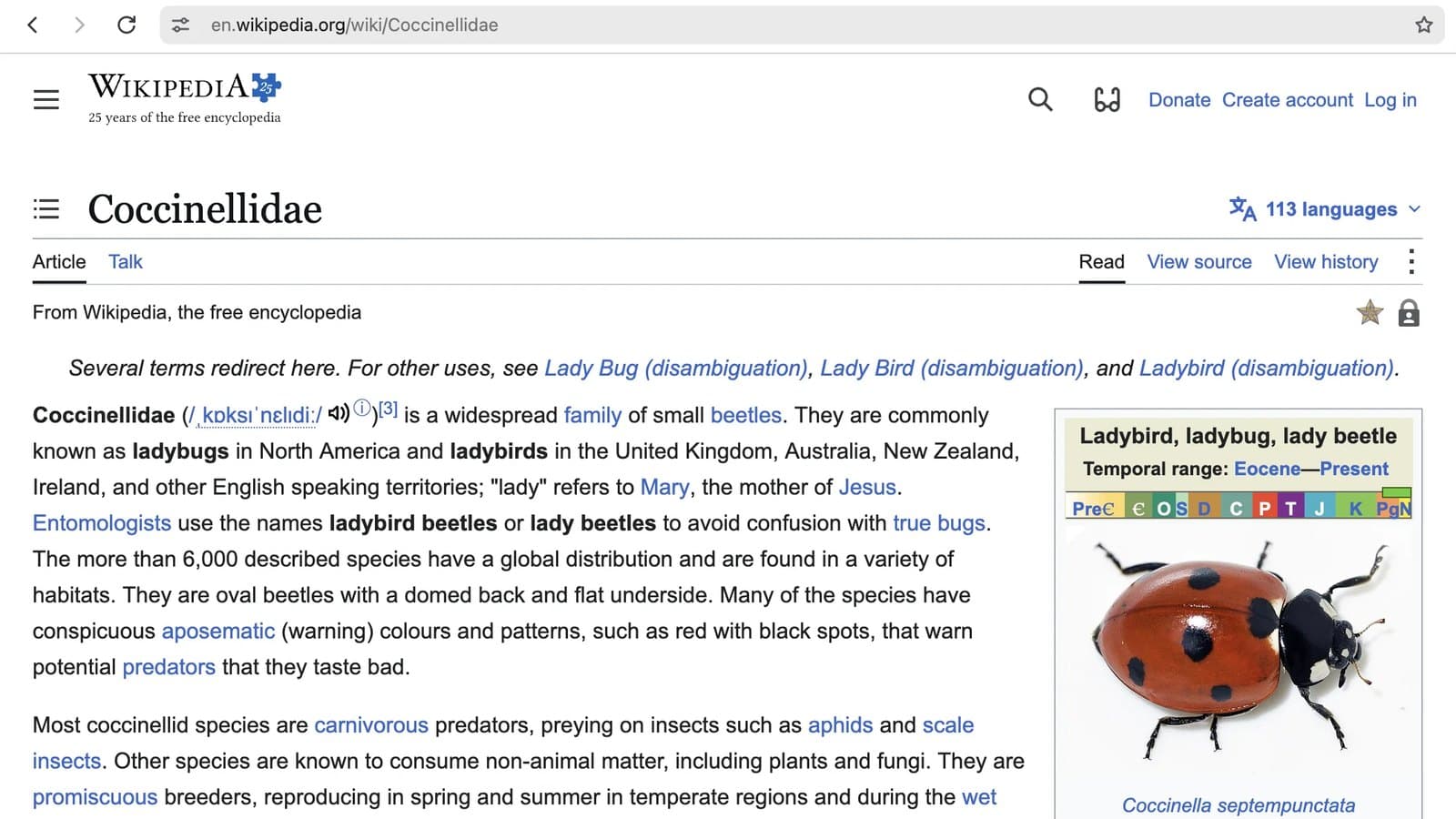
Cover credit: a screenshot of the Ladybird browser showing the Wikipedia article on Coccinellidae, courtesy of the Ladybird Browser Initiative. Cropped to 16:9.
Tags
Frequently asked questions
- What is Ladybird?
- Ladybird is an independent web browser built around its own rendering engine, LibWeb, and its own JavaScript engine, LibJS. It is developed by the Ladybird Browser Initiative, a US nonprofit, and had been available only by compiling the source until the alpha.
- Which operating systems does the Ladybird alpha support?
- The first alpha runs on macOS and Linux. Ladybird's founder has said a Windows version will arrive at a later stage of the project.
- Is Ladybird ready to replace Chrome or Firefox?
- No. The alpha is aimed at developers and early adopters. Ladybird warns that some websites will not work, that the browser will crash sometimes, and that it makes no security promises yet.
- Is Ladybird a fork of Chromium?
- No. Ladybird's engine is written from scratch rather than forked from Blink, WebKit or Gecko. The project has ported parts of its JavaScript engine to Rust, but it is not based on Google's Chromium code.

TPW Editorial
Editorial Team
TechPastWeek's editorial team reports and edits every story we publish. We research each piece against primary and credible secondary sources, and a human editor reviews and signs off before it goes live.