ServiceNow's Stock Fell 27% as AI Fears Came for the Software Trade
ServiceNow beat revenue estimates but guided fourth-quarter backlog growth to 18.5%, below consensus. The stock fell 27% on 29 October, its worst day on record.

On this page
Key takeaways
- ServiceNow reported third-quarter 2026 revenue of $4.106bn on 28 October, up 20.5% year on year, with subscription revenue of $3.988bn, up 21%.
- The company guided fourth-quarter current remaining performance obligations to 18.5% constant-currency growth, below the 19% analysts expected, according to Bloomberg.
- Adjusted earnings per share were $1.00 against a $1.02 consensus, and the shares closed at $109.67 on 29 October, down 27% on the day and 31% for the week.
- ServiceNow raised its 2026 AI annual contract value target to $1.7bn from $1bn at the start of the year, and said AI net new ACV rose 65% in the quarter.
- The sell-off reflects a wider fear that AI agents will reduce demand for seat-based enterprise software, not a collapse in ServiceNow's reported growth.
ServiceNow reported a quarter that most software companies would take. Revenue rose 20.5% to $4.106bn, subscription revenue rose 21% to $3.988bn, and the company said it beat the high end of its own guidance across every topline growth and profitability metric it highlights. The shares fell 27% the next day, the worst session in the company's history.
Related reading: Cloudflare Acquires Deno to Make Workers Self-Hosting · Google's Gemini 3.8 Flash TTS Can Clone a Voice From 30 Seconds of Audio.
The gap between those two facts is the story of the enterprise software trade in late 2026. ServiceNow is selling AI as fast as it can. Investors are asking whether AI will shrink the business that ServiceNow is built on. CNBC reported that the stock sank 27% on 29 October, its worst day on record, after the third-quarter results did little to calm what the network called "SaaSpocalypse" fears.
The trigger was the guide. ServiceNow told investors that current remaining performance obligations, the contracted revenue it expects to recognize over the next twelve months, would grow 18.5% in the fourth quarter at constant currency. Bloomberg reported that analysts had expected 19%. A half-point gap on a forward bookings measure was enough to erase roughly a quarter of the company's market value.
A clean quarter, a softer guide
The reported numbers were strong by almost any standard. Total revenue of $4.106bn was up 20.5%, subscription revenue of $3.988bn was up 21%, and current remaining performance obligations reached $13.65bn, up 20.5%. Total remaining performance obligations, which include contracts beyond twelve months, were $29.7bn, up 22%. GAAP net income was $277m, or $0.27 per diluted share. Non-GAAP net income was $1.039bn, or $1.00 per share.
That last figure is where the quarter missed. Analysts polled by LSEG expected $1.02, according to CNBC. The two-cent shortfall is small in isolation. In a stock trading at 79 times trailing earnings, according to Motley Fool, small misses carry a large price.
The full-year outlook moved in the right direction. ServiceNow raised its 2026 subscription revenue guidance to $15.780bn to $15.790bn, a 22.5% growth rate, and lifted its free cash flow margin target by 100 basis points to 36%. The fourth-quarter subscription revenue guide of $4.245bn to $4.255bn implies growth of 22.5% to 23%. None of that was enough.
The shares closed at $109.67 on 29 October, down 31% from the 23 October close. The S&P 500 gained 1.3% over the same period and the Nasdaq-100 rose 1.5%. ServiceNow fell while the market rose.
AI is both the pitch and the problem
ServiceNow's case to investors is that it is the control layer for enterprise AI. The company calls itself the "Super Intelligence Control Tower for business reinvention," a phrase that appears in the first line of its press release. It sells workflow software for IT, customer service, security and employee experience, and it is now selling agents that run those workflows with less human input.
The AI numbers it disclosed are not cosmetic. Net new AI annual contract value rose 65% in the quarter. The company raised its 2026 AI ACV target to $1.7bn from $1bn at the start of the year, a 70% increase. It counted 19 deals over $5m in net new ACV, up more than 135%, and 680 customers with more than $5m in total ACV, up about 23%. Agentic AI consumption in production rose more than 13 times year to date.
Those figures describe a company selling more AI, to more large customers, at a faster rate. The fear is that the same products cannibalize the per-seat subscriptions that made ServiceNow valuable. If an AI agent can resolve an IT ticket without a human agent opening a seat, the customer may need fewer seats. If agents can be built on top of other platforms, the workflow layer may become less defensible.
That is the "SaaSpocalypse" argument in its simplest form. It does not require ServiceNow to lose customers tomorrow. It only requires investors to believe that the number of seats, or the price per seat, will grow more slowly than it did in the previous decade. A forward bookings guide that lands a half-point below consensus is evidence for that view, even if the current quarter is healthy.
ServiceNow's answer is that AI expands the addressable work rather than shrinking the seat count. The company says its platform governs agents, actions and data across systems, which is a larger job than managing human workflows. It has partnered with OpenAI on a ChatGPT plugin and with Nvidia on agent policy enforcement, and it formed a Control Tower Alliance with Anthropic, AWS, Cisco, Nvidia, Okta, OpenAI and others. Those partnerships are real. They are also promises about a market that is still forming.
What cRPO does and does not measure
Current remaining performance obligations are contracted revenue for the next twelve months. They are not the same as revenue, and they move with contract duration, billing timing and renewals. A 0.5-point change in the growth rate can reflect a handful of large deals shifting by a few weeks. It is a signal about direction, not a verdict on the quarter.
Why a half-point of backlog matters
The market's reaction looks excessive until you consider what a software stock at 79 times earnings is pricing. At that multiple, investors are paying for years of compounding. A slowdown in current bookings, even a small one, changes the shape of the curve they are discounting.
Citi analyst Tyler Radke told CNBC that the result was "a little bit uncharacteristic for ServiceNow standards, just in terms of the lack of upside." He pointed to the cost of the company's forward-deployed engineering team, which embeds with customers to build AI solutions. That investment depresses margins before it produces revenue. Radke said the payoff is "just going to be a little bit longer of a waiting game, and so I think the market, you know, wanted to see something a little bit sooner."
CFO Gina Mastantuono pushed back on the idea that cRPO tells the whole story. She said on the earnings call that current backlog "does not necessarily capture all of the momentum in the business," according to Motley Fool. She cited half a percentage point of subscription backlog growth that is excluded from cRPO but will be recognized as revenue.
Both things can be true. The company can be growing quickly and the backlog measure can understate that growth. The market can also be right that the direction of travel has changed. The next quarter will show which reading holds.
The wider software trade
ServiceNow is not the only software company caught in this repricing. Salesforce trades at about 21 times trailing earnings and Workday at about 40, according to Motley Fool. ServiceNow's 79 times earnings is the premium end of the group, which makes it the most exposed to any sign that growth is decelerating.
The logic of the sell-off extends beyond one company. Enterprise software has spent two decades selling seats. AI agents are priced by consumption, by outcome or by workflow, and the largest platform vendors are still working out how to charge for them without cannibalizing existing contracts. Microsoft bundles Copilot into its productivity suites. Google is pushing Gemini into Workspace. OpenAI and Anthropic sell directly to enterprises. Every one of those moves gives a buyer another reason to question a per-seat renewal.
ServiceNow's response is to sell the control layer rather than the seat. If agents from multiple vendors are running inside a company, someone has to decide which agent can access which system, log what it did and stop it when it goes wrong. That is a plausible product. It is also a new category, and new categories take time to convert into the kind of predictable subscription growth that justifies a premium multiple.
What to watch
The fourth-quarter report in January is the first real test. Three numbers matter. The first is cRPO growth: does it stabilize near the guided 18.5% or slip again? The second is AI ACV: does the $1.7bn target convert into subscription revenue at the pace the company implies? The third is margin: how much of the forward-deployed engineering cost is still running through the income statement?
There is also a competitive question. ServiceNow's AI pitch depends on enterprises wanting a neutral governance layer above Microsoft, Google, OpenAI and Anthropic. If buyers instead consolidate on the platform they already use for email and documents, ServiceNow's control tower becomes one more tool to integrate. The OpenAI and Nvidia partnerships are an attempt to prevent that outcome. They do not settle it.
The stock's fall does not mean the business is broken. Revenue grew 20.5%, cash flow was positive, and the company raised guidance for the year. It means the market has stopped paying for AI ambition alone. ServiceNow now has to show that its AI products grow the subscription base.
Caveats
- The figures are company-reported and unaudited. Revenue, cRPO, RPO and margin numbers come from ServiceNow's release.
- Non-GAAP measures flatter the result. Non-GAAP net income and free cash flow exclude stock-based compensation and other costs.
- The 19% consensus is Bloomberg's figure. ServiceNow guided 18.5% at constant currency, which is not an identical basis.
- AI ACV is not revenue. Annual contract value measures the value of signed contracts, not what has been recognized.
- The 13x consumption figure is a year-to-date comparison off a small base. It describes growth in usage, not the size of the business.
- The 27% and 31% moves are 29 October closing snapshots. The stock can and did move further in later sessions.
- The forward-deployed engineering cost is not broken out. The margin effect is inferred from management commentary and analyst estimates.
The January report will show whether the backlog guide was a one-quarter wobble or the start of a slower phase. For a company priced for years of compounding, the difference is worth watching.
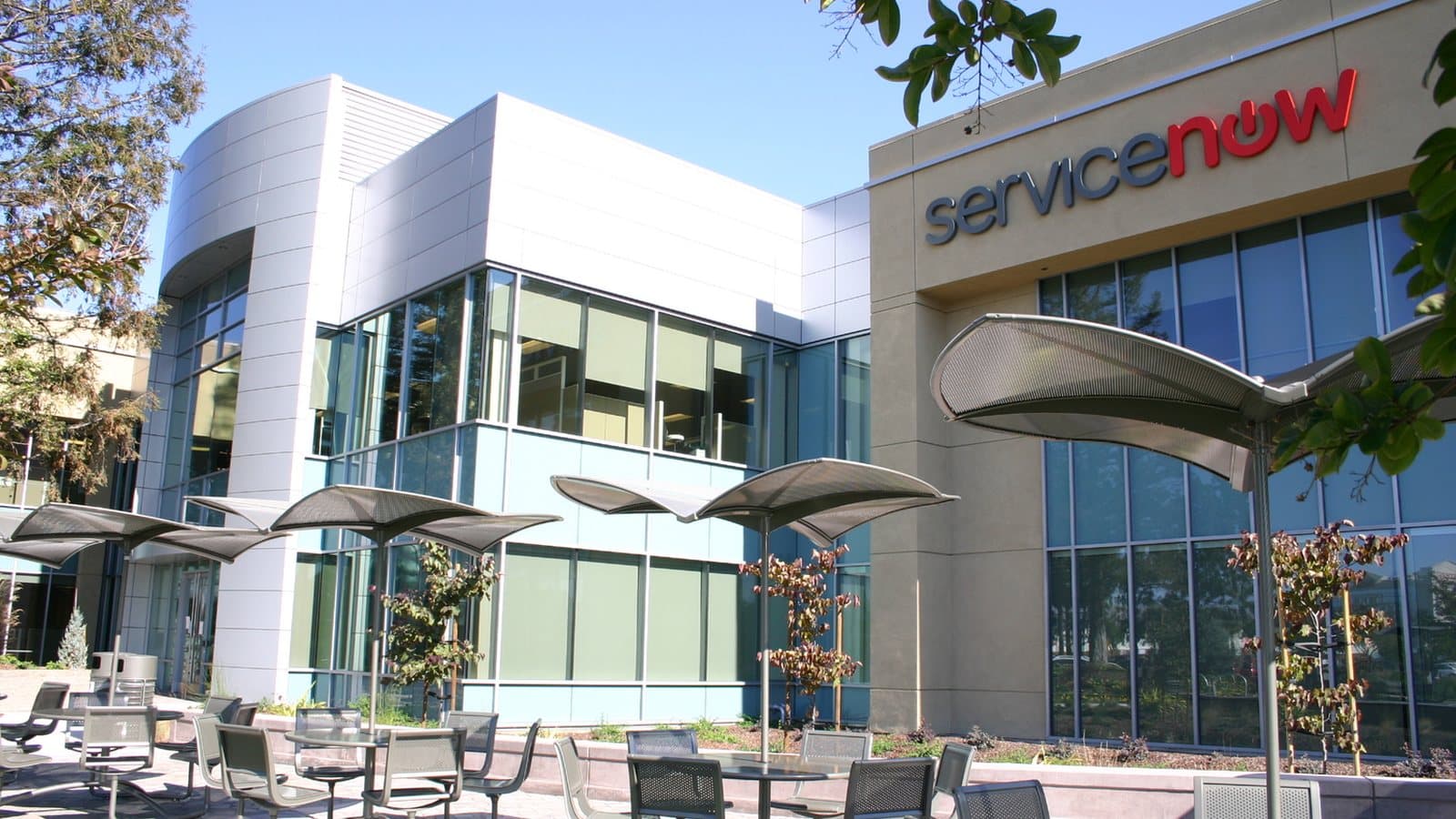
Cover: The ServiceNow global headquarters in Santa Clara, California. Photograph by Satyaki.snow, CC BY-SA 4.0, via Wikimedia Commons, cropped 16:9.
Tags
Frequently asked questions
- Why did ServiceNow stock fall 27%?
- ServiceNow guided fourth-quarter current remaining performance obligations to 18.5% constant-currency growth, just below the 19% analysts expected, and adjusted earnings per share came in two cents below consensus. Investors treated the backlog guide as a sign that AI is slowing, not accelerating, the expansion of existing software contracts.
- What is current remaining performance obligations?
- Current remaining performance obligations, or cRPO, is contracted revenue ServiceNow expects to recognize over the next twelve months. It is a forward-looking bookings measure, not reported revenue, and it can be affected by contract duration, billing timing and the mix of new versus renewal business.
- Is ServiceNow's AI business growing?
- Yes. ServiceNow said AI net new annual contract value rose 65% in the third quarter, deals spanning five or more AI products increased 8.5-fold, and agentic AI consumption in production rose more than 13 times year to date. It raised its 2026 AI ACV target to $1.7bn.
- When will investors know whether the sell-off was justified?
- The next checkpoint is ServiceNow's fourth-quarter report, expected in January 2027. It will show whether cRPO growth stabilizes near the guided 18.5%, whether AI ACV converts into subscription revenue, and whether the cost of the company's forward-deployed engineering team is still weighing on margins.

TPW Editorial
Editorial Team
TechPastWeek's editorial team reports and edits every story we publish. We research each piece against primary and credible secondary sources, and a human editor reviews and signs off before it goes live.