Nvidia's DSX POD Turns an AI Factory Into a Shipping Container
Nvidia's DSX POD packages a Vera Rubin AI factory into partner-built containers that install in 14 days. What ships inside, and what the number leaves out.

On this page
Key takeaways
- Nvidia announced the DSX POD at GTC Berlin on 21 October 2026, a reference design for partner-built modular Vera Rubin AI factories, with worldwide delivery targeted for early 2027.
- Nvidia says onsite deployment can fall from six months to as little as 14 days, a figure that assumes a prepared site and excludes building the facility, the grid connection and permits.
- Nvidia published no per-POD compute capacity, rack count or price; Dell announced its own Modular Data Center with NVIDIA DSX POD the same morning on the same early-2027 timetable.
- Nvidia claims 100% liquid cooling with coolant up to 45°C, and estimates 54 million litres of water saved per day at 2 gigawatts compared with conventional cooling towers.
- The efficiency figures Nvidia cites are partner measurements: Nscale recorded 49% higher inference throughput within the same 264-kilowatt budget, and StorageReview said it did not audit the results.
Nvidia announced the DSX POD at GTC Berlin on 21 October 2026: a reference design for a complete Vera Rubin AI factory, assembled by partners inside modular containers and validated before it ships. Jensen Huang, Nvidia's chief executive, said onsite deployment can shrink from six months to as little as 14 days once a site's utilities are ready, according to Nvidia.
Related reading: Nvidia's Vera Rubin NVL72 Debuts in MLPerf With a 3.7x Inference Claim · Nvidia's China AI-Chip Share Falls to 34 Percent as Huawei Closes the Gap.
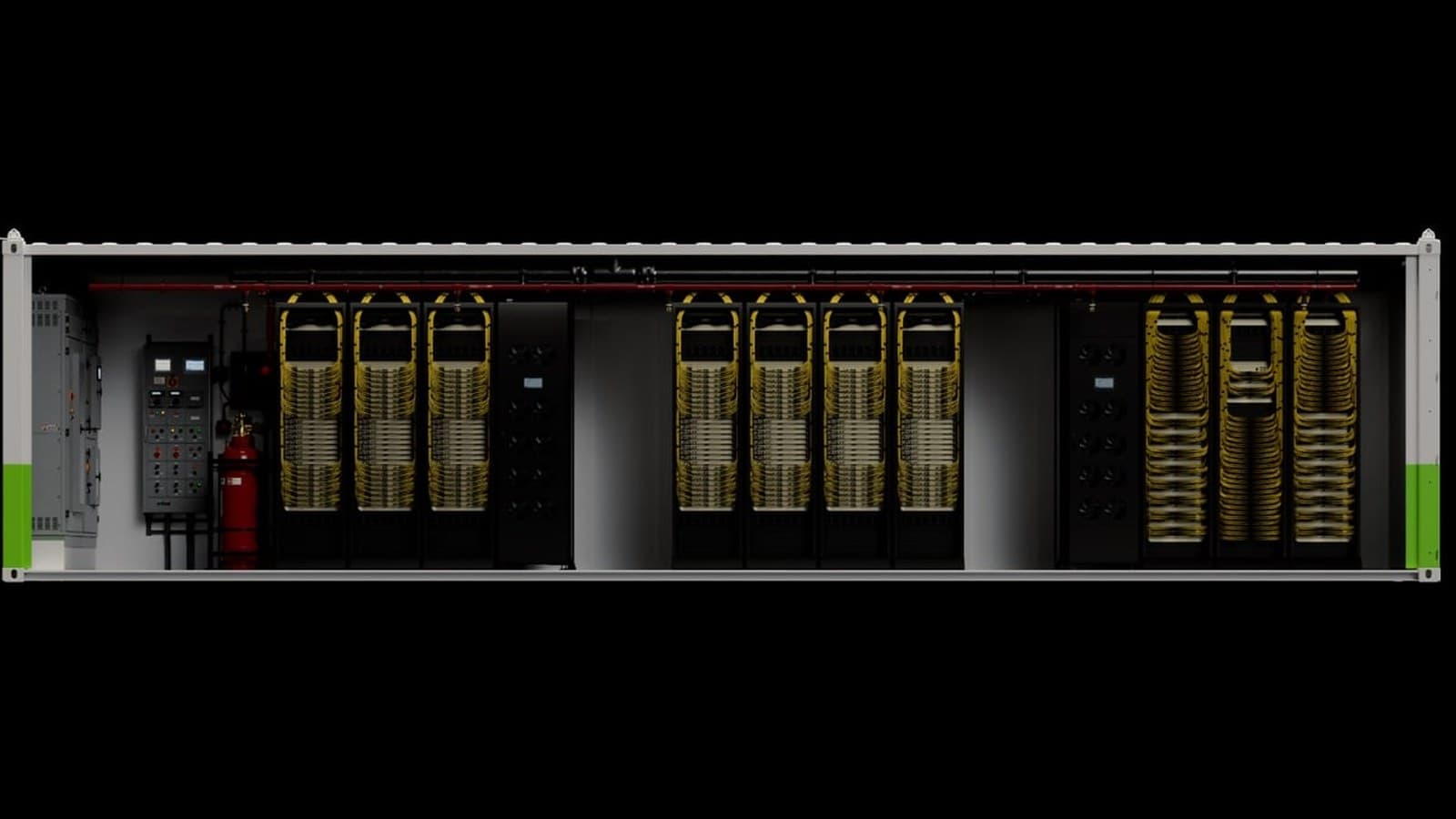
The container is the visible part. The product Nvidia is selling with it is broader: the integration work, the power budgeting software and the component supply chain that has to exist before any of it can be built. Nvidia describes DSX as a full-stack reference architecture covering compute, networking, storage, software, power and cooling, a claim that reaches past the GPU.
What actually ships inside the box
DSX POD is a reference design, not a product Nvidia manufactures. Partners build the containers, and Nvidia names seventeen of them aiming at worldwide delivery in early 2027: Anduril, Armada, Bull, Crusoe, DayOne, Dell Technologies, Delta, Eaton, Foxconn's Ingrasys, GIGABYTE, HPE, Lenovo, Pegatron, Quanta Cloud Technology, Schneider Electric, Vertiv and Wistron.
Each container carries Vera Rubin compute, networking, cabling, rack-level power distribution and liquid cooling. The partner finishes the work that normally happens on a customer's concrete floor: rack-to-rack cabling, wiring, piping and functional validation. What arrives at the site is a system that has already been powered on and tested. It connects to prepared power, cooling and network feeds, and the site work begins.
Dell announced its own Modular Data Center with NVIDIA DSX POD the same morning, on the same early-2027 timetable. Buyers will have several container products to compare.
There are no per-POD figures for compute capacity, no rack counts and no price. Buyers in early 2027 will compare configurations from more than a dozen partners without a public reference point from the company that designed the system. StorageReview noted the same gap.
The 14 days start after the hard part
The clock starts at the site boundary
The 14-day figure assumes a prepared site. It excludes building the facility, the grid connection and the permits, none of which the container shortens. Nvidia is claiming a faster fit-out, not a faster approval.
A container cannot queue for an interconnection study, and it cannot shorten a planning hearing. If the constraint on a project is a power connection that takes years, cutting six months of onsite assembly to two weeks removes a fraction of the schedule. The saving lands hardest where power is already available and the only obstacle is the labour and space needed to build a hall: retrofits, brownfield sites and campuses that have already secured their supply.
Seventeen partners signing up for a 2027 rollout implies factory floors being tooled for container assembly before any of this ships. Nvidia gives no volumes.
“This is a complete transformation of the world supply chain. This will change the way that people install and build data centers, and hopefully, as a result, velocity goes up.” — Jensen Huang, Nvidia chief executive
Cooling water is now part of the spec sheet
Nvidia says the design runs on 100% liquid cooling, with coolant at up to 45°C and heat rejected through closed-loop dry coolers. Water consumption can fall to near zero, with local climate deciding whether supplemental mechanical cooling is needed. At 2 gigawatts of capacity, Nvidia estimates the design saves 54 million litres of water a day against conventional cooling towers, or about 54,000 cubic metres.
The water figure has a commercial purpose: a design that needs little water is easier to site where water is contested. A 45°C loop is also warm enough for dry coolers to do the work in more climates than a colder loop would allow. Whether “near zero” holds in a hot region depends on how much mechanical cooling is added back, a decision Nvidia leaves to the site.
Power gets the same treatment. DSX MaxLPS allocates power dynamically within a provisioned budget, and Nvidia says it can deliver the same token output using up to 30% less power. DSX Flex coordinates workload with grid conditions. DSX Sim handles simulation, DSX OS manages the infrastructure and DSX Exchange connects computing systems to facility systems.
The software list is where the strategy shows. Nvidia has no obvious reason to sell grid-facing software unless it also controls the power budget that software manages.
DSX Exchange is the piece that makes the format portable. A container assembled by one partner and connected by a customer's own facilities team needs a common interface between the racks and the building systems. That interface is what Nvidia is standardising. The steel box is what partners build.
The efficiency claims come from the vendors
Nvidia's supporting evidence is a set of partner measurements rather than independent tests. Lambda recorded 24% higher cluster token throughput and 19% more GPU capacity within a fixed power budget on HGX B200 systems. Nscale recorded 49% higher inference throughput and 37% more managed GPU capacity within the same 264-kilowatt budget across four GB300 NVL72 racks in Iceland.
Both figures come from the companies named, and both are the kind of result a vendor selects for a keynote. StorageReview stated plainly that it did not run or audit the numbers. Nvidia has not published the workload mix, the baseline configuration or the measurement window behind them, so the figures describe what two customers achieved, not what a buyer should expect.
The agent software claims are thinner still. Nvidia showed OpenShell, an open-source policy-controlled runtime with kernel-level sandboxing, and Sentry, which runs on BlueField-4 DPUs and can quarantine an agent within milliseconds. Alongside them came three numbers: 20% higher agent capacity with Sentry, 30 times higher throughput per megawatt for agentic workloads on Vera Rubin NVL72, and twice the performance of x86 processors for Vera CPUs. No comparison configurations or workload conditions were given for any of the three.
Why Europe gets the first containers
The Berlin setting is not incidental. Huang said Europe accounts for roughly 5% of global AI computing capacity, against about 75% in the United States, a comparison AP reported from the keynote. Nvidia says it has committed nearly $10 billion to the European technology ecosystem over the past year and works with more than 12,000 partners there.
A pre-integrated container is a plausible answer to that gap. If the obstacle in Europe is the labour and grid work needed to turn plans into halls, then moving the integration into a factory removes part of it. The local requirement shrinks to a foundation, a power feed, a dry-cooler or water connection and a network link. Nvidia is selling that reduction as the product.
Huang framed the moment in the language of an industrial shift. “After decades of advancement in the computer industry, we are now at the beginnings of a new industrial revolution,” he said, according to Nvidia's newsroom.
The company's telecom bet runs on the same logic. Nvidia and Nokia completed what Nvidia describes as the first commercial AI-RAN call on T-Mobile's network in Bellevue, Washington. Huang put the opportunity at 100,000 sites and about 100 gigawatts of distributed data centres, which would put compute into existing telecom sites. That is a longer project than a container, and it depends on operators deciding they want to be compute hosts.
The supply chain is the second product
Nvidia spent part of the keynote on components that never appear in a DSX POD brochure, and that list is what makes the container schedule possible. The company plans to raise substrate capacity 2.5 times over three years. A multibillion-dollar advance to IBIDEN supports expanding its Ono plant in Japan to three times current capacity, with more ramping in the first quarter of 2028. Samsung Electro-Mechanics is joining the substrate supply chain through existing South Korean operations plus upgrades and new factories in Sejong and Busan. Nvidia is supporting Unimicron's KF substrate expansion in Taiwan, with capacity from the second quarter of 2027 and full capacity by mid-2028.
Further down the line, Nvidia and Amkor plan to increase interposer wafer capacity in South Korea by more than 300% by the end of 2028. Nvidia expects total semiconductor testing capacity to double from 2026 to 2027, and a $1.1 billion advance to King Yuan Electronics funds new US testing facilities with high-volume production targeted for April 2027. Nvidia and Siliconware Precision Industries plan to expand Taiwanese optical-engine capacity 15 times by mid-2027, then double it again by the end of 2028.
Every one of those is a planned capacity target. Nvidia gives no current baseline volumes, so the multiples cannot be checked against output today. Read together, they point upstream, to substrates, testing and optical engines, as much as to the assembly of containers.
Caveats
Several parts of the announcement are targets or company statements rather than verified results. The 14-day deployment figure assumes a prepared site and excludes the facility, the grid connection and permits. Nvidia published no per-POD capacity, rack count or price. The throughput, power and water figures come from Nvidia or its partners, not from independent audits. The substrate, testing and optical-engine numbers are planned capacity targets, and Nvidia gives no current baseline volumes. Vera Rubin is in “full production” by Nvidia's account; no independent shipment figure has been published.
What the first deliveries will settle
The first containers will answer the questions the keynote left open. Watch whether any partner publishes per-POD compute capacity, rack count and price. Watch whether the 14-day figure turns up in a customer case study with dates attached, and whether that customer had power available before the container arrived. Watch whether the Lambda and Nscale results survive an independent measurement.
The first DSX PODs are due in early 2027. Nvidia has not said what one costs.
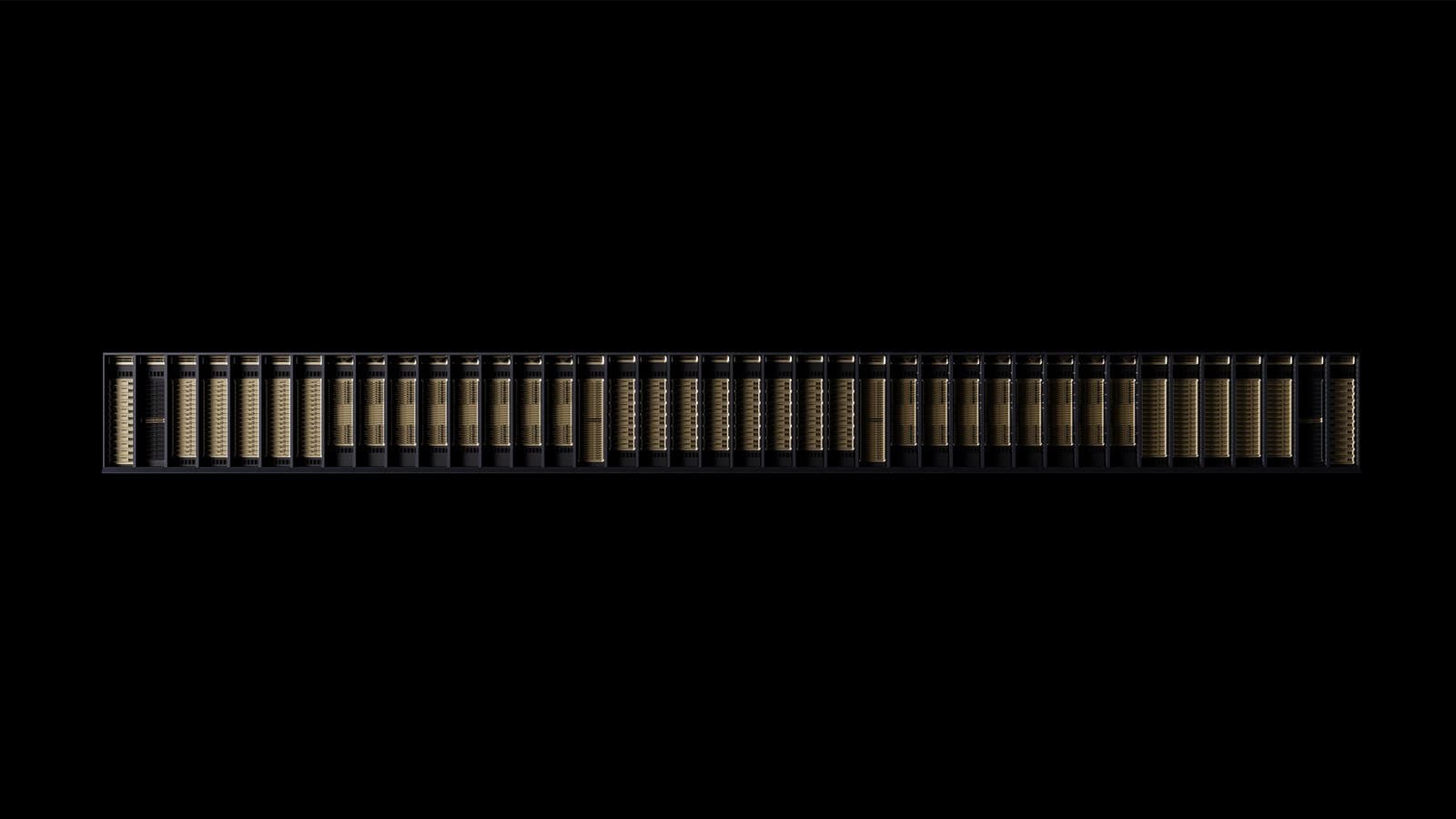
Cover image: NVIDIA DSX POD render, courtesy of NVIDIA (company-distributed press asset).
Tags
Frequently asked questions
- What is the Nvidia DSX POD?
- It is a reference design for a complete Vera Rubin AI data centre built inside modular containers. Partners assemble the compute, networking, cabling, power distribution and liquid cooling, validate the system in the factory, then ship it to a site that already has power, cooling and network connections ready.
- Can an AI data centre really be deployed in 14 days?
- Only the onsite fit-out, and only on a prepared site. Nvidia's 14-day figure excludes constructing the building, connecting it to the grid and obtaining permits. Nvidia gives six months as the conventional onsite timeline it is comparing against.
- How much does an Nvidia DSX POD cost?
- Nvidia has not published a price. It has also not published per-POD compute capacity or rack counts, so buyers cannot yet compare configurations from the seventeen partners targeting delivery in early 2027 on a public reference specification.
- Which companies are building DSX POD systems?
- Nvidia lists Anduril, Armada, Bull, Crusoe, DayOne, Dell Technologies, Delta, Eaton, Foxconn's Ingrasys, GIGABYTE, HPE, Lenovo, Pegatron, Quanta Cloud Technology, Schneider Electric, Vertiv and Wistron. All are targeting worldwide delivery in early 2027.

TPW Editorial
Editorial Team
TechPastWeek's editorial team reports and edits every story we publish. We research each piece against primary and credible secondary sources, and a human editor reviews and signs off before it goes live.