DeepSeek Open-Sources a Software Stack for Huawei's Ascend Chips, Aiming at CUDA
DeepSeek open-sourced TileLang and a set of Ascend kernel libraries, a CUDA-style software stack for Huawei's AI chips that lowers the cost of leaving Nvidia.

On this page
Key takeaways
- DeepSeek announced on September 30, 2026 that it had open-sourced a software toolkit for Huawei's Ascend AI accelerators, developed with Huawei's support.
- The centerpiece is TileLang, a high-level language for writing compute kernels that DeepSeek positions as a domestic alternative to Nvidia's CUDA.
- The toolkit is optimized for Huawei's Ascend 950 chips and supports a supernode linking up to 128 Ascend 950 accelerators, tuning compute and communication together.
- DeepSeek has increasingly adapted its models to Huawei silicon and plans to install more than 160,000 Ascend chips at a new data center in Inner Mongolia, according to reports.
- Nvidia CEO Jensen Huang has said US export restrictions pushed Nvidia's share of China's advanced AI chip market from roughly 95 percent to effectively zero.
DeepSeek published a software toolkit for Huawei's Ascend AI accelerators on September 30, 2026, developed with Huawei's support and aimed at the layer that has kept Chinese AI chips tied to Nvidia: the programming stack. The announcement came through DeepSeek's official WeChat account and was reported by Bloomberg and Reuters.
Related reading: Huawei Pulls Ascend 960DT to Q1 2027 and Unveils a Near-Packaged-Optics SuperPoD · Nvidia's China AI-Chip Share Falls to 34 Percent as Huawei Closes the Gap.
The headline item is TileLang, a high-level language for writing compute kernels. DeepSeek frames it as a domestic alternative to CUDA, the Nvidia software platform that has been the de facto standard for programming AI chips for more than a decade. The release is a software story about a hardware moat.
The moat is the toolchain, not the transistor
For most of the past decade, the question “which AI chip?” has really been “which software?” CUDA gives developers a familiar set of libraries, compilers, debuggers and documentation, and it runs only on Nvidia hardware. Moving a training or inference workload to another vendor means rewriting kernels, replacing collective-communication code and retuning performance, often over months of engineering time. That switching cost, more than any single benchmark, is what has kept rivals out.
An accelerator can match Nvidia on paper and still lose, because the paper does not include the years of accumulated tooling. That is the ground the Ascend platform has been trying to close, and it is the ground DeepSeek's release attacks. A free, open, CUDA-style language plus the libraries around it lowers the cost of moving a workload onto Chinese silicon, which is the strategic point of the announcement.
The lock-in is not a single choice but a series of them. A team picks CUDA for its first model because the tutorial, the library and the answer on a forum are all there. The next model inherits that code, the next engineer inherits the habits, and over time the codebase itself becomes the reason not to switch. Competing silicon has to offer comparable speed and a place where the existing code can run, which is the gap a kernel language is meant to narrow.
Software as the chokepoint
CUDA's hold rests less on technical elegance than on a decade of accumulated ecosystem and switching cost. A free kernel language and matching libraries attack that switching cost directly.
What a kernel language actually is
Training a model or serving it means running the same small number of operations billions of times. Matrix multiplication dominates the compute, and moving data between chips dominates much of the rest of the bill on multi-node systems. Each of those operations has to be expressed as a kernel, a function written to run efficiently on a particular piece of hardware.
Writing kernels by hand is specialist work. Developers write them in a low-level language close to the hardware, then tune memory access, thread scheduling and data layout until the operation runs near the chip's limit. TileLang sits above that layer. It gives programmers a higher-level way to describe an operation and lets a compiler handle the hardware-specific decisions. That is roughly the deal CUDA offers through its own languages and libraries, and it is why a kernel language, not a driver, is the entry point to an ecosystem.
The two libraries named in the release map onto the two halves of that work. DeepGEMM handles the matrix multiplications at the center of every model. DeepEP handles communication, the part that grows harder as a training run spreads across more accelerators. A supernode of 128 chips is a communication problem as much as a compute problem, and a stack that tunes both together is aimed at the scale where the two stop being separable.
That gives the release its structure. TileLang is the front door, DeepGEMM and DeepEP are the utilities a real workload needs, and the supernode support sets the hardware target.
What DeepSeek actually released
According to Bloomberg and Reuters, the centerpiece is TileLang. DeepSeek also released underlying libraries for high-throughput training and inference on Ascend, including DeepGEMM, which supplies matrix-multiplication kernels, and DeepEP, which handles large-scale communication across devices. Pandaily described the release as covering an Ascend port of TileLang, compute kernel libraries and a distributed communication library.
The fuller manifest varies by report. The Cryptonomist's summary adds FlashMLA, TileKernel and DeepSelect, along with benchmarking tools for kernel development. Those items appear in that outlet's account, so the exact package list is best treated as reported rather than as a settled manifest. What is consistent across the coverage is the shape: a language on top, kernel libraries beneath it, and a communication layer for multi-chip training.
DeepSeek said the toolkit is optimized for Huawei's Ascend 950 chips and supports a “supernode” configuration linking up to 128 Ascend 950 accelerators, tuning both compute and communication. Huawei, DeepSeek said, provided full support in developing the software infrastructure, and the two companies jointly advanced the supernode solution.
“To build a new generation of independent, self-controlled GPU software ecosystems, the first priority is establishing a high-level language that is universal, easy to program, and still capable of reaching the hardware's full performance potential.” — DeepSeek, in its September 30, 2026 WeChat announcement
That statement is the company's own case for TileLang. DeepSeek said TileLang was created for exactly that purpose and offers a simpler programming model than CUDA. The claim is about programmer effort as much as raw speed: the harder a chip is to program, the fewer people will build on it.
The chip it is aimed at
The release points at a specific piece of hardware. Two weeks before the toolkit, Huawei unveiled its next generation of AI processors and supernode systems and said it expected its AI systems to be widely used for model training next year. The Ascend 950 sits at the center of that road map, and DeepSeek's 128-accelerator supernode support is written for it.
The supernode framing points at a real constraint in AI training. A single accelerator holds only part of a large model and its optimizer state, so training runs spread across many chips that exchange gradients and activations constantly. As a cluster grows, the interconnect becomes a bottleneck, and a chip's useful throughput depends on how well the network around it performs. Huawei's supernode designs, and DeepSeek's software support for them, are aimed at that multi-chip problem as much as at single-chip speed.
The pairing makes sense on both sides. Huawei gets a mainstream AI lab shipping open-source tooling for its silicon. DeepSeek gets a software path that does not depend on Nvidia, at a moment when access to Nvidia's best parts in China is uncertain.
The export-control backdrop
The context is a market that US policy has reshaped. Nvidia CEO Jensen Huang has said US export restrictions pushed Nvidia's share of China's advanced AI chip market from roughly 95 percent to effectively zero, and that H200 sales to Chinese customers made up less than 1 percent of Nvidia's data center revenue in the quarter ended July 26. Nvidia closed at $227.21 on September 29, down 0.72 percent.
The restrictions have not frozen the market so much as redirected it. Beijing is considering allowing domestic firms including Alibaba and ByteDance to buy Nvidia's RTX Pro 5500, and Nvidia sales staff told customers to place orders by September 30 to secure supply, according to The Information, via Invezz. Those two signals point in opposite directions: a possible reopening on the Nvidia side, and a deepening domestic alternative on the Ascend side.
DeepSeek's own trajectory has moved toward Huawei. It previously relied heavily on Nvidia's H800 GPUs for training, and in 2026 it increasingly adapted its models and software to the Ascend platform. Its V4-Flash model was optimized for Huawei chips. The company reportedly plans to install more than 160,000 Huawei Ascend chips at a new data center in Inner Mongolia.
Reported, not confirmed
The Inner Mongolia volume and the details of the RTX Pro 5500 review come from press reporting, not from Huawei or DeepSeek filings. Treat the 160,000 figure as a reported plan rather than a shipped fact.
What is not proven
Three things are open, and they decide whether this matters beyond a press cycle.
Developer adoption is the first. Open-source licenses lower the legal barrier, not the practical one. A kernel language spreads when enough engineers use it, file bugs, write libraries and answer questions that CUDA's community answers today. TileLang would need that community, or an ecosystem built around it, to compete as a platform rather than as an internal DeepSeek tool.
Performance is the second. DeepSeek has not published independent benchmarks of the Ascend 950 against Nvidia hardware for training or inference, and no third party has tested the stack at scale. “Simpler than CUDA” is a claim about the programming model. Reaching “the hardware's full performance potential” is a goal, not a measured result, and until outside teams can run the comparison, the numbers are missing.
The third is maturity. CUDA is more than a language. It is a compiler, a profiler, a set of math and communication libraries, and a decade of edge-case fixes. A single release can cover the common cases and still fall short on the long tail of kernels that production systems contain. The package list here is wide; production depth is a separate question.
What to watch
- Outside developers. Whether teams beyond DeepSeek and Huawei write TileLang kernels and contribute to the libraries is the clearest adoption signal.
- Benchmarks. Independent training and inference numbers for the Ascend 950 against Nvidia parts would settle the performance question the announcement leaves open.
- Ascend 950 volume. Whether Huawei ships the supernode configuration in the quantities its road map implies will decide how much of this software has hardware to run on.
- Nvidia's China access. The RTX Pro 5500 review and any loosening of controls would test whether Chinese buyers stay on the domestic path.
- The next release. If DeepSeek and Huawei keep publishing tooling at this cadence, the software gap with CUDA becomes a moving target rather than a fixed one.
The toolkit lowers the cost of leaving Nvidia. Whether developers take that path is not yet known.
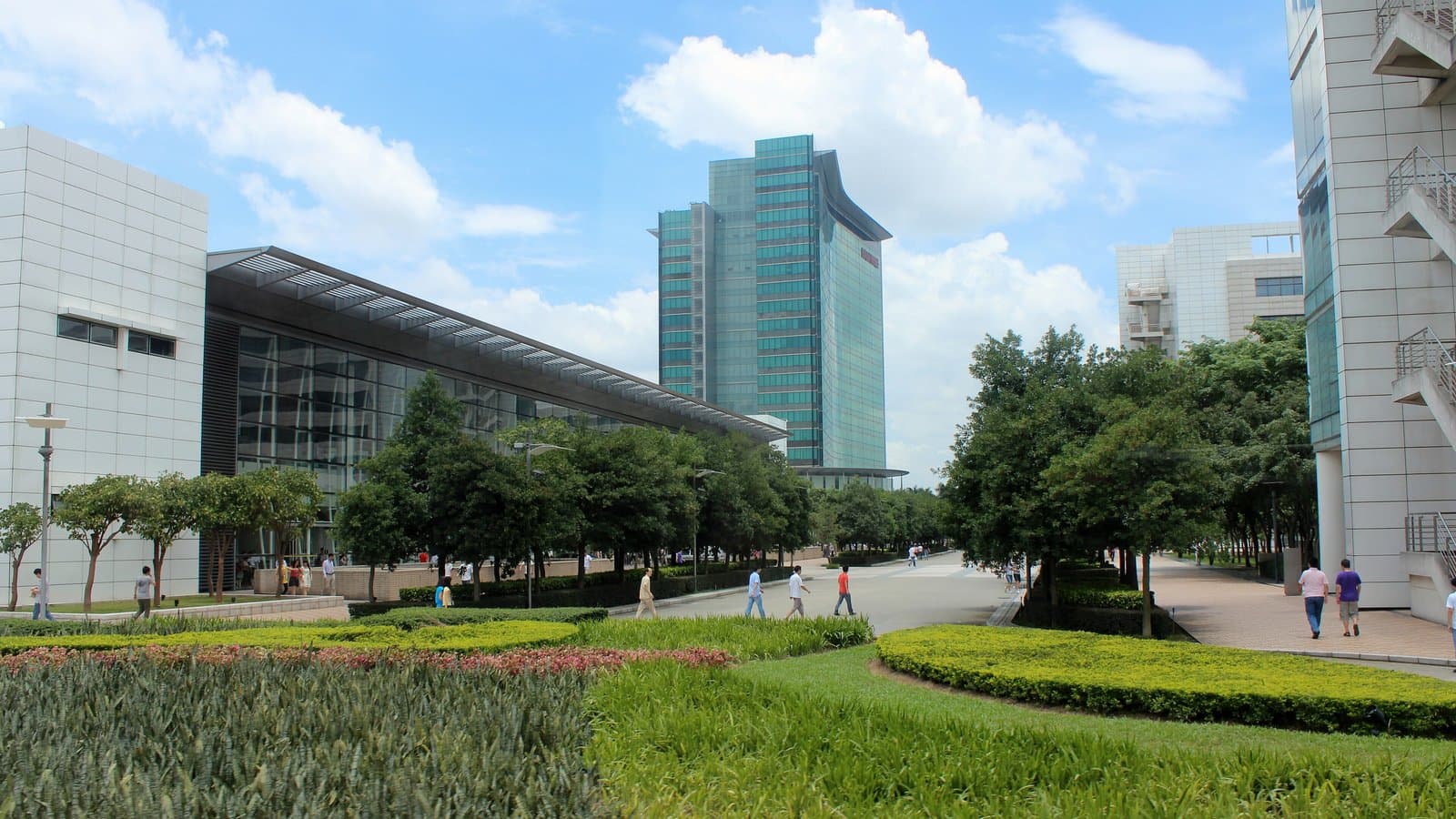
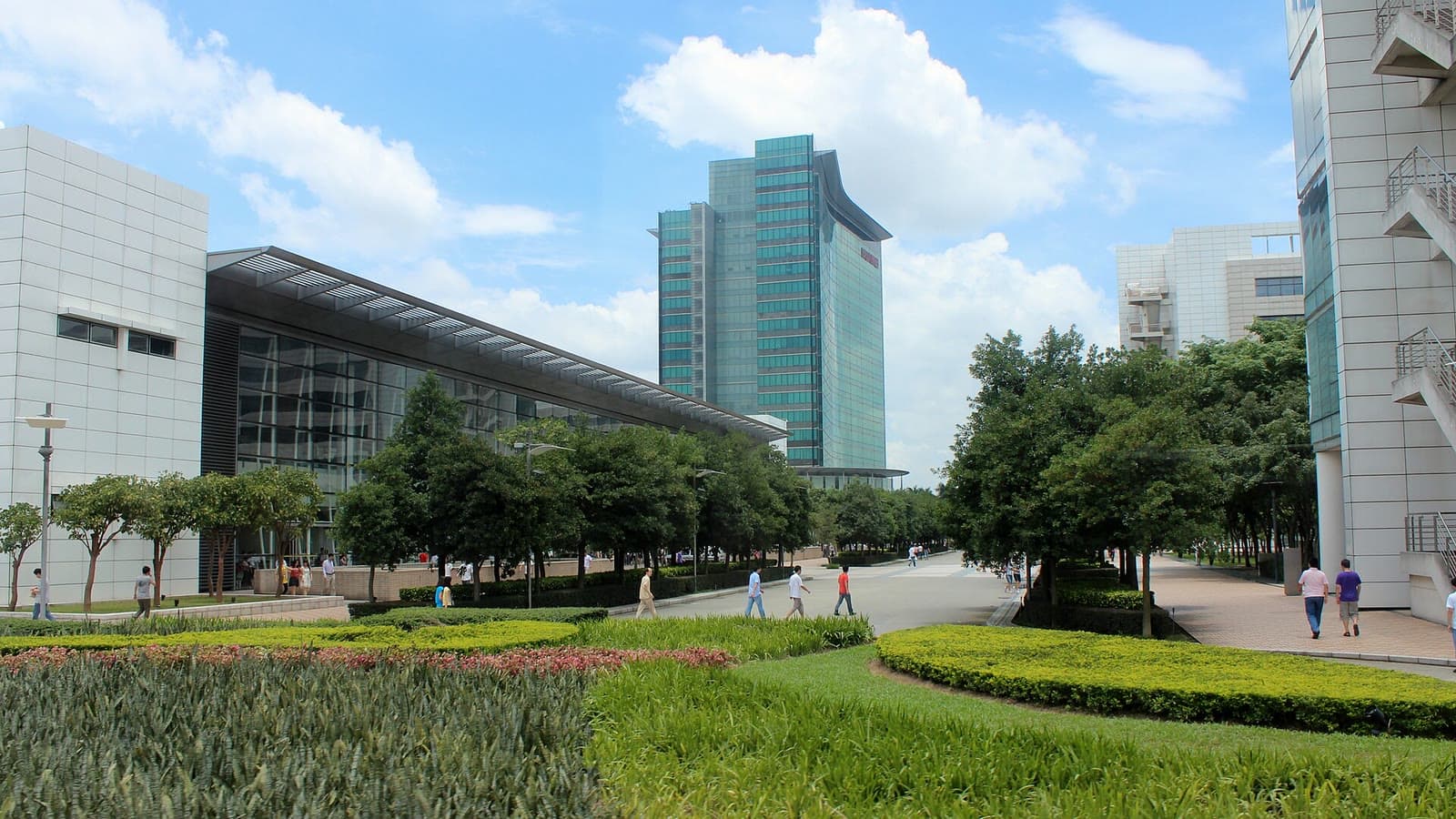
Cover: Huawei's headquarters campus in Bantian, Shenzhen. Photo via Wikimedia Commons (panoramio), CC BY-SA 3.0.
Tags
Frequently asked questions
- What did DeepSeek open-source for Huawei's Ascend chips?
- DeepSeek published a software toolkit built around TileLang, a high-level language for writing compute kernels, plus underlying libraries including DeepGEMM for matrix multiplication and DeepEP for communication across devices. Reports describe it as an Ascend port of TileLang, compute kernel libraries and a distributed communication library.
- Why does a kernel language matter for Huawei's Ascend chips?
- CUDA, Nvidia's programming platform, has been the default way to write AI software for more than a decade, and moving a workload off it means rewriting kernels and communication code. A free, CUDA-style language and matching libraries lower the cost of that move, which is what has kept workloads tied to Nvidia hardware.
- Has Huawei's Ascend software stack been proven against Nvidia's?
- Not yet. The release gives developers a path onto Ascend, but DeepSeek has not published independent performance results against Nvidia hardware, and the toolkit's real-world adoption is unproven. TileLang is also described by DeepSeek as a simpler programming model, a claim that still needs outside testing.

TPW Editorial
Editorial Team
TechPastWeek's editorial team reports and edits every story we publish. We research each piece against primary and credible secondary sources, and a human editor reviews and signs off before it goes live.