Micron's Revenue Nearly Quintuples to a Record $54.23 Billion on AI Memory Demand
Micron reported record fiscal Q4 2026 revenue of $54.23 billion, up nearly fivefold from a year earlier, as AI demand for DRAM and HBM lifted margins.

On this page
Key takeaways
- Micron reported fiscal fourth-quarter 2026 revenue of $54.23 billion on September 30, 2026, up from $11.32 billion a year earlier.
- GAAP net income for the quarter ended September 3, 2026 was $37.70 billion, or $32.87 per diluted share, on operating cash flow of $43.97 billion.
- Gross margin reached 83 percent in Micron's Cloud Memory unit and 90 percent in its Core Data Center unit as AI demand tightened memory supply.
- Micron guided fiscal first-quarter 2027 revenue to $61.5 billion plus or minus $1.5 billion, with GAAP gross margin of about 85.95 percent.
- Micron ended fiscal 2026 with $73.48 billion in cash, marketable investments and restricted cash and declared a $0.15 quarterly dividend.
Micron Technology reported record results for its 2026 fiscal year on September 30, 2026. Quarterly revenue reached $54.23 billion for the period ended September 3, 2026, up from $11.32 billion a year earlier and $41.46 billion in the prior quarter, according to the company's fiscal fourth-quarter and full-year release. That is about 4.8 times the year-earlier figure, nearly fivefold, and it came in above the $51.07 billion analysts expected, CNBC reported.
Related reading: SK Hynix Posts a Record 104.6 Trillion Won Quarter as HBM4 Ramps · SK Hynix Weighs Making Memory in the US by Leasing Intel's Ohio Site.
Micron does not design the GPUs at the center of the AI boom. It makes memory. The results show how much of the buildout's economics now runs through that layer, and why the companies that supply DRAM and high-bandwidth memory are capturing a share of the spending that rivals the chip designers themselves.
What the quarter contained
The profit line moved with the revenue. Micron reported GAAP net income of $37.70 billion, or $32.87 per diluted share, and non-GAAP net income of $38.40 billion, or $33.42 per share. Operating cash flow was $43.97 billion, against $25.39 billion in the prior quarter and $5.73 billion in the year-earlier quarter, according to the release.
The revenue splits into four units, and each one carries its own margin:
- Cloud Memory: $16.283 billion, 83 percent gross margin.
- Core Data Center: $18.002 billion, 90 percent gross margin.
- Mobile and Client: $13.114 billion, 90 percent gross margin.
- Automotive and Embedded: $6.824 billion, 84 percent gross margin.
Two units at roughly 90 percent gross margin are not what a memory business has historically looked like. DRAM has long been a commodity sold by the gigabyte, where prices rise and fall with capacity and the winners are often decided by who can survive the trough. The numbers Micron just posted describe something closer to a scarce input.
Why memory became the bottleneck
The reason sits in how AI systems are built. A GPU does its work on data held in memory, and much of that data has to arrive fast enough to keep thousands of cores busy. High-bandwidth memory, stacked in layers and mounted close to the processor, supplies the bandwidth that makes a training run or an inference session practical. When there is not enough of it, the GPU stalls and expensive compute sits idle.
That makes memory a second constraint alongside the GPUs themselves. Micron is the last major U.S. maker of DRAM, which puts it on the supply side of a market where demand has been rising faster than capacity. The same tightness that constrains buyers gives sellers pricing power, and pricing power is what a gross margin line records.
HBM is built by stacking DRAM dies vertically and wiring them together, then placing the stack beside the processor on the same package. Each generation holds more layers and costs more to manufacture, and the premium buys bandwidth rather than raw capacity. That is how memory moved from a line item counted in capacity to a component that can decide whether a system is worth shipping at all.
There is a second, quieter demand driver in inference. Serving a model means caching the intermediate data a conversation or a task generates, and that cache lives in memory. More inference means more memory per deployed system, on top of the memory already inside each accelerator.
Why a memory maker's numbers moved first
AI spending is usually read through GPU vendors, but a GPU is only useful if it can be fed. HBM and advanced DRAM decide how much of that compute can be kept busy, which is why a memory supplier's margins can move before the rest of the supply chain catches up.
Where the margins come from
A 90 percent gross margin says that for every dollar of revenue, about ten cents goes to the cost of the product sold. Micron earned that in its data center and mobile units during a quarter when memory supply was tight and the mix tilted toward higher-value parts. Those two conditions can change, and the company's own history is a reminder that memory pricing is not a one-way line.
The quarter arrived during a run of warnings about HBM and DRAM tightness and rising memory prices, a theme running through the week's coverage. A shortage looks like scarcity to the buyer and margin to the seller, and those are the same fact read from opposite sides.
What Micron argues is new is the durability of the demand. In the release, CEO Sanjay Mehrotra tied the results to the company's strategic customer agreements, long-term supply arrangements that it says give it more visibility than a spot market would.
“We are increasing our investments in technology, products and manufacturing to help drive SI forward with our customers, and our Strategic Customer Agreements provide added confidence in the durability of Micron's financial performance.” — Sanjay Mehrotra, Micron CEO, in the company's September 30, 2026 earnings release
That is the company's case for why this cycle differs from the last one. The counterweight is that the agreements are not public in detail, so their terms and their pricing are not something an outside reader can check. What can be checked is the margin, and it is very high.
The full-year picture
The quarter was not an outlier bolted onto an ordinary year. Micron reported fiscal 2026 revenue of $133.19 billion, against $37.38 billion in the prior year. GAAP net income for the year was $84.97 billion, or $74.33 per share; non-GAAP net income was $86.76 billion, or $75.52 per share. Full-year operating cash flow reached $89.68 billion, up from $17.53 billion.
The company also invested heavily. Net capital expenditures were $10.77 billion in the fourth quarter and $27.37 billion for the year. Adjusted free cash flow was $33.20 billion in the quarter and $62.31 billion for the year. It closed the year with $73.48 billion in cash, marketable investments and restricted cash, and its board declared a quarterly dividend of $0.15 per share, payable October 29, 2026 to holders of record October 14, 2026.
For scale, the $54.23 billion Micron booked in one quarter was larger than the $37.38 billion it reported for all of fiscal 2025. The full year at $133.19 billion was more than three and a half times that prior-year figure.
Guidance and the product pipeline
Micron's guidance for fiscal first-quarter 2027 points higher again: revenue of $61.5 billion plus or minus $1.5 billion, GAAP gross margin of about 85.95 percent, and GAAP diluted earnings per share of $37.84 plus or minus $1.00. Guidance is a forecast, not a result, and it rests on the company's own assumptions about supply, pricing and demand.
The release paired the numbers with the products it expects to sell into that demand. Micron said it began sampling the industry's first 512GB ultra-dense high-capacity DDR5 RDIMM modules at up to 9,200 MT/s, and completed customer qualifications of 1-gamma 8,800 MT/s high-speed server RDIMM modules. Server LPDDR SOCAMM revenue more than doubled sequentially. Its 7600 PCIe Gen 5 and 9650 PCIe Gen 6 SSDs are shipping for KV-cache applications, the 6600 ION SSD is in volume ramp, and it is shipping 6-channel 1-gamma LPDDR5X for flagship mobile devices. It also began sampling 1-gamma LPDDR6 for what it calls physical AI markets, and reported design wins with every Tier 1 OEM for an AI workstation product.
The pattern in that list is a vendor pushing capacity toward the highest-bandwidth, highest-margin parts, which is where the AI demand is concentrated. Ultra-dense DDR5 and high-speed server RDIMMs are data center parts, SOCAMM is a server-memory form factor, and the PCIe Gen 5 and Gen 6 SSDs are aimed at KV-cache workloads, the cached data that inference serves. Each is positioned above a standard commodity DIMM, so steering output toward them raises the average selling price without requiring Micron to run more wafers through its fabs. The consumer and automotive units still earn high margins today, but they are not where the growth story is being written.
Caveats
Three caveats belong next to these numbers.
The first is provenance. Every figure here is Micron's own, reported under GAAP and adjusted for non-GAAP measures that the company defines. The quarter ended September 3, 2026, and the results were published on September 30, so the picture is one quarter old and self-reported. That is normal for earnings, and it still means an outside reader is relying on the company's accounting.
The second is the multiple. CNBC described revenue as having “almost quadrupled” from a year earlier. The arithmetic is closer to a 4.8-fold increase, which is nearly fivefold. Both descriptions point the same way, and the precise figure is $54.23 billion against $11.32 billion.
The third is direction. Memory has historically been cyclical, and record margins in a tight market are the condition that invites new capacity from every supplier, including Micron, which is spending $27.37 billion a year on capital projects. Whether prices stay high depends on whether demand keeps outrunning that capacity. Micron's guidance says it expects to, and that expectation is the part most exposed to being wrong.
Guidance is not a result
The fiscal 2027 first-quarter figures are Micron's own forecast. The company has guided to $61.5 billion in revenue and 85.95 percent gross margin, but it has not earned either yet, and memory pricing can move sharply within a single quarter.
What to watch
- Memory pricing. The next earnings report will show whether the tightness that produced 90 percent gross margins in two units is holding or easing.
- Capacity adds. Rival capacity and Micron's own $27.37 billion capital program are the forces most likely to end the shortage.
- Customer agreements. More detail on the strategic customer agreements would test Micron's claim that this demand is more durable than past cycles.
- Product ramps. Whether the 512GB RDIMM sampling and the 1-gamma LPDDR6 sampling turn into volume shipments will show how fast the mix shifts toward AI parts.
- Demand at the edge. Mobile and Client still booked $13.114 billion in the quarter; a slowdown in consumer devices would matter even against a strong data center market.
The headline number belongs to a memory maker, not a GPU designer. Micron has guided to another record; the next print will show whether the shortage behind these margins is holding.
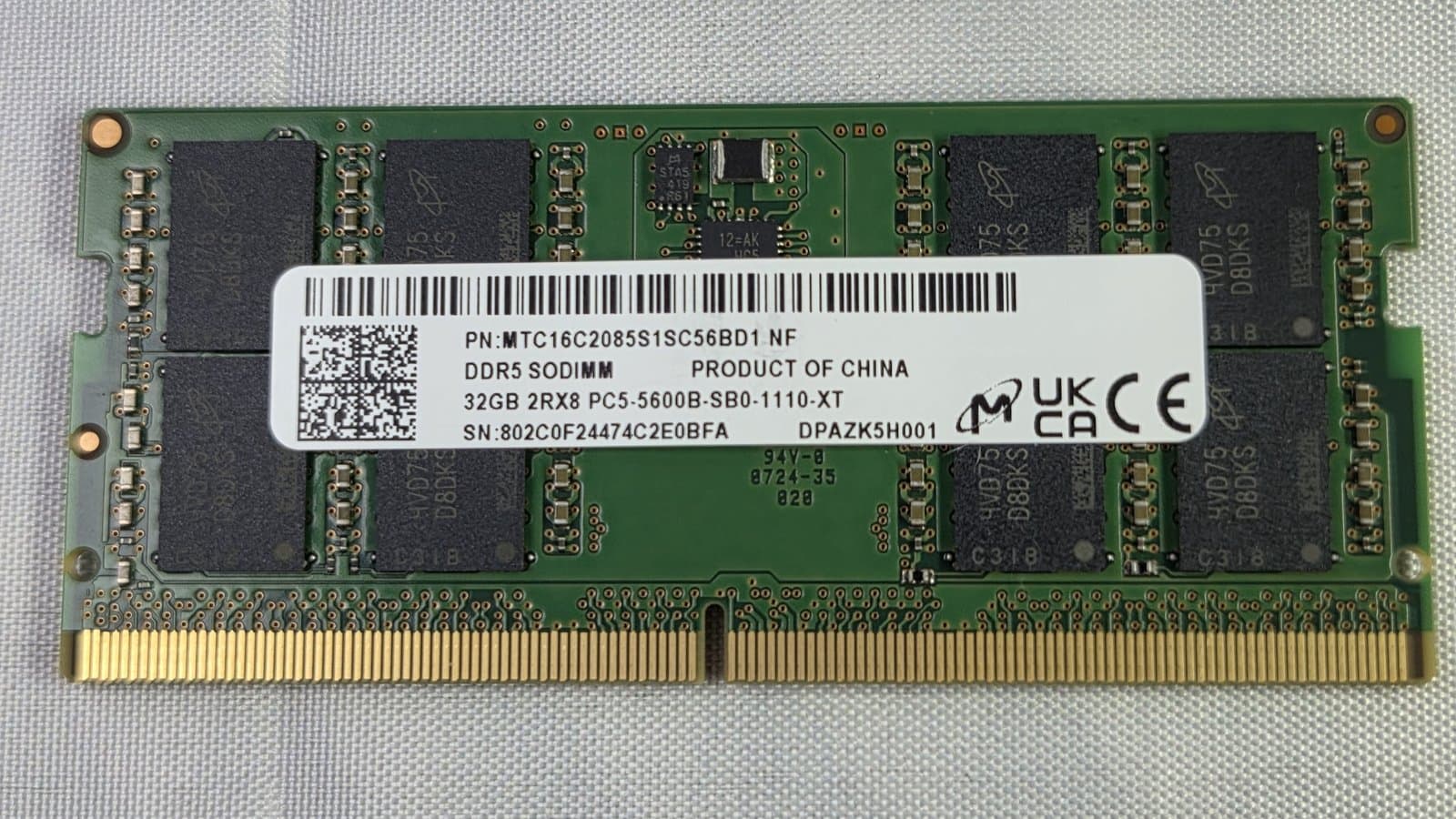
Cover: A Micron 32 GB DDR5-5600 SO-DIMM memory module. Photo by ITEagle Europe / Sebastiaan Broekhoven via Wikimedia Commons, CC BY-SA 4.0.
Tags
Frequently asked questions
- How big was Micron's fiscal fourth-quarter 2026 revenue?
- Micron reported revenue of $54.23 billion for the quarter ended September 3, 2026, up from $11.32 billion in the same quarter a year earlier and $41.46 billion in the prior quarter. The results were published on September 30, 2026.
- Why are Micron's gross margins so high?
- AI accelerators depend on high-bandwidth memory and advanced DRAM, and tight supply has pushed prices and margins up. Micron reported 83 percent gross margin in Cloud Memory and 90 percent in Core Data Center for the quarter.
- What is Micron's guidance for fiscal first-quarter 2027?
- Micron guided revenue to $61.5 billion plus or minus $1.5 billion, GAAP gross margin of about 85.95 percent, and GAAP diluted earnings per share of $37.84 plus or minus $1.00. Guidance is a forecast, not a result.
- Is Micron the only U.S. maker of DRAM?
- Micron is the last major U.S. maker of DRAM, which is the main memory used alongside high-bandwidth memory in AI systems. That position matters as memory becomes a bottleneck for the AI buildout.

TPW Editorial
Editorial Team
TechPastWeek's editorial team reports and edits every story we publish. We research each piece against primary and credible secondary sources, and a human editor reviews and signs off before it goes live.