Huawei Pulls Ascend 960DT to Q1 2027 and Unveils a Near-Packaged-Optics SuperPoD
Huawei pulled the Ascend 960DT to Q1 2027, showed the industry-first NPO Atlas 960E SuperPoD at Connect 2026 and set a yearly doubling cadence in Shanghai.

On this page
Key takeaways
- Huawei said the Ascend 960DT will be ready in Q1 2027, three quarters ahead of its original late-2027 plan, with the Ascend 960PR now set for Q3 2027.
- Rotating chairman David Wang, named Wang Tao by Bloomberg, said Huawei will ship the Ascend 970 in 2028 and Ascend 980 in 2029, roughly doubling compute each generation.
- Huawei unveiled the Atlas 960E SuperPoD, which it calls the industry's first near-packaged-optics SuperPoD, scaling to 4,096 NPUs at 8 EFLOPS of FP8 compute.
- Huawei says UnifiedBus will let a single agentic SuperCluster reach 1 million NPUs, and separately that connectivity will support up to 100,000 Ascend chips in a cluster.
- DeepSeek plans to deploy at least 160,000 Ascend 950DT chips in Inner Mongolia, while Huawei still relies on Nvidia chips for some frontier model training.
Huawei opened Huawei Connect 2026 in Shanghai on September 17 with an accelerated roadmap for its Ascend AI chips and a system-level argument meant to answer Nvidia. The company said the Ascend 960DT, previously expected in late 2027, is now slated for the first quarter of 2027, three quarters ahead of the prior plan. The Ascend 960PR variant follows in the third quarter of 2027, one quarter early, according to TrendForce.
Related reading: DeepSeek Open-Sources a Software Stack for Huawei's Ascend Chips, Aiming at CUDA · TSMC Posts a Sixth Straight Record Quarter as AI Demand Outruns Supply.
Huawei's newsroom account credits the keynote to David Wang, its deputy chairman and rotating chairman. Bloomberg, in a report carried by The Straits Times, calls the same executive Wang Tao, and Huawei's own executive page lists "Mr. Wang Tao (David Wang)." His rotating-chair term runs from April 1 to September 30, 2026. The naming difference is a house style split, not a second executive.
The event, which runs through September 19 at the Shanghai World Expo Exhibition & Convention Center and the Shanghai Expo Center, put hardware, optics and software on the same stage. The through-line is that Huawei is no longer selling individual chips as its main answer to Nvidia. It is selling clusters.
An accelerated roadmap, one generation a year
Huawei said development on the Ascend 960 has run ahead of its own expectations, with performance doubling as planned. The 960DT moves to Q1 2027 and the 960PR to Q3 2027, then the company intends to hold an annual cadence.
"We're evolving our Ascend chip series on a one-generation-a-year cycle," Wang said, according to Huawei. "In 2028 and 2029, we will roll out the Ascend 970 and 980 chips, respectively. Thanks to the Tau (τ) Scaling Law, not only will their compute specifications continue to double, but you can also expect to see huge improvements across the board in terms of memory bandwidth, memory capacity, interconnect bandwidth, and more."
TrendForce, citing the Chinese outlet Guancha, renders the same idea as "Tao's Law" and describes a "one-generation-per-year cadence," with the Ascend 970 in 2028 and Ascend 980 in 2029. Both accounts agree on the doubling claim. Treat "doubling" as a specification target from Huawei, not an independently measured result. South China Morning Post reported that Huawei says the Atlas 960 SuperPoD, built on the Ascend 960, promises a 2.3-fold gain in training and a 2.5-fold gain in inference for 10-trillion-parameter models compared with the Atlas 950 SuperPoD. Those are vendor figures.
The roadmap matters because it compresses a timeline that US export controls were meant to slow. Huawei's chips are fabricated on domestic process nodes that trail the leading edge, and the company cannot buy the most advanced lithography tools. Pulling the 960DT forward by three quarters is a signal about confidence in its foundry supply as much as about design.
Optics moves inside the package
The most concrete product on stage was the Atlas 960E SuperPoD, which Huawei calls the industry's first SuperPoD built on near-packaged optics (NPO). NPO places optical engines close to the switching or compute package instead of using pluggable modules at the edge of the box, which cuts distance, latency and power.
The enabling part is Hi-ONE, the High-density Optical-interconnect-Node Engine. Huawei says Hi-ONE reaches 7.2 Tbit/s per engine, is the first NPO product ready for mass production and the first with a built-in light source. "SuperPoDs are designed to coordinate multiple NPUs through interconnect," Wang said. "We have developed a next-generation optical interconnect product based on near-packaged optics (NPO)."
Huawei's numbers for a single Atlas 960E are large by any measure: up to 4,096 NPUs, 8 EFLOPS of FP8 compute, up to 1 petabyte of HBM capacity, and 5,500 Hi-ONE units standing in for the roughly 48,000 800G pluggable optical modules it says a conventional build would need. Huawei claims that substitution cuts power by more than 550 kilowatts, doubles fault-free operating time and reaches 99.8% system availability. Huawei also said it submitted an NPO implementation agreement to the Optical Internetworking Forum, an industry standards body.
Hi-ONE is not new. TrendForce covered a 7.2 Tbit/s Huawei near-packaged optics module on September 11, days before the keynote, so the Connect announcement is a system-level packaging of an existing optical part.
The cluster is the product
Huawei's argument is that Chinese labs do not need a chip that beats Nvidia's best die. They need a rack, or a hall, that can keep thousands of slower chips working as one machine. That is the role of UnifiedBus, Huawei's interconnect protocol, and of the larger SuperCluster.
Huawei said its upgraded TaiShan 950 SuperPoD, powered by UnifiedBus all-optical networking, supports up to 4,096 nodes and a unified memory pool of up to 256 TB. For agent workloads, Huawei claims startup of 100,000 sandboxes runs 30 times faster than on traditional servers, with 25% higher sandbox density, and that vector search over 10 billion 1,000-dimensional vectors is twice as efficient.
The storage layer is the OceanStor M900, a UnifiedBus context memory system that provides a petabyte-scale KV cache for what Huawei calls the L3.5 layer, aimed at long-context agentic inference. Huawei says hybrid media and a retention algorithm extend SSD read and write lifespan by 16-fold.
Above the SuperPoD sits the agentic SuperCluster. Huawei says a two-tier, four-plane Clos architecture can interconnect up to 512,000 NPUs, and that a multi-rail topology can push that to one million NPUs. Separately, Bloomberg reported that Huawei's SuperPod connectivity will soon allow as many as 100,000 Ascend chips in a single cluster. The two figures describe different products and should not be conflated: 100,000 refers to the near-term UnifiedBus cluster, and one million to the largest SuperCluster configuration Huawei is describing.
The company also framed the economics. It said more than 1,000 Atlas 900 A3 SuperPoDs have been deployed and that the Atlas 950 SuperPoD is in large-scale commercial use. Its Markov Lab simulation claims a 100,000-NPU cluster built from 4,096-NPU SuperPoDs delivers 2.75 times the model FLOPs utilization of a cluster built from 8-NPU servers, because intra-cluster communication otherwise consumes more than 40% of training time.
Open source as distribution
Huawei paired the hardware with an ecosystem pitch. CANN, the Compute Architecture for Neural Networks that underpins Ascend, has moved to sustained community-driven open source. Huawei said external CANN developers now make up 61% of all CANN developers, passing internal developers for the first time, with more than 5,200 monthly active developers.
Huawei also said Ascend supports more than 90 leading third-party open-source projects, including PyTorch, Triton, vLLM and veRL, and that the platform is the first official Chinese compute platform listed on PyTorch's website with Linux Foundation support. The Kunpeng ecosystem, meanwhile, has drawn more than 4.16 million developers and 7,200 partners, Huawei said. Open sourcing the software stack lowers the cost for developers to move models onto Ascend, which matters when the silicon is not the fastest per chip.
Why it matters: the compute gap and export controls
Huawei's roadmap lands in a specific policy moment. The Associated Press noted that the Shanghai announcement came days before an expected meeting between US President Donald Trump and Chinese President Xi Jinping in Washington on September 24, and that US-led restrictions have barred Huawei from some of the world's most advanced AI chips and chipmaking machines.
Those restrictions shape what Huawei can claim. Its chips still trail Nvidia's top offerings on raw performance. Frontier Chinese labs including DeepSeek still lean on Nvidia chips to train models, then run inference on domestic silicon, Bloomberg reported. Nvidia's most advanced Blackwell processors are not directly available in China, though small quantities of its newest silicon reportedly keep arriving through illicit channels.
The demand picture is not in doubt. Huawei is racing to meet demand in a market that Morgan Stanley estimates could reach 646 billion yuan, roughly $96 billion, by 2030. Production capacity remains the constraint. Bloomberg reported that Huawei recently raised pricing for the Ascend 950DT by 60 percent, citing tight component supply, after US controls cut Chinese buyers off from the latest AI memory from SK Hynix, Samsung and Micron.
DeepSeek gives Huawei a flagship customer. The AI startup plans to deploy at least 160,000 Ascend 950DT chips at a data center it is building in Inner Mongolia to run its models, and Huawei is exploring foreign markets including Malaysia and Egypt, according to Bloomberg.
Analyst opinion is split on how much the system-level bet closes the gap. Morgan Stanley analyst Charlie Chan argued the gap is narrowing through architecture. "System-level competitiveness matters more than ever," he wrote. "The effective gap is narrowing through multi-die design, advanced packaging, rack-scale system architecture, optical networking, and software-hardware co-optimisation." Bernstein analysts, cited by Cryptopolitan, estimated Huawei's next-generation Ascend 950 delivers only around 6% of the performance of Nvidia's upcoming VR200 superchip, a reminder that aggregate cluster figures and per-chip efficiency measure different things.
The July baseline and what to watch
This is not Huawei's first SuperPoD claim. At the World AI Conference in Shanghai in July 2026, Huawei exhibited an Atlas 950 SuperPoD and said the full system, at 8,192 Ascend 950DT chips, would deliver about 6.7 times the compute and 15 times the memory of Nvidia's NVL144 rack. Those were vendor comparisons based on a full configuration, not independent benchmarks, and the AP noted the Atlas 960 SuperPoD drew attention partly because it arrived so soon after the Atlas 950.
Three things are worth tracking. First, whether the Ascend 960DT actually ships in Q1 2027, and whether the 960PR holds Q3 2027, since slipped roadmaps are common. Second, whether any independent benchmark appears for a shipping SuperPoD; Huawei's MFU and efficiency numbers come from its own simulations. Third, whether DeepSeek's planned deployment of 160,000 Ascend 950DT chips and Huawei's overseas push into Malaysia and Egypt translate into durable orders, or stall on manufacturing capacity and the export regime.
Huawei's message at Connect 2026 is that the contest is now about systems, not dies. That framing is also a hedge. Until Huawei can build a chip that matches Nvidia's best, the cluster is the company's answer, and the roadmap dates are its promise that the chips keep getting closer.
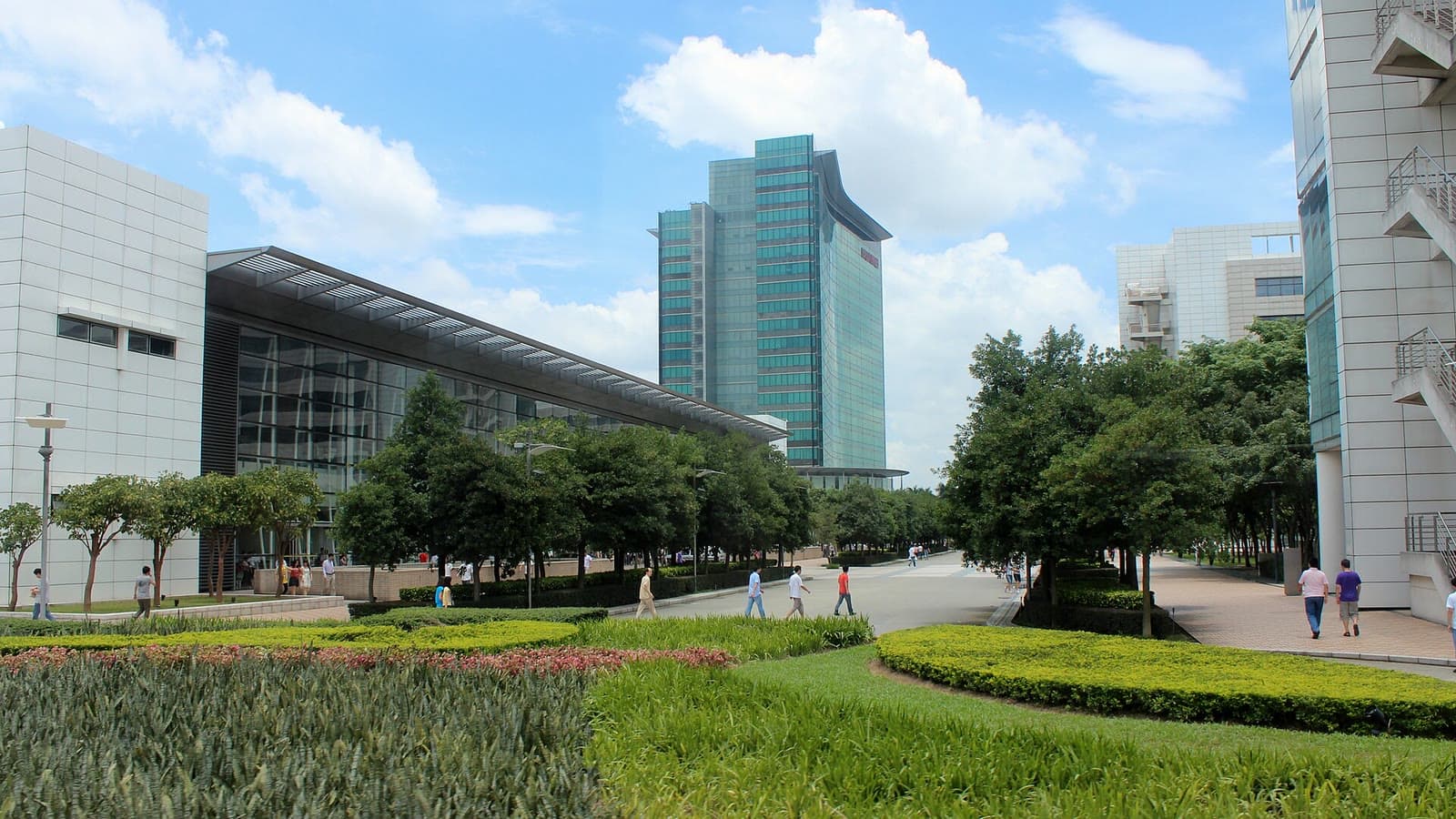
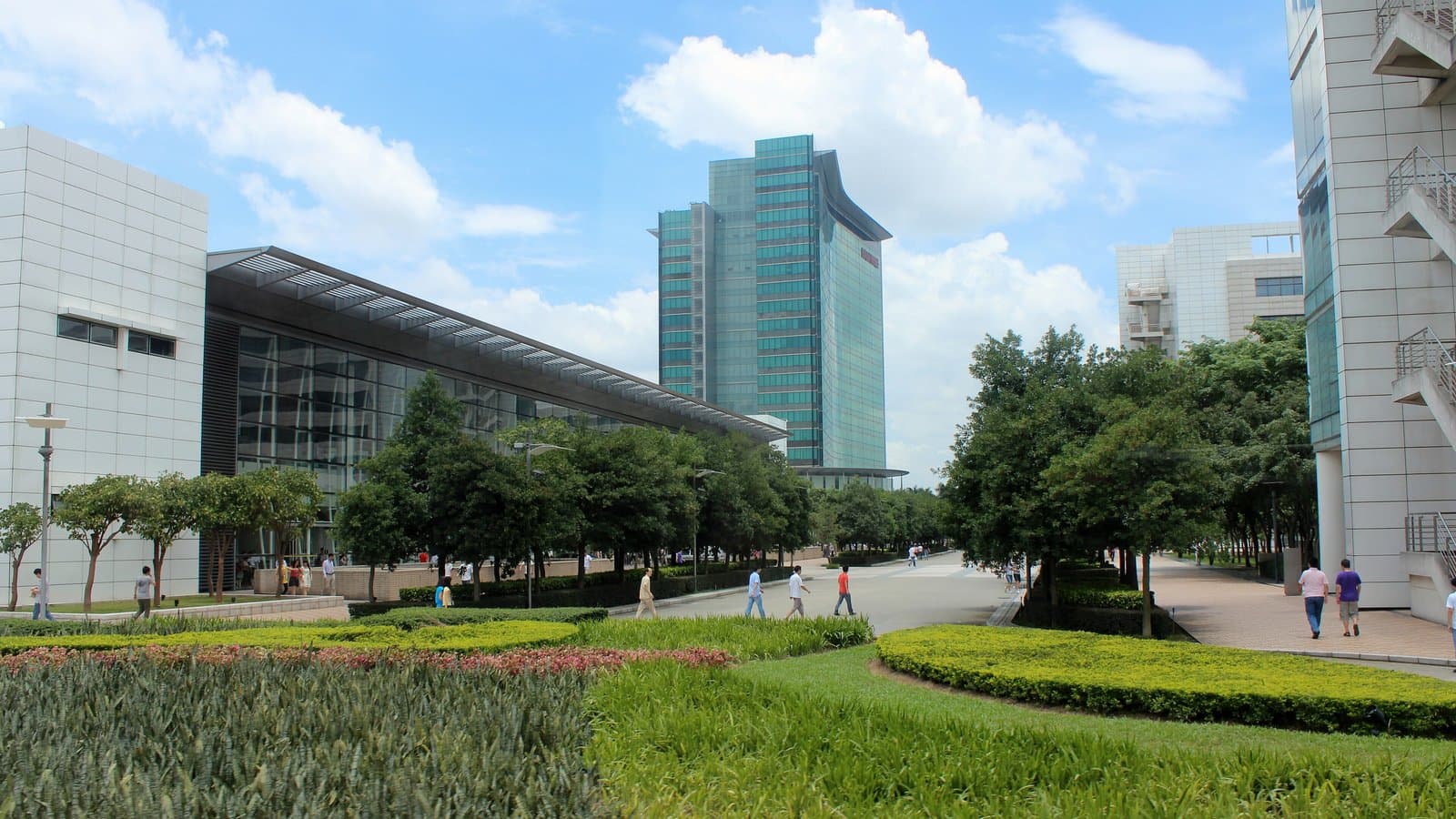
Cover: Huawei's Bantian headquarters campus in Shenzhen. Photo by fading via Wikimedia Commons (CC BY-SA 3.0).
Tags
Frequently asked questions
- When will Huawei's Ascend 960DT chip launch?
- Huawei said at Huawei Connect 2026 on September 17, 2026 that the Ascend 960DT will be ready in the first quarter of 2027, about three quarters earlier than its previous late-2027 target. The Ascend 960PR variant is slated for the third quarter of 2027.
- What is the Atlas 960E SuperPoD?
- The Atlas 960E is a rack-scale computing system that Huawei says is the industry's first SuperPoD built on near-packaged optics. A single unit scales to 4,096 NPUs, delivers 8 EFLOPS of FP8 compute and carries up to 1 petabyte of HBM memory, according to Huawei.
- Does Huawei still depend on Nvidia chips?
- Yes, in part. Reports say leading Chinese labs including DeepSeek still rely heavily on Nvidia GPUs for model training even as they run inference on domestic silicon, and US export controls continue to limit Huawei's access to advanced chipmaking tools.
- How does Huawei plan to close the gap with Nvidia?
- Huawei's strategy is to compensate for weaker single-chip performance by linking thousands of Ascend chips through its UnifiedBus interconnect and optical systems into one large cluster, rather than matching Nvidia chip for chip.

TPW Editorial
Editorial Team
TechPastWeek's editorial team reports and edits every story we publish. We research each piece against primary and credible secondary sources, and a human editor reviews and signs off before it goes live.