TSMC Posts a Sixth Straight Record Quarter as AI Demand Outruns Supply
TSMC's Q3 2026 net income hit a record NT$763 billion on 15 October, up 68.7% year on year, as AI demand beat its own guidance and chip stocks fell anyway.

On this page
Key takeaways
- TSMC reported Q3 2026 net income of NT$763.06 billion (about US$23.6 billion) on 15 October 2026, up 68.7% year on year and a record for the sixth consecutive quarter.
- Revenue was US$46.72 billion, up about 41.2% year on year and 16.2% quarter on quarter, above TSMC's own guidance of US$44.6 billion to US$45.8 billion.
- 3-nanometre and 5-nanometre processes made up 79% of revenue, and high-performance computing, which covers AI accelerators, accounted for 68%.
- TSMC guided Q4 2026 revenue to US$52.3 billion to US$54.3 billion and full-year 2026 growth of about 44%, after US$13.84 billion of capital spending in the third quarter.
- TSMC shares fell about 3.4% on the day of the results, caught in a broader chip and AI selloff over debt-financed infrastructure spending.
Taiwan Semiconductor Manufacturing Co. reported its sixth consecutive record quarter on Thursday 15 October 2026, with net income of NT$763.06 billion (about US$23.6 billion), up 68.7 percent from a year earlier, and revenue of US$46.72 billion, up about 41.2 percent year on year. Quartz reported the record profit, and Investing.com reported the quarter cleared both TSMC's own guidance and analyst expectations.
Related reading: TSMC's August Revenue Hits a Record NT$514.8 Billion as AI Demand Outruns Supply · Taiwan Plans to Make Unauthorised AI-Chip Exports to China a Crime.
The same day, TSMC shares fell about 3.4 percent. The drop came amid a broad selloff in chip and AI stocks over how much of the data-center buildout is being financed with debt, a repricing that ran straight through a set of results that beat on almost every line.
Two questions were moving at once. The earnings answered whether demand for AI silicon is still rising. The share price answered what investors think that demand is worth once the cost of funding it is counted. Both gave an answer this week, and they did not agree.
What the quarter actually showed
Net income of NT$763.06 billion beat a FactSet consensus of about NT$731.77 billion and an LSEG SmartEstimate of NT$746.3 billion, according to a Reuters preview published before the results. Revenue reached US$46.72 billion, Yahoo Finance reported, up about 41.2 percent year on year and 16.2 percent quarter on quarter, clearing TSMC's guidance of US$44.6 billion to US$45.8 billion and a consensus figure of roughly US$45.62 billion. In NT dollar terms, the Wall Street Journal reported, revenue reached NT$1.494 trillion, up 51 percent from a year earlier.
That is a company selling everything its most advanced factories can produce. A beat of that size moving the stock lower is the part that needs explaining, and the explanation sits mostly outside TSMC.
The streak matters on its own. Six consecutive record quarters covers a stretch in which demand for advanced chips kept climbing while rivals struggled to match TSMC's leading-edge capacity. When a company beats a consensus that analysts had already marked up, the surprise is about supply as much as demand: the market is large, and so far the foundry has kept pace with it.
Where the demand comes from
TSMC's process mix shows which parts of the business are carrying the load. Its 3-nanometre and 5-nanometre processes together accounted for 79 percent of revenue, and high-performance computing, the segment that covers AI accelerators, was 68 percent of the total, per Quartz. Those two figures explain why a single product cycle matters so much to the company's results. AI accelerators are what keep the leading edge full.
The next node is already on the schedule. Chief financial officer Wendell Huang said the fourth quarter would be supported by demand for leading-edge processes and by the steep ramp-up of the company's 2-nanometer technology. TSMC also pointed to rising adoption of agentic AI and open-source AI models as sources of demand, according to Quartz. Chief executive C.C. Wei said he saw no sign of a slowdown in AI infrastructure demand, a view reported by MarketWatch and cited by Quartz.
That concentration cuts both ways. It is why the last several quarters have been records, and it is why a slowdown in AI accelerator orders would reach the revenue line quickly. A foundry with a broader customer mix would absorb a dip in one segment more easily. One drawing more than two-thirds of its revenue from AI-related compute has less room to spread that risk.
Guidance points higher, and capex points longer
TSMC guided fourth-quarter revenue to US$52.3 billion to US$54.3 billion, Investing.com reported, and full-year 2026 growth of about 44 percent. Capital expenditure was US$13.84 billion in the third quarter, and the company said capex over 2026 to 2028 would rise substantially compared with the previous three years.
The gap between a US$46.72 billion quarter and a US$52.3 billion guide is about as direct a statement as a foundry can make about what its customers have booked. The capex line is where the cost of meeting those orders appears. TSMC is also investing US$265 billion to build factories in Arizona, including an additional US$100 billion announced in July 2026. Demand that runs ahead of supply does not stay unmet for long at this scale, and the answer is capacity, which at the leading edge is expensive and slow to add.
The guide also implies a further sequential increase from the US$46.72 billion just reported, extending the run for at least another quarter. TSMC's own recent history is a poor guide to whether that holds: the last six quarters have each surprised in the same direction, and there is no obvious sign in the numbers that the pattern has run out.
Why the stock fell anyway
None of that held up the share price. TSMC fell about 3.4 percent on the day, caught in the same selloff that hit chip and AI names broadly. The worry driving that move was the funding side of the buildout: how much of the data-center expansion is being paid for with borrowed money, and what the order book looks like if that borrowing gets more expensive.
Two numbers pulling in opposite directions
TSMC earned a record NT$763.06 billion in Q3 2026 and guided to a higher fourth quarter, but its shares fell about 3.4 percent the same day as chip and AI stocks were repriced over debt-financed infrastructure spending.
Set the two together and the quarter looks less contradictory. A foundry reports what it shipped and what it expects to bill. A share price reflects what the market thinks those future bills are worth after discounting the risks around them. The first was strong and got stronger on guidance. The second was being repriced over a debt question that the earnings call could not settle.
The gap between the two is not unique to TSMC, but it is sharper here because the company sits closest to the demand. If the market is wrong about AI spending, TSMC's booked orders are among the earliest places the error would show. If the market is right, the same backlog is what makes the eventual correction large. Either way, the shares are a bet on a question that company results cannot answer on their own.
Caveats worth keeping in view
Two figures need their labels. Reported results are in NT dollars, and the US dollar equivalents move with the exchange rate used, which is why net income is quoted at roughly US$23.6 billion to US$23.71 billion across coverage. And Wei's “no slowdown” line is his reading of the demand he can see, not a company forecast. It reached print through MarketWatch, as Quartz cited.
One piece of context sits outside TSMC. Chip-equipment maker ASML also reported strong AI-driven demand earlier in the week, the same week the selloff ran. Two companies reading the same order book is a better signal than either alone, and it does not change the fact that investors are weighing how that demand gets financed as much as whether it exists. Neither report says much about how the orders are paid for.
A third label belongs on the selloff itself. TSMC's share move is a same-day figure, and single-day moves in a sector being repriced carry limited information about a company's fundamentals. The 3.4 percent describes the mood of the market that afternoon; the order book did not change.
“Moving into fourth quarter 2026, we expect our business to be supported by continued strong demand for our leading-edge process technologies, including the steep ramp-up of our 2-nanometer technology.” — Wendell Huang, chief financial officer, TSMC, 15 October 2026
What to watch
Three numbers should settle the next phase. The first is the December quarter against the US$52.3 billion to US$54.3 billion guide, the first test of whether the ramp holds into the end of the year. The second is capex: the promise to spend substantially more through 2028 is what stands between today's demand and the capacity to serve it. The third is the 2-nanometer ramp, where the leading edge either keeps absorbing the AI buildout or starts to find its ceiling. Each was already in motion before this quarter, and none of them is settled by it.
The debt question will not resolve on TSMC's call. It resolves in the credit markets and in the spending plans of the companies placing the orders. One more read arrives in the meantime. TSMC's results land earlier than most of the industry's, because its customers report after it does, and the next round of those reports will show whether the demand it is guiding toward turns into finished systems and revenue elsewhere or builds as inventory. For now, the quarter says the demand is real and still climbing. What the market will pay for it is a separate conversation, and it is far from settled.
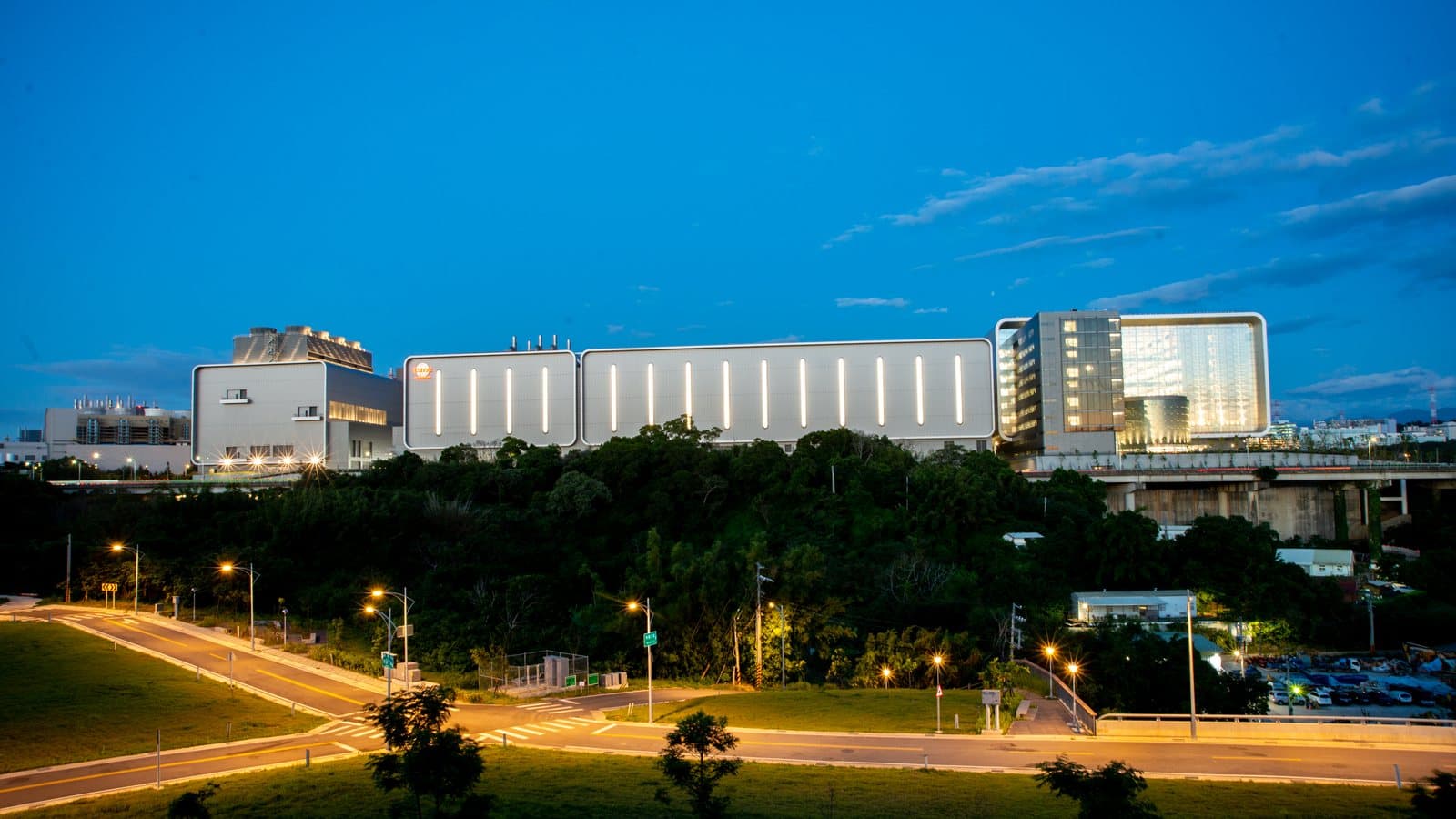
Cover image: "TSMC Global R&D Center at night.jpg" (台積電全球研發中心) by Tseng Cheng-hsun (曾 成訓), CC BY 2.0, via Wikimedia Commons.
Tags
Frequently asked questions
- How much did TSMC earn in Q3 2026?
- TSMC reported net income of NT$763.06 billion, about US$23.6 billion, for the third quarter of 2026, up 68.7 percent year on year and a record for the sixth straight quarter.
- What did TSMC guide for Q4 2026?
- TSMC guided fourth-quarter revenue to US$52.3 billion to US$54.3 billion and full-year 2026 growth of about 44 percent, after reporting US$46.72 billion in third-quarter revenue.
- Why did TSMC stock fall after record earnings?
- TSMC shares fell about 3.4 percent as a broader selloff in chip and AI stocks over debt-financed data-center spending outweighed results that beat both guidance and consensus.
- What is driving TSMC's AI demand?
- High-performance computing was 68 percent of Q3 revenue, led by AI accelerators, with growth in agentic AI and open-source AI models. TSMC is also ramping its 2-nanometer process.

TPW Editorial
Editorial Team
TechPastWeek's editorial team reports and edits every story we publish. We research each piece against primary and credible secondary sources, and a human editor reviews and signs off before it goes live.