Eight Tech Companies Are Evaluating Intel's 14A Node, and None Has Signed
A Piper Sandler research note says Amazon, Apple, AMD, Google, Tesla, Microsoft, Nvidia and Qualcomm are evaluating Intel's 14A process, with no commitments.

On this page
Key takeaways
- A Piper Sandler research note says Amazon, Apple, AMD, Google, Tesla, Microsoft, Nvidia and Qualcomm have all been evaluating Intel's 14A fabrication process, and none has committed to a deal.
- Piper Sandler says Intel needs at least one anchor customer by the end of 2026 or the beginning of 2027 to reach production by 2028.
- Intel chief executive Lip-Bu Tan said in July 2026 that Intel could halt 14A and later process technologies if it failed to land a significant external customer or meet key customer milestones.
- Intel says 14A, its 1.4-nanometer-class node, offers a 15% to 20% performance-per-watt gain over 18A and adds a turbo cell, a second-generation RibbonFET and backside power delivery; defect density fell to 0.5 by June 2026, with a target of 0.1 to 0.2 by the first quarter of 2027.
- Tesla said in April 2026 that it plans to use the 14A process at its planned Terafab chip complex in Austin, Texas, making it the first named major external customer.
Intel's contract chip manufacturing business has spent years waiting for a product line large enough to justify the factories built for it. On September 25, 2026, TechSpot reported that a Piper Sandler research note names eight companies that have been evaluating the company's 14A fabrication process: Amazon, Apple, AMD, Google, Tesla, Microsoft, Nvidia and Qualcomm. Not one of them has committed to a deal.
Related reading: TSMC's August Revenue Hits a Record NT$514.8 Billion as AI Demand Outruns Supply · TSMC's A16 Is Ready: Backside Power Meets the Angstrom Era.
That gap between interest and a signed contract is the whole story. Evaluating a process is cheap, quick and reversible. Committing a flagship product line to it is expensive, slow and close to irreversible, because a chip design is tied to the process it is built on and moving it later costs months of work. Intel's leadership has framed 14A as a node that depends on customers signing rather than on customers looking, and the eight-name list does not change that.
What the Piper Sandler note says
Piper Sandler's central claim is about timing. The firm said Intel needs to land at least one anchor customer by the end of 2026 or the beginning of 2027 for 14A to reach production in 2028. The News reported the same threshold, describing it as the condition Intel must meet to hit its 2028 production plan.
The note offers three explanations for why those eight companies are looking at all. Intel's technical results have improved, TSMC's advanced-node capacity is tight, and chip designers want manufacturing and packaging options that are not concentrated in Taiwan. According to TechSpot, Piper Sandler said TSMC's capacity is sold out through 2028, which is what turns a supply preference into a strategic problem for any company whose roadmap depends on getting wafers at a predictable time.
That is a description of an opening rather than a win. Piper Sandler's own phrasing, as quoted by TechSpot, was that the 14A datapoints "bode well" while the firm awaits an anchor customer. The companies named have every reason to run early work on the process. Doing so gives them pricing leverage with TSMC and a fallback if capacity, cost or geopolitics force one. Neither of those requires a company to move a product, and the note does not claim that any of them has.
The composition of the list is as telling as its length. It includes Intel's direct x86 rival, AMD, which has its own reasons to know what Intel's process can do without necessarily wanting to buy it. It includes Apple and Nvidia, two of the largest consumers of leading-edge capacity. It includes cloud buyers, an electric-vehicle maker and a mobile chip designer, which is close to the full range of companies that would need a second advanced-node supplier.
An anchor customer is not simply a first sale. In foundry terms it is a buyer large enough to justify the equipment spending a new node requires, and committed enough that the process gets exercised at volume. That is why Piper Sandler frames the question around one signed name rather than eight interested ones. A handful of evaluations spread across eight companies does not fill a fab. A single design win at volume can.
Tan set the condition in July
Intel chief executive Lip-Bu Tan made the stakes explicit in July 2026. He said the company could halt 14A and later process technologies if it failed to land a significant external customer or meet key customer milestones, because continuing to develop leading-edge nodes without that demand would not be economical.
"If we are unable to secure a significant external customer and meet important customer milestones for Intel 14A, we face the prospect that it will not be economical to develop and manufacture Intel 14A and successor leading-edge nodes on a go-forward basis," Tan said, in the version The News carried.
The framing inverts the usual foundry pitch. A foundry normally builds capacity and then sells it. Tan has said Intel will not expand leading-edge manufacturing without clear evidence of customer demand. On that logic, 14A is not a finished product waiting for buyers. It is a proposal waiting for a signature, and the deadline in the Piper Sandler note is the clock running on it.
A halt would also be difficult to reverse. Leading-edge development is continuous work, and Intel has described 14A and its successors as a sequence rather than separate projects. Stopping at 14A would put the company's claim to make leading-edge chips for outside customers at the end of that sequence instead of in the middle of it.
The warning also reads as an attempt to force the issue. Intel has spent years building contract-manufacturing capacity, and the pattern has been interest without the committed volume that makes a node pay for itself. Tan's message to the eight companies was, in effect, that customers who want the option of a second source have to fund it with orders rather than with meetings.
What Intel says 14A brings
Intel describes 14A as its 1.4-nanometer-class node, the step after 18A. The company says it offers a 15% to 20% performance-per-watt gain over 18A. It also introduces a "turbo cell" technology meant to raise CPU maximum frequency and improve GPU critical paths, a second-generation RibbonFET transistor, and a backside power delivery system. A variant called 14A-E will add further feature extensions, PCMag reported.
Those three features answer different problems. Backside power delivery moves the power wiring to the back of the wafer so the front can be used for signal routing, which helps both density and efficiency. RibbonFET is Intel's gate-all-around transistor, the structure that replaced the fin. The turbo cell is a library-level design choice aimed at the highest clock speeds, and its inclusion suggests Intel is pitching 14A at the parts of a chip where frequency decides who wins the benchmark.
Node names are branding rather than measurements, and the numbers attached to them do not translate cleanly between Intel, TSMC and Samsung. The comparison that matters to a customer is not the label but the clock: whether a process is ready when a product needs it, and what it costs per good die.
Manufacturing readiness shows up in defect density, and Intel has been publishing progress there. According to Gate News, 14A's defect density (D0) fell to 0.5 by June 2026, with the company targeting 0.1 to 0.2 by the first quarter of 2027. Lower defect density is what allows a fab to produce usable chips at a price a customer will pay.
Defect density is the quiet metric behind every foundry decision. A process can hit its performance targets and still fail commercially if too many dies come off the wafer broken. Intel's defect-density trend is the technical case for 14A; the anchor-customer deadline is the commercial one, and both have to land.
Intel has also been distributing process design kits (PDKs), the software and design rules customers need to lay out a chip for a node. The company says multiple customers have expressed intent to build test chips. Intent to test is a step short of intent to build a product, and it is the distinction that separates eight evaluations from the commitments Intel needs.
Tesla is the only named external customer
One name on the list has already gone further than evaluating. Tesla said in April 2026 that it plans to use the 14A process at its planned Terafab chip complex in Austin, Texas, making it the first named major external customer for the node.
That is a real commitment from a company with a reason to want it. Tesla designs its own silicon for vehicles and data centers, and a US-based leading-edge foundry would reduce its exposure to the same Taiwan concentration that worries every large chip buyer. It is still one customer. Intel's stated threshold was a significant external customer to justify continued development, and whether Tesla's volume clears that bar by itself is a question the company has not answered in public.
There is a strategic logic here that cuts both ways for Intel. A customer with a captive use for its own chips can commit to a new node earlier than a merchant buyer, because it does not have to persuade outside customers to accept the risk of an unproven process. Tesla can absorb early yields inside its own products. The merchant foundry customers Intel needs have to convince their own customers that a chip built on a new process is worth buying.
The distance to TSMC
The scale of what Intel is attempting is easy to lose in the node branding. Intel has invested about $90 billion over four years to build a contract manufacturing business able to challenge TSMC, the dominant supplier of advanced chips. That spending is the reason customer commitments carry so much weight. A foundry business with external customers is a second revenue engine. A foundry business without them is a very expensive internal factory that Intel alone has to keep full.
Intel's competitive position has been slipping on other fronts at the same time. Rival AMD recently joined the $1 trillion market-capitalization club, beating Intel to the milestone. Intel's share of the x86 processor market has eroded as AMD gained ground in both client and server CPUs. Those results come from a company whose own products compete for the same manufacturing attention that outside customers would be buying.
None of this makes 14A a failure. It makes it a bet with a clear test. TSMC's lead rests on more than process technology. It is a network of customers, design tools, packaging capacity and years of accumulated trust, and a new entrant has to earn each of those separately. The eight evaluations suggest Intel has at least earned a hearing.
What to watch next
Three things will settle this story, and none of them is a research note.
The first is the anchor customer. Piper Sandler's deadline is the end of 2026 or the start of 2027. If Intel names a customer with a committed product line in that window, 14A's path to a 2028 production ramp becomes credible. If it does not, Tan's warning about halting the node becomes the operative plan rather than a negotiating position.
The second is whether test chips turn into design wins. Intel says multiple customers have expressed intent to build test chips, and PDKs are in customers' hands. A test chip proves a process can run. A design win proves somebody is willing to sell a product built on it, which is the only evidence that counts for the foundry business's economics.
The third is TSMC's own capacity. The argument for looking at Intel assumes TSMC stays sold out and customers stay nervous about concentration in Taiwan. If TSMC adds capacity faster than expected, or if demand for leading-edge chips softens, the pressure that pushed eight companies to evaluate 14A eases with it.
All three tests point at the same question: whether a second advanced foundry outside Taiwan becomes real enough for the largest chip buyers to fund it. Intel has the fabs, the node and the defect-density trend. The missing input is a name on a contract.
Intel has put the technical pieces in place, from the defect-density trend to the feature set it says 14A will carry. What it has not put in place is a customer willing to say so on the record. Until that changes, eight evaluations remain eight evaluations.
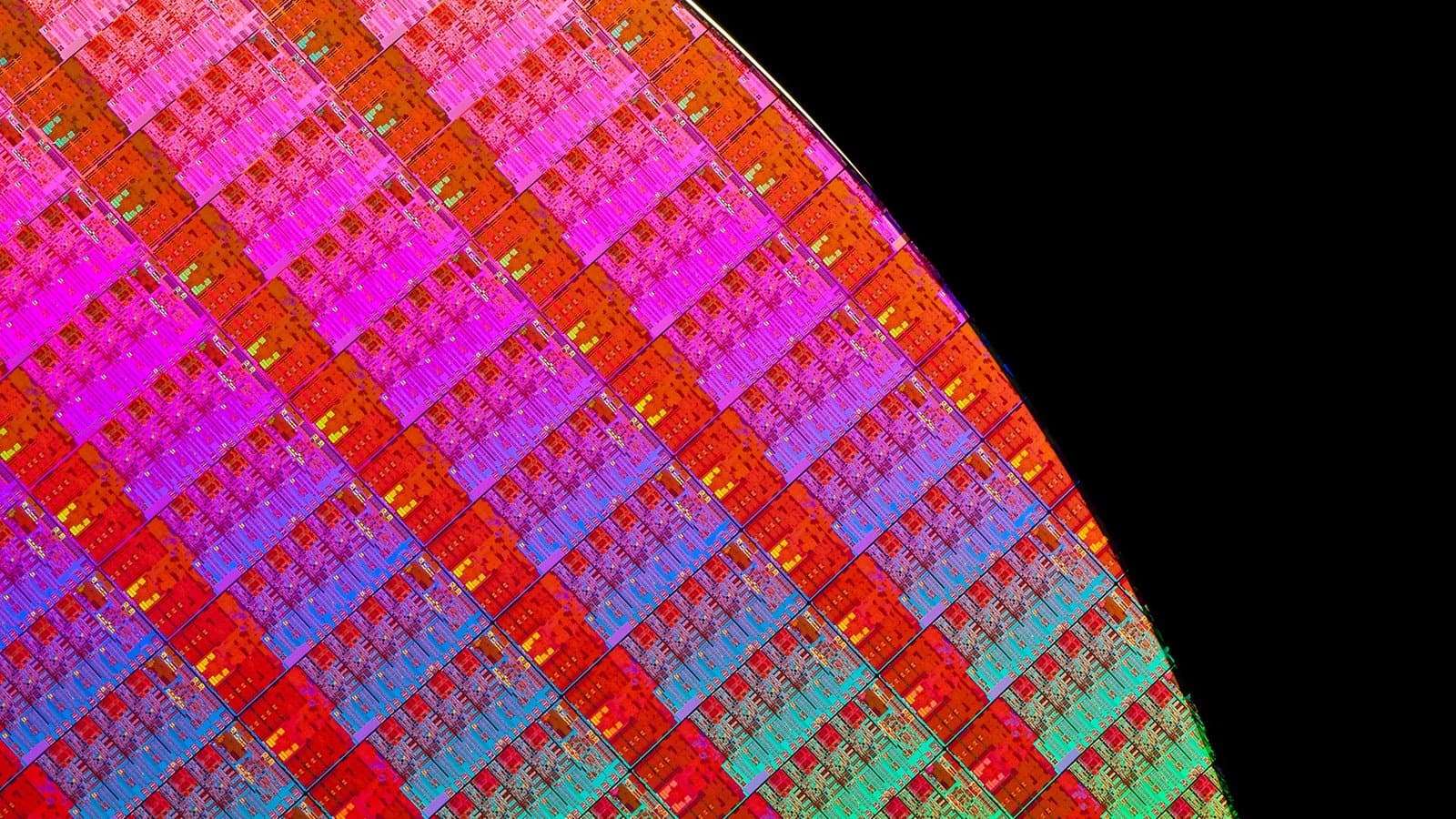
Cover: An Intel processor wafer. Photo by Intel in Deutschland via Wikimedia Commons, CC BY-SA 2.0.
Tags
Frequently asked questions
- Which companies are evaluating Intel's 14A process?
- A Piper Sandler research note reported that Amazon, Apple, AMD, Google, Tesla, Microsoft, Nvidia and Qualcomm have all been evaluating Intel's 14A fabrication process. None of the eight has committed to a deal, and Intel has not confirmed a signed production contract with any of them.
- Does Intel need a customer before it builds 14A?
- Yes, on the company's own account. Piper Sandler says Intel needs at least one anchor customer by the end of 2026 or the beginning of 2027 to reach production by 2028, and chief executive Lip-Bu Tan said in July 2026 that Intel could halt 14A and later nodes if it failed to land a significant external customer.
- What performance does Intel claim for 14A over 18A?
- Intel says 14A offers a 15% to 20% performance-per-watt gain over its 18A node. The node also introduces a turbo cell technology meant to raise CPU maximum frequency and GPU critical paths, a second-generation RibbonFET transistor and a backside power delivery system, with a 14A-E variant adding further feature extensions.
- Who is Intel's first named external customer for 14A?
- Tesla said in April 2026 that it plans to use the 14A process at its planned Terafab chip complex in Austin, Texas. That made Tesla the first named major external customer for the node, while the other seven companies on the Piper Sandler list have not been named as committed buyers.

TPW Editorial
Editorial Team
TechPastWeek's editorial team reports and edits every story we publish. We research each piece against primary and credible secondary sources, and a human editor reviews and signs off before it goes live.