AMD Will Buy World Labs for $8.2 Billion and Make Fei-Fei Li Its Chief Scientist
AMD agreed to acquire World Labs, Fei-Fei Li's spatial-intelligence startup, for $8.2 billion in stock, naming her executive vice president and chief scientist.

On this page
Key takeaways
- AMD said on September 28, 2026 that it will acquire World Labs, the spatial-intelligence startup co-founded by Fei-Fei Li, for approximately $8.2 billion in an all-stock deal.
- The transaction is expected to close by the end of 2026, subject to regulatory approvals and other customary closing conditions.
- Fei-Fei Li will join AMD as executive vice president and chief scientist, reporting to chief executive Lisa Su, while the World Labs team continues its model research.
- It is AMD's second-largest acquisition on record, after the roughly $50 billion it paid for Xilinx in 2022.
- World Labs launched its first commercial product, the Marble world-generation model, in November 2025, and raised $1 billion in February 2026 from investors including AMD and Nvidia.
AMD said on September 28, 2026 that it will acquire World Labs, the spatial-intelligence startup co-founded by Stanford computer scientist Fei-Fei Li, for approximately $8.2 billion in stock. The AMD newsroom described the deal as a way to bring model research directly into the chipmaker; The Verge reported it as an all-stock transaction, and TechCrunch confirmed the $8.2 billion figure, the same number carried by CNBC.
Related reading: Microsoft's Maia 300 Makes Its Own Silicon the Default for AI Inference · SpaceX in Talks to Raise $40 Billion to Buy Nvidia AI Chips.
Under the agreement, Li becomes executive vice president and chief scientist at AMD, reporting to chief executive Lisa Su, while the World Labs team stays focused on model research. The deal is expected to close by the end of 2026, subject to regulatory approval.
The company is paying for a research team, a set of models built to understand the physical world, and a claim about where it thinks AI compute is heading next. None of that shows up as revenue in the near term.
What AMD is buying
World Labs, based in San Francisco, builds what it calls spatial-intelligence models. According to the AMD newsroom, the company develops models that generate, reconstruct and simulate interactive 3D environments from text, image and video inputs, plus technology for robotic learning and simulation.
Its first commercial product, Marble, launched in November 2025 and lets users create interactive 3D worlds from a prompt. Marble was not the company's only release. In September 2026, World Labs introduced Atlas, an omni model that predicts new camera views from a handful of images and links generation to 3D reconstruction. In July 2026, it acquired the robotics company SceniX, adding simulation tools meant to train robot policies.
The founder gives the purchase much of its weight. Li is one of the most-cited researchers in computer vision. She led the creation of ImageNet, the image dataset and competition that helped set off the deep-learning boom, and later founded Google Cloud's AI unit and Stanford's Human-Centered AI institute. She started World Labs in early 2024 with researchers Justin Johnson and Ben Mildenhall, and the company came out of stealth that September. In her announcement post, Li cast the sale as the next step in the same mission: "To do this requires scaling our efforts, widening our reach, and getting closer to the hardware."
The through-line is a bet that language models alone cannot handle problems that depend on the structure and behavior of physical space. World Labs co-founder and chief executive Fei-Fei Li has made that argument in her own writing, and the company's models are aimed at creative work, industrial design and, increasingly, robots.
The price, the structure and the history
AMD is paying in stock, not cash. The roughly $8.2 billion makes the deal AMD's second-largest acquisition on record, CNBC reported, behind the roughly $50 billion it paid for chip designer Xilinx in 2022.
That price sits far above what World Labs was worth even months ago. The company came out of stealth in September 2024 with $230 million at a $1 billion valuation, Ars Technica reported. In February 2026 it announced a further $1 billion round, with investors including AMD, Autodesk, Emerson Collective, Fidelity, Nvidia and Sea. World Labs did not disclose a valuation at the time, and reporting by other outlets has put that round near $5 billion; AMD has not confirmed that figure.
The investor list is one of the more interesting details in the deal. AMD already held a stake and had been a technical partner since 2025, working with World Labs on training and inference optimization on AMD GPUs. Nvidia was also an investor. The company that leads the market AMD is chasing helped fund the startup AMD is now buying.
Because the consideration is stock, the value World Labs' backers and employees eventually receive will move with AMD's share price between now and the close. That gives the sellers upside if AMD's share price keeps climbing, and exposure if the market turns before the deal closes.
Why a chipmaker wants a model lab
AMD's AI business is built on accelerators and the software around them: the Instinct MI450 series, the Helios rack-scale systems, and ROCm, its answer to Nvidia's CUDA. The company has signed large deployment agreements, including a partnership with OpenAI for up to 6 gigawatts of GPU compute, starting with 1 gigawatt in 2026, and a July 2026 pact with Anthropic for up to 2 gigawatts of MI450 GPUs.
What AMD has had less of is the model layer. Nvidia ships Cosmos, a family of open-weight world models, and has been building tools around them. AMD has published its own world model, Micro-World, but Ars Technica noted that it does not amount to a stack that competes with Nvidia's.
That gap explains the strategy behind the purchase. Owning the team that trains frontier spatial models gives AMD a closer view of how those workloads use memory, compute and software, which is meant to inform the chips it designs years ahead. Su made the point in the announcement: "Building the compute platforms for the next generation of AI requires a deep understanding of how models are evolving."
There is a software argument as well. The chip business is increasingly fought over ecosystems as much as silicon. Nvidia's CUDA platform has kept developers tied to its GPUs for more than a decade, and AMD's ROCm is still catching up in maturity and tooling. A model lab gives AMD both a demanding internal customer for that software and a way to show that frontier models can run on AMD hardware too.
The timing fits a broader pattern in AI dealmaking. Nvidia agreed to buy Hugging Face for nearly $13 billion. Meta paid $14 billion for a minority stake in Scale AI. OpenAI bought Jony Ive's device startup io for about $6.4 billion. AMD's deal is smaller than its Xilinx purchase, and it fills a gap in the company's AI portfolio.
What world models are for
The phrase "world model" covers a lot of ground. It can mean a language model that understands images, or a system that generates and sustains a simulation of a physical scene. TechCrunch noted that the term remains loosely defined. World Labs' models lean toward the harder version: Marble produces 3D scenes, and Atlas reconstructs real spaces from a few photos and simulates how objects move.
That difference matters for how the technology gets used. A model that can hold a scene consistent in three dimensions, and predict what a camera would see from a new angle, is useful for film and game production. It is also the foundation for training software that has to act in space, which is why the robotics work at World Labs sits alongside the creative tools.
One use case has drawn heavy investment: synthetic data for robots. General-purpose robots are hard to train because the real-world data needed to teach them is scarce and expensive to collect. A model that can generate consistent 3D environments, and predict what a robot's cameras would see in them, offers a way to train and test policies without building a warehouse for every task.
Speaking alongside Su at a demonstration covered by CNBC, Li described the appeal directly: "Intelligent agents, whether it's robots or vehicles or even tools, can learn inside very rich physics-aware digital worlds before they even need to be deployed into the real one, making them much safer." The same idea underpins efforts at Tesla and Figure, and it is central to what the industry now calls physical AI.
The caveats
The deal is announced, not closed. AMD says it expects to complete the purchase by the end of 2026, subject to regulatory approvals, and to keep World Labs separate from its chipmaking business until then.
World Labs' commercial traction is also hard to measure. AMD disclosed no revenue, customer count or pricing for the company, and world models remain a young product category without settled benchmarks. A large share of the purchase price looks like a bet on the team, which raises the familiar question of whether the researchers stay once the stock vests.
AMD also has little experience running a frontier research lab. Its largest acquisition was Xilinx, a chip designer whose products folded into AMD's existing business. World Labs is a different kind of asset, closer to a corporate research group than a product line, and how much independence it keeps inside AMD is not yet clear.
There is a competitive wrinkle, too. World Labs' models were built and optimized partly in partnership with AMD, but the company also took money from Nvidia. Whether its technology becomes a genuine AMD advantage, or simply a well-funded research group inside a chipmaker, depends on what AMD does with it after the purchase closes.
What to watch
The first test is regulatory. An all-stock deal of this size between two US companies faces a review, and the close date will show whether it moves quickly. The second is software: whether World Labs' models run well on ROCm and Instinct hardware, or need the kind of tuning that keeps customers on Nvidia. The third is product. AMD has said the team will keep advancing model research, but it has not said whether it will ship an open world model to compete with Cosmos.
For now, the clearest signal is the price. AMD is willing to spend $8.2 billion on a company with one commercial product and a research reputation, at a moment when AI compute is shifting toward robots and simulations that have to understand the physical world. The company has not said how that research will become a product, or when.
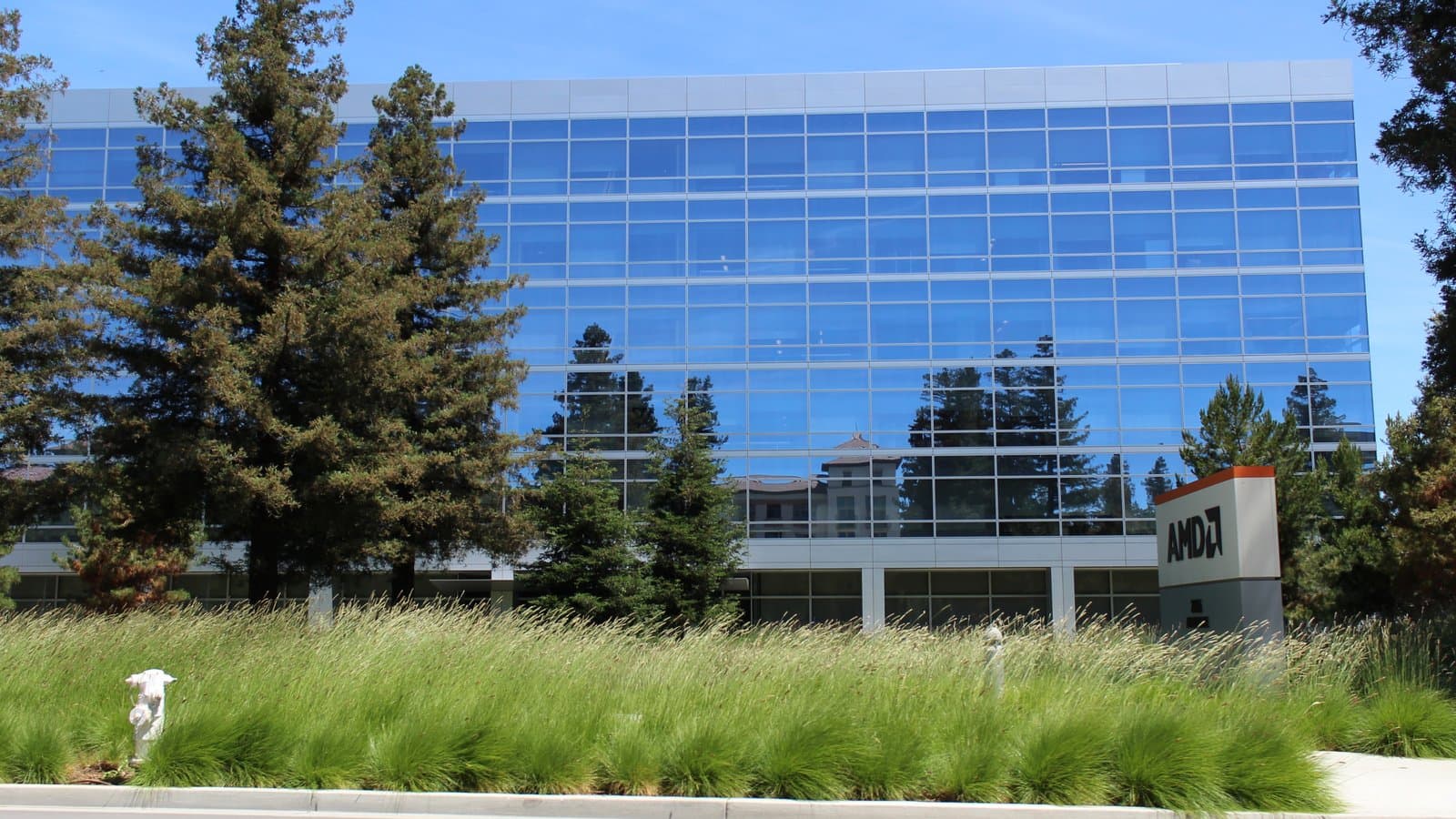
Cover: The AMD headquarters at 2485 Augustine Drive in Santa Clara, California. Photo by Coolcaesar via Wikimedia Commons, CC BY-SA 4.0.
Tags
Frequently asked questions
- How much is AMD paying for World Labs?
- AMD said it will pay approximately $8.2 billion for World Labs in an all-stock transaction, announced on September 28, 2026.
- What does World Labs build?
- World Labs builds world models, or spatial-intelligence models, that generate, reconstruct and simulate interactive 3D environments from text, image and video inputs, along with technology for robotic learning and simulation. Its first commercial product was the Marble world-generation model.
- When will the World Labs acquisition close?
- AMD expects the deal to close by the end of 2026, subject to regulatory approvals and other customary closing conditions. Until then, AMD says it plans to keep World Labs separate from its chipmaking business.
- Why does a chipmaker want a world-model company?
- AMD says insight into advanced models will help it shape future AI hardware and software. World models are also used to generate synthetic training data for robots, a field where rival Nvidia has a lead with its Cosmos models.

TPW Editorial
Editorial Team
TechPastWeek's editorial team reports and edits every story we publish. We research each piece against primary and credible secondary sources, and a human editor reviews and signs off before it goes live.