Nvidia's China AI-Chip Share Falls to 34 Percent as Huawei Closes the Gap
Nvidia's share of China's AI-accelerator market fell to 34 percent in the first half of 2026 as Huawei climbed to 28 percent, per IDC data reported by Reuters.

On this page
Key takeaways
- Nvidia's share of China's data-centre AI accelerator market fell to 34 percent in the first half of 2026, per IDC data seen by Reuters.
- Nvidia shipped 678,000 AI accelerators in China from January to June 2026, down 44 percent from a year earlier.
- Huawei shipped 572,000 AI accelerators in the same period, up from slightly more than 300,000, for 28 percent of the market.
- Total China AI-accelerator shipments reached 2.008 million units in H1 2026; IDC expects the category to grow 19 percent in 2026 while GPU shipments fall 9 percent.
- US export controls bar Nvidia's B200 and B300 from China, while Beijing requires approval to import even compliant Nvidia chips.
Nvidia sold 678,000 artificial-intelligence accelerators in China in the first half of 2026, a 44 percent drop from a year earlier, and its share of the country's data-centre AI chip market fell to 34 percent. Huawei shipped 572,000 accelerators over the same six months, up from slightly more than 300,000, and took 28 percent. The figures come from an IDC report seen by Reuters, which published them on October 13. The lead is now six points, and it is narrowing on units shipped. Nvidia still leads China's AI-chip market. It no longer leads it comfortably.
Related reading: China's AI Chipmakers Are Raising Prices as the HBM Shortage Bites · DeepSeek Open-Sources a Software Stack for Huawei's Ascend Chips, Aiming at CUDA.
The result is the first hard measure of how much the US export controls have reshaped the market they were designed around. The controls were meant to keep Nvidia's best data-centre parts out of China and, by extension, to slow Chinese AI development. Instead, the domestic supply chain absorbed the space: Huawei's volumes rose while Nvidia's fell. The outcome is neither the collapse some commentary predicted for Nvidia nor a clean win for the policy. Nvidia holds a plurality of the market, and Huawei's share is now close behind.
How the market got here
The numbers only make sense against the rules that have governed the trade for the past few years. US export controls restrict supplies of Nvidia's most powerful chips, and Reuters reports that the B200 and B300 (Nvidia's flagship data-centre parts) are barred from export to China but have been smuggled into the country anyway. Separately, Beijing requires Chinese companies to seek approval before importing even the compliant Nvidia chips that US rules permit. Two governments, with opposite goals, both make it harder to buy Nvidia in China.
The market has responded by building its own supply. That shift is what the first-half figures record: a foreign leader with a plurality, and a domestic challenger roughly doubling its volume year on year.
The arithmetic behind a six-point lead
The headline split conceals how differently the two companies arrived at it. Nvidia's 678,000 units were 44 percent below its own first-half 2025 shipments, which works back to roughly 1.21 million accelerators a year earlier. Huawei moved the other way, roughly doubling from just over 300,000. Put the two year-earlier figures beside each other and Nvidia shipped about four times as many accelerators in China as Huawei; in the first half of 2026 that ratio had fallen to about 1.2 to 1. Both ratios lean on Huawei's figure of “slightly more than 300,000,” so treat them as approximate.
Total China AI-accelerator shipments reached 2.008 million units in the half, which makes Nvidia's 34 percent and Huawei's 28 percent the two largest slices of a market that grew underneath Nvidia while its own volumes fell.
Nvidia shipped 678,000 AI accelerators in China in the first half of 2026, down 44 percent from a year earlier. Huawei shipped 572,000, up from slightly more than 300,000. — IDC data reported by Reuters, October 13, 2026
What the 34 percent leaves out
IDC did not say which Nvidia products made up its 34 percent share. The figure could mix China-specific parts, older inventory, and grey-market goods, so it is not a clean measure of the restricted top-end chips.
The domestic field behind Huawei
Huawei is not the only domestic supplier gaining room. Alibaba's T-Head held 7 percent of the market, Cambricon 5 percent, Baidu's Kunlunxin 4 percent, and Hygon 3 percent, per the Reuters-reported breakdown. Domestic vendors accounted for 95 percent of the non-GPU segment, the part of the accelerator market built on ASIC-like designs rather than graphics processors. That figure describes a segment where imports and foreign suppliers have nearly vanished.
The challengers below Huawei remain small next to it, and none is close to matching its scale. The pipeline behind them is real, though, and it is spread across China's largest internet and cloud firms rather than concentrated in a single state champion. That breadth is what makes the domestic supply harder to dislodge than one company's product line would be.
How the export controls cut both ways
The policy backdrop cuts at Nvidia from two directions at once. Washington removes the high-margin parts from the shelf; Beijing adds friction to the parts that remain legal. A Chinese buyer weighing a purchase therefore has to price in licensing and supply risk that does not attach to a Huawei part. That risk has a cost regardless of how the chips compare on a spec sheet, and over time it pushes procurement decisions toward domestic suppliers.
Huang's position on the controls has been consistent for a year. As earlier reporting noted in October 2025, the Nvidia founder and CEO repeatedly criticised the curbs, arguing that the policy forced a US company to cede China's $50 billion AI-chip market to Huawei. The latest IDC numbers sit close to that argument, though they do not prove it. Huawei gained volume in the categories the controls were meant to protect, and Nvidia lost it in the same period. Correlation is not causation, and a half-year of shipment data cannot settle a policy argument that both governments have already made up their minds about.
Announced is not the same as shipped
The B200 and B300 are barred from export, yet Reuters reports they have been smuggled into China regardless. A grey market of unknown size means the official shipment figures IDC counts may understate how much Nvidia silicon is actually in the country.
The competition is moving to systems
There is a second shift in the data that outlasts any single half-year. IDC said competition is moving away from the performance of a single chip and toward system-level capabilities, meaning how well accelerators work together inside a larger cluster. That framing moves the unit of competition from the die to the rack: interconnect, memory, networking, and the software that schedules work across many chips.
The shift suits Huawei. Its strengths sit in networking, systems integration, and relationships with Chinese cloud operators, all of which matter more when buyers optimise at cluster scale rather than chip by chip. For Nvidia, the open question is whether its software ecosystem and per-chip performance still command a premium once the purchase decision is made at the rack level, and once the only parts available to Chinese buyers are the ones Washington has not banned.
None of that means Nvidia's position is eroding quickly. Its 34 percent is far ahead of any single domestic rival, and its installed base across Chinese data centres remains large. The difficulty is directional: its volumes are falling while the market grows.
A market that grows even as GPU shipments fall
Another detail complicates the simpler story that China is simply buying fewer GPUs because the good ones are banned. IDC expects total China AI-accelerator shipments to grow 19 percent in 2026 even as GPU shipments fall 9 percent, according to the reported figures. The overall category is expanding; the GPU slice of it is contracting, and that contraction lands mostly on Nvidia.
Set the two forecasts beside the share split and they describe the same movement. A growing market losing its GPU component means non-GPU accelerators, many of them Huawei's and the smaller domestic suppliers', take a larger share of a larger total. Nvidia's China exposure is concentrated in the segment IDC expects to decline.
Caveats
Most of the central numbers rest on a single IDC report seen by Reuters rather than on audited shipment data, and several carry real uncertainty.
- Huawei's year-earlier total is given only as “slightly more than 300,000,” so its growth rate is approximate.
- IDC did not specify which Nvidia products made up the 34 percent, so the figure cannot be read as the restricted high-end parts alone.
- The 34 percent and 28 percent are IDC estimates of market share, and market-research shares are routinely revised as fuller data arrives.
- The grey-market reports come from Reuters and describe a trade that is hard to size from outside.
- The $50 billion market figure is Huang's own characterisation from earlier reporting, not an IDC number.
The direction of travel is clear enough to report, even where the precision is loose.
What to watch
- Whether Nvidia's China shipments stabilise in the second half of 2026 or extend the 44 percent slide recorded in the first.
- Whether Huawei's growth holds as it scales manufacturing, or runs into capacity limits.
- How Beijing's import-approval regime treats compliant Nvidia parts over the next two quarters.
- Whether T-Head, Cambricon, Kunlunxin, and Hygon keep gaining share or get squeezed by Huawei.
- Whether cluster-level competition pushes more of the purchase decision toward systems rather than single chips, which would favour Huawei's integration story.
The market now has a leader, a fast-closing challenger, and a widening field of domestic suppliers behind them. Nvidia still sells more AI accelerators in China than any other vendor, but the six-point edge over Huawei is the smallest the IDC data has recorded, and the first-half shipments moved it further in Huawei's direction.
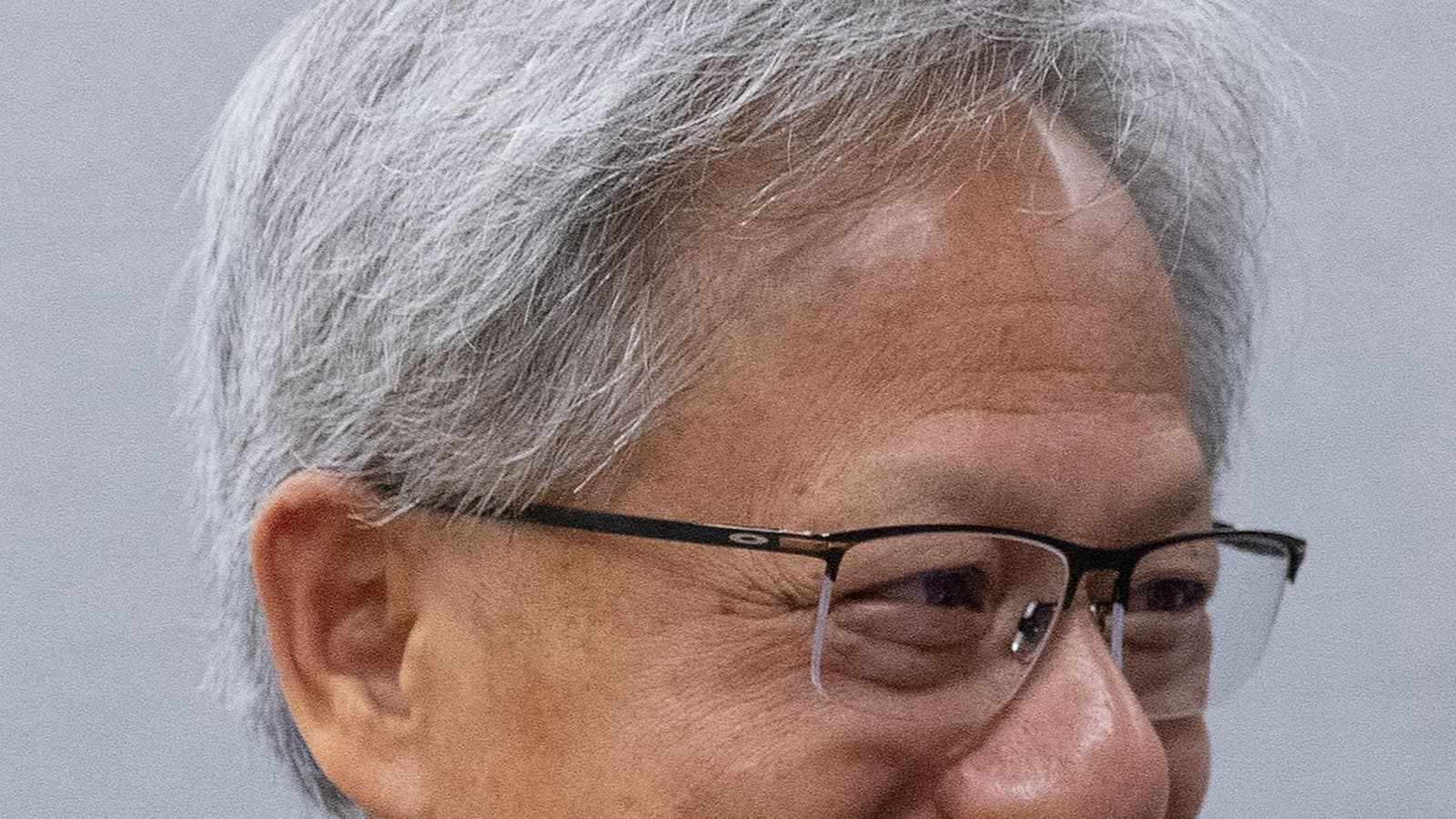
Cover image: Jensen Huang, Nvidia's founder and CEO, in 2024. Photo by Peter Dasilva, © European Union, CC BY 4.0, via Wikimedia Commons.
Tags
Frequently asked questions
- What is Nvidia's market share in China's AI chip market?
- Nvidia held 34 percent of China's data-centre AI accelerator market in the first half of 2026, according to an IDC report seen by Reuters. That was still the largest single share, ahead of Huawei's 28 percent.
- How many AI chips did Nvidia ship in China in 2026?
- Nvidia shipped 678,000 AI accelerators in China from January through June 2026, a 44 percent drop from the same period a year earlier.
- Is Huawei beating Nvidia in China?
- Not yet. Huawei held 28 percent of China's AI-accelerator market in the first half of 2026 to Nvidia's 34 percent, but Huawei's shipments nearly doubled while Nvidia's fell 44 percent, so the gap is closing.
- Why is Nvidia losing share in China?
- US export controls bar Nvidia's most powerful chips from China, and Beijing requires companies to seek approval to import even the compliant ones. Chinese buyers have shifted toward domestic suppliers such as Huawei, whose shipments have grown sharply.

TPW Editorial
Editorial Team
TechPastWeek's editorial team reports and edits every story we publish. We research each piece against primary and credible secondary sources, and a human editor reviews and signs off before it goes live.