A Decade-Old NGINX Flaw Can Turn HTTP/2 Traffic Into Code Execution
CVE-2026-123007 has sat in NGINX since 2015 and can let an unauthenticated attacker run code. Patched builds are out, but Debian and Ubuntu packages are not.

On this page
Key takeaways
- CVE-2026-123007, called nginx2root, is a memory-corruption flaw in NGINX's HTTP/2 flow control that can lead to remote code execution.
- The bug has been in the open-source code since version 1.9.5, released in September 2015, and affects every release through 1.31.8.
- F5 fixed it in NGINX 1.31.9 and 1.30.7, released on 18 November; the same updates fix four other flaws, all rated 9.2 under CVSS 4.0.
- No attacks exploiting the flaw have been reported, and it was not in CISA's Known Exploited Vulnerabilities catalog as of 18 November.
- Public proof-of-concept code exists, but researchers describe conditions that make a real attack expensive, including ASLR and a separate Linux kernel bug for root access.
NGINX released fixes on 18 November for a memory-corruption flaw in its HTTP/2 handling that can let an unauthenticated attacker run code on a server. The bug, tracked as CVE-2026-123007 and nicknamed nginx2root, has been in the open-source code since version 1.9.5 shipped in September 2015.
Related reading: AI Agents Found a Zero-Day in MONAI Label and Rooted a University Server · China-Linked Hackers Exploited a vCenter Zero-Day Weeks Before the Patch.
F5, which owns NGINX, published the advisory alongside updates to NGINX 1.31.9 and 1.30.7. The same releases fix four other flaws that can also lead to code execution under the same conditions. F5 rates all five 9.2 out of 10 under CVSS 4.0.
No attacks using the flaw had been reported as of 18 November, and it was not in CISA's Known Exploited Vulnerabilities catalog. That makes this a patch-now story rather than an incident response, with one complication: the major Linux distributions had not shipped fixed packages when the advisory went out.
What the bug actually does
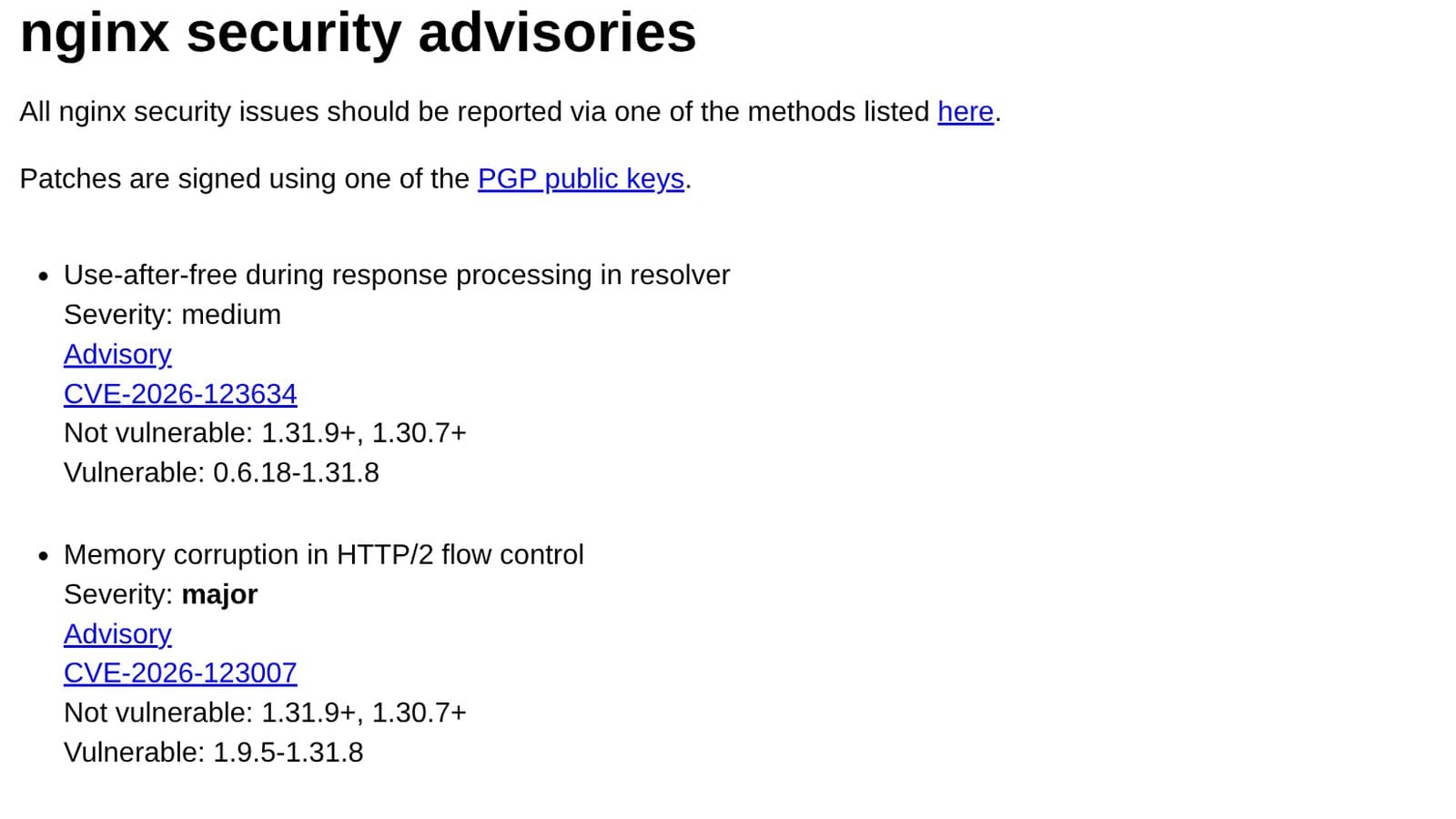
The flaw sits in NGINX's HTTP/2 flow-control code. According to the NGINX advisory, it is a memory-corruption issue that affects releases from 1.9.5 through 1.31.8. Rapid7's technical write-up describes it as an integer underflow that corrupts memory during HTTP/2 processing.
Exploiting it is not a single request. F5 says an attacker can run code where address space layout randomisation (ASLR) is turned off or can be bypassed. Wiz's researchers said they bypassed ASLR and ran code through the flaw in their tests. Xint said it did the same with nothing more than a reachable HTTP/2 port.
The code runs with the permissions of an NGINX worker process, not as root. Xint's researchers chained the flaw with a separate bug in the Linux kernel's SCTP implementation to get root on the host, including when NGINX was running inside a Docker container. That second step is not part of CVE-2026-123007, and it depends on SCTP being available.
Rapid7's version of the attack needs about 128GB of HTTP/2 traffic, according to its technical analysis. The demonstration took two and a half minutes on a fast link. On a connection slower than roughly 300 Mbit/s, the transfer would run past NGINX's default one-hour connection limit and the attack would fail. The method also depends on a glibc memory-copy routine selected on x86-64 chips with the avx512f and avx512vl features.
Those conditions do not make the bug harmless. They narrow the set of servers that can be attacked remotely and raise the cost of a reliable exploit. A public proof-of-concept is already on GitHub, though its notes say it is suitable only for demonstrating the attack against a freshly started Docker container on the same machine.
Upgrading the NGINX binary is not enough on its own. A reload leaves the old executable running and existing connections can stay on old worker processes. Use a full restart or NGINX's live binary upgrade, then confirm the new process is serving traffic.
Who is exposed
Every open-source NGINX release from 1.9.5 to 1.31.8 is vulnerable, including the October security releases 1.31.7 and 1.30.6. NGINX Plus is affected in the 37.x line before the fixed builds and in R34 through R36, for which F5 lists no fix. The fixed open-source versions are 1.31.9 for the mainline branch and 1.30.7 for the stable and older branches.
The official Docker images had 1.31.9 and 1.30.7 tags, including Alpine variants, on 18 November. Ubuntu's CVE tracker listed nginx as vulnerable on releases from 16.04 through 26.10, and Debian's tracker listed bookworm, trixie, forky and sid as vulnerable. A distribution can backport a fix without changing the version that nginx -v reports, so the package version and the distribution's own advisory are the numbers that matter.
Exposure depends on HTTP/2. A server is affected if a listen directive includes http2 or if http2 on is set in the relevant server block. Running openssl s_client with -alpn h2 against a server shows whether it negotiates HTTP/2: the output reads ALPN protocol: h2 if it does. Behind a CDN, the origin is the thing to test, because an origin that accepts only HTTP/1.1 cannot be reached through HTTP/2.
The other four flaws
CVE-2026-123007 is the headline, but the same update fixes four more issues that F5 also rates 9.2. Each needs a specific configuration:
- CVE-2026-123633 needs HTTP/2 and requests passed to a backend server while the worker is running low on
worker_connections. - CVE-2026-123634 needs a proxied server name built from variables plus a server-side include or
mirrorsubrequest to a location that looks up the same name. - CVE-2026-121810 needs HTTP/3 to be enabled.
- CVE-2026-113425 affects NGINX used as a mail proxy.
The resolver flaw is the one with the clearest workaround: avoid SSI and mirror directives and do not build proxied server names from variables. For the mail proxy flaw, F5 says to limit listeners to trusted networks. The other two are best handled by upgrading.
How to patch, and what to turn off
The direct fix is to move to 1.31.9 or 1.30.7, or to the current NGINX Plus builds listed in F5's advisory (37.3.0.1 and 37.0.8.1). One of the five fixes, CVE-2026-123633, landed in earlier Plus builds, 37.2.0.1 and 37.0.7.1, so operators on the 37.x line should check which build they are on. After upgrading, restart the master process fully or use the live binary upgrade. Then rerun the openssl check to confirm the server still negotiates the protocols you expect.
If an immediate upgrade is not possible, CIRCL's response guidance lists turning off HTTP/2 as a temporary mitigation. That blocks CVE-2026-123007 and CVE-2026-123633, but not the other three. On NGINX 1.25.1 and later, set http2 off; in each affected server block and remove http2 from its listen directives. On 1.9.5 through 1.25.0, remove http2 from the listen directive, so listen 443 ssl http2; becomes listen 443 ssl;.
Turning off HTTP/3 removes the setup CVE-2026-121810 needs. For the SCTP chain, CIRCL suggests blocking the kernel module on hosts that do not use SCTP, for example with install sctp /bin/false in a file under /etc/modprobe.d/. That does not unload a module that is already loaded or disable SCTP built into the kernel.
What a compromise would look like
CIRCL lists several signs worth checking: NGINX workers that start unexpected programs, workers that exit abnormally or leave core dumps, long-lived HTTP/2 connections with heavy incoming traffic but few logged requests, and unusual outbound connections or DNS lookups.
A clean access log does not rule out an attack. HTTP/2 control frames do not normally appear in the access log as requests, so the absence of a suspicious URL is not evidence that nothing happened. None of the signs on their own is proof.
Why a ten-year-old bug still matters
The flaw survived ten years of releases, through multiple security updates, which is a reminder that long-lived code paths can carry old bugs. NGINX sits in front of a large share of the web, and a memory-safety bug in its HTTP/2 parser can persist because the code path is complex and the failure mode is quiet. The same is true of the other four flaws patched this week: researchers found them, not an exploited incident.
The absence of attacks so far is a reason to patch on a normal schedule, not a reason to wait. Public proof-of-concept code tends to shorten the gap between disclosure and exploitation, and the conditions Rapid7 describes are engineering obstacles, not guarantees. A determined attacker with a fast link and a target that has ASLR disabled or a usable SCTP stack has a path.
Caveats
NGINX, F5, Wiz and Rapid7 had not reported exploitation as of 18 November, and CISA had not added the CVE to KEV. The ASLR bypass, the SCTP privilege escalation and the 128GB traffic requirement come from different research teams and different test setups; they describe what is possible, not a single turnkey exploit. The distribution status is a snapshot from 18 November and may have changed since. The Docker image tags fix the open-source build, but an image built on an unfixed distribution package may not.
What to watch
The first signal is whether CISA adds CVE-2026-123007 to KEV, which would turn a patch-now advisory into a deadline for federal agencies. The second is whether Debian and Ubuntu ship backported packages, and how quickly. The third is exploit maturity: a reliable, high-throughput attack would change the risk for every unpatched origin server behind a CDN.
For operators, the practical task is small and boring. Find every NGINX instance that negotiates HTTP/2, check whether it is on a fixed build or a fixed distribution package, restart it properly, and look for the signs CIRCL describes. The bug waited a decade. The patch does not have to.
Cover: a screenshot of NGINX's security advisories page, courtesy of NGINX and F5.
Tags
Frequently asked questions
- What is CVE-2026-123007?
- It is a memory-corruption vulnerability in NGINX's HTTP/2 flow control, nicknamed nginx2root. An unauthenticated attacker who can reach an HTTP/2 port may be able to run code with the permissions of an NGINX worker process. F5 rates it 9.2 under CVSS 4.0.
- Which NGINX versions are affected?
- Every open-source release from 1.9.5 through 1.31.8 is vulnerable, according to NGINX's advisory. NGINX Plus releases in the 37.x line before the fixed builds are also affected, and R34 through R36 have no listed fix.
- Is there a patch for CVE-2026-123007?
- Yes. NGINX 1.31.9 and 1.30.7 fix CVE-2026-123007 and four other flaws. Official Docker images with those tags were available on 18 November. Debian and Ubuntu had not shipped fixed packages at that point, so check the distribution's advisory rather than the nginx version string.
- Has CVE-2026-123007 been exploited in the wild?
- NGINX, F5, Wiz and Rapid7 had not reported any attacks as of 18 November, and CISA had not added it to the KEV catalog. Public proof-of-concept code exists, but it is limited and the attack has demanding conditions.

TPW Editorial
Editorial Team
TechPastWeek's editorial team reports and edits every story we publish. We research each piece against primary and credible secondary sources, and a human editor reviews and signs off before it goes live.