Ubisoft Cuts 166 Jobs and Turns Its Generative AI Team Into a Subsidiary
Ubisoft is cutting 166 roles in Montreal and Quebec City and spinning Motherbrain, the team behind its Teammates AI demo, into a dedicated subsidiary.

On this page
Key takeaways
- Ubisoft is cutting 166 positions across its Montreal and Quebec City studios, just under 4% of its Canadian workforce, the company confirmed on 19 November 2026.
- First-half net bookings fell 16.5% to EUR 644.7 million, and the IFRS net loss attributable to shareholders widened to EUR 254.5 million from EUR 161.3 million.
- Ubisoft established Motherbrain, the team behind its Teammates generative AI demo, as a dedicated subsidiary focused on AI for gameplay.
- Headcount fell by close to 1,100 in the six months to 30 September, and Ubisoft guided third-quarter net bookings to about EUR 250 million.
- GDC's November 2026 survey found 55% of game industry respondents see generative AI as negative for the industry, while 40% use it at work.
Ubisoft confirmed on 19 November that it is cutting 166 jobs across its Montreal and Quebec City studios, just under 4% of its Canadian workforce, and used the same half-year results to establish its generative AI team as a separate subsidiary. The announcements shared a news cycle with the launch of Grand Theft Auto VI, which went on sale the same day.
Related reading: Will Wright's MyMems Turns Your Memories Into a Playable AI World · Unity in Talks to Sell Itself to Silver Lake and PIF at About $25 Billion.
The cuts are modest next to the rest of the year. Ubisoft has closed studios, cancelled at least six games and postponed seven more. Its headcount fell by close to 1,100 in the six months to 30 September. The 166 figure is small in that context, but it points the same way as the rest of the release: production roles are still going, while the company builds a standalone business around AI tools for making games.
A Ubisoft spokesperson told Video Games Chronicle that the cuts are tied to a changing portfolio. "As our portfolio evolves, our production needs are changing, requiring us to adjust the size of some teams to ensure our resources are aligned with current production priorities and business needs," the spokesperson said. Affected staff are receiving severance, extended health benefits and career transition services.
A half-year that beat guidance and still lost money
The half-year beat guidance in the second quarter and still produced a large loss. Net bookings for the half year were EUR 644.7 million, down 16.5% from EUR 772.4 million a year earlier. Second-quarter bookings came in at EUR 389 million against guidance of about EUR 370 million, and Ubisoft said bookings excluding partnerships rose more than 50% year on year.
The beat came from Assassin's Creed Black Flag Resynced, which Ubisoft says outperformed expectations in its launch quarter, helped by a higher share of premium editions. Rainbow Six Siege also held up: Ubisoft says the game ranked in the top 10 across Xbox and PlayStation combined by monthly active users in the first half, after a refocus on its tactical core and a faster content cadence.
The losses are still large. IFRS operating income was negative EUR 189.2 million, and the non-IFRS operating loss was EUR 155.9 million, against operating income of EUR 27.1 million a year earlier. The IFRS net loss attributable to shareholders widened to EUR 254.5 million from EUR 161.3 million, according to the half-year release. Digital net bookings fell 20.1%, and back-catalogue bookings fell 40.8%, a comparison Ubisoft attributes to partnership revenue and Assassin's Creed Shadows in the prior year.
The cost programme is the bridge between those numbers. Ubisoft's fixed cost base was EUR 660 million in the half, down 6% year on year, against a target of EUR 1.25 billion on a run-rate basis by March 2028. Cash stood at EUR 1.03 billion at the end of September, and the company paid EUR 453 million from cash in mid-November to settle a put option on its 2028 convertible bonds. Net debt on a non-IFRS basis fell to EUR 541.4 million from EUR 1,148.8 million.
For the third quarter, Ubisoft guided net bookings to about EUR 250 million, citing a crowded holiday season. It kept its full-year targets: net bookings down by a high single-digit percentage, a high single-digit negative non-IFRS operating margin, and free cash flow consumption of no more than EUR 500 million.
What Motherbrain is meant to sell
Motherbrain is not a new team. It is the group behind Teammates, the voice-driven generative AI demo Ubisoft showed in late 2025, which the company calls its first playable generative AI experience. In the earnings release, Ubisoft says Motherbrain will develop "proprietary technologies for gameplay" and serve creators both inside its Creative Houses and beyond, with partnerships with selected technology companies.
The stated focus is specific. Ubisoft lists new player experiences, smart non-player characters with memory, and AI game masters that manage large systemic worlds. That is a long way from using a model to draft dialogue or generate textures. It describes systems that would run inside a shipped game and respond to what a player does, which is harder to validate and harder to sell as a tool.
"We have also established Motherbrain, the team behind our first playable generative AI experience Teammates, as a dedicated subsidiary developing proprietary technologies for gameplay to empower creators and open up new possibilities for richer, more immersive and engaging player experiences," chief executive Yves Guillemot said in the release.
The corporate structure matters as much as the technology. A subsidiary can sign partnerships, license technology and carry its own profit-and-loss account in a way that an internal research group cannot. It also separates the AI unit from the Creative Houses, which are now accountable for their own results. Video Games Chronicle notes that the Motherbrain name surfaced in September when Ubisoft trademarked it, and that it is not clear whether anything Motherbrain makes will ship as its own product.
Ubisoft did not disclose how many people work at Motherbrain, or whether any of the 166 cuts came from that team.
The cuts and the AI bet are separate decisions, for now
Ubisoft's statement does not connect the layoffs to Motherbrain. VGC understands the cuts are mostly tied to projects that were cancelled or rescoped, which fits the pattern of the past year: fewer projects in production, fewer production roles to staff them. The AI subsidiary is described as a bet on future tools, not a replacement for the people leaving.
The release does not connect the two, but it puts them in the same document. On the same morning, Ubisoft told investors that it had cut 166 jobs and that it had formalised a company whose pitch is doing more with fewer creative and technical staff. There is no evidence that Motherbrain is being built with the roles that were cut. The order of priorities is still visible: protect the franchises that are working, shrink the cost base, and fund a small AI unit that might change how the next games are made.
That is a reasonable bet for a company in Ubisoft's position.
The new operating model is now fully in place. Ubisoft has split its studios into Creative Houses with their own profit-and-loss responsibility. Creative House 2, which covers The Division, Ghost Recon and Splinter Cell, is now named Massive Entertainment. Houses 3 and 5 have been merged under Julien Bares, and an external general manager joins House 4 in January. A separate unit will handle brands outside the Creative Houses.
An industry that is cutting while it grows
The context outside Ubisoft is mixed. Grand Theft Auto VI launched on 19 November to record review scores and streaming numbers, and Take-Two has described pre-orders as unprecedented. The same week, Take-Two's Firaxis studio cut about 60 people, roughly a third of its staff, and its studio head left. Kotaku, citing Bloomberg, reported that an unannounced XCOM game had missed internal milestones.
The labour anxiety reaches the companies having the best year. Rockstar North animation programmer Nestor Uriarte wrote in The Guardian that he and his colleagues worry about layoffs even as they ship the biggest game of the decade. More than 1,600 Rockstar UK workers are voting this month on union recognition, and a UK tribunal is weighing whether the company's dismissal of more than 30 employees last year, most of them union members or organisers, was union busting. Rockstar says the workers were let go for leaking confidential information.
The survey data points the same way. GDC's November 2026 State of the Game Industry report found that 55% of respondents think generative AI is having a negative effect on the industry, unchanged from 54% a year earlier, while 40% said they use it at work. The same survey found that 28% of respondents had been laid off in the past two years, rising to 33% in the United States.
Those two findings sit next to each other without proving a causal link. Developers can use a tool and dislike what it is doing to hiring, budgets and creative control. But the combination is the story of the year in games: the technology is spreading through production while the workforce that makes the games is contracting.
Ubisoft's version of that story is now explicit. It is keeping the franchises that performed, cutting the roles tied to projects that did not, and giving its AI team a separate corporate identity and a mandate to sell its work outside the company.
Caveats
Ubisoft did not break down the 166 cuts by studio or team, and it did not say which cancelled or rescoped projects they were tied to. The "just under 4%" share of the Canadian workforce comes from the company's spokesperson through VGC, not from the earnings release. The IFRS net loss figure comes from the release's income statement as summarised by MLQ.ai; the GlobeNewswire extract reviewed for this article was truncated before that line.
Motherbrain's headcount, budget and internal reporting line were not disclosed. There is no evidence that the subsidiary is hiring displaced Ubisoft staff, or that its tools will replace specific roles. The GDC survey is self-selected and covers 2,600 respondents, so it describes sentiment among those who answered, not the whole industry.
Ubisoft reports third-quarter results early next year. By then the holiday slate will have tested the EUR 250 million guidance, and Motherbrain will have had a quarter as a standalone company.
This article uses EUR for Ubisoft's reported figures because the company reports in euros. Dollar comparisons are not given, since the release does not provide them.
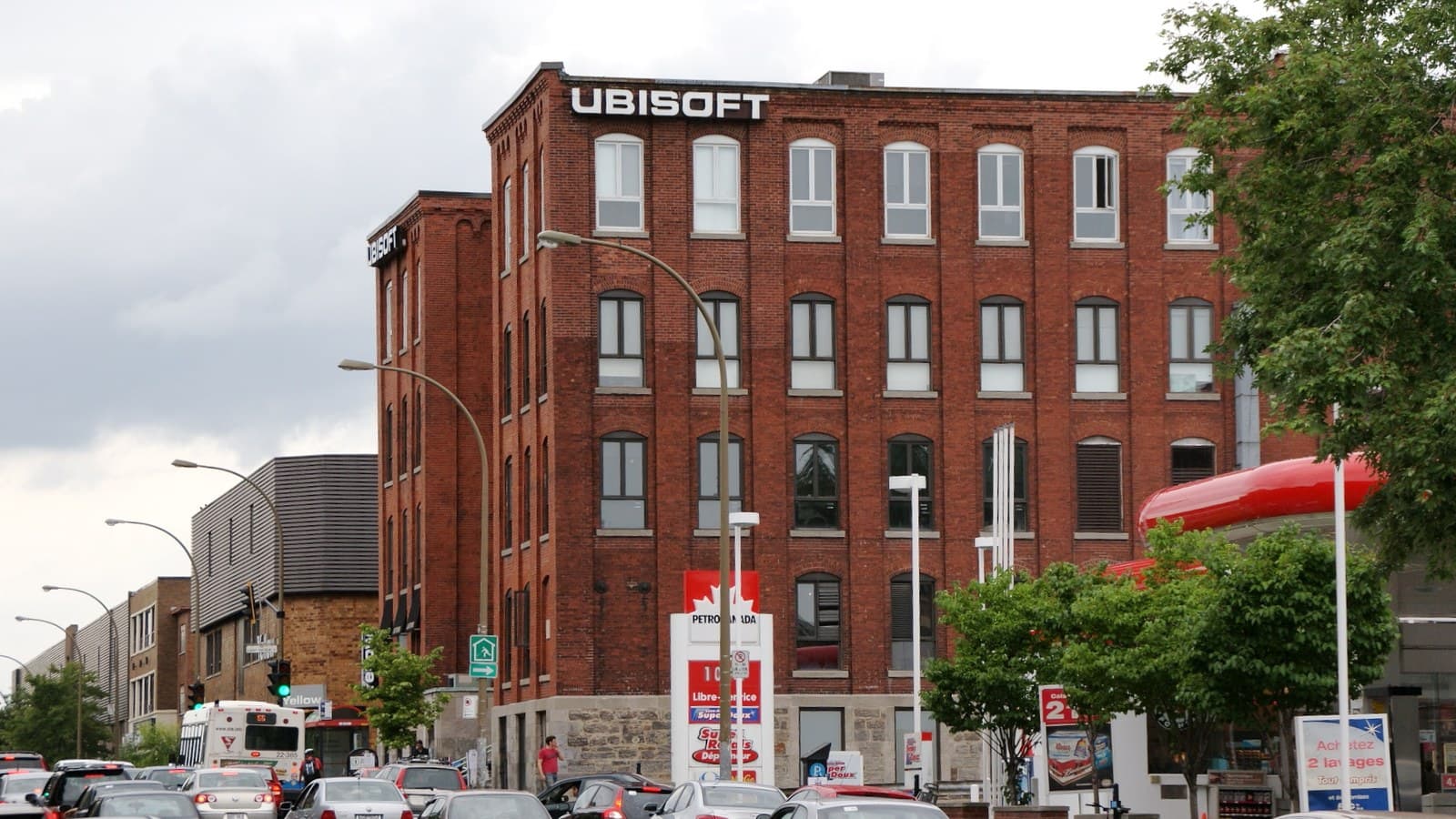
Cover: the Ubisoft building in Montreal. Photo by Shuichi Aizawa, CC BY 2.0, via Wikimedia Commons. Cropped to 16:9.
Tags
Frequently asked questions
- How many jobs is Ubisoft cutting?
- Ubisoft is cutting 166 positions across its Montreal and Quebec City operations. A company spokesperson said that amounts to just under 4% of Ubisoft's Canadian workforce.
- What is Ubisoft's Motherbrain?
- Motherbrain is the team behind Teammates, Ubisoft's first playable generative AI experience. On 19 November 2026 Ubisoft established it as a dedicated subsidiary working on AI for gameplay, including smart NPCs with memory and AI game masters.
- Did Ubisoft say AI caused the layoffs?
- No. Ubisoft said the cuts reflect cancelled or rescoped projects and the need to align resources with production priorities. The company did not connect the 166 cuts to Motherbrain.
- How did Ubisoft's half-year results look?
- Net bookings fell 16.5% year on year to EUR 644.7 million, but second-quarter bookings of EUR 389 million beat guidance of about EUR 370 million. The IFRS net loss attributable to shareholders widened to EUR 254.5 million.

TPW Editorial
Editorial Team
TechPastWeek's editorial team reports and edits every story we publish. We research each piece against primary and credible secondary sources, and a human editor reviews and signs off before it goes live.