FCC Tells California to Stop Blocking AT&T's Copper Retirement
The FCC ordered California to stop enforcing state approval rules that blocked AT&T from retiring copper lines used by 184,000 homes and 15,000 businesses.

On this page
Key takeaways
- The FCC released an order on 20 November 2026 that preempts California approval requirements blocking AT&T from discontinuing legacy phone service it authorized in June.
- AT&T wants to stop offering basic phone service to new California customers and disconnect 184,000 residential and 15,000 business lines on or after 1 June 2027.
- The order does not repeal California's carrier-of-last-resort law. The state can still enforce other basic-service rules, including requirements met by wireless service.
- AT&T's replacement product costs $45 a month, or $25 for Lifeline customers, compared with $50 for the basic copper service, according to the FCC.
- Commissioner Anna Gomez dissented, saying the FCC should have waited for California's open rulemaking, which now has a deadline of 19 February 2027.
The Federal Communications Commission told California on Friday to stop enforcing the approval requirements in its carrier-of-last-resort rules against AT&T, clearing a state barrier to a copper retirement the commission authorized in June.
Related reading: California Subpoenas Nvidia Over Whether Its Chips Reached China · Commerce Closes the Remote-Compute Loophole for Advanced AI Chips.
The order, FCC 26-78, was adopted on 13 November and released on 20 November. It grants in part AT&T's petition to preempt California rules that require the company to obtain state approval before disconnecting legacy phone service. AT&T has said it does not plan to disconnect anyone before 1 June 2027.
The decision lands in a long fight over who decides when a copper network has reached the end of its life. AT&T says the answer is the federal government. California says it has a duty to ensure that the replacement service is adequate and affordable for the people who depend on it.
What the order does
The ruling is narrower than the reaction suggests. It preempts a list of California statutes, Public Utilities Commission general orders and decisions, but only to the extent that they require state approval before AT&T can carry out the discontinuance the FCC has already allowed. The commission did not strike down California's carrier-of-last-resort regime in general.
The order says the CPUC may still impose its other basic-service requirements, which the state itself acknowledges can be met by other technologies, including wireless. The state can also still penalize a carrier that fails to meet those requirements.
What the order removes is the state's ability to sit in the approval chain for this specific retirement. The FCC approved AT&T's two discontinuance applications on streamlined treatment on 29 June 2026. AT&T had asked the commission in May to declare that California's approval process could not block the result.
The company's target is large. AT&T wants to stop offering basic phone service to new customers in the affected areas and disconnect 184,000 residential and 15,000 business customers on or after 1 June 2027, according to Ars Technica. The company has received relief from carrier-of-last-resort obligations in 20 of the 21 states in its wireline territory. California is the holdout.
The replacement AT&T is offering
The practical question is what happens to the people on those lines. AT&T's replacement is a wireless home phone product it calls AP-A, which connects to its LTE network rather than a copper pair. The FCC's order compares the prices: AP-A costs $45 a month, against $50 for AT&T's basic copper service, and the installation fee is waived against a $49 charge for the copper line. AT&T is also offering three free months to customers affected by the change. For existing Lifeline customers, the company has set a $25 monthly rate.
The commission says the LTE connection is included in the $45 price, so customers do not need a separate broadband subscription. It says AT&T's network covers all of the affected customers with enough signal for the service, and that the equipment includes a larger antenna than a typical phone, with professional installation of an external antenna where needed.
Coverage was the central dispute. The CPUC argued that the discontinuances would hit rural and low-income areas hardest, that the replacement could cost more, and that hundreds of comments from residents showed real concern. The commission rejected that case. It said the CPUC's own comparison table showed AP-A costing less than the copper service, and that more than 99% of affected customers are also covered by Verizon or T-Mobile networks that support Lifeline service from other providers. The order concludes that the CPUC identified "no actual evidence of any harm to vulnerable populations" from the discontinuances.
The order does not disconnect anyone. AT&T has said it does not plan to effectuate the change before 1 June 2027, and the FCC's coverage finding rests on AT&T's submissions and the National Broadband Map. California disputes that record, and no court has reviewed the preemption on the merits.
Carr says the rules belong to another era
FCC Chairman Brendan Carr framed the order as a matter of national network policy. The commission's March 2026 Network Modernization Order made it easier for carriers to retire copper and asserted that state rules conflicting with federal discontinuance authority can be preempted. AT&T cited that order when it sued California in May.
"California's Carrier of Last Resort framework may have made sense when it was established 30 years ago," Carr said in a statement. "But those rules were designed for a bygone era and no longer make sense in today's competitive, advanced marketplace."
The commission's own figures support part of that argument. As of December 2024, interconnected VoIP accounted for more than 80% of retail fixed voice connections in the United States, and 78% of adults used only wireless service for personal calls, according to the order. Carr also said the item preserves 911 access and the notice-and-comment safeguards that apply to discontinuances.
Gomez calls the state an obstacle
Commissioner Anna Gomez, the FCC's lone Democrat, dissented. She said the commission should have let California finish the rulemaking it has open on modernizing carrier-of-last-resort obligations. The CPUC has extended the statutory deadline for that proceeding to 19 February 2027, which leaves time before AT&T's June deadline.
Gomez said she had heard from Californians who rely on landlines during natural disasters. She also noted AT&T's public pledge that no customer will be left without access to phone or 911 service, and said she intends to hold the company to it.
"Rather than wait, this item tells the CPUC to write its new consumer protections around a federal ruling it opposed," Gomez said. "Instead, this item treats the CPUC as an obstacle to be cleared."
Her argument is institutional as much as technical. State commissions, she said, "are often the last line of defense for consumers" because they know their communities and answer to the people who rely on the service. The FCC's counterargument is that a single national framework is necessary for a transition that crosses state lines and involves a technology the commission has already approved.
Why California is the holdout
California's rules date to the 1996 telecom overhaul. A carrier of last resort must offer basic service to anyone in its territory, and it must clear a state process before withdrawing that service. The state's requirements include flat-rate unlimited voice calling, discounted Lifeline rates and telephone relay service for people who are deaf or hard of hearing. AT&T has argued that those obligations were written for a copper monopoly and now block a transition the federal government has authorized. California has argued that the rules are technology-neutral and that AT&T has not shown its wireless replacement meets them.
The state has fought this kind of preemption before. The first Trump administration lost a 2019 attempt to preempt state net neutrality laws nationwide, and California later defeated internet providers in court over its own net neutrality statute. This month, California also rejected federal demands to scrap state broadband laws, a dispute tied to $1.42 billion for 270,571 locations.
A federal judge rejected AT&T's attempt to override the California rules in July. The company had already asked the FCC for preemption in May, and the commission's order is the result. California could now sue the commission, which would move the question to a federal appeals court.
What it means for phone customers
Carrier-of-last-resort rules are a backstop. They exist because phone service is treated as a utility, and because the market does not always produce a second provider in sparsely populated or low-income areas. The rules also carry social obligations that a standard wireless plan may not: flat rates, relay access and discounted service for poor households.
The FCC says those protections survive in other forms. California can still require basic service, and the order says wireless can satisfy it. AT&T says its wireless home phone includes unlimited domestic calling to Canada, Mexico, Puerto Rico and the US Virgin Islands, caller ID, call waiting, voicemail and robocall blocking. The company has also pledged that no customer will lose phone or 911 access.
The disagreement is about proof. The FCC accepted AT&T's coverage evidence and its pricing comparison. The CPUC and rural groups wanted the state process to test both. The order acknowledges comments about line power, the ability of a home phone to keep working when the electricity fails, but it says the commission rather than California is the body that weighs those concerns, and it does not publish a separate reliability finding.
Caveats
The 184,000 residential and 15,000 business figures come from Ars Technica's reporting, not from the order, which does not put a customer count on the discontinuance. The order was adopted on 13 November and released on 20 November, and the commissioners' statements are dated 17 November, so the political reaction arrived after the decision was made.
The coverage finding rests on AT&T's submissions and the National Broadband Map, which the CPUC and rural groups dispute. The $45 rate and three free months described in the order are current terms, not a guarantee of future pricing. No court has reviewed the preemption on the merits, and California has not said whether it will sue.
What to watch
Three things will decide how far this goes. The first is whether California sues. A court challenge would test the FCC's authority to preempt state approval requirements, beyond the specific AT&T applications. The second is the CPUC's rulemaking, now due by 19 February 2027. If the state writes new rules that fit the federal order, the practical effect may be smaller than the political fight suggests. The third is AT&T's June 2027 target. The company still needs to move customers, and every missed installation or coverage complaint will become evidence in the next round.
For now, the order changes who has the final say over this retirement. The adequacy of the replacement service has not been tested.
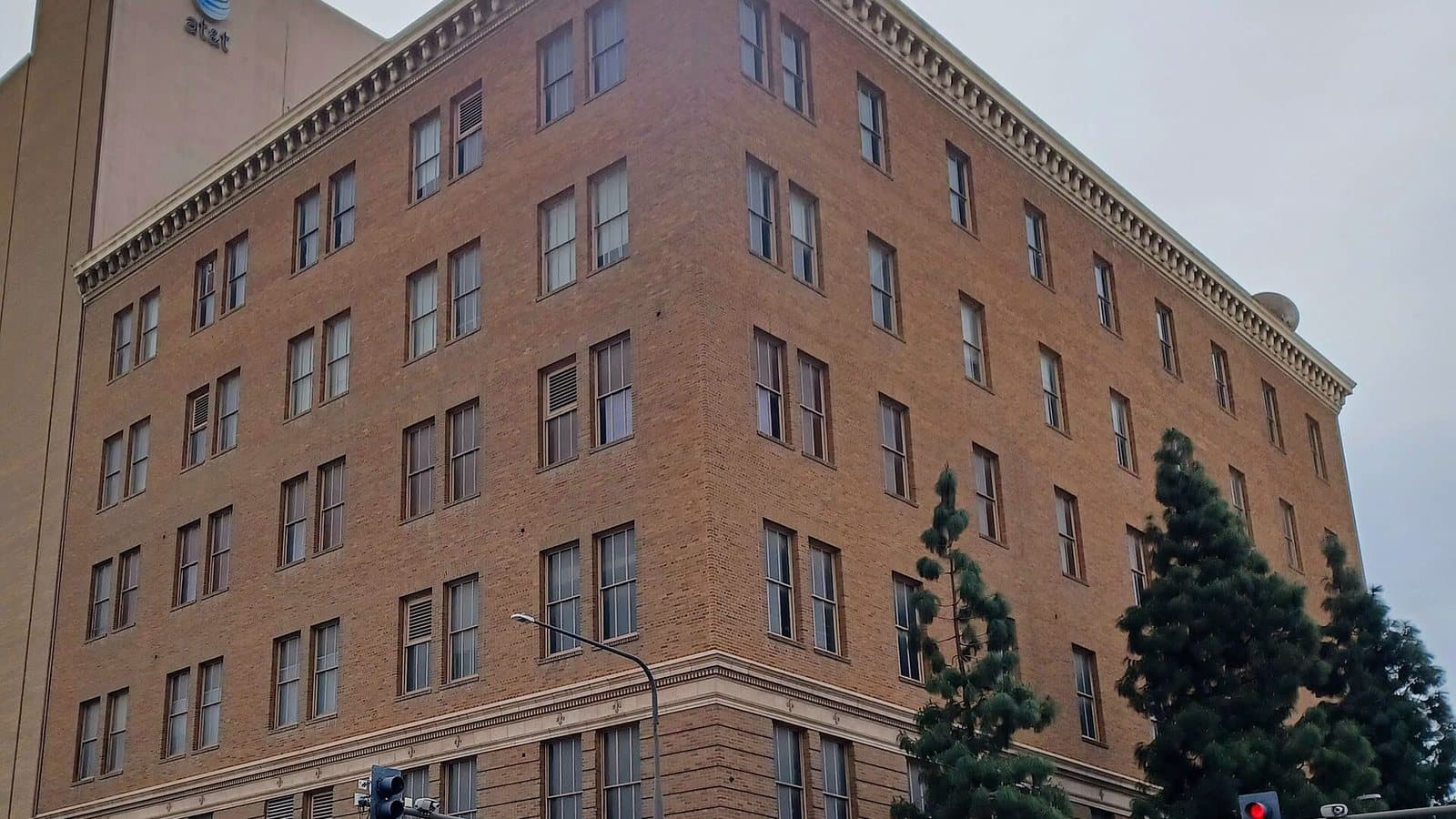
Cover image: An AT&T central office at 1455 Van Ness Avenue in Fresno, California. Photo by Xnatedawgx, CC BY-SA 4.0, via Wikimedia Commons.
Tags
Frequently asked questions
- Did the FCC ban California's carrier-of-last-resort rules?
- No. The order preempts specific state approval requirements only to the extent they stop AT&T from carrying out a discontinuance the FCC already authorized. California can still enforce other basic-service obligations, including penalties for failing to meet them.
- When will AT&T stop offering landline service in California?
- AT&T has said it intends to effectuate the discontinuance on or after 1 June 2027, pending regulatory approval. The FCC order does not set an earlier date or disconnect any customer by itself.
- What replaces the copper phone line?
- AT&T is offering a wireless home phone product it calls AP-A, which connects to its LTE network. The FCC says the $45 monthly price includes the connection, and Lifeline customers can get it for $25 a month.
- Can California challenge the FCC order?
- California can ask a federal court to review the order. The state has not announced a challenge, and the FCC's preemption finding has not been tested on the merits in court.

TPW Editorial
Editorial Team
TechPastWeek's editorial team reports and edits every story we publish. We research each piece against primary and credible secondary sources, and a human editor reviews and signs off before it goes live.