
Todoist Says a Stolen Developer Credential Led to a Breach Affecting 6% of Users
Todoist says a stolen version-control credential let an attacker reach production and take emails and old SHA1 hashes for about 6% of users, plus Outlook mail.

On this page
Key takeaways
- Todoist says an attacker used a stolen version-control credential between 22 and 23 November 2026 to reach production systems and take data for about 6% of its users.
- The largest affected group lost email addresses, account creation dates and salted SHA1 password hashes, a legacy format Todoist says it should have retired sooner.
- Smaller groups lost Todoist API and Slack tokens (about 0.003%), had credential-like text in tasks or comments searched (0.001%), or had connected Outlook mailbox metadata read (0.001%).
- Todoist blocked the access paths, reset affected passwords, revoked tokens and disabled the Todoist for Outlook add-in on 24 November.
- Todoist has not said how the developer credential was stolen or how many accounts were affected in absolute terms; it says users who received no email need to do nothing.
Todoist confirmed on 24 November that an intruder reached its production systems and copied account data for about 6% of its users, including email addresses and salted SHA1 password hashes left over from a method the company stopped using more than a decade ago. It began emailing affected customers at 16:11 UTC, roughly 23 hours after its security team found an administrator account it had not created. TechCrunch reported the confirmation on 25 November, citing the company's incident notice.
Related reading: CISA Flags Active Exploitation of the MailAssure Flaw N-able Found During Its Breach · Attackers Used GL.iNet's Own Cloud Service to Backdoor Routers and KVM Devices.
What Todoist has confirmed
The notice says a stolen credential associated with the company's version control system was used between 22 and 23 November to modify automated workflows in three repositories. That yielded more credentials and read access to source code. Todoist says its investigation found no changes to application code.
One of those credentials could alter how employees sign in to internal systems. The attacker used it to take over an employee's work account, enter the cloud infrastructure, query production databases, export account records and search for tokens and secrets.
The largest affected group is the 6%. Their records contained email addresses, account creation dates and password hashes produced with salted SHA1. Smaller groups lost API and Slack tokens, had tasks and comments searched for credentials, or had connected Outlook mailboxes read through the add-in.
Todoist removed the attacker's cloud accounts, revoked the credentials, stopped running tasks, reset affected passwords, revoked API tokens, disconnected OAuth applications and ended sessions. It disabled the Outlook add-in on 24 November at 05:06 UTC and began notifying users at 16:11.
How a repository credential became cloud access
The notice's timeline is detailed. The earliest identified use of the stolen development credential was 22 November at 14:04 UTC. By 06:06 the next morning the attacker held an administrative credential for the system employees use to sign in. Between 06:33 and 06:54 it changed an employee's authentication settings and entered the cloud environment as that person. Two more accounts appeared at 08:20, and by 09:08 the attacker was running commands inside production.
The export ran from 12:45 to 12:51. Queries for account tokens, reads of connected mailboxes and searches of customer content continued until 17:12. Monitoring raised the alarm at 17:01, about four hours after the records left; by 17:42 the company had disabled an attacker-created access key, removed the accounts and restricted remote command execution.
The attacker moved from a repository credential to production in under a day, and containment took 41 minutes once the anomaly was spotted. Detection was the slow part: the first known use was at 14:04 on 22 November, and the alarm came 27 hours later.
The four affected groups carry different risks
Todoist lists four groups, with what it calls minimal overlap. The percentages are approximate:
- About 6%: account records. Email address, password hash and account creation date. The company says the file was downloaded, not browsed.
- About 0.003%: API and Slack tokens. The attacker retrieved Todoist API tokens and Slack integration tokens, which act as keys to other systems until revoked.
- About 0.001%: content that looked like credentials. Searches of tasks, comments and attachment names for API keys, access tokens and similar secrets. Todoist says the queries hit one database shard and returned the matching text, up to 320 characters.
- About 0.001%: connected Outlook accounts. Email subjects and senders, the beginning of messages up to 255 characters, and attachment names, types, sizes and links.
An email address and an old hash is a credential-stuffing problem with a long fuse. A live API token or a mailbox preview is a way into other accounts now.
The old hashes are the largest exposure
SHA1 was designed to be fast, the opposite of what a password hash needs. A salt defeats precomputed tables, but it does not make each hash expensive to attack, and modern graphics cards can try billions of candidates a second against a fast hash. Todoist acknowledges the weakness: older hashes "can be vulnerable to password guessing."
Todoist says some older accounts kept SHA1 because their passwords had not changed since it dropped the method over a decade ago. "We should have retired support for it sooner," the notice says. OWASP treats SHA1 as unsuitable for passwords and recommends memory-hard functions such as Argon2id, scrypt or bcrypt.
Todoist reviewed newly created sign-in sessions for this group and found no indication the attacker signed in. That covers the attacker's logins, not what happens if the hashes are cracked elsewhere. The file has left the company's control.
The 6% share is the only scope figure Todoist has given. If the user base is in the tens of millions, as its about page says, 6% is millions of records; The Express estimated 50 million.
Why the Outlook add-in is the sharpest edge
Only about 0.001% of users had connected Outlook mailboxes read, but the data is more sensitive per record than an email address. Subjects and senders reveal who a person talks to; the first 255 characters often carry the ask, the link or the invoice number. Attachment names and links can expose projects, vendors and file-sharing services.
Todoist says the attacker requested recent messages and searched for terms associated with developer tools, credentials, cryptocurrency and file sharing. That points at a hunt for other accounts. A mailbox preview is enough to draft a convincing phishing message or work out which password reset to try next.
The add-in has been disabled since 24 November. Todoist warns that the replacement app may appear as unverified while Microsoft's review is completed, and that work or school accounts may block reconnection. Anyone who used it should treat the mailbox as potentially profiled, even if only message previews were read.
A stolen credential and an automation pipeline are a familiar pair
The path is not unique to Todoist. TechCrunch groups the incident with Uber, which confirmed a breach on 16 November, and Klue, which disclosed one in June, as cases involving stolen credentials. The common element is a credential that can change automation, and automation that can mint more credentials.
That makes repository access a production concern. A token that can rewrite a deployment workflow can usually reach the secrets it uses. Todoist says it has reviewed the permissions granted to developer automation, restricted which changes can trigger sensitive workflows and shortened credential lifetimes. Those changes address the amplification that turned one credential into several.
What Todoist has not said
The notice does not explain how the credential was stolen. Phishing, an infostealer on a developer machine, password reuse from another breach and a compromised integration would all fit the facts Todoist has published. The company has not chosen among them.
It has not named an attacker, said whether the data is for sale, or published an absolute number of affected accounts. It has not said when it notified regulators. Under the GDPR's general rule, a breach affecting EU users must be reported to the lead supervisory authority within 72 hours of awareness unless it is unlikely to create a risk. Todoist has not described its notifications.
The notice leaves open what read access to source code means. Todoist says no application code was changed, which addresses tampering, not disclosure. Source code can reveal internal endpoints, configuration patterns and assumptions about trust. Whether the attacker used that access beyond the three repositories is not stated.
Caveats
Everything above rests on Todoist's account and TechCrunch's report. No forensic firm has published an independent analysis, and no regulator has confirmed the timeline. The percentages are approximations, and the four groups have minimal overlap, so they should not be added into a single victim count.
The claim that the attacker did not sign in comes from a review of new sessions. It does not rule out offline cracking. The 50 million figure is the Express's estimate; Todoist says "tens of millions." The statement that no application code changed says nothing about whether source code was copied.
Todoist's assurance that users who received no email need do nothing depends on a notification list nobody outside the company can check.
What account holders should do
Anyone who received a Todoist email should reset the password from the link and change it anywhere else it was reused. Reconnect Slack after checking the workspace's permissions, and expect an approval prompt when reconnecting Outlook. Replace API tokens in Settings, then update every script that used them.
Secrets stored in Todoist comments or task text need to be revoked at the service that issued them. Deleting the comment does not invalidate a key that may already have been copied. Todoist says its notifications come from [email protected] and that it will not ask for a password.
Users who got no email are, by the company's account, outside the affected groups. The usual advice applies: unique passwords, a password manager and two-factor authentication. For teams, the incident is a reason to audit which automation credentials can reach production.
"Protecting your information is our responsibility, and we fell short. We're sorry for letting you down. We have taken precautions to ensure similar attacks can't happen again." — Todoist, incident notice
Todoist says its investigation is continuing. The notice does not say when it will be finished.
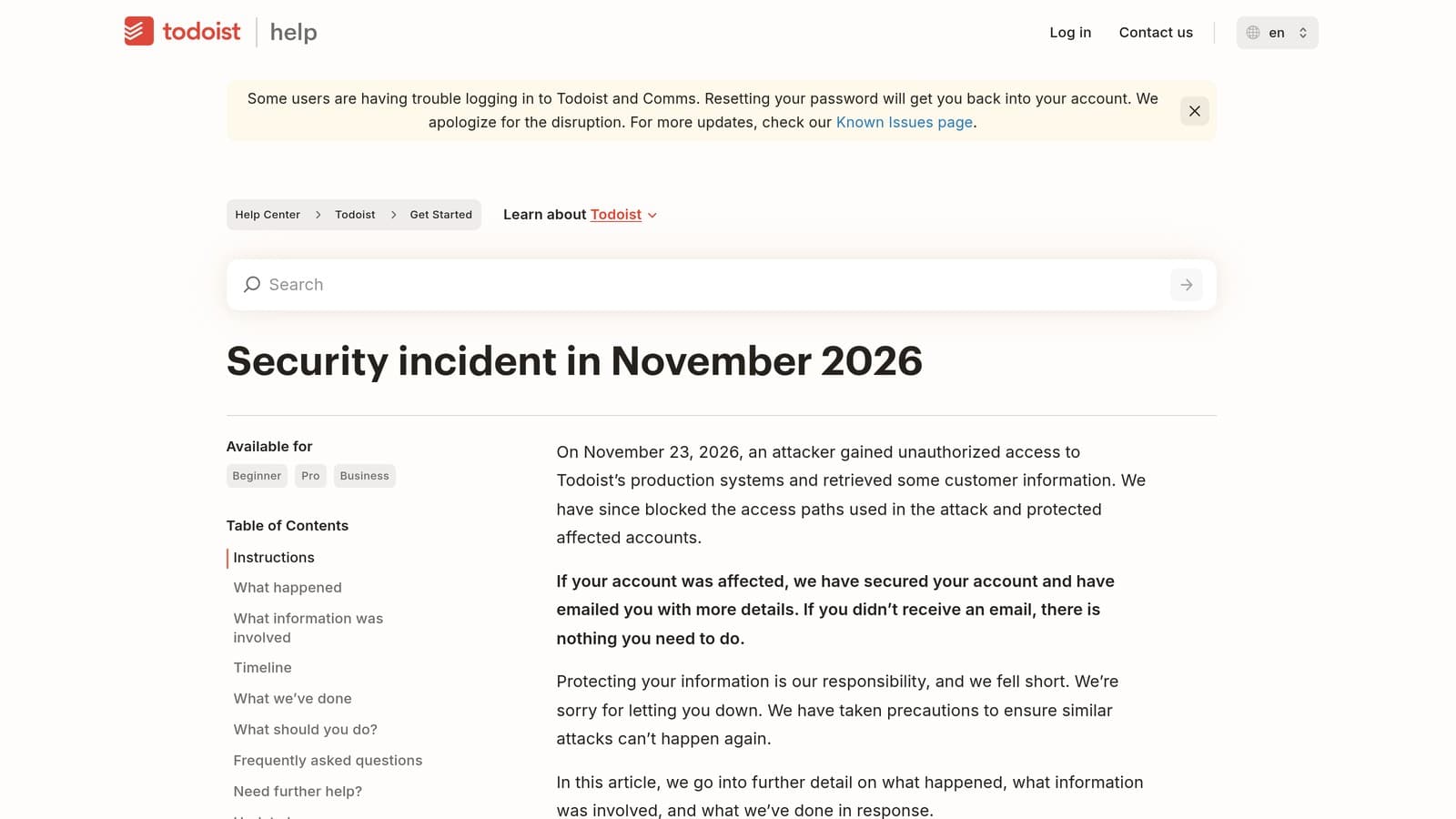
Cover image: Todoist's help centre page headed "Security incident in November 2026", showing the company's breach notice and a login warning banner. Screenshot courtesy of Todoist.
Tags
Frequently asked questions
- Was my Todoist account affected by the November 2026 breach?
- Todoist says it emailed affected accounts and that users who received no email need to do nothing. The company has not published a way to check an address independently, so the absence of an email is the only signal it has offered.
- Were my Todoist tasks and comments exposed?
- For most affected users, no. Todoist says about 6% had account records downloaded, while about 0.001% had tasks, comments and attachment names searched for credential-like text. Those searches were targeted, limited to one database shard, and returned matching text rather than a full copy of the database.
- Were my Google or Apple passwords stolen?
- No. Todoist says Google and Apple account passwords were not affected. If you sign in with either service and received an email about a password hash, it refers to a separate Todoist password on the same account, which Todoist has reset.
- What should I do if I received a Todoist breach email?
- Reset the Todoist password from the link in the email, change that password anywhere else you reused it, replace API tokens, and reconnect Slack or Outlook only after checking the permissions. Revoke any API keys or recovery phrases you had stored in Todoist comments, since deleting the comment does not invalidate a copied secret.

TPW Editorial
Editorial Team
TechPastWeek's editorial team reports and edits every story we publish. We research each piece against primary and credible secondary sources, and a human editor reviews and signs off before it goes live.