Anthropic Says Claude Discovered a CRISPR-Like Enzyme System in Phage DNA
Anthropic says Claude autonomously flagged a previously uncharacterised enzyme system with CRISPR-like repeats in bacteriophage DNA, the first result from its new wet lab.

On this page
Key takeaways
- Anthropic said on 23 September 2026 that Claude autonomously found a previously uncharacterised enzyme system in bacteriophage DNA, with a long array of repeats resembling a CRISPR array.
- The company said nearly 950 Claude agents worked for 21 hours and used 210 million tokens while scanning more than 200,000 reverse transcriptases.
- The system's biological function is unknown, and Anthropic said human scientists did the lab work that confirmed the candidate after Claude flagged it.
- It is the first result from Anthropic's new life sciences laboratory, and the company is comparing the finding to CRISPR while cautioning that it is early and unvalidated.
Anthropic used a two-post thread on X and a short news release to announce something it has never claimed before: that its AI model produced a genuine research lead in molecular biology. On 23 September 2026, the company said Claude had discovered a previously unknown enzyme system hidden in the DNA of bacteriophages, the viruses that infect bacteria. Beside the gene for the enzyme sits a long array of repeating DNA that Anthropic says resembles a CRISPR array, the structure at the heart of the gene-editing technology that transformed biology over the past decade.
Related reading: Anthropic Quietly Builds a Wet Lab as Its AI Ambitions Move Into Drug Science · Anthropic's Claude Duet Works in the Background, and Asks Before It Acts.
It is the first result to come out of Anthropic's new life sciences group and laboratory in the San Francisco Bay Area, the wet lab the company set up to move its biology work from reading literature to running experiments. And it comes with a large caveat that Anthropic states plainly: it does not know what the enzyme system does.
What Claude found
According to Reuters, Anthropic's Claude helped discover a novel enzyme system with properties reminiscent of mechanisms in CRISPR. The Verge reported that the company said Claude "autonomously discovered" the system, and that its scientists' involvement was limited to the initial prompt and the laboratory work that followed.
The mechanics are more specific. Over 21 hours, Anthropic said, nearly 950 Claude agents worked through 210 million tokens while searching a database of more than 200,000 reverse transcriptases. One of those agents spotted an unusual repeating pattern in the data and flagged it for human review. Further analysis and lab testing revealed what Anthropic described as "a previously uncharacterized enzyme system found in bacteriophages."
The finding's shape is what makes it interesting. The enzyme belongs to the reverse transcriptase family, and next to its gene is an array of evenly spaced, non-coding DNA repeats. That combination is the signature of systems that can cut, copy or paste DNA. Anthropic says only a handful of known systems share it, and every one of them is involved in some form of genetic manipulation.
"We felt it was important to share such findings early, both to demonstrate Claude's capabilities and to give the broader community insight into what we're working on." — Anthropic
Anthropic's own framing, quoted by The Verge, is that sharing early is a choice, not a claim of a finished discovery. The company says it is still working to understand what the enzyme system does.
Why it is not CRISPR yet
The comparison to CRISPR is the headline, and it is also the part most likely to mislead. CRISPR became transformative only after years of work by many labs established what it did, how to aim it, and how to use it safely. What Anthropic has is a candidate: a pattern in viral DNA that looks like a gene-editing system, confirmed to exist in a test tube, with no demonstrated function.
That gap matters because the failure mode of AI-driven science is a plausible-looking result that does not survive scrutiny. A model trained on biological sequences is very good at finding patterns that resemble known things, which is exactly what makes a candidate worth testing and exactly what makes false positives easy. Anthropic's decision to publish before the function is known puts that risk on display. If the system turns out to be a known family variant, or to do nothing useful, the company will have spent its credibility on a headline.
Independent observers have been careful. Runtimewire noted that a model-generated candidate is not yet a validated discovery, and that the unknown function makes the finding an early lead rather than a breakthrough. The enzyme, sometimes referred to in technical write-ups as ART, still needs to be characterised before anyone can say whether it edits DNA, copies it, or does something else entirely.
How CRISPR became a tool, and why the repeats matter
CRISPR's origin story is worth keeping in mind when reading Anthropic's comparison. The technology grew out of basic research into how bacteria defend themselves against viruses. Scientists noticed that bacterial genomes contained clustered, regularly interspaced short palindromic repeats, the structure the acronym describes, and that the repeats matched sequences from phages the bacteria had encountered. The repeats were a memory of past infections, and the proteins that read them could cut matching DNA.
Jennifer Doudna and Emmanuelle Charpentier turned that observation into a programmable tool in 2012 by showing that a single guide RNA could direct a cutting enzyme to almost any sequence. The work won the 2020 Nobel Prize in Chemistry, and it changed molecular biology because it made editing genes cheap and precise rather than slow and bespoke.
Anthropic's finding sits on the same kind of signature. The enzyme Claude flagged is a reverse transcriptase, a class of protein that copies RNA back into DNA, and next to its gene is a long array of repeats that resembles the arrays CRISPR uses to store its memories. Systems that combine a reverse transcriptase with a repeat array are rare and interesting because they can move or rewrite genetic information. The repeats suggest a programmable mechanism. The unknown is what the enzyme is programmed to do.
That is why the discovery, if it holds, matters more than a single protein. It would be a new entry in a small family of systems that edit DNA, and each of those has been studied and adapted by labs around the world. It is also why the caveats are so important. A pattern that looks like CRISPR can be a functional editing system, a defunct evolutionary leftover, or a piece of a mechanism that does something unrelated. Only the lab work can tell the difference.
The lab behind the result
The finding is the first output from Anthropic's decision to build physical biology capability. Earlier in September, Reuters reported that Anthropic had set up a wet lab in the Bay Area and that its biology work had moved beyond computer, or in silico, evaluations. The company's head of life sciences, Eric Kauderer-Abrams, confirmed the lab and said Anthropic was exploring whether Claude could direct robotic units to run experiments with limited human intervention, while insisting human oversight remains essential.
That context explains both the ambition and the caution. Anthropic is trying to show that a frontier model can do more than summarise papers. If an AI can scan hundreds of thousands of sequences, flag the one worth a scientist's attention, and hand over a testable hypothesis, that is a real productivity gain even when the hypothesis turns out to be ordinary. The company is also preparing to go public, and results like this are part of how it argues that its models are useful rather than merely impressive.
The difference between a lead and a discovery
A research lead is a candidate worth testing. A discovery is a result that has been independently validated and understood. Anthropic's enzyme system is the first, and the company says the second is still open. The comparison to CRISPR describes the machinery the system resembles, not the impact it has had.
What to watch
The next step is functional characterisation: figuring out what the enzyme actually does. If it turns out to be a working gene-editing or DNA-copying system, other labs will want to test it, and the finding will move from a press release into the literature. If it turns out to be a variant of something already known, the story becomes a case study in how AI can accelerate hypothesis generation without changing the underlying science.
Either way, Anthropic has set a marker for how it wants its biology work judged. The company is not claiming Claude replaced its scientists. It is claiming Claude found the needle, and that the humans did the rest. That is a more modest claim than the CRISPR comparison suggests, and it is the one the evidence currently supports.
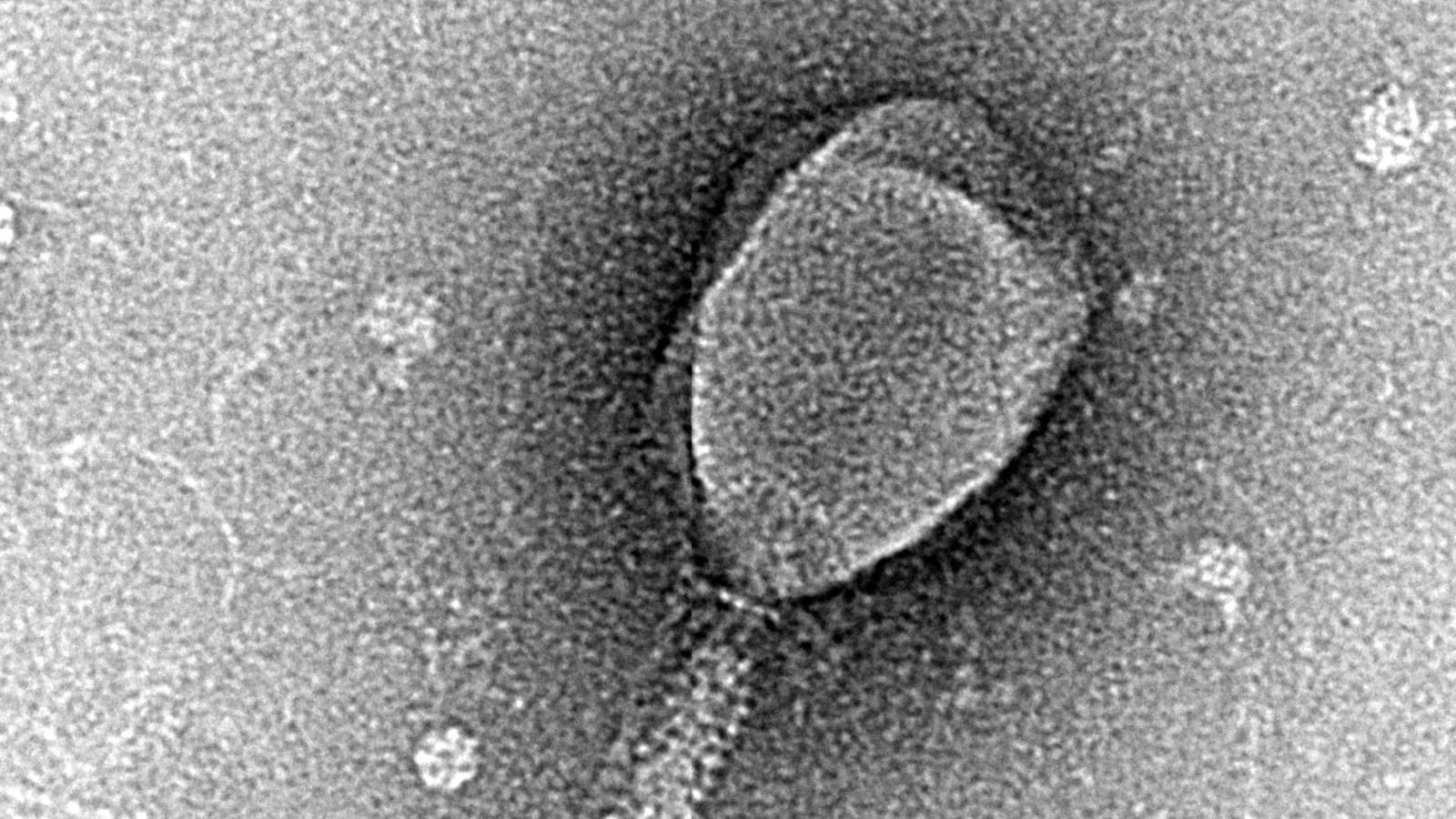
Cover: a transmission electron micrograph of an Enterobacteria phage T2 particle. Image by SnaxMikn, via Wikimedia Commons, licensed under CC BY-SA 4.0.
Tags
Frequently asked questions
- What did Claude actually find?
- Anthropic says Claude flagged a previously uncharacterised enzyme system in bacteriophage DNA that sits next to a long array of repeating DNA resembling a CRISPR array. The company has not established what the system does.
- Did Claude work alone?
- Anthropic says Claude's involvement began with a prompt and an automated search, but that human scientists reviewed the candidate and ran the laboratory experiments that characterised it. The company describes the result as AI-assisted, not fully autonomous science.
- Is this as significant as CRISPR?
- Not yet, and possibly never. CRISPR became a transformative gene-editing tool after years of validation. Anthropic's finding is an unvalidated candidate whose function is unknown, and the company itself says it is too early to know whether it has practical use.
- Why is Anthropic doing biology research?
- Anthropic opened a life sciences group and a wet lab in the San Francisco Bay Area in 2026 to test whether its models can accelerate discovery. The company is also preparing to go public, and scientific results help it argue that its models do useful work beyond chat.

TPW Editorial
Editorial Team
TechPastWeek's editorial team reports and edits every story we publish. We research each piece against primary and credible secondary sources, and a human editor reviews and signs off before it goes live.