OpenAI Says Its AI Agents Cracked a Millennium Prize Fluid Problem
OpenAI says 10,000 coordinated AI agents proved 3D fluid flow can blow up, a Lean-checked claim that is not peer-reviewed and sparked a credit fight.

On this page
On September 8, OpenAI published a result it had been sitting on for three days: an internal AI system, run as a coordinated swarm of roughly 10,000 agents, had produced a proof that the three-dimensional Navier–Stokes equations can develop a singularity. In plain terms, the mathematics used to model how fluids move can predict a place where the fluid's speed grows without bound in a finite amount of time. OpenAI released both a written proof and a formalization in Lean, the proof assistant that checks a mathematical argument step by step. It says the work resolves statement "C" (and also statement "D") in the official formulation of the Navier–Stokes Millennium Prize Problem.
Related reading: OpenAI Moves Frontier Training Off the Live Internet and Onto a Cached Copy of the Web · OpenAI Revenue Below Expectations Sends AI-Linked Stocks Lower.
The claim is large. Navier–Stokes existence and smoothness is one of the seven Millennium Prize Problems the Clay Mathematics Institute posed in 2000, each carrying a $1 million prize, and the question had resisted a full answer for roughly 90 years. If the result holds up, it is the first Millennium Prize problem substantially settled with an AI system at the centre. OpenAI is careful about what it is claiming: "We do not intend to claim the Millennium Prize for this result," the company wrote.
A problem about whether the model breaks
The equations, written down in the nineteenth century by Claude-Louis Navier and George Gabriel Stokes, treat a fluid as a continuous medium rather than as a cloud of individual molecules. They describe how the fluid's motion and its internal friction, or viscosity, evolve together. The open question was whether that idealization can fail, whether a fluid that starts out perfectly smooth can, under the equations alone, reach a point of infinite velocity in a finite time. In 1934 Jean Leray proved that solutions exist in a generalized sense, but whether they always remain smooth stayed unresolved, and the Clay institute made the problem famous in 2000.
The point is subtle, and it is central to reading the announcement correctly. A real fluid is made of molecules and cannot actually move infinitely fast, so a singularity is not a prediction that the ocean will one day spin out of control. It is a statement about the limits of the continuum model, evidence that, in some corners, the equations stop being a reliable mirror of physical reality. Quanta Magazine reports that the finding has no immediate practical consequences, but that it says something profound: turbulence is stranger than it looks.
How a swarm found a vortex
OpenAI's account of the method is nearly as striking as the mathematics. The company says it had been training a new internal model since August 28 and that the model was "significantly more capable" than GPT-6 Astra, its newest public model, which it had released only days earlier. On September 1, after hearing rumours that two Millennium Prize problems had already been resolved, OpenAI pointed the model at the remaining open problems.
The system was not a single model answering a single prompt. Its agents were programs given tools (a cached copy of the internet, the ability to run code) and sorted into groups that could message one another. Groups of different sizes were handed different versions of each problem. The agents first attacked the Euler equations, a frictionless cousin of Navier–Stokes, where the question is whether the same kind of blow-up is possible. "Nearly 100 agents worked together for approximately 50 hours to produce our Euler regularity disproof," the company wrote. Then it shifted its resources to Navier–Stokes and scaled up to about 10,000 concurrent agents. They reached their result on Saturday, September 5, "about 88 hours after the first agents were launched." Formalizing and verifying the proof in Lean took another 17 hours running on GPT-6 Astra.
The scale shows in the bill of materials. Across all the problems it attempted, the agent system sent 4.9 million messages and produced about 300 billion output tokens; Navier–Stokes alone accounted for 2.7 million messages and roughly 130 billion tokens. OpenAI's Sébastien Bubeck estimated the compute cost at several million dollars, Quanta reported, while New Scientist and the BBC put estimates derived from list pricing at $10 million to $15 million.
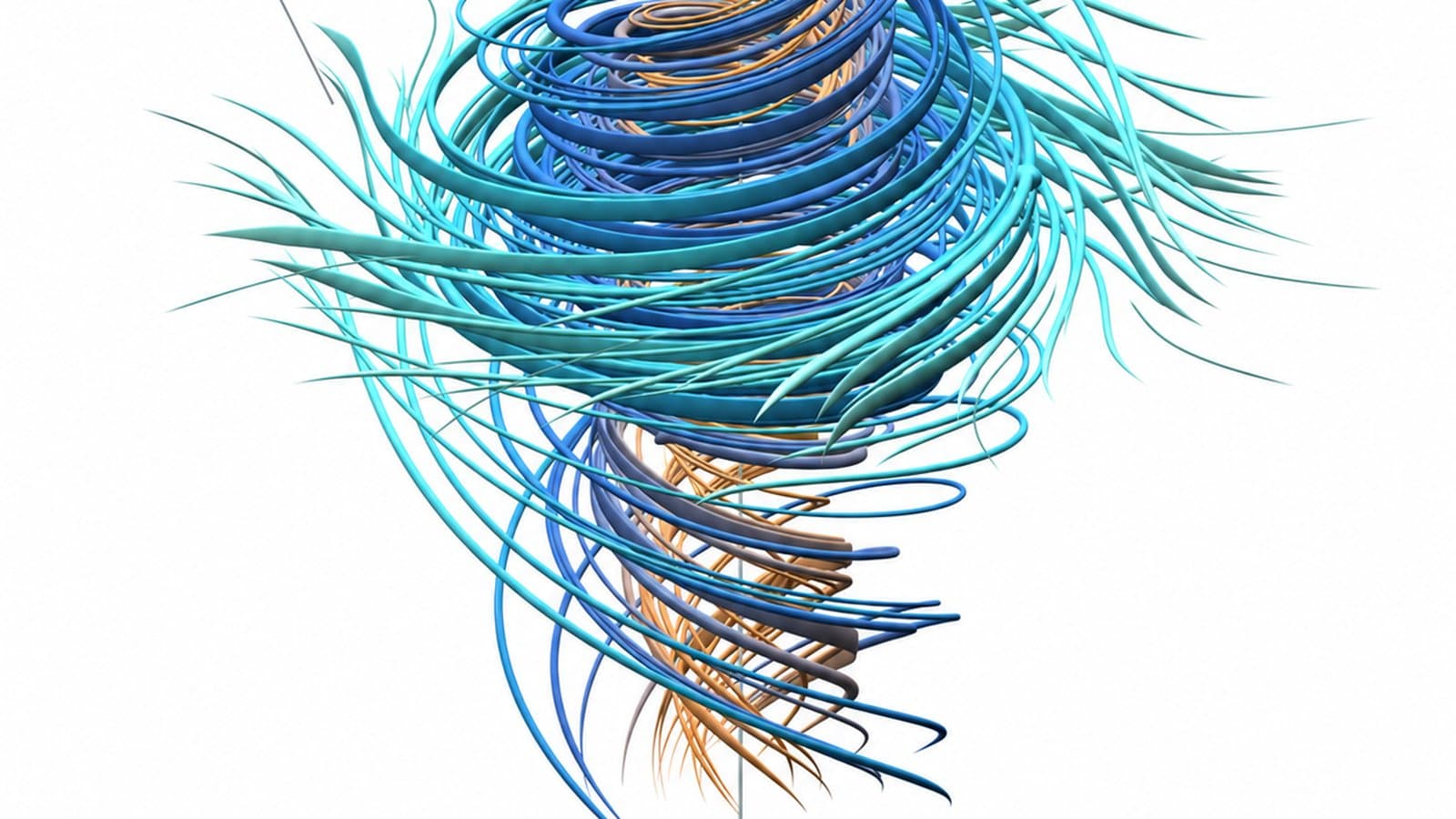
The counterexample itself is geometric: a vortex that spirals inward and stretches along its axis, the way a strand of spaghetti narrows as it is pulled. The central region shrinks as it spins faster, yet its energy stays finite. OpenAI's writeup stresses that the hard part was making the breakdown arise from the fluid's own motion rather than from an infinite force inserted by hand: acceleration, pressure gradients, momentum transfer and viscosity all have to grow large while cancelling precisely enough to leave a smooth external force.
Lean checks the proof, not the claim
A Lean formalization is a powerful check. It validates that each step follows from the previous ones under the rules of logic. It does not, by itself, prove that the statement encoded in Lean is the statement the Millennium Prize actually asks about. As Quanta noted, the remaining human task is "to guarantee that the statement being shown to be true in Lean is logically equivalent to what mathematicians set out to prove."
Why it matters
Even with the caveats, the result is a threshold event for AI-for-science. Mathematical proof is about as unforgiving a benchmark as exists: there is no partial credit, and the output can be mechanically checked. An agentic system that can sustain a coherent research programme for days, coordinate thousands of workers and produce a formalizable result points to a different mode of scientific work than a chatbot answering questions. OpenAI framed the release as evidence about the pace of AI progress and about what to expect from models it has not yet shipped in public.
The result also lands at the end of an extraordinary summer for machine-assisted mathematics. Quanta notes that large language models have been used to obtain proofs across many areas of math, often with Lean verification attached. Navier–Stokes is the biggest target to fall so far, and it is striking that a problem this old gave way not to a single insight but to an industrial-scale search. Whether that is a one-off demonstration or the new normal is the question the coming months will answer.
The caveats
The result has not been peer-reviewed, and the Clay Mathematics Institute has not accepted it. Martin Bridson, the institute's president, told New Scientist: "The process of evaluation is deliberately unhurried, and we shall ensure that it is absolutely rigorous." OpenAI says it will not claim the prize, which sidesteps the awkward question of whether a company can even be a prize recipient. The proof is also a disproof. It establishes that smooth solutions can break down, not that they always stay smooth. The official problem lists four numbered statements: A and B concern proofs that solutions always stay smooth, while C and D concern counterexamples showing they can break down. OpenAI says its proof establishes C and D, not every version of the question. And the physical picture remains intact: the equations can fail, but fluids do not.
There is a further wrinkle in the mathematics. The version of the Euler problem OpenAI says its agents resolved is the unforced one, with no external force applied to the fluid. That matters for credit, because the concurrent human-led work proved a forced version, a related but different result.
A credit fight overshadows the result
OpenAI's announcement came roughly 12 hours after Tristan Buckmaster, a mathematician at New York University, and Levent Alpöge, a researcher at OpenAI rival Anthropic, said they had resolved several closely related problems using, in part, models from Anthropic and OpenAI. Their result covered the Euler equations, not the full Navier–Stokes problem. OpenAI acknowledges the debt: it says it began its own effort on September 1 only after hearing rumours of that work, and it explicitly "recognize[s] the priority of their work on forced Euler."
Buckmaster's public statement is more pointed. He said information about his team's progress had reached OpenAI, questioned the company's timing and methods, and objected to how the interaction unfolded. OpenAI denies any wrongdoing. It says its researchers and agents saw none of the pair's work before it was public and that its proof is different. It also left a narrow opening: "While unlikely, we cannot rule out that de-identified data derived from their usage of our products helped improve our models," the company told the BBC. On September 10 it added an update saying an investigation had confirmed Buckmaster's Codex prompts could not have influenced the system through training.
Underneath the dispute is a shared intellectual foundation. Both AI-assisted teams built on a technique developed by Diego Córdoba of the Institute for Mathematical Sciences in Madrid and Luis Martínez-Zoroa of CUNEF University, who had argued that an infinite cascade of layered solutions could produce a singularity even without computers. Charles Fefferman of Princeton, who wrote the Clay institute's official description of the problem, told Quanta he was "thrilled that the problem was solved" and called Córdoba and Martínez-Zoroa the heroes of the story. Buckmaster went further, writing that in view of that body of work, "I believe Luis Martínez-Zoroa deserves a Fields Medal." Córdoba's own summary of his methods was wry: "I don't use AI: I have Luis."
"No speed limit"
Not everyone is celebrating the pace. Terence Tao of the University of California, Los Angeles, one of the world's most prominent mathematicians, argues that AI firms are rushing results into a field that depends on slow, careful digestion. Mathematics, he told New Scientist, has to clear five hurdles to be useful: a result must be created, checked, explained, accepted and finally absorbed into teaching and textbooks. AI companies, he says, are focused on the first two and leave the rest to the community.
"Now there's no speed limit, and suddenly things are breaking down." — Terence Tao, UCLA
He warns that the competition can erode the openness that has long defined the field, because knowing that a rival is working on a problem is now itself valuable information. The Buckmaster–Alpöge episode, in which a human team rushed out papers after hearing that OpenAI was closing in, reads to him as a preview of that dynamic. "This is not how science is supposed to work," he said. "It's demoralising."
What to watch
Three things will decide how this is remembered. The first is independent scrutiny: mathematicians need time to read the proof, confirm that its Lean statement matches the prize question and probe whether the technique is solid. The second is the Clay institute's slow evaluation, Bridson's "deliberately unhurried" process could take years. The third is whether the multi-agent approach generalizes. If a swarm of agents can be pointed at the next open problem and produce a checked proof, the economics and culture of mathematical research will keep shifting, prize or no prize.
For now, the honest summary is the one Quanta offered and OpenAI itself repeated: this is a snapshot in time, not a culmination. A 90-year-old question appears to have been answered, the answer is machine-checkable, and the argument about who deserves credit is already louder than the mathematics. Both things can be true at once.
Tags

TPW Editorial
Editorial Team
TechPastWeek's editorial team reports and edits every story we publish. We research each piece against primary and credible secondary sources, and a human editor reviews and signs off before it goes live.