East of Eden Review: Netflix's Steinbeck Series Puts Cathy and Lee First
Zoe Kazan's seven-part East of Eden, on Netflix from October 1, 2026, puts Cathy Ames and Lee first. Critics praise Pugh and Hoon Lee; the compression shows.

On this page
Key takeaways
- Netflix released all seven episodes of East of Eden on October 1, 2026; Zoe Kazan created the limited series from John Steinbeck's 1952 novel.
- Florence Pugh plays Cathy Ames and executive produces, and Hoon Lee plays Lee, whose role the series expands with an episode co-written by novelist Alexander Chee.
- Zoe Kazan is the granddaughter of Elia Kazan, who directed the 1955 film adaptation; the series covers the whole novel, while the film covered only its final phase.
- Rotten Tomatoes stood at about 85 to 86 percent and Metacritic at 80 from 26 critics as of October 3, 2026.
- Kazan originally intended eight episodes and produced seven, and early reviews note the compression, a softened origin for Cathy, Mike Faist's limited presence after the early hours, and a New Zealand shoot standing in for California.
Netflix released all seven episodes of East of Eden on October 1, 2026. Created by Zoe Kazan and adapted from John Steinbeck's 1952 novel, the limited series arrived with mostly strong reviews and a deliberate rearrangement of the book: it opens on Cathy Ames instead of the Salinas Valley, and it gives Lee, the Trask family's Chinese American household manager, an arc the earlier screen versions never built for him. Netflix's Tudum page confirmed the all-at-once release and the cast, and the series' Wikipedia entry records that Rotten Tomatoes stood at about 85 to 86 percent and Metacritic at 80 from 26 critics as of October 3.
Related reading: Lupin Part 4 Debuts at No. 1 as Critics Back a Bigger, Uneven Return · Nobody Wants This Season 3 Reviews: A Brief 100%, Then 87%.
Those numbers put it near the top of Netflix's literary adaptations without making it a consensus triumph. The reviews that landed in the first two days agreed on the performances and the look of the thing, and they split on how well seven hours carry a book that runs to roughly 600 pages.
This is not a straightforward adaptation. Kazan, who wrote the episodes, treats the novel as a set of interlocking questions about inheritance and choice, and she reorders the material to put those questions in front of the audience early. The title points at the theme: the land east of Eden is where Cain is sent after killing Abel, a place of exile and of the possibility of choosing differently. The series leans on that reading rather than on the novel's surface as a family saga, and that decision is what the reviews are responding to, favorable or not.
A novel that has resisted the screen
Steinbeck's novel moves from Connecticut to California across three generations, and its back half carries the Cain-and-Abel parallel between the brothers Cal and Aron that supplies the title. Elia Kazan's 1955 film, with James Dean as Cal, solved the scope problem by starting late. It skipped most of the family's origins and settled on the final phase, and that version remains the one most viewers know. It is also why a full adaptation stayed difficult for seventy years. This series covers the whole book.
Zoe Kazan carries a family tie to that history: Elia Kazan was her grandfather, a relationship the series' Wikipedia entry notes. The production also assembled an unusual writers' room for prestige television, with Jeb Stuart as co-showrunner and novelist Alexander Chee co-writing one episode. Garth Davis directed the first four hours and Laure de Clermont-Tonnerre the last three, with Stuart Dryburgh as cinematographer and Laura Karpman composing the score.
Part of what made the book hard to film is structural. Steinbeck wrote long, with a narrator who digresses into family history and philosophy, and the emotional payload sits late, in the Cal and Aron story that most people remember from the film. An adaptation that starts where the film started gets the payoff but loses the setup. An adaptation that covers everything risks spreading itself thin across the generations. Kazan chose the second problem, and the reviews that fault the middle are mostly faulting the arithmetic of that choice rather than the intent.
Seven episodes is more room than the film had and less than the novel wants. Kazan has said she originally intended eight, and the production delivered seven, which is the first fact a viewer notices in the middle stretch.
Cathy goes first, and Florence Pugh holds the frame
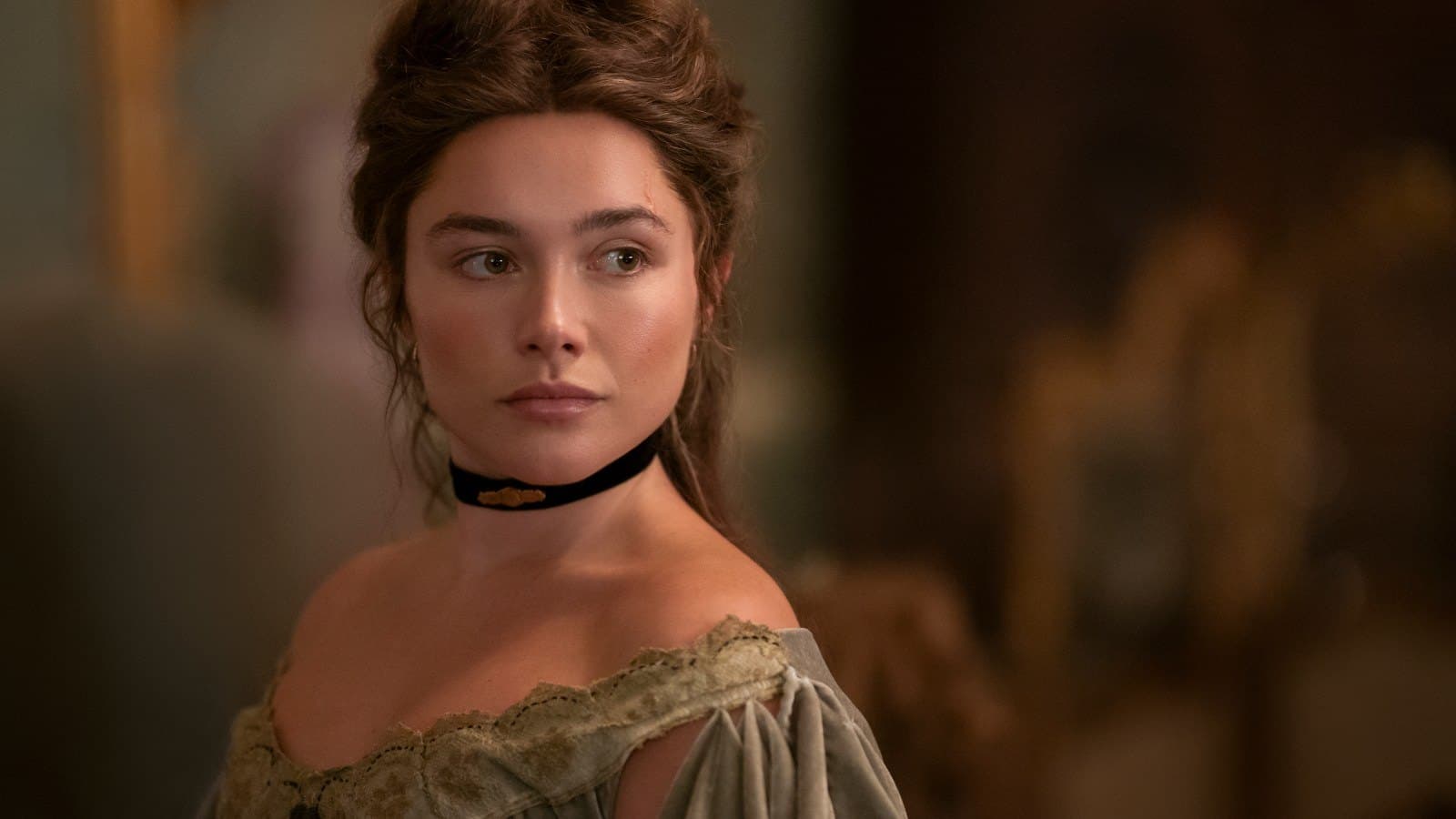
Adaptations of this book usually introduce the Trask family and let Cathy Ames arrive as a disruption. Kazan inverts that. Cathy is the series' opening figure, which tilts the story away from a family's inheritance and toward the woman whose damage sets it in motion. Florence Pugh plays her and also executive produces, and the expanded character work is one of the two things the early reviews single out most often.
The other is subtler, and it is the clearest place where the adaptation's choices cost something. Giving Cathy a childhood origin can soften the "born monster" reading Steinbeck wrote. The novel's Cathy is cold from her first appearance; the series explains her. Whether that counts as enrichment or dilution is the question the reviews are arguing about, and both answers are defensible from the same seven hours.
Pugh's presence does double duty. She is the series' biggest name and its most discomfiting character, and she carries an executive-producer credit that gives her a stake in how the adaptation treats Cathy. Reviews differ on much else but agree on the performance, which matters for a series built around a woman whose actions are meant to be hard to forgive. The novel gives Cathy no interior explanation; the screen gives her one, and Pugh has to make that explanation credible without turning Cathy into a victim. The reviews suggest she mostly clears that bar, even where they disagree about whether she should have been asked to.
Lee gets the hours he was owed
The series' second center is Lee, played by Hoon Lee, and his episode is the one Chee co-wrote. Assigning a novelist to the Lee hour is a statement about how seriously the production took a character who has often been rendered as a stage-managing servant. Variety's Alison Herman called Pugh and Hoon Lee the show's "beating heart," and that assessment tracks with where the series spends its quietest scenes.
Lee's expansion is the adaptation's clearest improvement on both the page and the 1955 film, which reduced him to a supporting presence. In the novel he is already a philosophical voice and a bridge between the Trask family and the world outside it. The series gives him scenes and a history of his own, and it hands one of its seven hours to a Chinese American writer to write them. That choice is why several reviews describe the series as re-centering the book rather than merely filming it. It is also a bet that a streaming audience will follow a literary adaptation that spends a full episode on a character who is, in most versions of this story, in the background.
Timshel, the word at the center
The Hebrew word timshel, which Steinbeck translates as "thou mayest," anchors the novel's argument that people choose their own path rather than inherit it. The series keeps it as the thematic pivot, which is why the Cathy and Cal stories are staged as questions of choice rather than fate.
"Delicious moral quandaries and sumptuous landscapes." — Rotten Tomatoes critics' consensus
Where the seven episodes thin out
Length is the recurring complaint. Kazan's original eight-episode plan became seven, and the compression is visible in the middle. Mike Faist's Charles, a major presence in the novel's early chapters, recedes after the first hours. The production also shot in New Zealand, standing in for both the Connecticut and Salinas Valley sections; Auckland, Dunedin and Oamaru are a long way from Steinbeck's California.
Across the reviews aggregated on Rotten Tomatoes, those trade-offs show up as recurring notes rather than isolated gripes: the compressed middle, the softened Cathy origin, Faist's limited screen time after the opening episodes, and a landscape that occasionally reads as not-quite-California. None of them is fatal on its own. Together they mark the difference between a faithful adaptation and a complete one.
The compression is the adaptation's main structural cost. With eight hours cut to seven, the series has to keep four generations of plot moving at once, and the characters who suffer first are the ones the book uses as texture rather than engine.
What the numbers and the trade press say
Reception is warm rather than unanimous. Rotten Tomatoes and Metacritic figures collected on Wikipedia put the series at about 85 to 86 percent and 80, respectively, the latter described as "generally favorable." The critics' consensus praises Kazan's "delicious moral quandaries and sumptuous landscapes" along with the expanded character work from Pugh and Lee.
Collider called the series "a daring new perspective," noted its Certified Fresh standing, and reported that it was an instant hit on Netflix's viewership charts, particularly in the United States, citing FlixPatrol. That combination matters for how Netflix reads the project. A prestige literary adaptation that performs immediately gives the streamer a reason to keep funding auteur-driven takes on canonical novels rather than safer, more literal ones.
The gap between the two aggregate scores is worth a note. An 85 to 86 percent figure counts the share of critics who liked the series at all, while Metacritic's 80 averages how much they liked it, and a title can land high on the first and merely good on the second. That is roughly what happened here. The picture is of a series that almost everyone found worthwhile and almost no one found flawless, a different profile from the ecstatic reception a Netflix literary hit sometimes gets.
Variety's review is the other useful temperature reading. It treats the series as a serious work with a genuine point of view, and the performances it elevates are the same two the rest of the coverage does. RogerEbert.com's review rounds out the early wave. Together the reviews describe a series whose strengths are atmospheric, performative and thematic, with its narrative compression as the standing cost.
Caveats
Two limits apply here. The scores are early. Rotten Tomatoes and Metacritic move as more reviews land, and the figures above were recorded two days after release, so treat them as a snapshot rather than a verdict.
The disagreement is also narrower than the aggregate suggests. Most reviewers liked the series and argued over whether the rearranged structure serves the book. And the most quotable lines circulating about it come from a handful of outlets, worth remembering before treating any single review as the consensus.
One more caution on the commercial framing. The "instant hit" label rests on FlixPatrol's chart tracking, which measures engagement with Netflix's public top-10 lists rather than total viewing. It is a real signal and an imperfect one. Netflix has not published first-week hours for the series, so until it does, the commercial verdict is provisional.
What to watch
Netflix has spent several years betting on prestige literary adaptations and on Westerns, and East of Eden sits at the intersection of both. If it holds its audience past the first week, the case for letting a showrunner rearrange a canonical novel rather than adapt it straight gets stronger. The reviews have already had their say. The streaming numbers have not.
Cover: Florence Pugh as Cathy Ames in Netflix's East of Eden. Still courtesy of Netflix.
Tags
Frequently asked questions
- When does East of Eden come out on Netflix?
- All seven episodes of the limited series were released on Netflix on October 1, 2026. Zoe Kazan created the adaptation of John Steinbeck's 1952 novel, and Florence Pugh stars as Cathy Ames and executive produces.
- Who is in the cast of Netflix's East of Eden?
- Florence Pugh leads as Cathy Ames, with Christopher Abbott as Adam Trask, Mike Faist as Charles Trask, Hoon Lee as Lee, Ciarán Hinds as Samuel Hamilton, Martha Plimpton as Faye, Tracy Letts as Cyrus Trask, Joseph Zada as Cal and Joe Anders as Aaron.
- How does Netflix's East of Eden differ from the 1955 film?
- Elia Kazan's 1955 film covered only the final phase of Steinbeck's novel. This seven-episode series covers the whole book, starts with Cathy Ames rather than the Salinas Valley, and expands the role of Lee.
- What did critics say about Netflix's East of Eden?
- Reviews were largely positive as of October 3, 2026, with Rotten Tomatoes around 85 to 86 percent and Metacritic at 80 from 26 critics. Praise focused on Zoe Kazan's adaptation, the landscapes and the performances of Florence Pugh and Hoon Lee, while some reviews noted the compression and other trade-offs.

TPW Editorial
Editorial Team
TechPastWeek's editorial team reports and edits every story we publish. We research each piece against primary and credible secondary sources, and a human editor reviews and signs off before it goes live.