'You Can See Everything': Nathan Fielder's Elizabeth Holmes Documentary Opens to Universal Acclaim
A24's 'You Can See Everything' follows Elizabeth Holmes in the 34 days before prison; Nathan Fielder and Lance Oppenheim's documentary opens to acclaim.

On this page
Key takeaways
- A24 released 'You Can See Everything,' a documentary directed by Nathan Fielder and Lance Oppenheim, in US theaters on 16 October 2026.
- The film follows Elizabeth Holmes, the convicted Theranos founder, through the 34 days before she reported to prison in May 2023, after production that ran about three years.
- It runs 2 hours 54 minutes, is rated R, and has a UK and Ireland release set for 20 November 2026.
- Rotten Tomatoes lists a 100% approval rating from 49 reviews and an average of 9.5/10; Metacritic lists 97/100 from 21 critics, both mid-October snapshots.
- Holmes was convicted in January 2022 on four counts of wire fraud and sentenced to 11 years and 3 months; Theranos was once valued at about $9 billion.
A24 released "You Can See Everything" in US theaters on 16 October 2026, and the documentary about Elizabeth Holmes arrived to near-unanimous praise from critics. Wikipedia's production summary sets out the basics: the film is directed by Nathan Fielder and Lance Oppenheim and distributed by A24, and it follows the founder of the collapsed blood-testing company Theranos through the 34 days before she reported to prison, after she invited a crew to film her. It runs 2 hours 54 minutes (174 minutes) and is rated R for language and some graphic nudity. Holmes's partner, Billy Evans, appears in it.
Related reading: It: Welcome to Derry Surprise-Releases a 30-Minute Halloween Special Set Centuries Before Pennywise · Dexter: Resurrection Season 2 Opens at 86% on Rotten Tomatoes, Below Season 1.
The autumn schedule was staggered. The picture premiered at the Telluride Film Festival on 6 September 2026, played the New York Film Festival on 30 September, opened in limited release across the US and Canada on 16 October, and has a UK and Ireland date set for 20 November. On Rotten Tomatoes it holds a 100% approval rating from 49 reviews, with an average score of 9.5 out of 10. Metacritic lists 97 out of 100 from 21 critics, a figure the site labels "universal acclaim." Both numbers were taken in the film's first days in cinemas, and both will move.
The film in brief
"You Can See Everything" is directed by Nathan Fielder and Lance Oppenheim and distributed by A24. It runs 2 hours 54 minutes, is rated R, and opened in US theaters on 16 October 2026. A UK and Ireland release is set for 20 November 2026.
What Holmes agreed to
The film exists because Holmes allowed it. Wikipedia's account records that she invited a film crew to document her in the weeks before she went to prison, and that production ran about three years. She began her sentence in May 2023. Holmes had been convicted in January 2022 on four counts of wire fraud and sentenced to 11 years and 3 months. Theranos, the company she founded, was once valued at about $9 billion before it collapsed.
That arrangement separates the project from the wave of Theranos coverage that followed the trial. A documentary built on a subject's cooperation raises an immediate question about who holds the frame, and the first published reviews suggest the film does not dodge it. The verdict is a matter of record, and the film's interest is the person who once ran the company.
Evans's presence in the film is part of the access. A portrait shot in the weeks before a prison sentence tends to move between the public Holmes and the private one, and a partner in the frame supplies a second view of the person behind the courtroom coverage. The early reviews do not treat the domestic material as the main draw. They treat it as context for a subject who otherwise appears only in the footage she agreed to provide.
A film that questions its own form
RogerEbert.com's Tomris Laffly called the result "a triumphant, riveting, and continually shape-shifting piece of creative non-fiction," and described it as inquisitive and skeptical both about Holmes and about documentary filmmaking itself. That second half carries the weight. A film about a woman convicted of fraud that also doubts the form used to show her is doing something the standard true-crime treatment does not attempt.
WBUR's Sean Burns, writing on 14 October, called it "a wild, mind-melting movie." He wrote that the film folds in on itself late in its running time with a "prankish" spirit, and he flagged a "surprise guest star MVP" who, by his account, runs away with the final stretch. That is praise of a particular kind. It treats the closing act as a turn, and the review stops short of explaining what that turn is.
What both reviews share is an interest in the film as an object, alongside its value as a record of its subject. The access Holmes granted and the three years of production are the raw material, and the early notices suggest the film treats that material as a form to interrogate.
A skeptical documentary about a persuasive subject is doing two things at once. Holmes was convicted on four counts of wire fraud, and the case turned on the gap between what she told investors and what her technology could do. A film that shares the screen with her has to keep that gap visible, which is harder when the subject is also the one who opened the door. Laffly's phrasing suggests the film builds that tension into its structure, and does not reduce it to a single caveat.
Reading the reception
Forty-nine reviews is a large enough sample that a 100% rating carries weight, though Rotten Tomatoes scores tend to run high early, before the slower outlets publish. Metacritic's 97 rests on a smaller group of 21 critics, and its "universal acclaim" band is the site's top tier. Neither figure settles the film's reputation. Both say the critics who filed in the first days were close to unanimous, which is rare for any release and rarer for a documentary that runs nearly three hours. The distributor keeps the trailer and screening information on its A24 film page.
Documentaries of this length are a hard sell in cinemas, and the limited opening is only the start of the run. What the early reviews establish is that the film will be judged as filmmaking, and that it is being separated from the news story it grew out of. That distinction matters to the distributor as it decides how wide to go.
Why a fraud story still earns three hours
Holmes's story has been public for years, and the conviction closed the legal chapter. At this distance the fraud itself is well documented; what a documentary can add is the texture of the person who committed it, and the access Holmes granted is the way to get that material. The timing matters for the same reason. The film arrives three years after she began serving her sentence, past the verdict and the first wave of coverage, when the open question is how she accounts for her own conduct now.
That is also why the reviews sound the way they do. Critics who have followed the case for a decade are hard to surprise with the facts of Theranos. A film that turns its attention to how the story gets told can still surprise them. When Laffly calls the picture skeptical about documentary form, the skepticism is the story for an audience that already knows how the Theranos case ends.
The case itself carries the stakes. Theranos was once valued at about $9 billion, and Holmes was sentenced to 11 years and 3 months, numbers large enough that the story moved past business coverage into general interest. A film arriving after the verdict cannot lean on surprise. The access it secured is what it offers instead.
There is a wider signal in the release itself. A distributor put a nearly three-hour documentary about a convicted founder into theaters, and the early notices suggest the bet is working with critics. A limited opening is not a wide one, and audience numbers are a separate question.
Caveats worth keeping in view
The aggregates are mid-October snapshots. Rotten Tomatoes and Metacritic both change as reviews arrive, and a 100% or a 97 is most fragile in the first week, when the most receptive press tends to file first. Read the figures as a strong opening, not a final grade.
Only two reviews are quoted here, and both are positive. One calls the film shape-shifting and skeptical; the other calls it "a wild, mind-melting movie" and points to a final-act turn it does not explain. Nothing in the early coverage settles how that last section plays for a general audience, and the reviewers are deliberately holding it back. The "surprise guest star" is teasing from WBUR, not a confirmed detail, so it should be read that way.
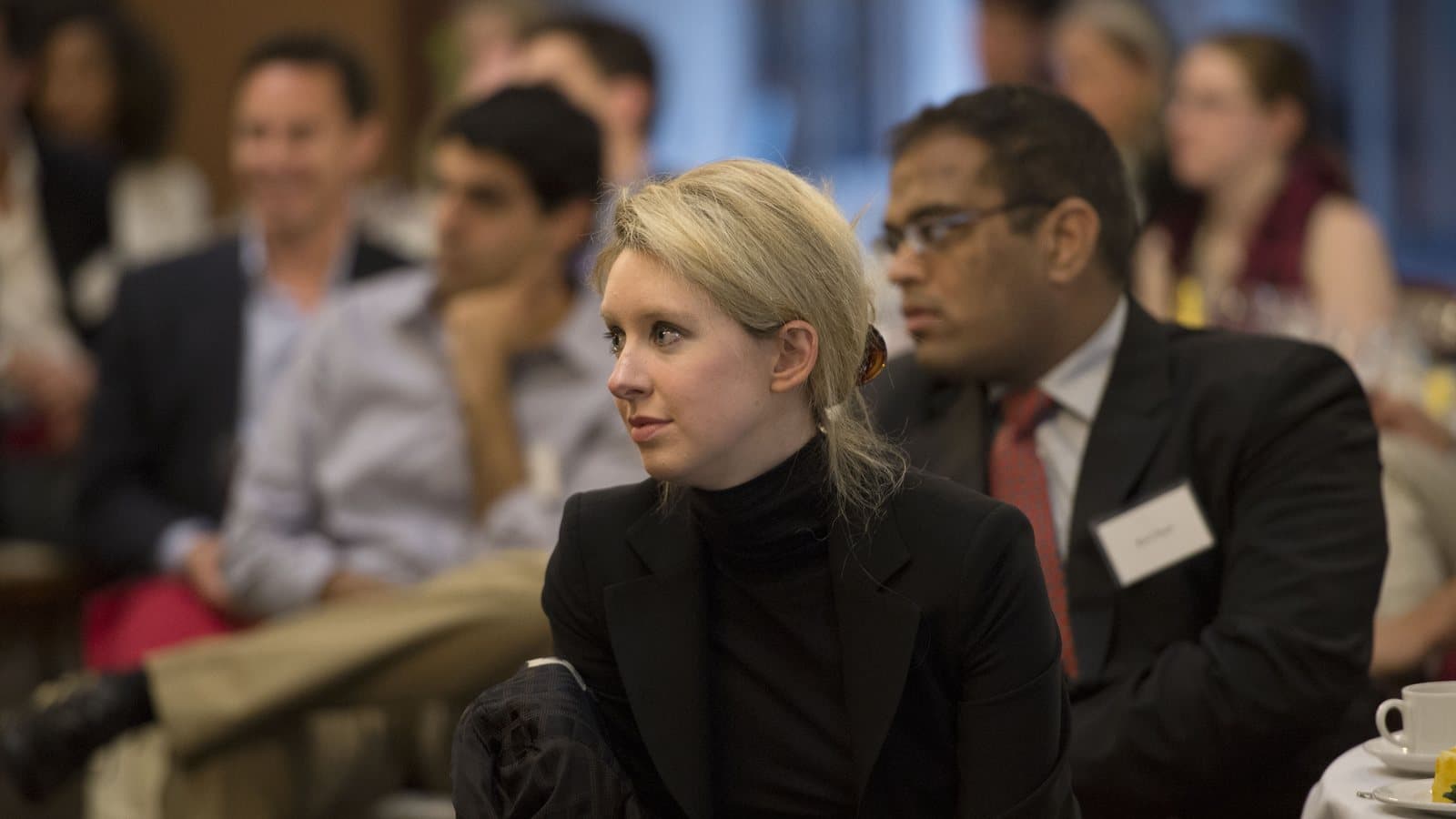
The cover image on this article is a 2013 portrait of Holmes from before the documentary existed. It shows the founder at a nuclear nonproliferation discussion that year, not a frame from the film.
Early numbers
The 100% Rotten Tomatoes rating (49 reviews) and the 97 Metacritic score (21 critics) are snapshots from the middle of October 2026, taken during the film's first days in release. Both will change as more reviews are published.
What to watch
The UK and Ireland release on 20 November 2026 is the next fixed point, and it will bring a second wave of reviews from British and Irish critics. Watch whether the aggregates hold once the sample grows, and whether A24 expands the theatrical run beyond its limited opening. The film's own final act is the other thing to watch, since the early reviews describe a turn without revealing it, and word of mouth around that section is likely to shape how the film is talked about into the winter.
For now the numbers are high, the reviews are close to unanimous, and a documentary that runs 174 minutes and follows a founder who invited the cameras in has found an audience among critics. Whether that audience widens is decided at the box office.
"a triumphant, riveting, and continually shape-shifting piece of creative non-fiction" — Tomris Laffly, RogerEbert.com, October 2026
Cover image: Elizabeth Holmes at a Nuclear nonproliferation discussion in 2013 (130417-D-NI589-107) by Glenn Fawcett, public domain (US Department of Defense), via Wikimedia Commons. The portrait predates the documentary.
Tags
Frequently asked questions
- What is 'You Can See Everything' about?
- It is an A24 documentary directed by Nathan Fielder and Lance Oppenheim that follows Elizabeth Holmes, the founder of the collapsed blood-testing company Theranos, through the 34 days before she reported to prison in May 2023.
- When did 'You Can See Everything' come out?
- It opened in limited release in US and Canadian theaters on 16 October 2026, after premiering at the Telluride Film Festival on 6 September and the New York Film Festival on 30 September. A UK and Ireland release is set for 20 November 2026.
- What are the reviews for 'You Can See Everything'?
- Early reviews are close to unanimous. As of mid-October 2026, Rotten Tomatoes listed a 100% rating from 49 reviews with a 9.5/10 average, and Metacritic listed 97/100 from 21 critics. The figures will change as more reviews are published.
- How long is 'You Can See Everything' and what is it rated?
- The documentary runs 2 hours 54 minutes (174 minutes) and is rated R for language and some graphic nudity.

TPW Editorial
Editorial Team
TechPastWeek's editorial team reports and edits every story we publish. We research each piece against primary and credible secondary sources, and a human editor reviews and signs off before it goes live.