Anthropic Says It May Be Close to Its Own Threshold for Self-Improving AI
Anthropic's amended S-1 says it may imminently meet its own definition of dramatically accelerated AI progress, though it has designated none as crossing it.

On this page
Key takeaways
- Anthropic's Amendment No. 1 to its S-1, filed with the SEC on 2 November 2026, says internal estimates and expectations for future models indicate the company may imminently meet its Responsible Scaling Policy definition of dramatically accelerated progress attributable to AI.
- The same filing says Anthropic has not designated any current model as exceeding that threshold, and that it is considering updates to its Responsible Scaling Policy to keep humans in control of frontier model development.
- Anthropic reported nearly $17 billion in third-quarter 2026 revenue, a more than $5 billion increase from the second quarter, alongside a $567 million operating loss, according to Business Insider.
- Revenue grew 1,127 percent year over year in the quarter ended 30 September 2026, while compute and infrastructure expenses grew 382 percent, per the filing.
- Anthropic disclosed about $895 billion in committed spending on compute and infrastructure, nearly half of it expected by the end of 2030.
Anthropic told US regulators on Monday that it may be close to meeting its own threshold for dramatically accelerated AI progress, the condition that TechCrunch and others describe as recursive self-improvement. The company also said it has not designated any current model as having crossed that line.
Related reading: AI's Own Builders Are Warning About the Machines They Are Making · Anthropic Pitched Congress a Draft AI Safety Bill It Wrote Itself.
The statement appears in Amendment No. 1 to Anthropic’s S-1, filed with the Securities and Exchange Commission on 2 November 2026, the registration document behind the company’s planned Nasdaq listing under the ticker ANT. TechCrunch noted that much of Monday’s attention went to the updated financials. The risk-factor language is the part that will still matter after the IPO is priced.
What the filing actually says
Anthropic builds to the disclosure in two steps. The first is general: “Using AI to help build more capable AI could also pose a considerable safety risk, particularly if it sharply accelerates the pace of progress,” the company writes, before pointing to its Responsible Scaling Policy (RSP).
The second is specific, and it is the one that got quoted:
Our internal estimates and our expectations regarding future models, rather than our current models, indicate that we may imminently meet our Responsible Scaling Policy’s definition of “dramatically accelerated progress attributable to AI.” We have not designated any of our current models as exceeding this threshold, and we continue to assess the underlying data.
Three qualifiers sit inside it: the evidence is “internal estimates” and expectations about models that do not exist yet; the verb is “may”; and the threshold belongs to Anthropic, written by the company that would be judged against it.
A sentence just above is easier to skim and harder to forget: “we have in the past not identified, and may in the future not identify, a significant acceleration in our rate of development until after it has occurred.” That is a statement about detection. Anthropic is telling investors that an acceleration could outrun the company’s ability to notice it.
The filing also sets a limit on what Anthropic says it will do with the capability. It does “not anticipate being able to safely use Claude to fully autonomously design and build successive generations of frontier models without meaningful human supervision or understanding, if and when that becomes technically possible.” It adds that it is “considering updates to our Responsible Scaling Policy to keep humans in control of frontier model development at Anthropic.”
Those two clauses matter as much as the one about the threshold. Anthropic is not announcing a system that builds itself. It is describing a future it thinks it can see, promising human supervision inside that future, and conceding that the threshold for the future is one it set.
What recursive self-improvement means
Recursive self-improvement has no agreed technical threshold. In general use it describes a loop: a model helps design a better model, which helps design a better one still, and the interval between generations collapses. Anthropic’s own research page describes the far end as “an AI system capable of fully autonomously designing and developing its own successor.”
The paragraph in the filing does not use the phrase “recursive self-improvement.” It uses the RSP wording, and TechCrunch read that as Anthropic’s threshold for the capability.
The near end is already here, and it is a different thing. Anthropic's own research page reports that more than 80 percent of the code merged into its codebase as of May was written by Claude, up from low single digits before Claude Code launched in early 2025, and that engineers were shipping about eight times as much code as they had between 2021 and 2025. The same report draws its own boundary: “We are not there yet, and recursive self-improvement is not inevitable.”
That boundary is where the filing’s phrase does its work. “Dramatically accelerated progress attributable to AI” describes a rate of change, not a coding milestone or a single experiment. It is a judgment made against a definition Anthropic wrote. The language quoted here attaches no number to it, and the excerpt published by TechCrunch gives no measurement that would settle whether the threshold has been crossed.
The measurement problem is not a technicality. A lab can show that a model writes more of its code, or that it completes longer tasks. Neither observation answers the question the RSP poses, because the question is about the pace of capability growth relative to what would have happened without the AI. That counterfactual cannot be observed. It has to be estimated, which is why the filing says “internal estimates” and stops there.
Where the disclosure ends and the pitch begins
Every S-1 is two documents at once. As a disclosure, it exists to put bad news in front of buyers before they can claim they were misled; a company that omits a material risk can be sued for it. As a sales document, it is the brochure for a business that wants a high price. The same paragraph can serve both purposes, and often does.
TechCrunch’s Julie Bort made the skeptical case in plain terms: “Skeptics might point out that an S-1 functions as both disclosure and marketing, and that claims of being close to a model so powerful that it can build itself could fall into the latter category.”
There is a version of this that is entirely cynical, and a version that is entirely sincere, and the text does not choose between them. A company that says it may soon pass its own safety threshold is telling investors it stands at the frontier, which helps the valuation, and warning them that its risk profile is changing, which securities law requires. Both readings can be true at once, and neither has to be true for the paragraph to do its legal job.
The claim becomes useful only if it becomes checkable: whether the threshold gets a public definition, whether a model is formally designated, and whether anyone outside the company is allowed to look at the evidence. Until then, the sentence is a disclosure of uncertainty, which is what risk factors are for.
The amendment lands a week after the original S-1, filed on 26 October 2026 and underwritten by a 22-bank syndicate led by Goldman Sachs and Morgan Stanley. It adds the third-quarter figures and the new risk language, and it asks investors to price both at once.
The quarter behind the warning
The financials in the same amendment give the safety language its context. Anthropic reported nearly $17 billion in third-quarter revenue, a more than $5 billion increase from the second quarter, according to Business Insider. The quarter also produced a $567 million operating loss, against $974 million in operating profit in the second quarter.
The growth rates are the ones an IPO buyer will study. Revenue rose 1,127 percent year over year in the three months to 30 September 2026, while compute and infrastructure expenses rose 382 percent, per the filing. Trailing twelve-month revenue per employee was above $6.6 million at the end of the quarter.
That pairing cuts both ways. Revenue compounding at roughly twelve times the prior year, against costs compounding at under five times, is the shape of a business gaining operating leverage. It is also the shape of a business whose absolute costs are now large enough to produce a loss in a quarter when it booked close to $17 billion. The company is growing into its cost base, and the cost base is growing too.
The half-year numbers from the original filing show how steep the curve has been. Anthropic booked $16.29 billion in revenue in the first half of 2026, against $1.16 billion a year earlier, and reported a net loss of $80.7 billion that was mostly a noncash charge tied to convertible instruments. The third quarter on its own was larger than that entire first half.
The $895 billion commitment
The amendment also discloses about $895 billion in committed spending on compute and infrastructure, nearly half of it expected by the end of 2030. A commitment is an obligation to pay over time, not a bill that has arrived, and the schedule matters as much as the total.
For scale, $895 billion is roughly 53 times the quarter’s revenue. That comparison is arithmetic on two reported figures, not a forecast: revenue is rising fast, and the commitment runs for years. Even so, it sets the scale of the revenue Anthropic will need to justify the infrastructure it has contracted to buy.
This is where the two disclosures touch. If a company has committed close to $900 billion and already generates more than $6.6 million of trailing revenue per employee, the return can come from more customers, higher prices, or more output per person. AI doing more of the research and engineering is one route to the third, and it is the one the filing describes in its own risk factors. Anthropic does not draw that line between the compute commitment and the RSI warning. The juxtaposition is ours, and it is an inference rather than a disclosed strategy.
Investors can make a similar inference with better information. A company that has committed to spend at that scale needs the productivity story to be real. The same productivity story is what makes the safety warning credible, and the filing puts both on the same page.
Caveats: what “imminently” does not establish
The filing is careful. Anthropic says it may meet the threshold. It does not say it has. The signal comes from internal estimates and from expectations about future models, not from an evaluation of a system that exists today. No current model has been designated as exceeding the threshold.
“Imminently” is a forecast with no date attached, and no independent lab has verified it. The RSP is Anthropic’s own framework, which the company writes, applies, and can revise; the filing says revisions are under consideration. A revised policy could tighten the controls around frontier development, or it could restate the threshold in a way that is easier to meet. The filing does not say which, because the text has not been published.
The detection sentence deserves its own caveat. “We have in the past not identified, and may in the future not identify, a significant acceleration in our rate of development until after it has occurred” is an admission that the company’s monitoring may lag the thing it is monitoring. It is not evidence that an acceleration has happened.
Nor does the filing offer a date, a benchmark, or a named model that would mark the crossing.
What to watch
The first signal is the RSP update. If Anthropic publishes a revised policy before the listing, the wording will show whether “keep humans in control” becomes a rule with named triggers and an audit trail, or stays a statement of intent.
The second is a designation. The filing says none of the current models has been designated as crossing the threshold. The next real data point is the first model to be designated, or a public explanation of why the threshold has still not been met.
The third is the fourth-quarter report. Revenue, the operating result, and the size of the compute commitment will show whether growth is catching up with the spending or falling further behind. A widening gap would make the productivity argument more urgent, and the safety warning more load-bearing.
The fourth is outside scrutiny. Whether an outside group can examine the evidence behind an RSI claim is the difference between a risk factor and a verified fact.
Anthropic has told investors what it thinks may be coming. It has not shown that it is there, and it has not said how anyone outside the company would know.
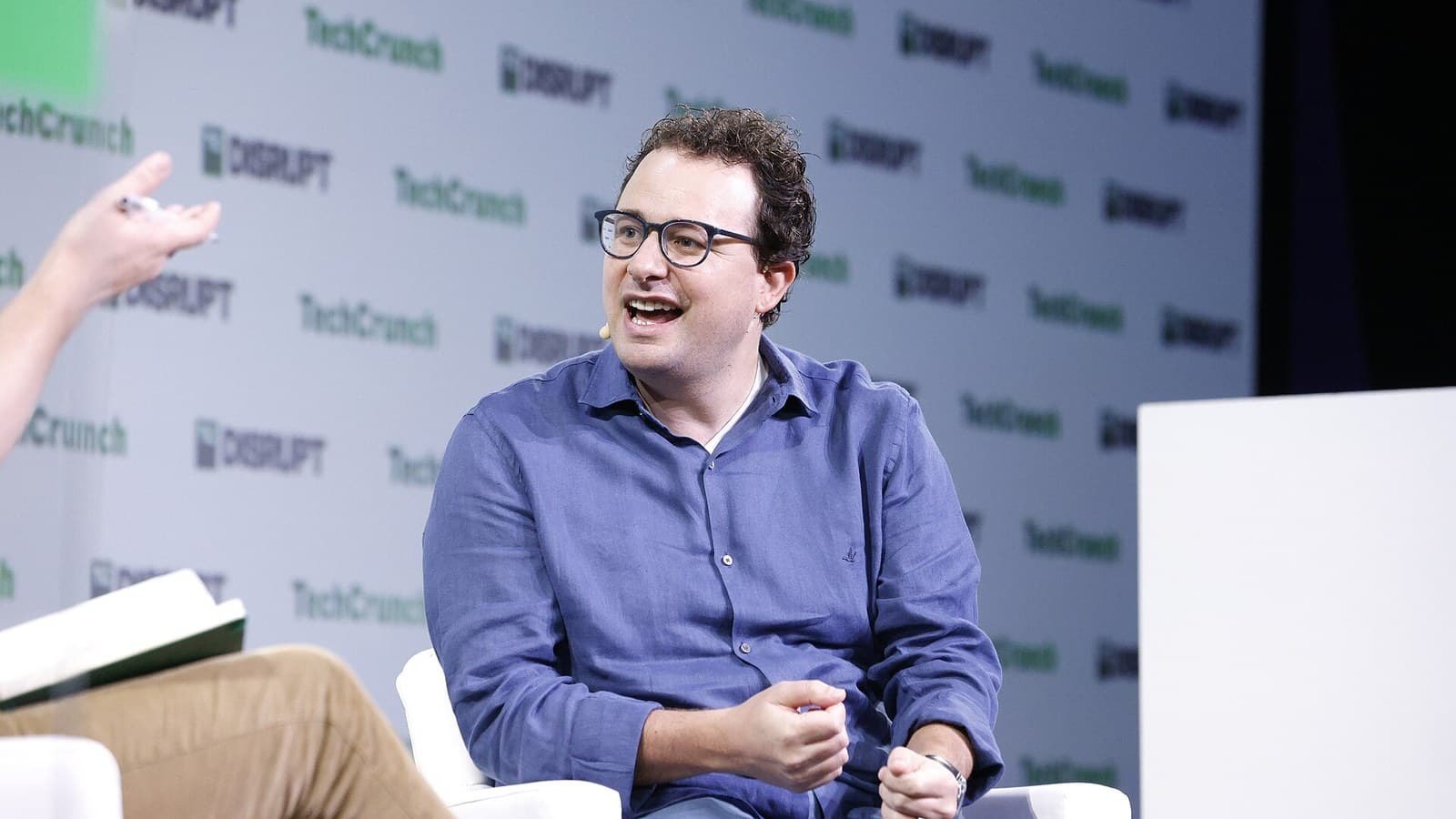
Cover image: “Dario Amodei at TechCrunch Disrupt 2023” by TechCrunch, CC BY 2.0, via Wikimedia Commons, cropped 16:9.
Tags
Frequently asked questions
- Has Anthropic built a self-improving AI?
- No. The amended S-1 says Anthropic has not designated any current model as exceeding its threshold for dramatically accelerated progress, and the language is about internal estimates and expectations for future models. Anthropic's own research page also says the company is not there yet.
- What is recursive self-improvement?
- Recursive self-improvement describes an AI system becoming capable enough to design and build a more capable successor, which then does the same, so that capability grows faster than the human research process alone would allow. It has no single agreed technical threshold, and AI assisting human engineers is not the same as AI running the loop on its own.
- What exactly did Anthropic's amended S-1 say about RSI?
- The filing says Anthropic's internal estimates and expectations regarding future models, rather than its current models, indicate that it may imminently meet the Responsible Scaling Policy definition of dramatically accelerated progress attributable to AI. It adds that no current model has been designated as exceeding the threshold and that the company continues to assess the underlying data.
- How much has Anthropic committed to compute and infrastructure?
- About $895 billion, according to the amended S-1, with nearly half of that spending expected by the end of 2030. The figure is a commitment to pay over time, not money already spent.

TPW Editorial
Editorial Team
TechPastWeek's editorial team reports and edits every story we publish. We research each piece against primary and credible secondary sources, and a human editor reviews and signs off before it goes live.