Fortnite Bets Its November on One Piece and an 80-Player Island
Fortnite's Treasure Hunters mini-season is live with an 80-player Crossbones Isle, One Piece characters and a staggered schedule of November shop drops.

On this page
Key takeaways
- Fortnite's Treasure Hunters mini-season launched on November 1, 2026 with update v43.00, replacing Chapter 7 Season 4.
- Crossbones Isle is smaller than the previous map and caps matches at 80 players, with 12 named points of interest including Arlong Park, Windmill Village and Loguetown.
- The One Piece Battle Pass includes Nico Robin and Portgas D. Ace, while Luffy, Nami and Usopp were in the item shop at launch and Zoro, Sanji and Chopper were scheduled for November 7.
- Epic cancelled a planned music pass three days before launch and extended the existing Lil Tecca pass by three months.
- The season is expected to run about 30 days, with Chapter 7 ending in a live event on December 5 and Chapter 8 expected in December 2026.
Fortnite's Treasure Hunters mini-season went live on November 1, 2026 with update v43.00, replacing Chapter 7 Season 4 and putting One Piece characters on a map built for 80 players instead of 100. Epic's status account said downtime began at 1 a.m. ET, with matchmaking ending shortly beforehand, and Timesaver reported servers back at 08:12 UTC. The GameSpot overview and IGN's patch notes agree on the broad shape: a smaller island, a crossover Battle Pass, and a run of shop drops that stretches through mid-November.
Related reading: Modern Warfare 4 Season 1 Puts Warzone at the Center on 6 November · GTA VI Has Already Booked About $630 Million in Pre-Orders.
The crossover sells the season. The map may decide whether it plays well. Crossbones Isle is shaped like a skull and crossbones and carries more water than the island it replaced, with 12 named points of interest. Three come from One Piece: Arlong Park, Windmill Village and Loguetown. The rest include The Chest, Loot Lagoon, Lantern Landing, Cursed Cavern, Plunder Port, Busy Bay and Rubber Resort, plus Lil Uzi Vert's Stronghold and The $.$. Rocky, an A$AP Rocky battleship.
The lobby size matters more than the theme
Cutting a lobby from 100 to 80 does more to a battle royale than any skin. On a map that is also smaller, the player-per-area ratio stays closer to the old one, so the island should not feel empty. What changes is the cost of moving. With more water between named locations, rotations take longer, and the 12 points of interest sit closer together than they did on the previous island. The intended result is a faster loop with more early fights.
That is a design trade, made for a season expected to last about 30 days rather than a full chapter. A smaller map gives a short season a tighter loop: fewer long quiet stretches, more contact, quicker decisions about where to land. It also limits how much of the island players have to learn before the chapter ends. The risk sits on the other side. An 80-player cap reduces the number of squads in a match, and a smaller island with more water can make the final circles more predictable if rotations funnel through the same crossings.
A short-season experiment, not a new default
Epic has not said the 80-player cap will carry into Chapter 8. The smaller lobby arrives with a smaller map and a roughly 30-day season, which makes it a controlled change rather than a permanent reduction in match size.
One Piece arrives as a calendar, not a launch day
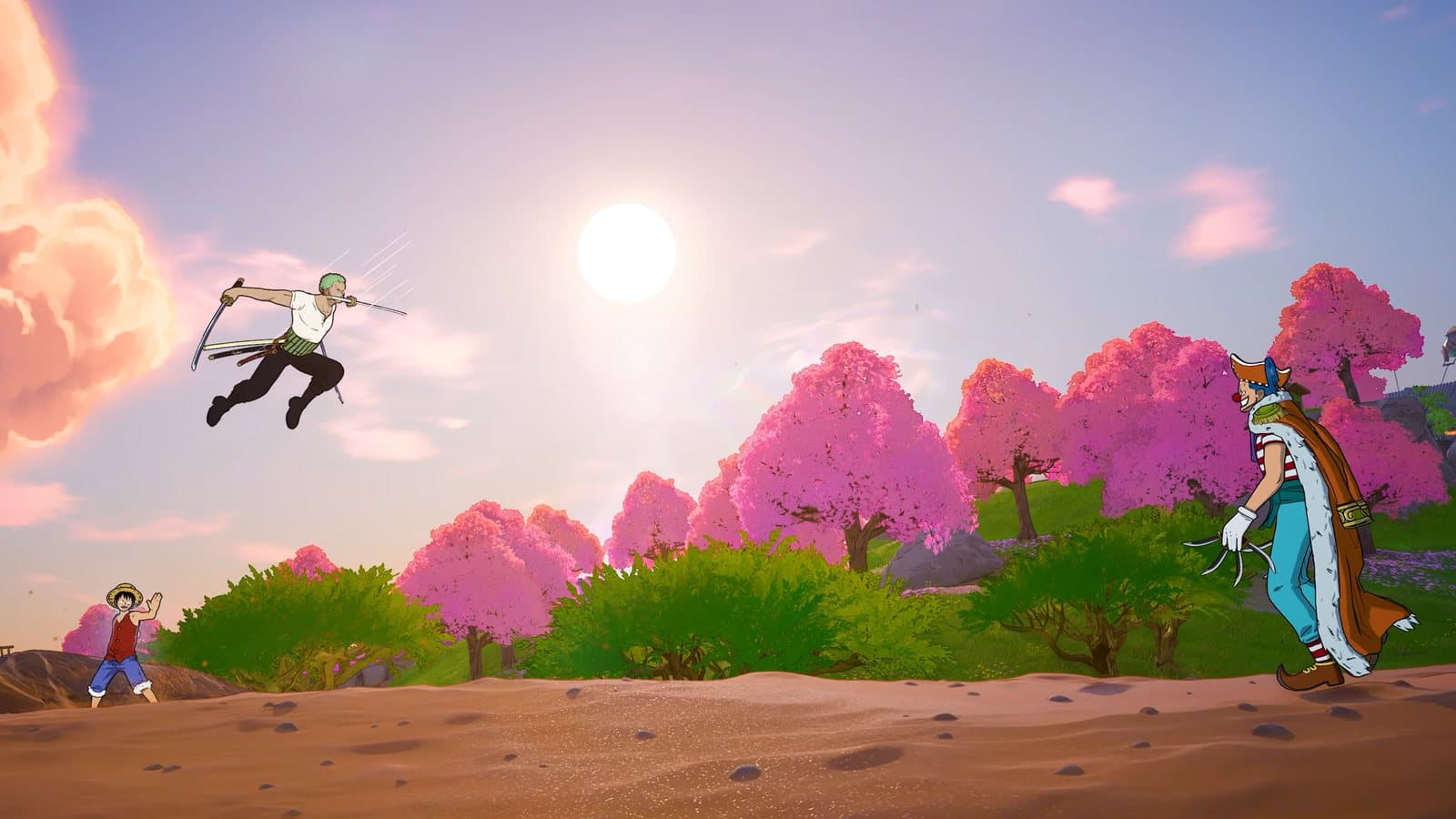
The Battle Pass carries Nico Robin and Portgas D. Ace. Luffy, Nami and Usopp were in the item shop at launch. Zoro, Sanji and Chopper, the last as a sidekick, were scheduled for November 7, and Buggy the Star Clown for November 13, according to GameSpot's report of Epic's schedule. That gives the season three shop dates between November 1 and November 13, on top of the Battle Pass, and the dates come from reporting rather than a live store page.
The loot follows the license. The Gum-Gum Fruit grants Gum-Gum Rocket and Pistol abilities, the Flame-Flame Fruit is in the season, and Zoro's Three Swords is a weapon, as Beebom's key art report and GameSpot both note. The fruit powers give the crossover a mechanical identity beyond costumes: a movement option and a ranged attack that last only as long as the season's loot pool.
Spreading the character drops also changes the shape of launch week. A single day with every One Piece skin would concentrate spending and then fade. A schedule keeps the collaboration in the shop rotation for the length of the season, and gives players who cannot afford a full set a reason to come back for one item. Store rotations have slipped before, so the dates are plans rather than guarantees.
The original characters borrow the same language
The Battle Pass also leans on Epic's own characters. It includes anime-themed versions of Jonesy and Syd, a remix of Charlotte, and Captain X, who unlocks on November 21 through weekly quests. They carry no external license and give the season a visual style that holds together when the One Piece items rotate out of the shop.
Captain X is the interesting one. A late-season unlock tied to weekly quests rewards players who keep playing into the back half of a short season, when the launch crowd has usually moved on. It is a retention tool disguised as a reward.
A music pass disappeared days before launch
Three days before the season began, Epic cancelled a planned music pass and extended the existing Lil Tecca pass by three months, according to GameSpot. The company has not explained the decision in the material reviewed for this article. The timing is the signal. A pass cancelled that close to launch was already part of the season's planning, which makes the change look like an adjustment to the monetization calendar rather than the content slate.
The music collaborations still run. A$AP Rocky arrives on November 5, Lil Uzi Vert on November 12, and Kasane Teto with a pirate-themed Hatsune Miku on November 14. Those are shop events rather than a pass, which means the revenue comes from individual sales instead of a multi-tier purchase. Whether that earns more or less than a pass would have is exactly the question Epic is not answering publicly.
The season is a bridge with a fixed far end
Fortnite's annual November mini-season has become a bridge between the end of a full chapter season and the start of the next chapter. Last year's was The Simpsons-themed. This year's leans on One Piece, described by GameSpot as one of the most requested collaborations in the game. The season is expected to run about 30 days, and Chapter 7 will end with a live event on December 5. Chapter 8 is expected in December 2026, according to Vice's pre-launch explainer and GameSpot.
The mini-season exists to hold attention between a chapter finale and a new map, and its content schedule is built to do that week by week.
The exact end date is not confirmed on the Battle Pass page. That gap matters more than it sounds. If the mini-season ends before December 5, players get a short lull before the finale. If it runs through the event, the finale becomes the season's closing beat. Epic has confirmed the December 5 event but not how the two fit together.
The format suits a license like One Piece. A full chapter would require a map and a story built around it for months. A 30-day mini-season lets Epic use the characters, sell the skins and leave the underlying game intact for Chapter 8.
Eighteen days before GTA VI
The launch lands 18 days before Grand Theft Auto VI arrives on November 19. Fortnite is competing for the same attention and the same spending window, and a large anime crossover is one way to hold players who might otherwise drift toward Rockstar's release. GameSpot frames the season in those terms. The logic is straightforward: a live-service game cannot pause while a rival takes the news cycle, so it schedules its biggest collaboration of the autumn directly in front of it.
Whether that works is unproven. A crossover can bring lapsed players back for a week without keeping them for a month. The staggered shop schedule is the part designed to stretch that return, and the weekly quests around Captain X serve the same purpose. Both are attempts to convert a launch spike into a month of sessions.
The calendar also stacks the crossover drops ahead of the rival launch. A$AP Rocky on November 5, Lil Uzi Vert on November 12 and Kasane Teto on November 14 all land before November 19, so the collaboration's shop traffic arrives while Fortnite still has the window to itself. That sequencing looks deliberate even if Epic has not framed it that way: the season's content peaks before GTA VI, not after.
What Epic has not said
Epic has not published player numbers, revenue or engagement for the new season. The 80-player cap and the 12 named points of interest come from Epic's materials as reported by GameSpot and IGN, not from a public document. The One Piece shop dates are from the same reporting. Chapter 8's release date is expected in December rather than confirmed to a day, and the mini-season's exact finish is not stated on the Battle Pass page. Some early details circulated through datamining and leaks before launch, which is why this article relies on post-launch reporting and Epic's own materials rather than pre-release speculation.
The missing numbers are the ones that would settle the argument. A smaller lobby could improve pacing or make matches feel thin. One Piece could lift November engagement or simply pull existing players into new purchases. Without retention or revenue data, both readings remain open.
The signals that will settle it
- November 7 and November 13. The Zoro, Sanji, Chopper and Buggy drops will show whether the staggered schedule produces repeat shop traffic or a single launch spike.
- November 21. Captain X and the weekly quest chain test whether a late-season unlock can hold players into the final third of a 30-day run.
- December 5. The Chapter 7 live event is the one hard date on the calendar, and it will define how the mini-season hands off to Chapter 8.
- The first engagement disclosure. Epic has published no player numbers for this season, so any figure that surfaces, from Epic or a tracking firm, will be the only real check on whether 80 players and One Piece worked.
For now the season is live, the shop schedule is public, and the 80-player cap is the one match-size figure in Epic's materials. Everything else, from retention to revenue, is still unpublished.
Cover image: Fortnite: Treasure Hunters gameplay screenshot, courtesy of Epic Games, via IGN.
Tags
Frequently asked questions
- When did Fortnite's Treasure Hunters mini-season launch?
- It launched on November 1, 2026 with update v43.00, replacing Chapter 7 Season 4. Epic's status account said downtime began at 1 a.m. ET, and Timesaver reported servers back at 08:12 UTC.
- How many players are in a Treasure Hunters match?
- Matches are capped at 80 players instead of the usual 100. The new Crossbones Isle map is smaller than the previous island and has 12 named points of interest.
- Which One Piece characters are in Fortnite?
- Nico Robin and Portgas D. Ace are in the Battle Pass. Luffy, Nami and Usopp were in the item shop at launch. Zoro, Sanji and Chopper were scheduled for November 7, and Buggy the Star Clown for November 13.
- How long does the Treasure Hunters season last?
- It is expected to run about 30 days. Chapter 7 ends with a live event on December 5, and Chapter 8 is expected in December 2026, but Epic has not confirmed the mini-season's exact end date.

TPW Editorial
Editorial Team
TechPastWeek's editorial team reports and edits every story we publish. We research each piece against primary and credible secondary sources, and a human editor reviews and signs off before it goes live.