Apple Puts Touch on the Mac at $2,899, Reversing a Long Resistance
Apple's first touchscreen MacBook Pro starts at $2,899 in the US and ships 6 November, ending years of resistance and climbing to $14,549 fully specced.

On this page
Key takeaways
- Apple announced the MacBook Pro with PROLED XDR Display and Touch on 28 October 2026, its first touchscreen Mac, starting at $2,899 with shipping from 6 November.
- The 14-inch and 16-inch models use M5 Pro or M5 Max chips, not the M6 announced in a separate 14-inch MacBook Pro on 27 October.
- A fully specced 16-inch configuration reaches $14,549, about five times the $2,899 entry price, according to The Verge.
- Existing apps respond to touch because macOS 27 translates touches into clicks, while new gesture APIs let developers build touch-specific controls.
- Apple names touch support for Notion, Canva, Word, Lightroom, DaVinci Resolve, Blender and Shapr3D, but says third-party apps will be available later this year.
Apple put a touchscreen in a MacBook Pro on 28 October 2026 and priced it at $2,899. Preorders for the 14-inch model opened the same day; the 16-inch starts at $3,399, and both ship on 6 November. The product is called the MacBook Pro with PROLED XDR Display, a long name for a straightforward change: Apple now sells a laptop that responds to a finger, after years of arguing that nobody should want one.
Related reading: Apple's New iPad Mini Starts at $699, $200 Above the Model It Replaces · iPhone Duo Pre-Orders Slip to January 2027 as Apple Warns Against Walk-Ins.
The display is impressive and the chip is an iteration, but neither explains why the company changed its mind about a category it spent a decade dismissing. Apple's press release announces the feature and never mentions the argument it settles.
Steve Jobs, in 2010, called touchscreen laptops "ergonomically terrible." Tim Cook, in 2012, put it another way: "You can converge a toaster and a refrigerator, but those things are probably not going to be pleasing to the user." Apple then spent seven years selling the Touch Bar, a thin strip of touch controls above the keyboard, and dropped it in 2023.
Neither quote is a technical judgment. Both are arguments about posture. A laptop screen sits upright and a little beyond arm's length, which is a poor place to put a finger, and the trackpad is closer to the hand than the display will ever be. That reasoning still holds. What Apple has done is stop treating it as decisive.
The Touch Bar taught a specific lesson: a touch surface that replaces keys forces people to look down and away from the screen. A touchscreen that supplements an existing trackpad and keyboard requires nothing of the user. It can be ignored, which is a lower bar than the Touch Bar had to clear.
The sensor moved inside the panel
The touch sensor is built into the display panel rather than layered on top of it. Apple says that reduces latency, and the engineering claim is easy to state: a separate touch layer would sit between the pixels and the glass. That adds thickness and another optical surface. Building the sensor into the panel avoids the trade.
The panel itself is a tandem OLED design that Apple markets as PROLED XDR. The 14.2-inch and 16.3-inch screens carry slimmer bezels than the models they replace and reach 2,000 nits peak brightness in both HDR and SDR, with a 10,000,000:1 contrast ratio. ProMotion runs from 10Hz to 120Hz. The displays cover P3 and Adobe RGB and exceed 80% of Rec. 2020. A nano-texture finish is etched into the cover glass rather than applied as a coating.
Around the screen, the changes are the ones touch makes necessary:
- Hinge. Apple designed a new one for stability when a finger pushes against the display.
- Weight. The 14-inch is 3.0 lb, half a pound lighter than before; the 16-inch is 4.0 lb, down 0.7 lb.
- Thickness. The 14-inch loses 0.5mm and the 16-inch nearly 1mm.
- Battery. Up to 24 hours, with a fast charge to 50% in 30 minutes on Apple's September 2026 test.
The machine has three Thunderbolt 5 ports, HDMI, SDXC, MagSafe 3 and a headphone jack, plus Wi-Fi 7 and Bluetooth 6. There is a 12MP Center Stage camera and a six-speaker system with 50% deeper bass. An M5 Pro machine drives up to three external displays and an M5 Max up to four.
The software problem, solved by translation
A touchscreen with no touch software is a demo. Apple's answer is that macOS 27 translates touches into clicks, so every existing application responds to a finger the moment the machine boots. That is a compatibility layer, not a redesign, and it is the reason the feature does not arrive with an empty app catalogue.
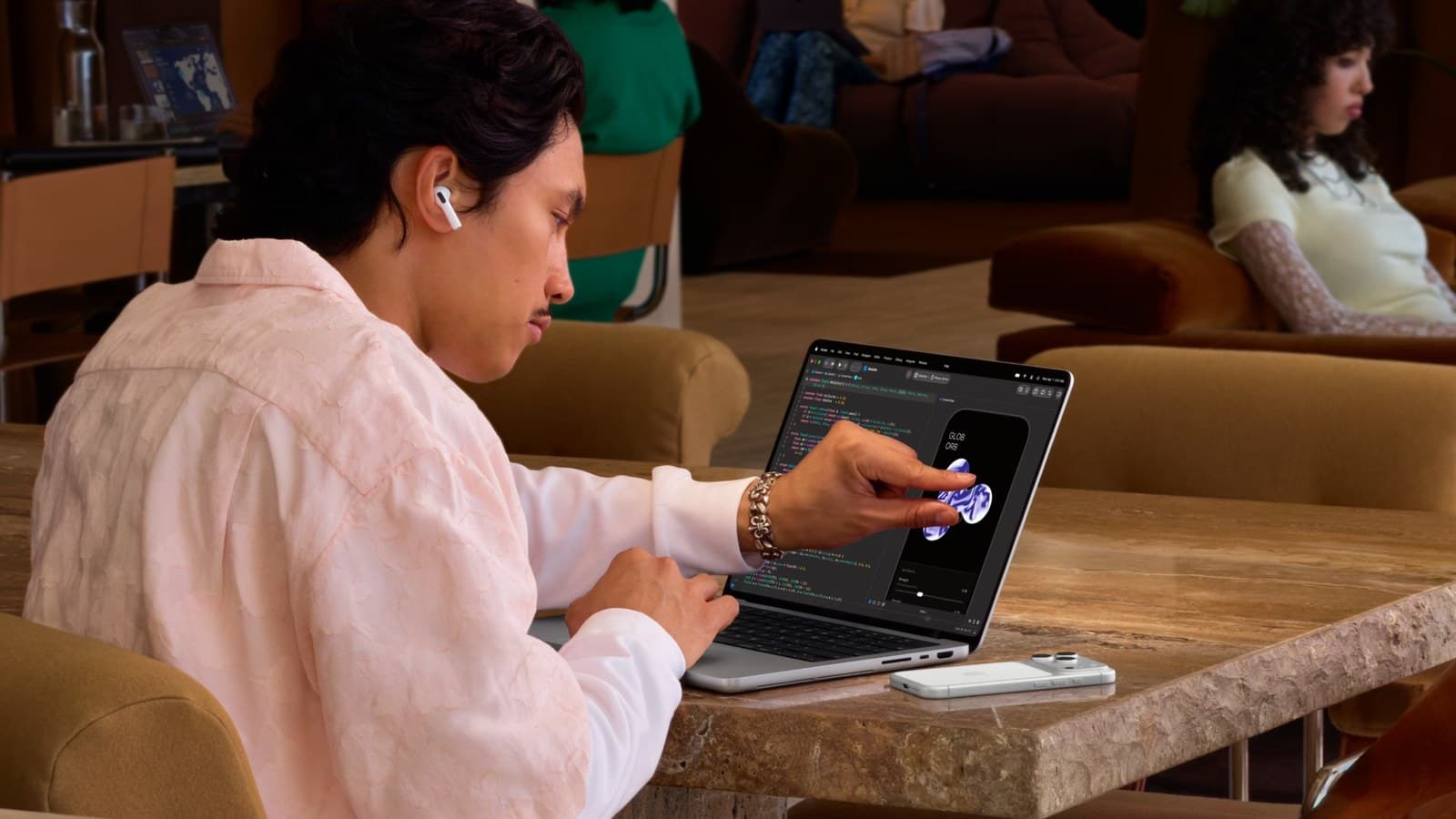
The more interesting part is what developers can do beyond that. New gesture APIs let them build controls that expect a finger: dragging a slider, pinching a canvas, rotating a model. Apple's own Final Cut Pro, Logic Pro and Pixelmator Pro get touch features at launch. The third-party list is long and specific: Notion, Canva, Zoom, Microsoft Word, Excel, PowerPoint and Outlook, Adobe Lightroom, DaVinci Resolve, Blender, Maxon Cinema 4D, Maxon ZBrush, Shapr3D and Algoriddim djay Pro.
Two MacBook Pros in one week
Apple announced a 14-inch MacBook Pro with an M6 chip and an M6 iMac on 27 October, one day before this event. The touchscreen machine uses M5 Pro or M5 Max. They are separate products with similar names, and the chip is the quickest way to tell them apart. The same week also brought an OLED iPad mini starting at $699, with preorders on 28 October and sales from 6 November.
Apple says the listed third-party apps "will be available later this year," so the launch window may not include all of them. Buyers on 6 November get the translation layer and Apple's own touch features. The professional app support that makes the screen useful for modelling, photo editing or timeline work is promised for later in the year, not for launch day.
The Dynamic Island also arrives on the Mac for the first time, as the home for Spotlight, Live Activities and Siri. Siri AI is in beta in macOS 27.2 and needs a supported language and device. Apple says it is currently unavailable in the EU on iOS, iPadOS and watchOS, so the assistant side of this launch is the least settled part of it.
"PROLED XDR is the world's best laptop display" — Johny Srouji, Apple chief hardware officer, press release, 28 October 2026
A $2,899 floor and a $14,549 ceiling
Touch is not sold as an extra. Every configuration in the new line has it, and the range runs from $2,899 for a 14-inch M5 Pro to $14,549 for a fully specced 16-inch, a figure The Verge reported on announcement day.
| Configuration | US price | Education price |
|---|---|---|
| 14-inch, M5 Pro | $2,899 | $2,749 |
| 16-inch, M5 Pro | $3,399 | $3,199 |
| 14-inch, M5 Max | $4,499 | $4,199 |
| 16-inch, M5 Max | $4,799 | $4,499 |
The ceiling comes from memory and storage rather than the screen. The line supports up to 128GB of unified memory and up to 16TB of storage, and the top M5 Max configuration with both is where the $14,549 comes from. That is roughly five times the entry price for the same display technology and the same touch layer.
The $2,899 model is the one that will be compared with every other premium 14-inch laptop. The $14,549 model is a workstation configuration, and the buyers who choose it will expense it.
The M6 laptop is a different machine
The naming collision is the most likely source of buyer confusion this week. Apple's 27 October announcement covered a 14-inch MacBook Pro with an M6 chip and an M6 iMac. The 28 October announcement covered the MacBook Pro with PROLED XDR Display, which uses M5 Pro and M5 Max silicon, up to 128GB of memory, a Neural Accelerator in every GPU core and third-generation ray tracing.
Both are 14-inch MacBook Pros, and only one has a touchscreen. The M6 model was announced first and sits below the new line on price, positioned as a standard MacBook Pro rather than a pro-display machine, an unusual order for two launches in two days.
Who this is actually for
The app list answers the question better than the marketing does. Shapr3D, ZBrush, Cinema 4D and Blender are tools for manipulating objects in three dimensions, where rotating a model with a finger is faster than finding the orbit control with a cursor. Lightroom and Pixelmator Pro are masking and brushing tools, where a fingertip is a crude but direct brush. DaVinci Resolve and Final Cut are timeline tools, where scrubbing with a finger is a natural gesture and precise trimming is not.
In each case, touch is a shortcut for one motion and a worse option for the next. That is also why the ergonomic objection from 2010 has not been refuted. Apple is not asking anyone to work with an arm outstretched. It is selling a second input method for the moments when the pointer is in the wrong place.
The professional framing fits the business. Macs were about 10% of Apple's revenue in the most recent quarter, according to CNBC, and Apple shares were up 26% year to date as of 19 October, ahead of the S&P 500. A higher entry price on the flagship laptop helps revenue per unit without requiring a new category, and it puts the touchscreen in front of the people most likely to pay for it.
What the spec sheet does not settle
Every brightness, contrast, battery and performance figure here is Apple's own measurement, not an independent test. No reviews of shipping units exist yet; the press has had hands-on time only. The $2,899 price is US before tax, and the $14,549 figure is a configuration ceiling. Third-party touch apps are promised for later this year, and Siri AI is in beta with regional limits.
Caveats
- The display numbers are claims. 2,000 nits, 10,000,000:1 contrast and 24 hours of battery come from Apple's test conditions, including a September 2026 fast-charge test. Nobody outside the company has measured a production unit.
- Hands-on is not a review. Early coverage describes feel and build, not sustained work. Whether the hinge stays firm after a year of poking, and whether fingerprints on a nano-texture surface are a real annoyance, are open questions.
- The price is a US price before tax. Education pricing starts at $2,749, and the $14,549 ceiling assumes 128GB of memory and 16TB of storage.
- The software is not finished. Siri AI is beta in macOS 27.2, and the third-party touch apps Apple named have a "later this year" window rather than a launch date.
- Touch is not on the cheaper Mac. The M6 14-inch MacBook Pro announced on 27 October is a different machine, and the MacBook Air has no touchscreen.
What ships on 6 November
The first units arrive nine days after the announcement, with the translation layer, Apple's own touch-enabled apps and the new hinge. The third-party apps arrive later in the year. Siri AI arrives as a beta, and not in every region.
The machine that decides whether touch sells on the Mac is the $2,899 one, because that is the configuration most buyers will compare against everything else on a shelf. The $14,549 version will sell in small numbers to people with a specific render or a specific deadline. Apple has not published unit expectations for either, and the first real evidence will come from reviews that require a shipping unit and a few weeks of use.
Cover image: MacBook Pro with PROLED XDR Display product image courtesy of Apple.
Tags
Frequently asked questions
- When can I buy the touchscreen MacBook Pro?
- Preorders opened on 28 October 2026 and the machines ship on 6 November. The 14-inch model with an M5 Pro chip starts at $2,899 in the United States, or $2,749 for education.
- Does the touchscreen MacBook Pro use the M6 chip?
- No. It uses the M5 Pro or M5 Max. Apple announced a separate 14-inch MacBook Pro with an M6 chip on 27 October, one day earlier, and the two machines are different products.
- Do existing Mac apps work with touch?
- Yes. macOS 27 translates touches into clicks, so current apps respond without an update. Developers also get gesture APIs for touch-specific interfaces, and Apple says the third-party apps it named will arrive later this year.
- How much does a fully specced model cost?
- The Verge puts a fully configured 16-inch machine at $14,549. That is a configuration ceiling rather than a typical price; the range starts at $2,899 before tax.

TPW Editorial
Editorial Team
TechPastWeek's editorial team reports and edits every story we publish. We research each piece against primary and credible secondary sources, and a human editor reviews and signs off before it goes live.