Castlevania: Belmont's Curse Launches to the Series' Best Reviews in Years
Castlevania: Belmont's Curse arrived October 15, 2026 to the series' strongest reviews in two decades, with OpenCritic at 86 and Metacritic up to 88 on Xbox.

On this page
Key takeaways
- Castlevania: Belmont's Curse launched on October 15, 2026 for Nintendo Switch, PlayStation 5, Windows and Xbox Series X/S, with Steam listing the PC build for October 14.
- It is the 26th main entry in the Castlevania series, the first new console game since Lords of Shadow 2 in 2014, and the first traditional 2D story in the original timeline since Order of Ecclesia in 2008.
- OpenCritic reports about an 86 top-critic average with 96% of critics recommending, and Metacritic shows 82 on PC, 84 on PS5 and 88 on Xbox Series X/S.
- OpenCritic calls it the highest-rated traditional Castlevania game since 2005's Dawn of Sorrow and the fifth highest-rated in the series overall.
- Evil Empire, the studio behind Dead Cells, developed the game with Motion Twin advising, and Konami has said it is not a roguelike.
Castlevania: Belmont's Curse launched on October 15, 2026 for Nintendo Switch, PlayStation 5, Windows and Xbox Series X/S, the 26th main entry in a series that began in 1986 and the first new console Castlevania since Lords of Shadow 2 in 2014 (Wikipedia). Evil Empire, the studio behind Dead Cells, developed it. Konami published it, with Dead Cells co-creator Motion Twin in an advisory role. On PC, the Steam listing carried a release date of October 14.
Related reading: Castlevania Turns 40, and Konami Is Giving the Original Away on Mobile · Well Dweller Turns a Tiny Bird With a Matchstick Into a Dark Fairy-Tale Hero.
The game matters for two reasons. It puts the series back into the exploration-driven 2D format that made its name, and it is the first shipped result of Konami's plan to rebuild Castlevania after years of rereleases, collections and licensing. The reviews suggest the plan is holding up: OpenCritic reports a top-critic average of about 86 with 96 percent of critics recommending, and Metacritic lists 82 on PC, 84 on PS5 and 88 on Xbox Series X/S.
Back inside the castle
Belmont's Curse follows the non-linear template set by Symphony of the Night in 1997. The player controls Rose Belmont, daughter of Trevor Belmont and Sypha Belnades, in 1499 Paris, where a castle materialises in the middle of the city 23 years after the events of Castlevania III: Dracula's Curse. She carries the family whip, the Vampire Killer. The setting connects this game to the oldest strand of Castlevania continuity rather than to the reboot or the handheld lines, which matters to a fanbase that has spent a decade arguing about which timeline Konami wanted to continue.
A demo released on October 1, covering the opening areas and the first boss, with progress carrying over into the full game. That gave players roughly two weeks to form their own view before the reviews landed, and it is the kind of move that suits a game whose appeal depends on feel rather than on a marketing trailer.
Placing a daughter of Trevor and Sypha at the centre links the game directly to Castlevania III: Dracula's Curse, the entry that first assembled that pairing. The setting is Paris rather than the usual remote countryside, but the premise solves that neatly by bringing the castle to the city instead of asking the hero to journey out to it. For a series that has spent decades revisiting the same castles from different angles, an urban backdrop with a castle dropped into it is one of the few genuinely fresh rooms Konami could have opened.
What Metroidvania means here
The term describes the structure Symphony of the Night established: one connected map, abilities that unlock new routes, and backtracking into places that were previously out of reach. Belmont's Curse is a deliberate return to that design after a long gap.
A series that had gone quiet
Konami greenlit several new Castlevania projects as part of a 2021 shift back toward premium console and PC games. Belmont's Curse is the first of those to ship, and Konami has described it as the first of several new Castlevania titles rather than a one-off revival. The 40th-anniversary timing is not incidental; anniversaries give publishers a reason to spend on marketing a dormant property, and Konami's own official site frames the release in that context.
The choice of developer was deliberate. Dead Cells shares the exploration DNA that Castlevania helped define, even though it pushes that DNA toward fast, repeatable runs. Konami wanted a team that could hold on to the classic sense of discovery while modernising how it plays, and it has been explicit that the result is not a roguelike, despite the Dead Cells lineage behind it. That distinction matters, because the obvious question when the studio was announced was whether Castlevania was being folded into the run-based template.
There is a business logic underneath. A well-received 2D Castlevania is cheaper to build than a full 3D reboot and can be sold on nostalgia at a lower risk. If this one earns back its production cost, the rest of the greenlit slate becomes easier to justify.
What the reviews say
The aggregate picture is strong. OpenCritic ranks the game in the 95th percentile of everything it has scored. Its news desk went further and called it the highest-rated traditional Castlevania game since 2005's Dawn of Sorrow, and placed it as the fifth highest-rated Castlevania overall, behind Circle of the Moon and Aria of Sorrow at 91 and Symphony of the Night and Dawn of Sorrow at 89.
On Metacritic, the PS5 figure of 84 comes from 55 critic reviews, of which 51 were positive and three mixed. Xbox Series X/S sits highest at 88. PC trails at 82, a gap the headline average smooths over. A lower PC score can reflect a mix of performance problems and a different review pool.
Across outlets the scores cluster tightly instead of splitting between admirers and detractors. A breakdown of 51 positive against three mixed leaves little room for a prominent dissent, and the named reviews run from strong to stronger. That consistency is itself informative: the critical question in the run-up to launch was whether a Dead Cells studio could deliver a Castlevania, and the reviewers answering it appear to have agreed.
Named reviewers landed close to the aggregate. IGN's Scott White wrote that the game "brings Konami's beloved series into the modern era with a fast-paced focus on action first." GameSpot's Steve Watts titled his review "Castlevania: Belmont's Curse Is The Series At Its Best." Game Informer's Charles Harte called it "Worthy of the Whip." TheGamer's George Foster gave it 4.5 out of 5.
The recurring praise centres on combat, exploration and level design, the art, and the voice acting. Reviewers describe a near-perfect blend of classic whips-and-castle Castlevania with modern action-platforming, which is roughly what Konami said it wanted when it hired this studio.
"It's like 2D Castlevania never left." — Dom Peppiatt, Eurogamer, reviewing Castlevania: Belmont's Curse, October 2026
Why the reception matters beyond launch week
A high Metacritic score at this scale does something specific for Konami. Castlevania has spent years as a catalogue property, its reputation carried by 1990s and 2000s games that keep getting reissued. A new entry that reviewers rank beside Symphony of the Night gives the company a current reference point, and it gives the announced slate of further titles evidence that the formula still works.
The casting is part of the same continuity play. The voice cast includes Abby Trott as Rose, JB Blanc as Trevor, Alejandra Reynoso as Sypha and Graham McTavish as Dracula, with Reynoso and McTavish reprising roles from the Netflix animated adaptation, plus Liam O'Brien as Isaac. Konami is leaning on the animated series' audience and rewarding people who came to Castlevania through the show rather than the games.
The counterargument is that goodwill for a 2D revival is easy to overread. The last decade's strongest Castlevania memories are handheld and 16-bit, and a good new one does not automatically rebuild a franchise. It does, however, remove the most common complaint about the series, which was that Konami had stopped making games for it.
The comparison to Symphony of the Night is the one OpenCritic leans on, and it is also the most dangerous one available. Symphony is nearly thirty years old and its reputation has grown well past what any single release can match, so a new game measured against it will read as a successor rather than a peer. The fairer benchmark is the series' own recent past: Order of Ecclesia in 2008, Lords of Shadow 2 in 2014, and the long quiet stretch between them. Against that, a mid-80s aggregate is not a coronation. It is a restart.
Caveats
Three things are uncertain or worth stating plainly.
The scores are a snapshot. OpenCritic and Metacritic averages move as more outlets publish, and a game reviewed by 55 outlets on one platform will settle differently from one reviewed by far fewer elsewhere. Treat the exact numbers as current rather than final.
The platform spread is real and easy to flatten. The Xbox Series X/S Metascore of 88 is six points above the PC score of 82 and four above PS5's 84, so a single "the game scores 86" line hides how differently the versions have been received. Which platform each figure belongs to should be stated every time it is quoted.
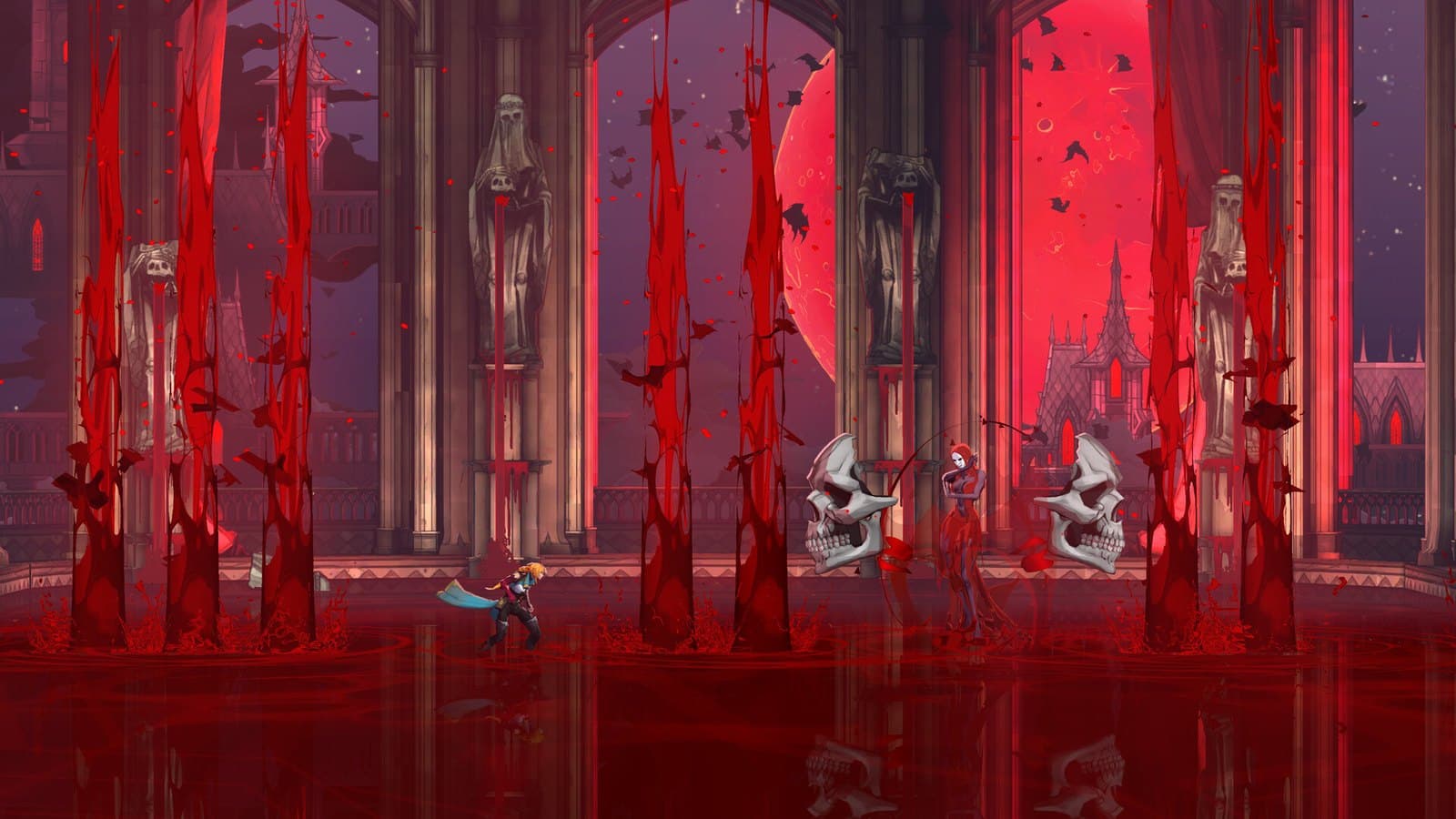
The cover image for this article is an official promotional screenshot from the Steam store page, not a capture from a review build, so it reflects marketing material rather than what reviewers actually played.
Aggregates move after launch
The Metacritic and OpenCritic figures here were recorded during launch week. They can shift a point or two as late reviews arrive, so the direction of the reception is the reliable signal and the exact averages are provisional.
What to watch
- Sales against the 2014 benchmark. No unit figures have been published. Lords of Shadow 2 is the last console Castlevania to compare against, and how this game performs will tell Konami whether the 2D path is worth repeating.
- The rest of the greenlit slate. Konami has said Belmont's Curse is the first of several new Castlevania titles. Confirming the next one, and its format, would show how far the revival goes.
- PC performance patches. The lower PC score leaves room for post-launch fixes to shift how the version is seen.
- Whether the timeline continues. Rose Belmont's story sits in the original continuity. A follow-up in that thread, or a jump to another era, would signal which direction the series takes next.
- Awards season. A score near the top of the series and a 95th-percentile OpenCritic placing put it in the conversation for year-end lists, which tend to extend a game's sales tail.
The reviews give Konami the clearest sign in years that there is still an audience for a 2D Castlevania. Whether that audience is large enough to fund the next one is the question the sales figures will answer.
Cover image: official Castlevania: Belmont's Curse in-game screenshot, courtesy of Konami (Steam store page).
Tags
Frequently asked questions
- When did Castlevania: Belmont's Curse come out?
- The game launched on October 15, 2026 for Nintendo Switch, PlayStation 5, Windows and Xbox Series X/S. The Steam store page listed the PC version for October 14.
- What platforms is Castlevania: Belmont's Curse on?
- Nintendo Switch, PlayStation 5, Windows and Xbox Series X/S. It is the first new console Castlevania since Lords of Shadow 2 in 2014.
- How is Castlevania: Belmont's Curse reviewed?
- Strongly. OpenCritic reports about an 86 top-critic average and 96 percent of critics recommending, while Metacritic shows 82 on PC, 84 on PS5 and 88 on Xbox Series X/S. OpenCritic called it the series' best traditional entry since 2005.
- Who developed Castlevania: Belmont's Curse?
- Evil Empire, the studio behind Dead Cells, developed it and Konami published it, with Dead Cells co-creator Motion Twin in an advisory role. Konami has said the game is not a roguelike.

TPW Editorial
Editorial Team
TechPastWeek's editorial team reports and edits every story we publish. We research each piece against primary and credible secondary sources, and a human editor reviews and signs off before it goes live.