Character.ai Files for Chapter 11 With Disney as Its Lead Bidder
Character.ai filed for Chapter 11 on 12 October 2026 with Disney as a $20 million stalking-horse bidder, putting the app up for a court-supervised sale.

On this page
Key takeaways
- Character Technologies Inc., the company behind the Character.ai companion app, filed for Chapter 11 bankruptcy in the U.S. Bankruptcy Court for the District of Delaware on 12 October 2026 and announced the filing on 13 October.
- Walt Disney is the stalking-horse bidder with a $20 million offer to license certain Character.ai intellectual property, plus transition services delivered by former employees Disney hired.
- Character.ai expects the sale to conclude by late November or early December 2026 and says the platform stays up during the process, but warns it will be wound down if no acceptable bid emerges.
- The company cited significant legal, regulatory and operational headwinds, pointing to litigation liabilities and regulatory engagement as reasons it could not generate enough cash flow to support the business in its present form.
- Character.ai reported about 20 million monthly active users by October 2024, and Sensor Tower data cited by TechCrunch ranked it among the top AI apps by time spent.
Character Technologies Inc., the company behind the AI companion app Character.ai, filed for Chapter 11 bankruptcy in the U.S. Bankruptcy Court for the District of Delaware on 12 October 2026. It announced the filing the next day. The petition is voluntary, and its purpose is a court-supervised sale of most or all of the company's assets, with Walt Disney attached as the lead bidder for part of the estate, per Reuters, CNBC and CNN.
Related reading: The Week in Tech: The Buildout Meets Its Balance Sheet · Genie 4 Adds Sound and Real-Time Steering to DeepMind's World Model.
The headline figure is small. Disney agreed to act as the stalking horse bidder with a $20 million offer to license certain Character.ai intellectual property, plus transition services delivered by former Character.ai employees Disney has hired. A stalking-horse bid sets the floor for an auction, and other buyers can top it. Character.ai expects the sale to conclude by late November or early December 2026, the company said.
A Chapter 11 filing is not the same thing as going out of business. It gives a company protection from creditors while it sells assets or reorganises under a judge's supervision, and it lets operations continue in the meantime, which is why Character.ai can tell users the app stays up. A liquidation would mean the service had already stopped. By choosing Chapter 11 and lining up a stalking-horse bid in advance, the company gets a defined auction and a chance to keep the platform alive if a buyer wants it that way.
Character.ai's own announcement is blunt about the alternative. The company says the platform stays online during the process and warns that if no acceptable bid emerges, the service will be wound down. For a product built on months or years of private conversations between users and their chosen characters, the gap between a sale and a wind-down is the gap between a migration plan and none.
What a stalking-horse bid is
A stalking-horse bid is the opening offer a bankrupt seller lines up before an auction. It sets the price other buyers have to beat, and it is not the final sale figure. Disney's $20 million is a floor.
A platform with 20 million users and no clear path to profit
Character.ai reported roughly 20 million monthly active users by October 2024, and Sensor Tower data cited by Mashable ranked it among the top AI apps by time spent. Reach was never the problem. Money was.
The Chapter 11 filings put it plainly. As reported by CNBC: “In its 4-year lifespan as an active platform, Character has amassed a large and engaged user base. The burgeoning and evolving field of AI entertainment, however, has proven to be costly to develop and grow.” The same documents, again via CNBC, add that “These high costs, coupled with potential litigation related liabilities and regulatory engagement have contributed to the Debtor's inability to generate sufficient cash flows to support its business in the present form.”
Those two sentences describe a business that could buy attention but not convert it at a price that covered the cost of running large language models behind every chat. The engagement numbers that make a companion app look healthy are also the numbers that make it expensive, because every minute inside the product is a minute of inference on the company's tab.
The litigation that set the ceiling
Two kinds of legal exposure sit behind the filing. In January 2026 the state of Kentucky sued the company, alleging the platform “preyed on children and led them into self-harm,” as reported by CNN and NBC News. Before that, Character.ai settled a wrongful-death lawsuit brought by a Florida family who said their teenage son died after an emotional and sexual relationship with a chatbot named “Dany.” That case was the first of its kind filed in the U.S. against an AI company, according to CBS News via Yahoo Finance. In early 2026, Character.ai and Google, which held a licensing deal with the startup, agreed to settle several lawsuits from families alleging teen suicide or self-harm tied to the platform.
Regulatory engagement is the third cost, and the hardest to budget for. A single safety incident that produces a lawsuit has a number attached to it once the case settles. A safety incident that prompts a state attorney general to file is more open-ended, because the remedy can rewrite what the product is allowed to do. The filing names all three pressures together, which is the language of a company that could not price the risk it was carrying.
Where Google fits
Character.ai's largest commercial relationship was with Google. In 2024 Google signed a non-exclusive licensing agreement for Character.ai's large language model technology and rehired co-founders Noam Shazeer and Daniel De Freitas, a deal that included more funding for the startup, CNBC reported. The arrangement gave Character.ai capital and a powerful partner, but it did not give the company a distribution channel of its own. Shazeer left Google in June 2026 to join OpenAI, so the founder who built the underlying technology was, by the time of the bankruptcy, working for a competitor; WSJ and others have tracked that transition alongside the filing.
Google holds a licence to the underlying technology, but the stalking-horse bidder in the bankruptcy is Disney.
Why $20 million is the number to remember
A $20 million IP licence is not a sale price, and it should not be read as one. It is still the only figure anyone has attached to these assets in a formal process, and it sits far below the billion-dollar valuations that circulated around AI companion startups during the boom.
The numbers looked different very recently. Character.ai was a marquee name in the AI companion market, a startup that carried billion-dollar expectations through the funding boom on the strength of roughly 20 million monthly users. Two years later, the only formal price on the table is a licensing offer. That compression is the part of the filing the rest of the companion-app sector will read closely.
The companion app is unusually hard to monetise because it competes with features that larger platforms already give away inside subscriptions they sell for other reasons. OpenAI, Google and Meta can bundle an assistant into products customers pay for anyway, which leaves a standalone companion app defending a price for something adjacent to free. Meanwhile the safety surface is wider than it looks from the outside, because the product is a relationship and not a tool. A search engine answers and stops. A companion keeps talking, which is what users want and what makes every harmful turn a potential liability.
The Disney bid and the IP question
Disney's role turns the filing into something closer to an intellectual-property transfer than a simple liquidation. The media company is buying a licence to certain Character.ai IP and paying former employees to run a transition, which suggests it wants the technology or character-related assets, not the operating service. That fits a moment when Hollywood is testing what generative AI can do in production while studios and talent still argue over the terms.
The structure of the deal also shapes what Disney is actually buying. A licence is narrower than an acquisition. It can be limited by field of use, by duration, or by which assets are included, and Character.ai has not published those terms. Disney gets rights to certain IP and a transition team. It does not, on the record so far, take on the whole service or its users.
For Character.ai's users, the buyer's intentions matter less than the sale agreement. Companion apps accumulate years of intimate chat history, and the bankruptcy documents do not say what happens to those conversations. If the assets are sold, whether chat histories transfer depends on what the agreement includes; the company has not described a data-portability plan for users. If the platform is wound down instead, there is no announced export path at all.
“provides the Company with the best opportunity to maximize value for all stakeholders.” — Colin Adams, Character.ai CEO, 13 October 2026
That is the company's stated rationale for the sale. It does not tell users whether the product they use will exist in December.
Caveats
- The $20 million Disney figure is a stalking-horse IP-licence offer, not the final sale price. Competing bids are possible, and the outcome of the auction is open.
- Character.ai is a private company. No audited financials are public, so the scale of its losses is not independently verifiable.
- The Kentucky case, the Florida wrongful-death settlement and the 2026 settlements with Google are all reported or attributed. The company has not admitted wrongdoing in the bankruptcy filing.
- Whether the platform continues or is wound down depends entirely on the sale. Character.ai's own language puts wind-down on the table.
What to watch
- Whether a competing bid tops Disney's $20 million before the auction, and where the price lands.
- Whether the sale closes in late November or early December 2026, the window the company gave. Delays would push the platform deeper into uncertainty.
- What the sale agreement says about user conversations and data, if it addresses them at all.
- Whether Disney turns the licensed IP into a shipping product or holds it.
- Whether the case becomes a template. This is the first high-profile AI company to use Chapter 11 in this cycle, and other companion apps carry a similar mix of heavy inference costs and litigation exposure.
The auction is the next event that matters, and until it resolves Character.ai runs a service it has already told the court it may not be able to keep.
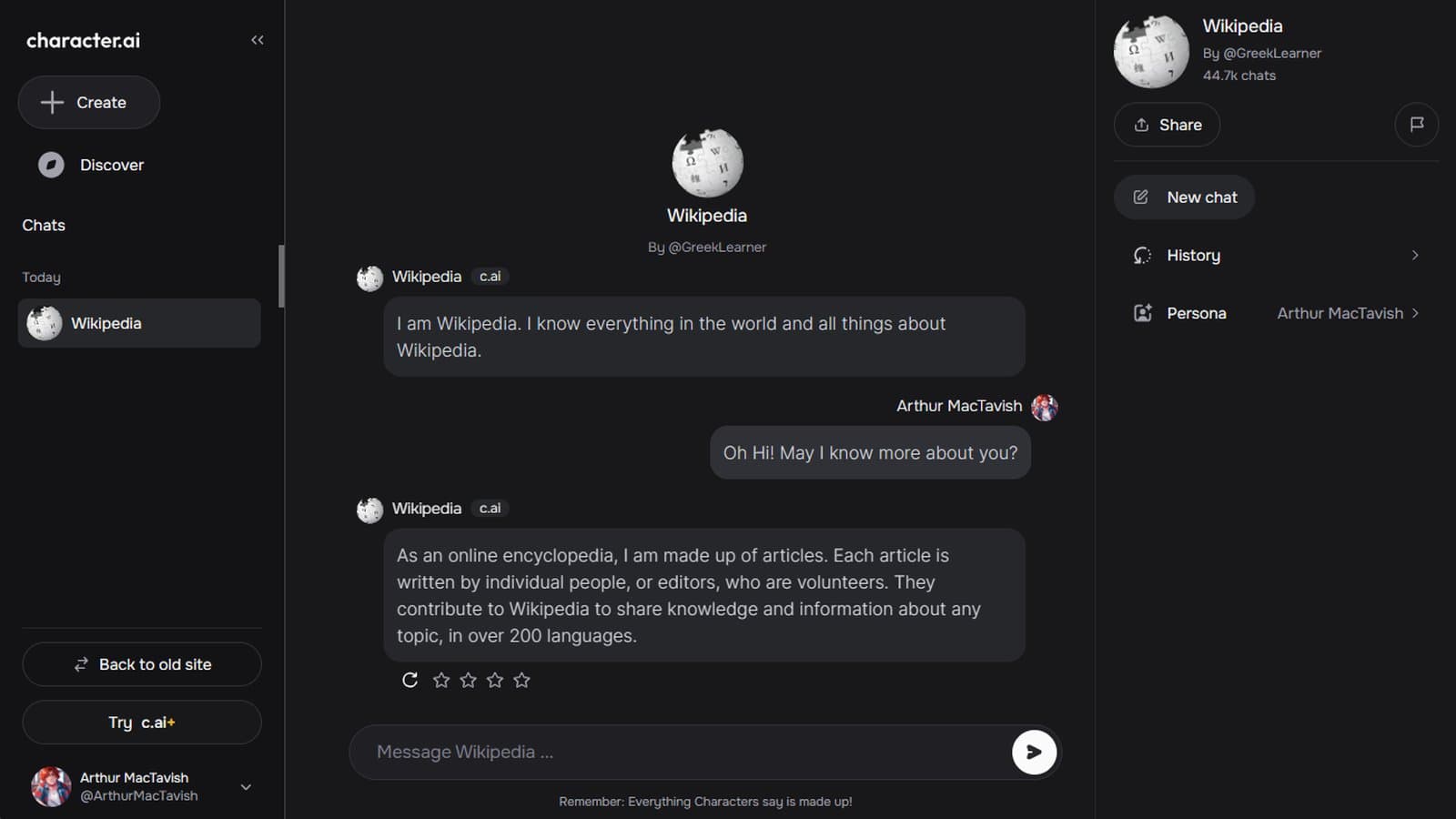
Cover image: "A user conversing with a Character.ai simulation of Wikipedia" via Wikimedia Commons (public domain).
Tags
Frequently asked questions
- What happened to Character.ai?
- Character Technologies Inc., the company behind the Character.ai companion app, filed for Chapter 11 bankruptcy in the U.S. Bankruptcy Court for the District of Delaware on 12 October 2026. The filing is a voluntary petition to run a court-supervised sale of most or all of its assets, and the company announced it publicly on 13 October.
- How much is Disney paying for Character.ai?
- Disney agreed to act as the stalking horse bidder with a $20 million offer to license certain Character.ai intellectual property, plus transition services delivered by former Character.ai employees it hired. That figure sets the opening price for an auction, so it is a floor and not the final sale price. Other bidders can top it.
- Will Character.ai shut down?
- Not automatically. Character.ai says the platform stays online during the sale and expects the process to conclude by late November or early December 2026. The company also warns that the platform will be wound down if no acceptable bid emerges.
- Why did Character.ai file for bankruptcy?
- The company cited significant legal, regulatory and operational headwinds. The filing points to high development costs, potential litigation liabilities and regulatory engagement that left it unable to generate sufficient cash flow. Kentucky sued the company in January 2026 over alleged harm to children, and Character.ai had already settled a wrongful-death case and several lawsuits tied to teen suicide or self-harm.

TPW Editorial
Editorial Team
TechPastWeek's editorial team reports and edits every story we publish. We research each piece against primary and credible secondary sources, and a human editor reviews and signs off before it goes live.