DeepSeek Reportedly Raises $15 Billion at a $74 Billion Valuation, Two Days After a US Federal Order
DeepSeek is reported to have raised about $15 billion at a roughly $74 billion valuation, two days after DHS ordered its removal from federal civilian systems.

On this page
Key takeaways
- DeepSeek is reported to be closing a round of about 100 billion yuan, or roughly $15 billion, at a valuation of about $74 billion, according to reports on 22 October 2026.
- Reports name CATL, Tencent, Meituan, Geely, GigaDevice and several investment firms as investors, though DeepSeek has not confirmed the round and the list could change.
- The round was reported two days after DHS ordered federal civilian agencies to remove DeepSeek products and third-party services built on its models from their systems.
- DeepSeek raised more than $7 billion at a $50 billion valuation in June 2026, then reportedly sought another $1.5 billion at about $71 billion in July.
- DeepSeek is reportedly preparing a possible IPO in China as early as 2027; founder Liang Wenfeng holds an estimated 81.6% of its Chinese operating entity.
DeepSeek is closing a funding round of about 100 billion yuan, or roughly $15 billion, Reuters and Bloomberg reported on 22 October 2026. Tech Startups put the valuation at about $74 billion. TechCrunch put it among the largest rounds raised in China. DeepSeek has not confirmed the terms, and the investor list could change before the round closes.
Related reading: Databricks Raised $5B at a $190B Valuation, and Still Won't IPO · OpenAI Nears a $30 Billion Round at $1.25 Trillion, $150 Billion Below Its Earlier Target.
The timing matters as much as the number. Two days earlier, on 20 October, the US Department of Homeland Security ordered federal civilian agencies to remove DeepSeek products from their systems. One government was pushing the company out of its procurement while investors in its home market were putting $15 billion in. Both things happened in the same week.
A reported round at a reported price
The core numbers come from people familiar with the deal. DeepSeek has not published them. Reuters and Bloomberg reported the 100 billion yuan figure on 22 October. Tech Startups put the valuation at about $74 billion, while other reports describe a pre-money valuation near 500 billion yuan, or roughly $75 billion.
The two valuation numbers are close but they are not the same measure, and none of the reports reconciles them. A pre-money figure and a post-money figure at the same headline price imply different prices per share and different ownership for the new investors. The dollar difference is small. The basis still matters for ownership.
Investors named in the reports are a cross-section of Chinese industry: CATL, the battery maker; Tencent; Meituan; Geely; GigaDevice, which makes memory chips; and several investment firms. TechCrunch names CATL and Tencent among the participants. The fuller list comes from Reuters and Bloomberg reporting summarized by Tech Startups. Because the round has not closed, the list is a snapshot and may not match the final cap table.
The sequence of rounds is more informative than the headline. In June 2026 DeepSeek raised more than $7 billion at a $50 billion valuation. In July it was reportedly seeking another $1.5 billion at a valuation around $71 billion. The October round is ten times the size of the July target, while the valuation has moved only a few billion dollars above it. Reports do not say how much of the $15 billion is new capital and how much buys existing shares. A round that large with a small markup is easier to explain as money to spend on infrastructure. The July report and the October one may describe different phases of the same fundraising. The reports do not explain the gap.
What strategic money buys
The investor mix is the clearest signal of what the round is for. CATL makes batteries. Geely builds cars. Meituan and Tencent operate in e-commerce and local services. GigaDevice makes memory chips. The list maps onto energy, deployment and hardware, the physical side of running models at scale.
Money from that group is strategic in the literal sense. Each investor has a commercial reason to want DeepSeek's models cheap and widely deployed. That money can, in principle, bring demand and a route into factories and vehicles that a software company would struggle to reach on its own. It also creates a cap table that a stock exchange will examine closely, because industrial holders are not typical venture investors.
The order, and its limits
On 20 October the Department of Homeland Security issued an order excluding DeepSeek products from federal civilian agency procurements and requiring agencies to remove DeepSeek and DeepSeek-affiliate products from their systems. The order also covers third-party products and services "developed using DeepSeek implementations". It cites national security concerns.
The scope matters. The order applies to federal civilian executive branch systems, not to the US market as a whole. Private companies can still use DeepSeek models, and the order does not stop anyone from downloading them. It does reach further than a simple vendor ban, because the third-party clause puts contractors and software vendors on notice that embedding a DeepSeek model in a federal-facing product creates a compliance problem.
The clause that reaches contractors
The order does not name only DeepSeek. It also covers third-party products and services "developed using DeepSeek implementations", which puts federal contractors and software vendors in scope. An agency that buys a tool with a DeepSeek model inside it has to remove the tool, whoever sold it.
Why the money and the order can coexist
The two events look like a contradiction. They are better read as two instruments aimed at different things. The DHS order restricts demand inside one government. It does not restrict capital, and it does not touch the constraint that actually limits DeepSeek: access to advanced chips under US export controls. The company can raise money at home; it still has to buy compute in a market shaped by export rules.
For DeepSeek, the money is a way to convert investor appetite into infrastructure. It is expected to go into AI infrastructure, compute and open models for domestic and international markets. The investor list points the same way, weighted toward companies in energy, vehicles, chips and consumer platforms.
Losing access to US federal procurement is a real cost, but it is a small slice of global AI demand. The order may strengthen DeepSeek's domestic position and its appeal in markets outside the US, where buyers are less exposed to US procurement rules. The reports offer no revenue figures to test it.
The order is a demand-side restriction. DeepSeek's binding constraint is compute, and the new capital is aimed at exactly that.
Open weights as a distribution strategy
DeepSeek became known outside China in early 2025 with R1, a free reasoning model released with open weights. It has kept releasing open models since. Open weights complicate a procurement ban. A model that can be downloaded and run on a customer's own hardware cannot be removed by an order, and developers in countries wary of US cloud providers can use it without routing data through an American platform.
That is the commercial logic behind open releases. Distribution does not depend on a platform owner's permission. The DHS order's third-party clause is an attempt to cover the gap. It targets products built on DeepSeek models, including services from contractors that use those models underneath. The order does not cover the download itself.
The IPO option
Reports say DeepSeek is preparing for a possible IPO in China as early as next year. A listing would do three things the private round cannot. It would give the company a public currency, create a valuation benchmark for Chinese AI, and expose DeepSeek to disclosure and governance requirements.
It would also put a concentrated ownership structure in front of public investors. Liang Wenfeng, who founded DeepSeek in 2023 after co-founding the quantitative hedge fund High-Flyer, holds an estimated 81.6% of the Chinese operating entity, according to corporate ownership data analyzed by WireScreen for TechCrunch. Public shareholders in a company with that level of control have limited influence, and an exchange will want to know how decisions are made.
None of that is unusual for a founder-led Chinese technology company. It is a change in kind for a lab that has operated with very little public financial reporting. A listing would require regular public reporting from a company that has published almost no financial detail.
How the round compares
The $15 billion is large for China. Moonshot AI raised $2 billion at a $20 billion valuation in May 2026. Manus AI raised more than $500 million in October. Zhipu AI and MiniMax listed in Hong Kong in January 2026 and were worth roughly $29 billion and $7.2 billion respectively on 22 October, according to TechCrunch. DeepSeek's reported round is bigger than either the Moonshot or Manus round, and at about $74 billion the company would be worth more than either listed peer.
It is not a global benchmark. The reports describe it as one of China's largest rounds, and that is a statement about the depth of Chinese capital for AI. It says little about global leadership, and it is not evidence that DeepSeek has closed the gap with the American labs. The money buys compute and time. It does not buy the chips that export controls withhold.
What is not confirmed
Three things remain open. The round has not closed, so the terms and the investor list can change. The valuation is reported on inconsistent bases, with about $74 billion in some accounts and a pre-money figure near $75 billion in others, so the precise price is not known. And the practical reach of the DHS order depends on how agencies and their contractors interpret the third-party clause.
A few events would settle more than the current reporting. A closing announcement would confirm the size and the cap table. An IPO filing would name the venue and show the financials. If Washington widens the order beyond federal civilian agencies, that would answer whether it intends to move from procurement to the market. None of the three has happened.
The DHS order is on the Federal Register. The funding round is not on any public register, and no IPO filing exists. Until a filing appears, the $15 billion and the $74 billion are numbers in reports, not facts on a balance sheet.
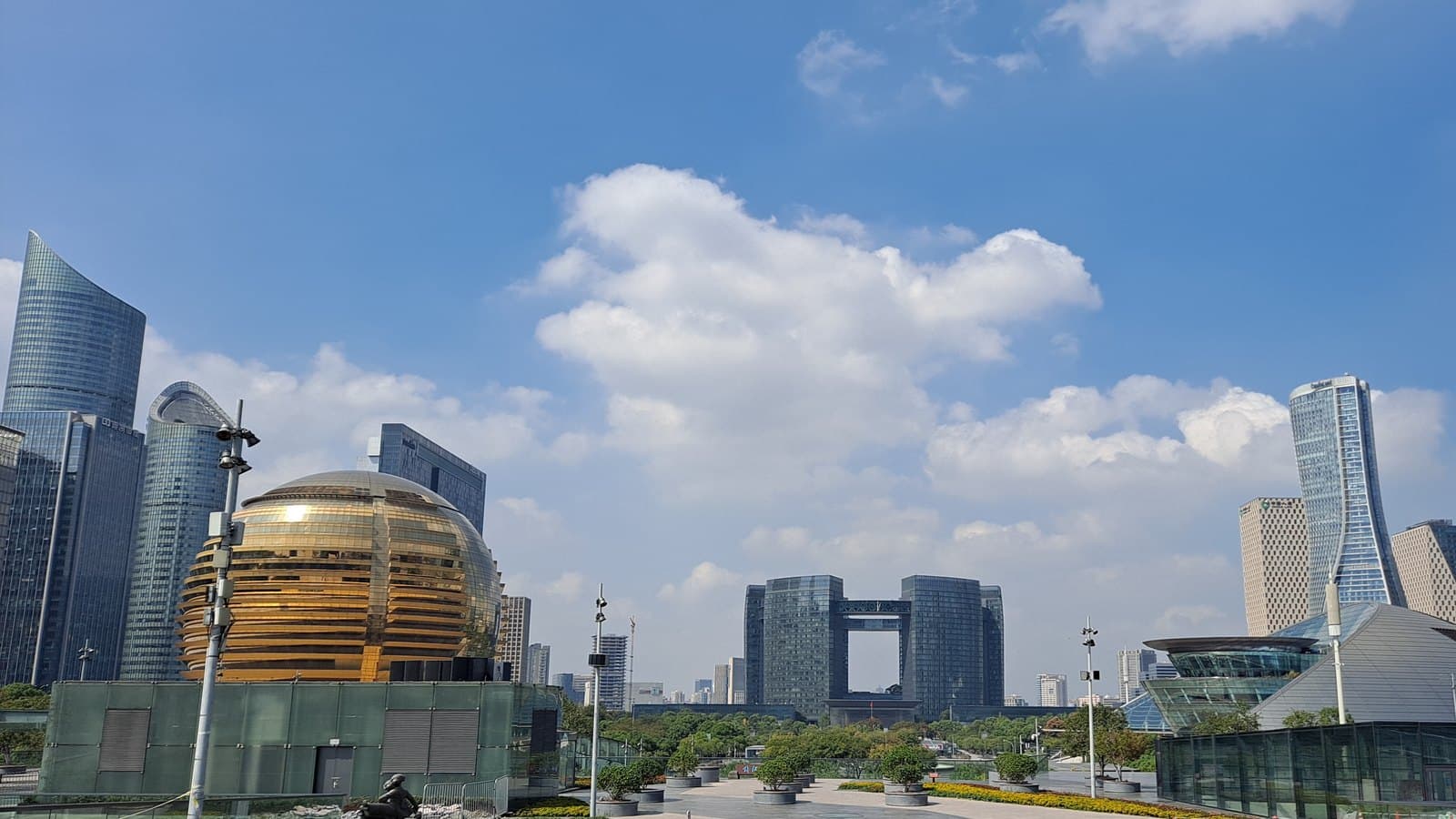
Cover image: Hangzhou's central business district, where DeepSeek is based. Photo by 钉钉, Wikimedia Commons, CC BY-SA 4.0.
Tags
Frequently asked questions
- How much did DeepSeek raise, and at what valuation?
- Reports on 22 October 2026 said DeepSeek was closing a round of about 100 billion yuan, roughly $15 billion, at a valuation of about $74 billion. DeepSeek has not confirmed the terms, and some reports describe a pre-money valuation near 500 billion yuan, or about $75 billion.
- Who invested in DeepSeek's $15 billion round?
- Reports name battery maker CATL, Tencent, Meituan, Geely, GigaDevice and several investment firms. TechCrunch names CATL and Tencent among the participants. The final investor list has not been published and could change before the round closes.
- Did the US ban DeepSeek?
- No. The 20 October 2026 DHS order applies to federal civilian executive branch agencies, which must remove DeepSeek and affiliate products plus third-party services built on DeepSeek implementations. It does not cover private businesses or the US market as a whole.
- Is DeepSeek going public?
- Not yet. Reports say DeepSeek is preparing for a possible IPO in China as early as next year, but no filing has been made public and no exchange or timetable has been confirmed.

TPW Editorial
Editorial Team
TechPastWeek's editorial team reports and edits every story we publish. We research each piece against primary and credible secondary sources, and a human editor reviews and signs off before it goes live.