Star Wars: Galactic Racer Launches to Strong Reviews for Debut Studio Fuse Games
Star Wars: Galactic Racer launched October 6 on PS5, Xbox and PC to strong reviews, pairing a roguelite campaign with arcade racing from UK studio Fuse Games.

On this page
Key takeaways
- Star Wars: Galactic Racer launched on October 6, 2026 for PlayStation 5, Xbox Series X|S and PC, developed by Fuse Games and published by Secret Mode with Lucasfilm Games.
- Launch-week aggregates put Metacritic at 88 on PS5 and 86 on Xbox Series X|S, with a lower PC score; Polygon's roundup recorded an OpenCritic average of 87.
- Fuse Games is a UK studio founded in 2023 by former Criterion Games developers, including Need for Speed and Burnout veterans; Galactic Racer is its debut title.
- The single-player campaign is a roguelite, with procedurally generated events, vehicle building and perks and unlocks that carry between runs.
- The game shares its October 6 release date with Gears of War: E-Day, inside a fall slate that several publishers rearranged around GTA 6 on November 19.
Star Wars: Galactic Racer launched worldwide on October 6, 2026 for PlayStation 5, Xbox Series X|S and PC, the debut title from Fuse Games, a British studio founded in 2023 by former Criterion Games developers. Secret Mode published it, and Lucasfilm Games took part in creative decisions from the start, according to Wikipedia's development summary. The review embargo lifted on October 2, and the arcade racer drew strong reviews: Metacritic showed 88 on PlayStation 5 and 86 on Xbox Series X|S, with the PC score a few points lower, and Polygon's review roundup recorded an average of 87 on OpenCritic.
Related reading: Forza Horizon 6 PS5 Release Date Reportedly Set for January 26, 2027 · Valve's Cancelled Portal Prequel F-Stop Surfaces as a Playable Build.
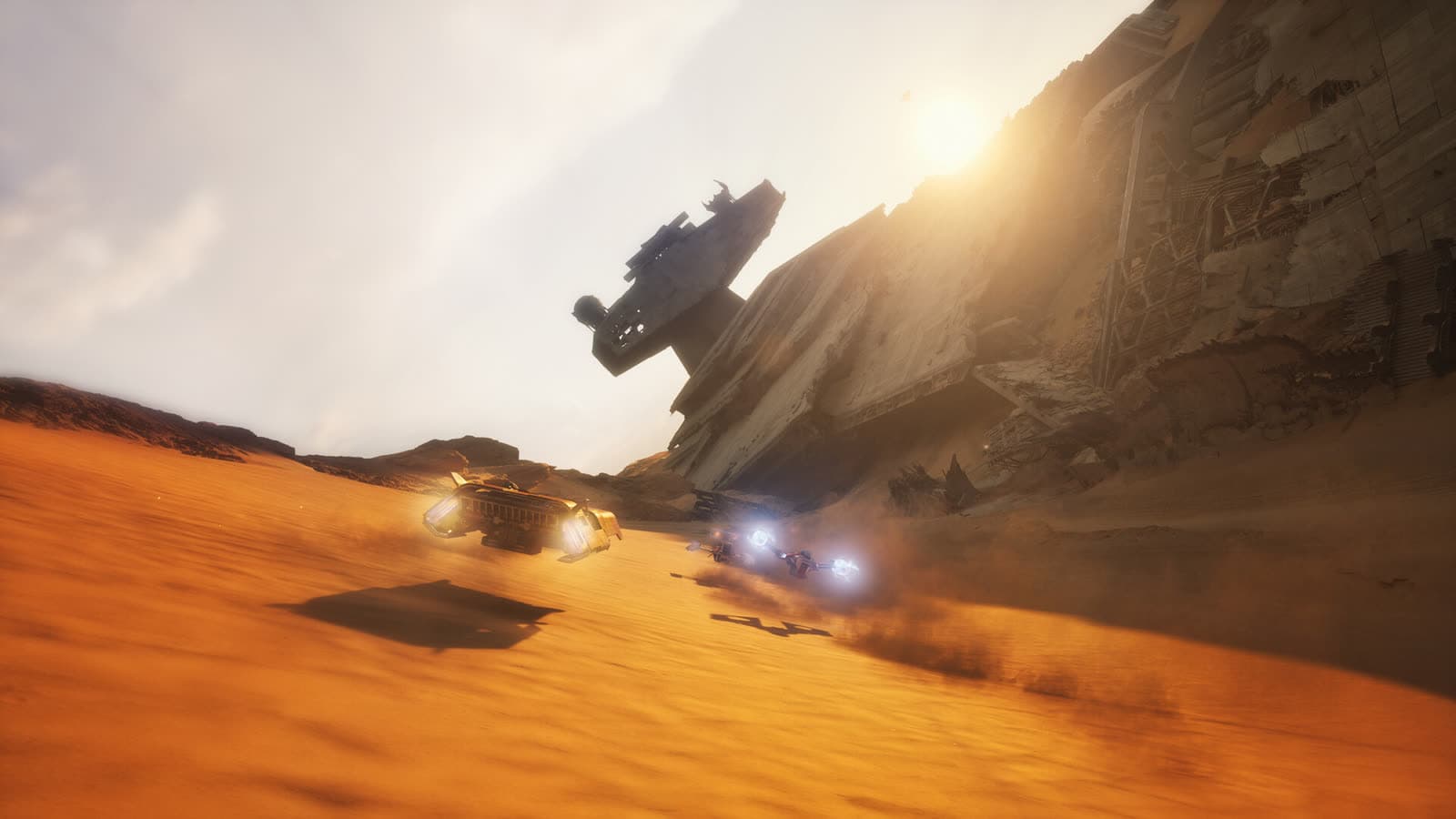
The pitch is easy to state and hard to build: Burnout and Wipeout moved into the Star Wars galaxy, with a structure borrowed from roguelites. Galactic Racer is the fifth Star Wars racing game, after Episode I: Racer (1999), Racer Arcade (2000), Super Bombad Racing (2001) and Racer Revenge (2002). More than twenty years separate it from the last of those. Wikipedia records podracers, landspeeders and speeder bikes available at launch, plus a new vehicle class called the skimspeeder.
Fuse got the license as a studio with no shipped games. That is rare for a franchise this size, and it is the kind of bet a publisher makes when it wants a genre instead of another sequel.
A studio built from Criterion veterans
Fuse Games is based in Guildford and was founded in 2023 by senior staff from Criterion, the studio behind Need for Speed and Burnout, as VGC reported at the project's announcement. The team already had Star Wars vehicle combat on its record: director Matt Webster was at Criterion when it worked with DICE on Star Wars Battlefront (2015) and Battlefront II (2017). Galactic Racer runs on Unreal Engine 5, with a score by Gordy Haab, a composer who has written music for several Star Wars games.
By 2026 Fuse employed about 75 developers, with roughly 150 people involved in Galactic Racer in total. Lucasfilm Games has been part of creative development decisions from the beginning, Webster has said. The project was unveiled at The Game Awards in December 2025 and had been in the works since the studio's founding. The Steam store page lists the standard edition and sets out the single-player and multiplayer modes.
Fuse's founders came out of a studio known for crash physics and speed. Their argument, that arcade racing had settled into a rut, is a design claim, not a technology one. Whether a 75-person team could carry a licensed blockbuster on its first attempt was an open question a year ago. The reviews answer it, at least for this game.
How the roguelite loop works
The single-player campaign is run-based. Events are procedurally generated, and the player navigates a tour, choosing missions, tracks and challenges that influence where the story goes. Too many crashes ends a run. Perks and unlocks carry into the next attempt, so failure adds to progress instead of erasing it. Difficulty can be adjusted in solo play.
Vehicle building runs through Hibi, an Ardennian mechanic. Parts grant different stat boosts and abilities, and customization opens up as the player advances. The developers designed the tracks so there is no single ideal racing line, which matters when the campaign asks you to learn a route and then rearranges it.
The story follows Shade, a racer with a grudge against the Bool family, who enters the Galactic League to unseat its corrupt champion, Kestar Bool. Wikipedia describes the League as founded by Darius Pax, a former podracer mechanic, in the lawless Outer Rim, with Bool trying to push Pax out of the business he built. It is set in the New Republic era after Return of the Jedi, and the cast includes racers from The Phantom Menace such as Ben Quadinaros and Sebulba.
Away from the campaign, there is an arcade mode for quick races and a scenario mode with time trials and objective-based events. Online multiplayer supports up to 12 players, and a ranking system is planned. Tracks sit on Tatooine, Lantaana, Jakku, Ando Prime and Sentinel One.
Why a roguelite, and why now
Fuse has argued that racing games barely changed their progression for two decades: race, earn money, buy a faster vehicle, repeat. The roguelite replaces that with runs that vary in order and outcome, so the campaign is built to be replayed rather than finished once.
Where the reviews land
The scores cluster high, and the volume behind them is large enough to make the direction clear. GameSpot gave it 9 out of 10, Giant Bomb 5 out of 5, Game Informer 8.5 out of 10, TheSixthAxis 9 out of 10, DualShockers 8.5 out of 10 and TechRadar 4.5 out of 5. Collider wrote that "the racing feels fantastic." At the time of one report, Metacritic counted about 72 critic reviews and OpenCritic listed 71, and the PC version trailed the consoles.
GameSpot's Jordan Ramée, whose review Polygon's roundup quotes, wrote that "every moment feels joyfully fast" and called each run "a rewarding chance to learn, improve, tinker, and adapt, whether it ends in success or failure." Giant Bomb's Jeff Grubb, who scored it five out of five, said:
Everything I hoped it would be. Fuse built a campaign that keeps giving me reasons to master the tracks, then made the racing feel good enough that I wanted to.
Polygon's Oli Welsh went further, describing it as "the best arcade racing game in a generation" and writing that "speed never sounded so good as it does in Star Wars." TechRadar's Demi Williams called it "an exhilarating, highly engaging roguelike racer with amazing buildcraft customization that offers endless possibilities on the track." VGC's Jordan Middler framed it as "a throwback to the glory days of PS2 racing, and one of the best arcade racers in years," as the roundup collects.
Not every note is positive. IGN's Luke Reilly, at 8 out of 10, found the run-based campaign "unavoidably tedious over long stints because of its heavy reliance on repeatedly revisiting the same slim selection of planets." GamesRadar's Will Sawyer raised a difficulty spike near the end of the third act and an abrupt ending. Neither treats those as disqualifying. The pattern across the coverage is consistent: high scores, and the same few complaints repeated.
Review scores are a snapshot
Metacritic and OpenCritic figures cited here were current during launch week. Aggregates move as more outlets publish, so treat the exact averages as provisional and the broad reception as the reliable signal.
A licensed game that skips the Jedi
For years the Star Wars games pipeline ran through lightsabers and the Force. Galactic Racer is a licensed racer with no Jedi at the wheel, and Lucasfilm Games was involved from the start, beyond a final sign-off. That is a small signal that the licensor is willing to fund genres beyond the saga template.
The market context supports the bet. Polygon noted that another Star Wars title, the tactics game Zero Company, shipped in late August to strong reviews and a metascore of 85, in a genre that is not blockbuster-sized either. Collider framed Galactic Racer as the biggest Star Wars release of 2026; that is a headline judgment rather than a measured fact, but the review volume behind it is real. A racing game with a live multiplayer mode also has a longer commercial tail than a story-driven title, because tracks and vehicles can be sold after launch to players who stay.
A crowded release window
Galactic Racer shares its October 6 date with the worldwide launch of Gears of War: E-Day, and it arrives in a fall that several publishers rearranged around GTA 6's November 19 console window. A racing game with a defined audience can live alongside a shooter launch; the harder question is how much attention is left for either in a season this full. The date also puts the game in the same week as its own review cycle, which gave the scores less time to settle before players could buy.
Caveats
Three caveats belong next to the scores.
The first is timing. The aggregates here are a snapshot from launch week. The PC score trails the console scores, and a launch-week average can settle a point or two in either direction.
The second is sales. No unit figures have been published, and strong reviews do not guarantee commercial success. The closest comparison is Star Wars Episode I: Racer from 1999, the best-known of the earlier racing games; whether the new game reaches a comparable audience is unresolved and, for now, unmeasurable.
The third is durability. The roguelite depends on procedural variety holding up. IGN's complaint about revisiting the same planets states the risk in one sentence, and no review can settle whether the loop still feels fresh after fifty runs. Reviewers judge a game in the first week; players decide in the months after.
What to watch
- Sales and player numbers. Neither has been disclosed. They are the first real test of whether a licensed racer from a new studio found an audience.
- Post-launch content. The multiplayer mode and a planned ranking system give Fuse room to add tracks and vehicles; what ships in the first months will show how long the studio intends to support the game.
- The tedium question. If an update adds planets and event variety, it answers IGN's critique directly. If it does not, the campaign's long-tail reputation will carry that complaint.
- The licensing model. A second non-Jedi Star Wars game greenlit on the back of this reception would say more about the strategy than any single review.
The reviews are in and the reception is strong. Whether that turns into the sales and the long tail Secret Mode is counting on is a separate question, and an open one.
Cover: A screenshot from Star Wars: Galactic Racer, courtesy of Fuse Games and Secret Mode.
Tags
Frequently asked questions
- When did Star Wars: Galactic Racer release?
- It launched worldwide on October 6, 2026 for PlayStation 5, Xbox Series X|S and PC. The review embargo lifted on October 2, four days before release.
- What platforms is Star Wars: Galactic Racer on?
- PlayStation 5, Xbox Series X|S and PC via Steam. The game supports single-player and online multiplayer for up to 12 players, and a ranking system is planned.
- Is Star Wars: Galactic Racer a roguelite?
- Its single-player campaign is. Events are procedurally generated, too many crashes ends a run, and perks and unlocks carry into the next attempt.
- Who developed Star Wars: Galactic Racer?
- Fuse Games, a UK studio founded in 2023 by former Criterion Games staff. Secret Mode published it, and Lucasfilm Games was involved in creative decisions from the start.

TPW Editorial
Editorial Team
TechPastWeek's editorial team reports and edits every story we publish. We research each piece against primary and credible secondary sources, and a human editor reviews and signs off before it goes live.