Cohere and Aleph Alpha Sign a Merger to Build a $20 Billion Sovereign AI Stack
Cohere and Germany's Aleph Alpha signed a definitive merger on September 16, creating a transatlantic AI company built to keep regulated data outside US cloud reach.

On this page
Key takeaways
- Cohere and Aleph Alpha signed a definitive business combination agreement on September 16, 2026, announced at the ALL IN conference in Montreal.
- The combined company will operate as Cohere, with dual headquarters in Toronto and Berlin and more than 1,000 employees across both continents.
- The deal was first disclosed in April 2026 at a valuation of about $20 billion; the companies did not publish updated financial terms in September.
- Schwarz Group, the owner of Lidl and Kaufland, is investing €500 million and will lead Cohere's Series E, with €11 billion to €13 billion pledged for a German data-center campus of up to 100,000 AI chips.
- The transaction remains subject to regulatory approval in Canada and Germany and is expected to close by the end of 2026.
Cohere and Aleph Alpha signed a definitive business combination agreement on September 16, formalizing a tie-up the two companies first outlined in April and creating a single transatlantic vendor aimed squarely at governments and regulated industries. The deal was announced on stage at the ALL IN conference in Montreal by Cohere co-founder and chief executive Aidan Gomez, with Aleph Alpha's leadership alongside him.
Related reading: OpenAI Nears a $30 Billion Round at $1.25 Trillion, $150 Billion Below Its Earlier Target · DeepSeek Reportedly Raises $15 Billion at a $74 Billion Valuation, Two Days After a US Federal Order.
The combined company will operate globally as Cohere. It will be dual-headquartered in Toronto and Berlin, keep Aleph Alpha's Heidelberg office as a research center, and employ more than 1,000 people across North America and Europe. Reuters reported that the deal keeps the Cohere brand and that Aleph Alpha co-chief Ilhan Scheer will become chief operating officer. Aleph Alpha co-founder Samuel Weinbach becomes chief research officer, both appointments conditional on the deal closing.
The transaction still needs regulatory approval in Canada and Germany. Both companies say they expect it to clear by the end of 2026.
A merger five months in the making
The pairing is not a surprise. Cohere announced in April that it intended to combine with Aleph Alpha, and TechCrunch described the structure then as Cohere taking over its German peer with the blessing of both governments. BetaKit reported that the larger Canadian company is buying Aleph Alpha, and Forkast put the split at roughly 90 percent Cohere and 10 percent Aleph Alpha.
The two firms are near contemporaries. Both were founded in 2019. Cohere has raised about $1.6 billion from investors including Nvidia, AMD Ventures, Salesforce Ventures, Oracle and Cisco, and reached a $7 billion valuation in 2025, according to The Next Web. Aleph Alpha employs about 200 people across four German locations and has raised more than $600 million.
They also arrive from opposite directions. Cohere built a model business around the Command family of language models and sells deployments that can run in a customer's own environment, including fully air-gapped systems. Aleph Alpha built the PhariaAI orchestration platform and deep relationships with European public institutions, including the German government, Deutsche Bank and Infineon. Combined, the pitch is a full stack: models at the bottom, an enterprise application layer in the middle and a legally European cloud underneath.
The layer that makes it sovereign
The strategic anchor of the merger is not the models. It is STACKIT, the cloud business of Schwarz Digits, the IT division of Schwarz Group, the German retail conglomerate behind Lidl and Kaufland. Schwarz Group is investing €500 million (about $600 million) in the combined company and will lead its Series E round, and both companies say the merged entity will sell sovereign AI running on STACKIT.
The legal argument is about jurisdiction rather than performance. The US CLOUD Act lets American authorities compel US-based cloud providers to hand over data stored anywhere in the world, including in European data centers. STACKIT has no US parent and runs exclusively in German and Austrian facilities, which the parties present as placing customer data outside that reach. TechTimes framed the combination as the first vertically integrated enterprise AI stack with no layer subject to US access authority.
Schwarz is putting real money behind the infrastructure. Reuters reported the group plans to spend between €11 billion and €13 billion on a German data-center campus designed to hold up to 100,000 AI chips, with capacity routed to Cohere through STACKIT. Those are single-source figures and should be read as plans rather than completed construction. The bet is that regulated buyers will pay a premium for a stack they can point to as outside US legal reach, even if the models themselves are not the strongest on public leaderboards.
Sovereignty claims live or die on independent certification, and this is where the German cloud has an edge that the models do not. TechTimes reported that STACKIT holds SEAL-3 under the EU Cloud Sovereignty Framework and was named in April 2026 as one of four certified providers in a European Commission cloud tender worth about €180 million. Those credentials are the kind of procurement evidence that a startup cannot self-certify, and they are part of what Aleph Alpha brings to a company whose pitch is compliance as much as capability.
Why sovereignty sells
Cohere and Aleph Alpha are selling into a specific procurement problem. Banks, defense contractors, health systems and tax authorities handle data they often cannot legally or politically ship to a hyperscaler, and the concentration of frontier AI in a handful of US and Chinese providers makes some of those buyers uneasy about single-provider dependence.
Cohere's own framing is that the company will be the first foundation-model developer anchored on both sides of the Atlantic and aligned with the sovereignty requirements of Canada and Germany. That is a company claim, not an independent ranking. The concrete asset is the customer list and the certifications that come with the German half of the business.
The deal also has a diplomatic dimension. Canada and Germany have been building a closer technology relationship, including a sovereign technology alliance that both governments describe as a way to reduce strategic technology dependencies. When the combination was first announced in April, Germany's digital minister and Canada's minister of AI appeared alongside the two companies, according to The Logic, and the Canadian government has framed the deal as evidence that the alliance produces commercial results rather than just communiques. Gomez has described the combined company as a Canadian-German company, though TechCrunch noted that keeping that identity gets harder if the firm eventually lists publicly and ownership spreads to global shareholders.
The political logic runs in both directions. Ottawa has been courting middle-power partners as a counterweight to US and Chinese technology dominance, and Berlin wants a European AI champion it can procure from. A merged Cohere gives each government a domestic-footprint supplier that the other has already endorsed, which shortens the trust-building that public-sector procurement normally requires. It also creates a dependency: if the integration stalls or the company later reincorporates in the United States, both governments lose the sovereign story they have been selling to their own voters and institutions.
The money behind it
Schwarz Group's €500 million commitment is the cornerstone of the financing, but it may not be the whole round. The Globe and Mail reported on September 11, citing four sources, that Cohere was in advanced talks to raise $2 billion to $3 billion in its Series E at a $20 billion valuation, with participation from the Canadian government and possibly the German government. If it closes at the top of that range, it would be the largest private financing on record for a Canadian startup.
The $20 billion figure comes from the April term sheet reported by the Financial Times and Handelsblatt, according to TechCrunch. Cohere did not disclose fresh terms in September, so the only public valuation remains the April number. Canada had already committed up to CA$240 million to Cohere through its Sovereign AI Compute Strategy in December 2024, the first outlay under that program.
The competitive map
The merger reshapes the market for AI vendors that are neither American nor Chinese. Cohere's most direct comparison is Mistral, the French lab that raised roughly €3 billion in the week before the merger announcement at a valuation above €21 billion. Both now pitch themselves to European institutions as the sovereign alternative, and the two are close enough in enterprise value that the contest will be decided on model quality, deployment completeness and public-sector trust rather than price alone.
Cohere's advantage, on paper, is geographic breadth and a more complete deployment stack through STACKIT and PhariaAI. Mistral's advantage is model performance and mindshare in European language tasks. Neither is anywhere close to the scale of OpenAI, Google or Anthropic, which is precisely why the sovereign argument is their opening.
There is also an integration risk that the announcement papers over. The two product lines, Command and Pharia, must be unified, and Aleph Alpha's existing customers have to be moved onto the combined architecture without losing the compliance guarantees they bought. The companies have said a unified Command-Pharia foundation model is planned, but the timeline and the technical details are not public.
What to watch
Three things will determine whether the sovereign stack thesis holds. First, the Series E close: whether it lands at the full $2 billion to $3 billion and whether government money ends up on the cap table, which would make Cohere a test case for industrial policy in AI. Second, the speed of product integration, since a merger that leaves two parallel model families is harder to sell than one platform. Third, the sales cycle in regulated industries, which moves slowly and rewards incumbents with certifications and references.
For now the deal is a bet that a meaningful slice of the AI market will be decided by where data is allowed to live, not only by which model writes the best code. The September agreement turns that thesis into a single, roughly $20 billion company with two governments watching. Whether the demand is deep enough to justify the infrastructure behind it is the question the next year will answer.
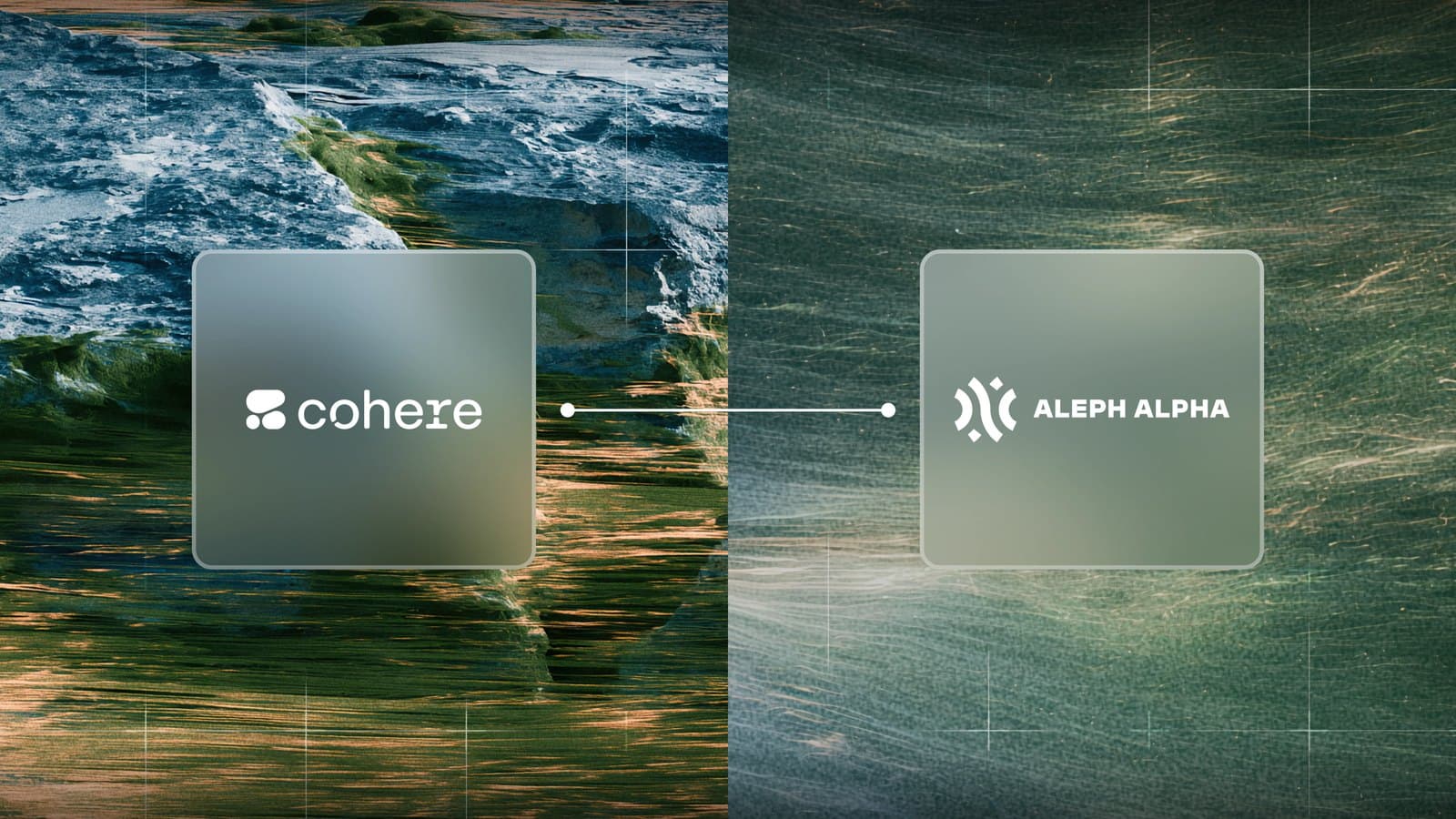
Cover: The official Cohere and Aleph Alpha announcement graphic. Image: Cohere (company-distributed press asset).
Tags
Frequently asked questions
- What is the Cohere and Aleph Alpha deal?
- It is a definitive business combination agreement, announced on September 16, 2026, that folds Germany's Aleph Alpha into Canada's Cohere to create a transatlantic company selling sovereign AI to governments and regulated industries.
- How much is the merged Cohere and Aleph Alpha company worth?
- The figure reported when the deal was first disclosed in April 2026 was about $20 billion, based on a term sheet reported by the Financial Times and Handelsblatt. The companies did not disclose updated financial terms in September.
- Why does STACKIT matter to the Cohere merger?
- STACKIT is the sovereign cloud of Schwarz Group's Schwarz Digits division. It runs only in Germany and Austria and has no US parent company, which the parties present as keeping customer data outside the reach of the US CLOUD Act.

TPW Editorial
Editorial Team
TechPastWeek's editorial team reports and edits every story we publish. We research each piece against primary and credible secondary sources, and a human editor reviews and signs off before it goes live.