Google's 'Googlebook' Laptops Want Android Users to Buy a Premium PC for Gemini
Google opened pre-orders on 21 September 2026 for five premium Googlebook laptops from Acer, ASUS, Dell, HP and Lenovo, priced from $899 and built for Gemini.

On this page
Key takeaways
- Google opened pre-orders for the first Googlebook laptops on 21 September 2026, with five premium models from Acer, ASUS, Dell, HP and Lenovo priced from $899 to $1,299.
- The devices run Googlebook OS, built on the Android technology stack with ChromeOS foundations and a native Linux kernel, and are designed around Gemini Intelligence.
- Every model includes a year of Google AI Pro with 5TB of cloud storage, along with trials of YouTube Premium, Adobe Photoshop and CapCut.
- Googlebook laptops go on sale on 4 October 2026 in the United States and 5 October in Canada, the United Kingdom, Ireland, France, Germany and Australia.
- Google promises up to 10 years of OS updates, and says Chromebooks will continue for schools and budget buyers.
Google opened pre-orders on 21 September 2026 for the first Googlebook laptops, a new premium category it first teased in May, with five models from Acer, ASUS, Dell, HP and Lenovo priced from $899 to $1,299. The devices run Googlebook OS, a platform built on the Android technology stack with desktop foundations from ChromeOS, and they are designed to sell one idea above all: that a laptop built to work with your Android phone and put Gemini at the centre is worth paying MacBook Air money for.
Related reading: How to Buy a Laptop That Lasts: A Practical Longevity Guide · Apple Puts Touch on the Mac at $2,899, Reversing a Long Resistance.
Google is not building the machines itself, at least not yet. It set the standards and handed the hardware to partners that have spent years making Chromebooks. The Verge reported that the first wave includes five models, and that the cheapest, the Acer Googlebook 14, carries a launch price that Acer describes as limited-time.
What Google is actually selling
The hardware is genuinely premium for a platform rooted in Chromebooks. Every Googlebook must use materials such as aluminium, magnesium alloy or carbon fibre, meet a baseline of 16 gigabytes of RAM with 32 gigabyte options, and include a touchscreen, a backlit keyboard and a haptic trackpad. Displays reach 2.8K OLED on several models, and the chips come from Intel's Core Ultra Series 3 line or Qualcomm's Snapdragon X Elite, paired with neural processing units rated above 45 trillion operations per second.
Battery life is quoted at up to 14 hours of video playback and 16 hours of web browsing. Google says some models carry as many as six speakers with Dolby Atmos and studio-quality microphones. A light strip on the outside of every unit, called the Glowbar, shows battery level and reacts when the user speaks to Gemini, echoing the HiLight strip Google introduced on its Pixel phones. Google says it will let developers drive the Glowbar for their own apps.
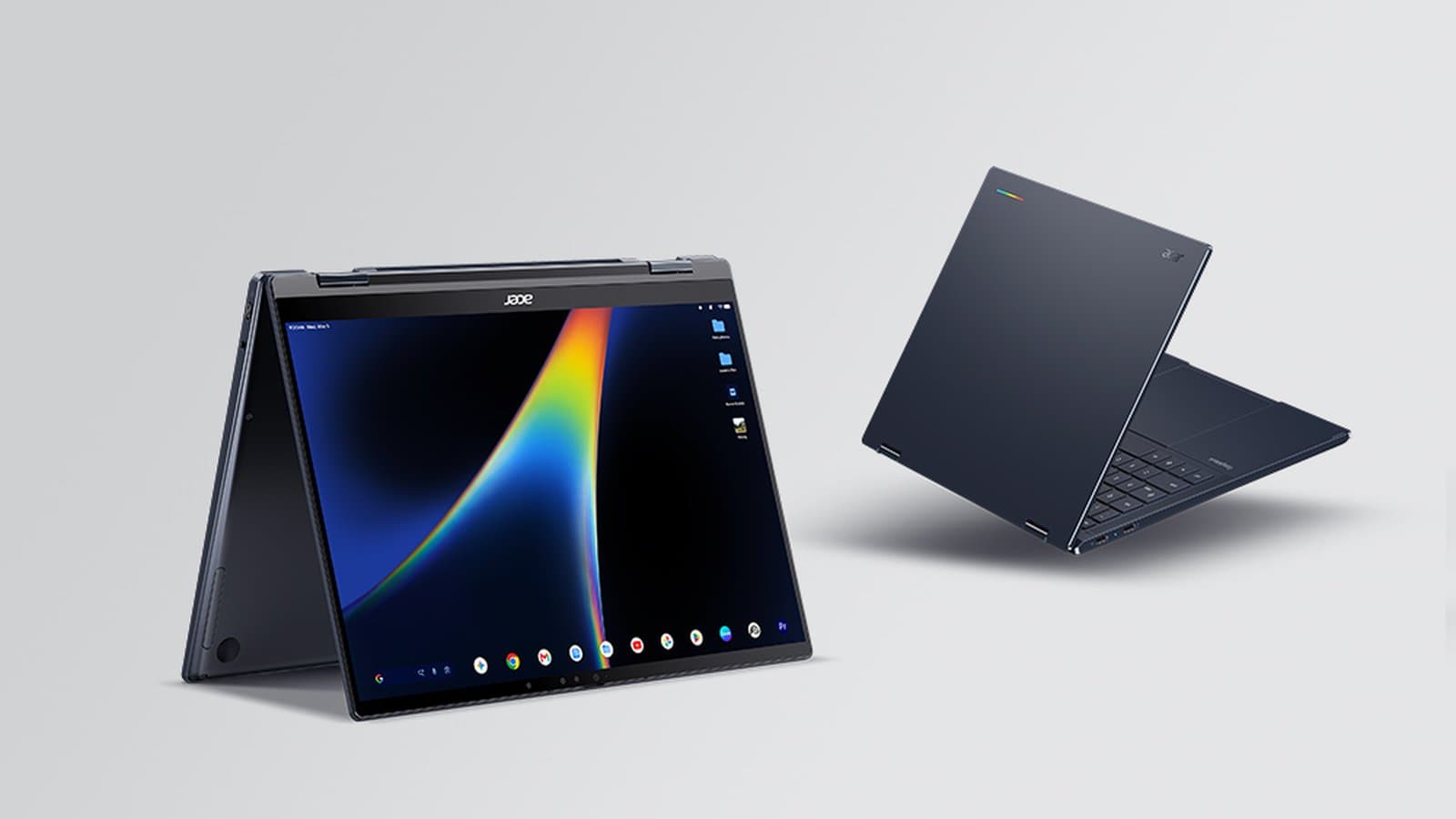
The lineup spreads across price and shape. The Acer Googlebook 14 is the entry point at $899 and the only convertible, folding into a tablet. The Dell XPS Googlebook starts at $1,199 with a 13.4-inch display and a Snapdragon X Elite chip. ASUS, HP and Lenovo all start at $1,299, with Lenovo offering the largest screen at 15.3 inches. MediaTek's Dimensity CX C10 Max also supports the platform, though no launch laptop uses it yet.
The lineup at a glance: Acer Googlebook 14 from $899, Dell XPS Googlebook from $1,199, and ASUS, HP and Lenovo Googlebooks from $1,299. All include a year of Google AI Pro with 5TB of storage and three months of YouTube Premium, Adobe Photoshop and CapCut.
Gemini is the product, the laptop is the box
Google's own framing puts the software first. A post on the Google blog describing the built-in intelligence lists features that all lean on the model: Magic Pointer, which summons Gemini next to the cursor and lets it read what is on screen; Rambler, a voice dictation tool that tidies spoken notes into structured text; Create My Widget, which builds small tools from a description; and Continue, which hands a task from an Android phone to the laptop.
The same blog confirms what buyers get in the box. Every Googlebook includes 12 months of Google AI Pro, which brings Gemini Advanced and 5 terabytes of cloud storage, plus three months of YouTube Premium, Adobe Photoshop and CapCut. Several outlets also report a year of NVIDIA GeForce Now cloud gaming.
That bundle is doing real work on the price. A year of Google AI Pro is a subscription Google values at a meaningful monthly rate, and attaching it to every laptop lowers the effective cost of the machine for anyone who would otherwise pay for it. Google has used the same playbook with Pixel phones and its broader AI plans, and it ties the hardware sale to a recurring software relationship.
The deeper pitch is continuity with Android. Users can pull messages, files and notifications from a paired phone, and pick up tasks they started on mobile. For the large base of Android owners who have never found a laptop that talks to their phone the way an iPhone talks to a Mac, that is the specific gap Google is targeting. WIRED framed the launch around that Android-first audience, quoting Google's Android ecosystem president, Sameer Samat, arguing that today's laptops were designed before mobile devices existed.
Why Googlebook OS, not another Chromebook
Google could have called these premium Chromebooks and been done with it. Instead it created a distinct operating system and a new brand, and it kept Chromebooks alive alongside them. Google says Chromebooks will continue to serve schools and act as the budget-friendly option, which matters because the education market is where the Chromebook name still carries weight.
The new OS runs Android apps from the Play Store, includes the desktop Chrome browser, and uses a native Linux kernel, so it is built to run on both x86 and ARM chips. That dual-architecture support is a practical necessity given that half the launch lineup uses Qualcomm silicon and half uses Intel.
The name game: Googlebook is a hardware standard and an operating system, not a single device. Five companies make the first models, and Google has not said whether it will build its own. Confusing it with a Chromebook, which remains a separate product line, is easy and wrong.
Setting a standard rather than shipping one device is a deliberate choice. It lets Google define what a Googlebook is without carrying the manufacturing risk, and it gives OEMs a shared premium tier to sell into. It also creates a coordination problem. When five companies build to the same spec, the machines risk feeling interchangeable, and their differences come down to price, weight and display quality rather than anything fundamental.
The bet and the risk
The commercial logic rests on two assumptions. The first is that enough Android users want a laptop that behaves like part of the same system to justify a new category. The second is that Gemini is compelling enough today to sell hardware, rather than something buyers expect to improve after they have already paid.
Both carry risk. The launch prices sit in the same territory as a base MacBook Air and a crowded field of Windows laptops, and the Chromebooks that came before at this price did not find wide adoption. Google is also asking buyers to trust a brand-new OS with their work, even with a 10-year update commitment that is unusually long for the category.
But the strategy behind it is coherent. Selling a subscription-heavy ecosystem is easier when the hardware is good enough that the software is the reason to buy, and Google has spent the past two years making Gemini the through-line of its products. Googlebook is the laptop-shaped expression of that plan.
Chromebooks grew up, and Google wants the margin
Googlebook is the latest step in a long climb upmarket. Chromebooks began as cheap, browser-first machines aimed at schools and price-sensitive buyers, and they succeeded there by being simple and inexpensive. That focus left Google without an answer when those same users grew up, earned more and wanted a laptop that felt premium. The Pixelbook and Pixel Slate were attempts to fill the gap, and neither built a durable category.
Googlebook is a different approach because Google is not selling one flagship. It set a hardware standard, opened it to five manufacturers and let them compete on design and price within it. That model has worked for Android in phones, where a shared platform and many vendors produced scale that a single Google device never would have. Running the same play in laptops depends on the platform being good enough that buyers do not simply choose a Windows machine at the same price.
The deeper strategic point is subscriptions. Googlebook is built to make Gemini part of the daily routine, and every purchase carries a year of Google AI Pro. If the hardware establishes the habit, the recurring revenue follows, which is the outcome that matters more to Google's long-term position than a single laptop sale. The company is treating the machine partly as a delivery vehicle for a service.
What to watch
Three things will reveal whether Googlebook works. The first is app support. Android apps on a desktop are not automatically good desktop apps, and Google says it will curate and test which ones are optimised. If the productivity apps that office workers rely on do not feel native, the pitch narrows to Android faithfuls.
The second is how the first wave performs at retail after the launch discount on the Acer model ends. Acer has already signalled it will revisit pricing, and the $899 headline may not hold. The third is whether Google eventually builds its own Googlebook, a move that would put it in direct competition with the partners it is relying on now.
For buyers, the decision is less about specs than about ecosystem. Anyone already living inside Google's services with an Android phone in their pocket is the target customer, and the bundle means the first year comes with a stack of software. Everyone else has a familiar set of premium Windows and Mac options, and Googlebook has to earn the switch rather than assume it.
Cover: official Acer Googlebook 14 press image, courtesy of Acer via Ars Technica.
Tags
Frequently asked questions
- What is a Googlebook?
- A Googlebook is a premium laptop that runs Googlebook OS, a platform built on the Android technology stack with desktop foundations from ChromeOS. Google requires partners to meet hardware standards including at least 16GB of RAM, a touchscreen, a backlit keyboard and more than 45 TOPS of neural processing.
- How much do Googlebook laptops cost?
- Prices start at $899 for the Acer Googlebook 14, which is the only convertible in the first wave, and run to $1,299 for models from ASUS, HP and Lenovo. The Dell XPS Googlebook starts at $1,199.
- When can you buy a Googlebook?
- Pre-orders opened on 21 September 2026. Devices reach shelves on 4 October 2026 in the United States and on 5 October 2026 in Canada, the United Kingdom, Ireland, France, Germany and Australia.
- Is Googlebook replacing the Chromebook?
- Not directly. Google says Chromebooks will continue to serve schools and act as the budget option, while Googlebooks sit above them at a premium price point.

TPW Editorial
Editorial Team
TechPastWeek's editorial team reports and edits every story we publish. We research each piece against primary and credible secondary sources, and a human editor reviews and signs off before it goes live.