Marvell Bets $115 Billion That Light Replaces Copper in AI Data Centers
Marvell's $115 billion all-stock takeover of Lumentum is a bet that optical links, not copper, become the spine of AI data centers. The deal is not closed.

On this page
Key takeaways
- Marvell and Lumentum announced a definitive all-stock agreement on 2 November 2026 that values Lumentum at $115 billion in enterprise value, with Lumentum holders receiving a fixed 4.500 Marvell shares for each Lumentum share.
- The companies put the implied price at $1,132 per Lumentum share, a 23.9 percent premium to Lumentum's 28 October 2026 close, with Marvell holders owning about 67 percent of the combined company and Lumentum holders about 33 percent.
- Closing is expected in the first half of calendar 2028, subject to shareholder and regulatory approvals, so the deal has not been completed.
- Lumentum reported fiscal first-quarter 2027 revenue of $1.26 billion on 2 November 2026, against a $1.25 billion Koyfin consensus, with pump lasers and optical circuit switches leading growth.
- Marvell traded at about $190.43, down 3 percent, and Lumentum at about $788.51, down 6 percent, in morning trading on 2 November 2026, according to 24/7 Wall St.
Marvell Technology and Lumentum announced a definitive agreement on 2 November 2026 under which Marvell will acquire Lumentum in an all-stock deal with an implied enterprise value of $115 billion. Lumentum makes lasers, optical transceivers and optical circuit switches, the parts that turn electrical signals into light and steer it between racks of AI accelerators. Marvell designs custom processors and the networking silicon around them. The price is a wager that the connections inside AI data centers will be optical by default, and that whoever supplies the light will hold a position as durable as the companies that supply the compute.
Related reading: AMD Will Buy World Labs for $8.2 Billion and Make Fei-Fei Li Its Chief Scientist · Intel's Data Center Revenue Rose 78% and the Stock Fell 28.58%.
Both boards approved the agreement unanimously. The deal is not complete. Closing is expected in the first half of calendar 2028, subject to shareholder and regulatory approvals, which leaves a long stretch in which the two businesses stay separate and the terms stay exposed to Marvell's share price.
What Marvell actually agreed to
The mechanics are simple and rigid. Each Lumentum share converts into a fixed 4.500 shares of Marvell, with no cash component. The companies put the implied value at $1,132 per Lumentum share and an enterprise value of $115 billion, debt included. That was a premium of about 23.9 percent to Lumentum's closing price on 28 October, the last trading day before reports of a deal began to circulate.
Ownership splits roughly two to one. Marvell shareholders would hold about 67 percent of the combined company and Lumentum shareholders about 33 percent on a fully diluted basis. Matt Murphy stays chairman and chief executive. Three Lumentum directors, including chief executive Michael Hurlston, join a board that currently has seven members.
The fixed ratio is the detail that matters most for anyone holding the stock. Lumentum shareholders are paid in Marvell paper at a set conversion rate, so the dollar value of the offer rises and falls with Marvell. No cash changes hands. Lumentum's holders receive a fixed slice of Marvell's equity, in a deal valued at $115 billion in enterprise value on the day it was signed and worth whatever that slice is worth when the deal closes.
Three numbers, one moving target
The $115 billion is an enterprise value at announcement. The $1,132 per share is the exchange ratio multiplied by Marvell's share price at the reference point used for the announcement. And 23.9 percent is the premium measured against Lumentum's 28 October close. The first two move whenever Marvell's stock moves, because the ratio is fixed and the price is not.
Why copper is losing the argument
For most of the history of the data center, copper did the short links. A passive cable between two switches a few metres apart is cheap, reliable and burns almost no power. Optics were reserved for the long runs, where light's lower loss over distance justified the cost of a laser, a photodetector and the circuitry that drives them.
Both sides of that division are under strain. Bandwidth per accelerator keeps climbing, and copper's reach shrinks as the data rate rises: the same cable that carried a signal cleanly at one generation struggles at the next, because high-frequency signals attenuate faster and the equalisation needed to recover them costs power. At the same time, AI clusters have grown from a rack of machines into a building full of them, so a larger share of connections qualify as long by data center standards.
The consequence is that optics keeps moving closer to the silicon. Co-packaged optics, the approach Lumentum and several rivals are developing, puts the optical engine on the same package as the switch chip, shortening the electrical path and cutting the power spent pushing signals through copper. That is harder to build and harder to service, which is why the industry has talked about it for years without making it the default.
The business Marvell is buying
Lumentum's argument to investors has been that it occupies the parts of the optical chain that are hardest to replicate. It makes pump lasers, the light sources that power optical amplifiers; transceivers, which convert between electrical and optical signals at each end of a link; and optical circuit switches, which redirect beams of light instead of converting them to electrons and back.
The last of those is the most interesting. An optical circuit switch can move a light path from one port to another without an electrical switch in the middle, avoiding the power and latency of an extra conversion. Hurlston has said the product could become a multibillion-dollar annual revenue stream, 24/7 Wall St. reported. That is a chief executive's forecast, not an order book.
Part of the order book arrived the same day. Lumentum reported fiscal first-quarter 2027 revenue of $1.26 billion, slightly ahead of a $1.25 billion consensus compiled by Koyfin, with pump lasers and optical circuit switches leading growth, according to the same report. Hurlston also said Lumentum had landed a second major near-packaged and co-packaged optics win, backed by purchase commitments exceeding $5 billion. Commitments of that kind are not revenue. They are customer promises, usually spread across years and contingent on the product meeting specification.
Lumentum also owns indium phosphide manufacturing. InP is the material system behind the lasers that emit at the wavelengths optical links use, and compound-semiconductor fabs are expensive, slow to expand and few in number. That is the strategic case for paying a premium. If optics becomes the spine of the cluster, laser supply becomes as much of a bottleneck as logic wafers.
Marvell brings the other half: custom accelerators, switching silicon, electrical and optical interconnect, and the customer relationships that come from designing chips for the largest cloud operators. The companies argue that owning both ends allows co-design, so an optical module can be validated against the switch and the accelerator before a customer sees it. Faster time to market is the claim. Whether one combined company designs better than two specialists that already talk to each other is an old question in semiconductors, and a press release does not settle it.
The $550 billion question
Marvell and Lumentum put their combined addressable market at $550 billion and expect more than $1 billion in annual run-rate cost synergies, with the deal accretive to Marvell's non-GAAP earnings per share in the first year after closing. Those are company forecasts, published with the announcement. Run-rate means the annualised saving once the work is finished, not the saving in year one, and the first year after closing begins in 2028 at the earliest. A synergy target announced 18 months before completion has plenty of time to be revised.
The $550 billion is a total addressable market, the broadest definition of what the combined company might sell into. It is not a revenue forecast and not a pipeline. Investors tend to treat such figures as a framing device, which is roughly what they are.
Why did both shares fall?
The first reaction was not a vote of confidence. In morning trading on 2 November, Marvell was quoted at about $190.43, down 3 percent, and Lumentum at about $788.51, down 6 percent, according to 24/7 Wall St. A takeover target falling on the announcement is unusual. It normally means shareholders expected a richer offer, or that they are marking the bid to the acquirer's falling stock.
The arithmetic explains most of it. Four and a half Marvell shares at $190.43 come to about $857 per Lumentum share, roughly a quarter below the $1,132 implied at announcement. Lumentum's quoted price of $788.51 sat below even that, a further discount for a wait of about 18 months, two sets of approvals and the chance that the deal never closes.
Marvell's own shareholders had a different set of worries. Marvell's stock had nearly tripled in 2026, and in October the company raised its fiscal 2028 revenue forecast to $20 billion from $15 billion, citing custom AI chips and networking, as Reuters reported before the deal. Paying in stock preserves cash, but it means issuing a great deal of paper at a moment when investors are debating whether AI hardware spending has peaked. The wider market did not help: the iShares Semiconductor ETF fell 17 percent in October and was 28 percent below its June high, according to William Blair figures cited by Business Insider. A $115 billion merger announced into that backdrop asks shareholders to look past the cycle.
Nvidia owns a piece of both
One awkward fact sits under the deal. Nvidia invested $2 billion in Lumentum in March 2026 to support research and development and fab expansion, and $2 billion in Marvell the same month. It is a major shareholder in both, TechCrunch noted. The company whose accelerators sit at the center of these networks is also financing two of the suppliers consolidating beneath it.
That is not automatically a problem. Nvidia's money helped Lumentum expand capacity for components the whole industry needs, and a supplier with a stronger balance sheet is easier to depend on. It does mean the combined company will be judged partly on how it handles a relationship in which its largest customer is also an owner, and the overlap is the sort of vertical tie that merger reviewers tend to examine.
Eighteen months is a long time
The closing date deserves the most scepticism. The first half of calendar 2028 is more than a year away, and much can change before then: the AI capital-spending cycle, Marvell's share price, Lumentum's order book and the regulators reviewing the case. The announcement gave only the first half of 2028, with no quarter or month. The agreement is definitive in the sense that the parties have signed and committed; it does not guarantee that the transaction completes. Shareholders can still vote it down, and regulators can block it or demand remedies.
Between signing and closing, the two businesses keep running separately. Customers choosing an optical supplier for a platform that ships in 2028 must weigh a roadmap that is about to be merged into another company's. Engineers with process knowledge at Lumentum's fabs have 18 months to decide whether they want to work for a chip designer. Marvell designs its chips and has them manufactured by foundries; Lumentum runs its own compound-semiconductor production. Folding a fab into a fabless company is a different task from merging two design teams, and the synergy figure does not say which kind of saving it assumes.
TechCrunch placed the deal against Microsoft's $68.7 billion purchase of Activision Blizzard in 2022 and Dell's $67 billion acquisition of EMC in 2016. This one is larger in headline value, and it lands in a sector where governments are already paying close attention to supply chains.
What to watch
The first signal is the shareholder documents. A proxy statement should set out the break fee, the conditions and the timetable, and it should show how the $1 billion in synergies is expected to be found.
The second is Lumentum's next quarterly report. The $5 billion in purchase commitments is the most concrete evidence that co-packaged optics is becoming a real product line rather than a demonstration. Watch whether those commitments convert into revenue, and whether optical circuit switching keeps growing towards the multibillion-dollar stream Hurlston described.
The third is Marvell's guidance. Its fiscal 2028 target of $20 billion was set before this deal existed, and closing could fall in the same fiscal year. Investors will want to know whether the target is restated for the acquisition or left as a standalone number.
The fourth is Nvidia. It is a customer, an investor in both companies and the party with the clearest view of how quickly copper actually gives way. Its next generation of systems will say more about the pace of the optical transition than any projection in a merger presentation.
Until the shareholder votes and the regulatory reviews are done, both companies go on reporting their results separately, and the $115 billion stays a number in a filing.
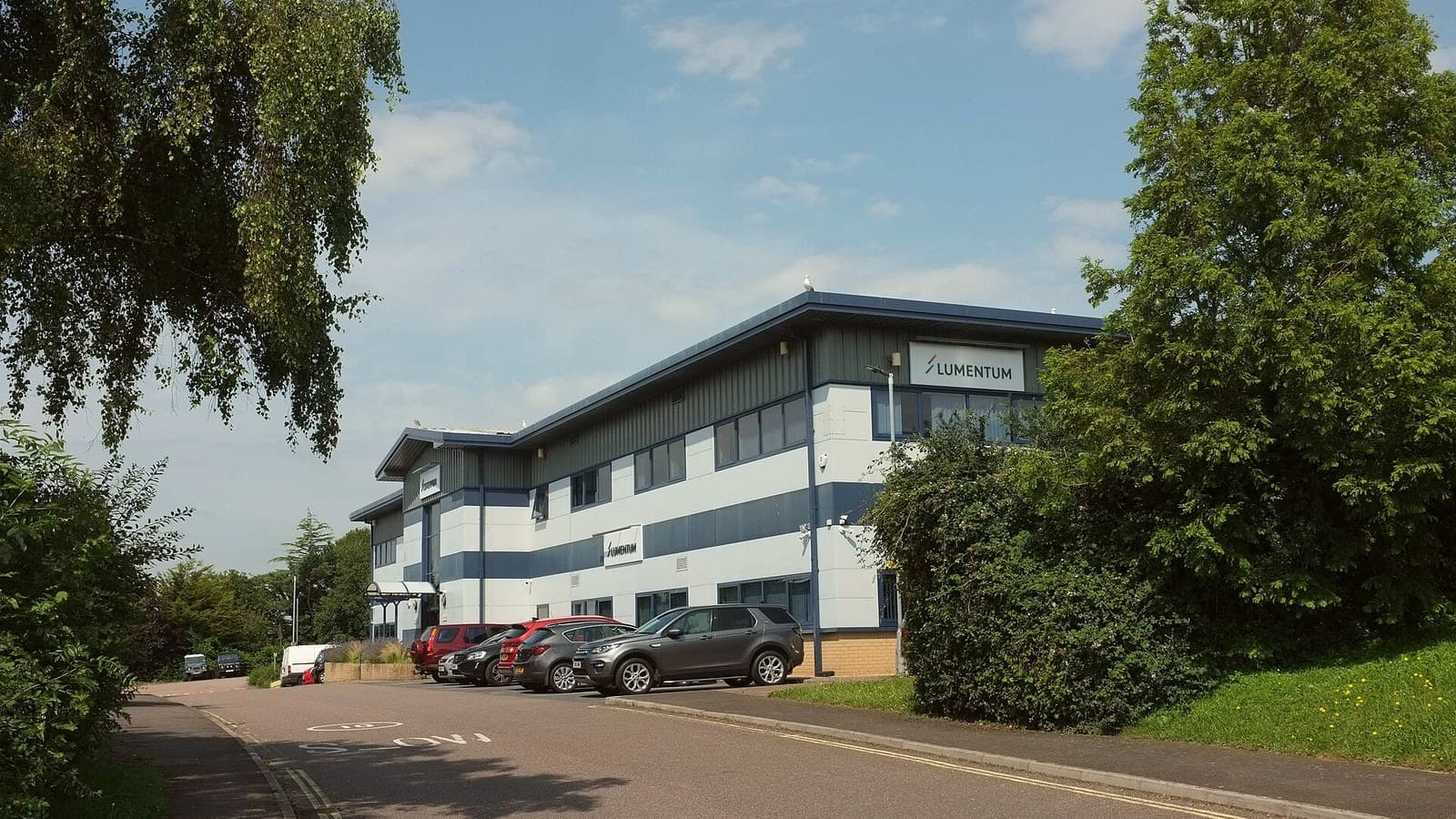
Cover image: "Lumentum, Westfield Business Park" by Derek Harper, CC BY-SA 2.0, via Wikimedia Commons and Geograph, cropped 16:9.
Tags
Frequently asked questions
- Has Marvell completed its acquisition of Lumentum?
- No. The two companies announced a definitive agreement on 2 November 2026, but closing is expected in the first half of calendar 2028 and still requires shareholder and regulatory approvals.
- How much is Marvell paying for Lumentum?
- The companies announced an all-stock deal with an implied enterprise value of $115 billion, including debt. Each Lumentum share converts into 4.500 Marvell shares, which the companies valued at $1,132 per Lumentum share at announcement.
- Why is Lumentum's share price below the stated deal value?
- Because the exchange ratio is fixed, the offer's dollar value moves with Marvell's share price. Marvell fell on the announcement, and Lumentum traded below even the recalculated value, which also reflects the long wait until closing and the risk that approvals fail.
- Why does optical interconnect matter for AI data centers?
- Copper cables lose more signal and need more power as data rates rise, and their practical reach shrinks. Optics can carry far more bandwidth over longer distances, so the connections between accelerators and switches are moving from copper to light.

TPW Editorial
Editorial Team
TechPastWeek's editorial team reports and edits every story we publish. We research each piece against primary and credible secondary sources, and a human editor reviews and signs off before it goes live.