Tesla Unveils a Flying Roadster 2 in Texas, With Production Set for 2028
Tesla unveiled its next-generation Roadster at SpaceX's Texas site on October 15, 2026, showing a four-thruster car it says can fly and plans to build in 2028.

On this page
Key takeaways
- Tesla and CEO Elon Musk unveiled the next-generation Roadster 2 on 15 October 2026 at SpaceX's rocket facility in McGregor, Texas, where the car lifted off the ground using four thrusters.
- Tesla executives said the car can accelerate from 0 to 60 mph in one second, and the company says it will travel more than 300 miles on a single charge.
- Tesla plans to begin Roadster 2 production in 2028, after first announcing the car in 2017 and initially promising it would ship in 2020, a delay Investor's Business Daily described as a nine-year wait.
- Tesla lists three variants: a road-ready Performance model with no thrusters, a race-ready Thrust version, and an invite-only one-seat Rocket version.
- No price was announced; reservations cost $5,000, with $45,000 due within 10 days for the Performance variant and $245,000 for the Thrust variant.
Tesla put a car in the air on Thursday night, and it did not look like a finished feature. At SpaceX's rocket development and testing facility in McGregor, Texas, on October 15, 2026, Tesla and chief executive Elon Musk unveiled the next-generation Roadster, the two-seat electric car the company first promised nearly a decade ago. The centrepiece was a flying demonstration: the car lifted off with what WIRED described as a "herky-jerky burst of steam," and at one point it appeared to flip over Tesla's entire line-up while floating several feet above one of the company's electric semi-trucks.
Related reading: CATL's TECTRANS II Aims to Make Electric Trucks a 1,000-Kilometer Business · Tesla Energy and Zhero Sign a 3 GWh Megapack Framework for Italy.
The numbers Tesla attached to the car are just as striking. Executives said it could accelerate from zero to 60 mph in one second, a figure no production car has approached. The lift comes from four thrusters, according to Lars Moravy, Tesla's head of vehicle engineering, who said the production version would "hopefully" reach 230 mph. Musk said he hoped to "crack halfway to the speed of sound," roughly 385 mph. Tesla says the car will travel more than 300 miles on a single charge.
A road car that levitates and a claimed acceleration time in the low single digits make the Roadster 2 as much a piece of theatre as a product. Tesla released the numbers and the model line-up alongside the jump, and those details say more about what the company is selling than the spectacle does.
What Tesla actually demonstrated
The thrusters are the defining feature. Tesla says they run on onboard compressed gas, which puts the system closer to a cold-gas thruster than to anything in SpaceX's launch hardware. Moravy said the car uses four of them. Musk added that the same technology that lets the car fly also produces downward force to help it corner. If that holds up, the flying hardware does work on a track as well as lifting the car off the ground.
The flight itself was brief and visibly imperfect. WIRED's account describes the car lurching upward rather than gliding, and the pass over the semi-truck read as a demonstration of capability, not a controlled flight profile. TechCrunch took the same tone in its headline, describing a car that "flies and falls with style." Tesla did not present the flight as finished hardware. It presented it as evidence that the hardware exists.
One part of the specification raises a practical question. Tesla says the car will travel more than 300 miles on a charge, and the thrusters run on compressed gas carried onboard. The company has not said how much thruster use affects that range, how often the car can hop, or how long the gas supply lasts. A road car that occasionally leaves the ground is a different engineering problem from an aircraft that sustains flight, and the demo did not settle which one Tesla is building.
The model line-up splits the flying capability into options. WIRED reported that Tesla will sell three versions:
- A two-seat Performance model, road-ready and without thrusters.
- A Thrust variant the company calls "race ready."
- A one-seat Rocket variant labeled "air ready" and listed as "invite only."
Only the Performance and Thrust versions can be reserved. The Rocket, the version closest to what flew in Texas, is not on open sale. That is a telling choice. Tesla showed its most extreme variant and put the two tamer ones on the order page, which suggests the thrusters are not yet something a normal buyer can simply tick on a form.
A nine-year wait, and a date that is still a promise
Tesla first announced the Roadster in 2017, advertised at $200,000, with enthusiasts putting down $50,000 deposits. The company initially said it would ship in 2020. It did not. Investor's Business Daily framed the October 2026 reveal as the end of a nine-year wait, and Tesla now says production of the Roadster 2 will begin in 2028.
That timeline deserves scrutiny. Musk has a long history of missing product deadlines, and the 2028 production date and the performance claims should be read as targets rather than commitments. A car announced in 2017, promised for 2020 and now scheduled for 2028 has had its schedule move more than once. The same caution applies to the speed figures, since they come from the company rather than from independent testing.
The deposit structure has changed with the car. The original Roadster's $50,000 deposit sat against a $200,000 price. For the Roadster 2, Tesla's site lists a $5,000 reservation fee for the Performance model, with an additional $45,000 due within 10 days. The Thrust variant takes an initial $5,000, with $245,000 due within 10 days. WIRED reported those figures, and CNBC reported that Musk said the car would not enter production until 2028 and did not reveal a price.
Why Tesla showed a flying car now
The reveal lands at a difficult moment for electric vehicles in the United States. Sales have stalled after a Republican-led Congress cut federal support, while global demand is rising amid an energy crisis, according to WIRED. The luxury end of the market is under particular pressure: Lamborghini shelved its electric-vehicle plans this year. In that environment, a six-figure hypercar that flies is a harder sell than it would have been in 2017, when battery-electric performance still carried the shine of novelty.
Bloomberg framed the demonstration as an effort to revive a sluggish auto business. The Roadster is, in effect, a marketing asset as much as a product. It draws attention that Tesla's core models do not, and it does so without requiring the company to ship a mass-market vehicle to earn that attention. For a manufacturer whose growth story has stalled in its largest market, a spectacle with a four-thruster car is a cheaper way to make news than a new volume model would be.
The reservation terms also serve a purpose beyond revenue. Money up front, with a large balance due within 10 days of reserving, filters for serious buyers and gives Tesla a running tally of demand before it commits capital to tooling. For a low-volume car with unusual hardware, that signal is worth more than the deposits themselves, which are a rounding error next to Tesla's core business.
There is a second message buried in the car. Tesla bills the Roadster 2 as its last human-driven vehicle, and Musk has argued the company should be understood as a builder of autonomous-vehicle technology and robots. A low-volume, thruster-equipped hypercar is an odd capstone for a company whose stated future is autonomy. One reading is that the Roadster marks the end of the era when Tesla's business was cars people drive themselves.
The regulatory question hanging over the demo
The flying feature brings federal regulators into the picture. A WIRED companion piece expects federal agencies, including the Federal Aviation Administration, to take an interest, because the feature sits outside the framework that governs cars. Road vehicles are certified for crash safety and emissions. Aircraft are certified for airworthiness. A machine that does both has no obvious home in either system.
That gap is not a technicality. If the Rocket variant is meant to fly in any formal sense, Tesla will have to answer questions about how the airspace around it is managed, what happens when a thruster fails in the air, and how a one-seat aircraft is certified at all. Tesla has not described a regulatory pathway, and a single demo does not establish one. Musk's own summary of the car was blunt. "This is not necessarily a safety-optimized car," he said, per WIRED.
"It's going to crush every track record that has ever existed." — Elon Musk, speaking at the Tesla Roadster 2 reveal in McGregor, Texas, October 15, 2026
A demonstration is not a product
The October 15 event showed the Roadster 2 lifting off the ground. It did not show a certified flying car, a price, or a production-ready Rocket variant. The thrusters, the flying capability and the performance figures are all Tesla-stated, and the road-going Performance version has no thrusters at all.
Caveats
Separating what Tesla showed from what Tesla claimed is the useful exercise here.
- The flight happened. Tesla demonstrated the car lifting off at McGregor on October 15, 2026, and multiple outlets covered it, including WIRED and TechCrunch.
- The acceleration figure is a company statement. The one-second 0 to 60 mph claim came from Tesla executives, not from an instrumented test.
- The top-speed figures are hopes, not specs. Moravy said the production car would "hopefully" reach 230 mph; Musk floated around 385 mph. Neither is a published specification.
- The 2028 production date is a target. It rests on Tesla's own statement, and the company has missed Roadster deadlines before.
- No price was announced. CNBC reported that Musk did not reveal one.
- The Performance variant cannot fly. Tesla's own variant list puts the thrusters only on the Thrust and Rocket versions.
What to watch
- Whether the 2028 date holds. The Roadster has slipped once already, and Musk's record on deadlines is the reason to treat the date as provisional.
- How the FAA and other federal agencies respond. A road vehicle that flies crosses two regulatory regimes, and Tesla has not said how it intends to bridge them.
- Whether the speed claims survive testing. The one-second 0 to 60 and the 230 to 385 mph range are company targets. Independent figures, if they arrive, will be the real test.
- Whether any variant gets a price. Reservations are open, but Tesla has not named a purchase price for any version.
- Whether Tesla ships a human-driven car at all. The company calls the Roadster 2 its last one, which makes the car a test of whether that framing holds.
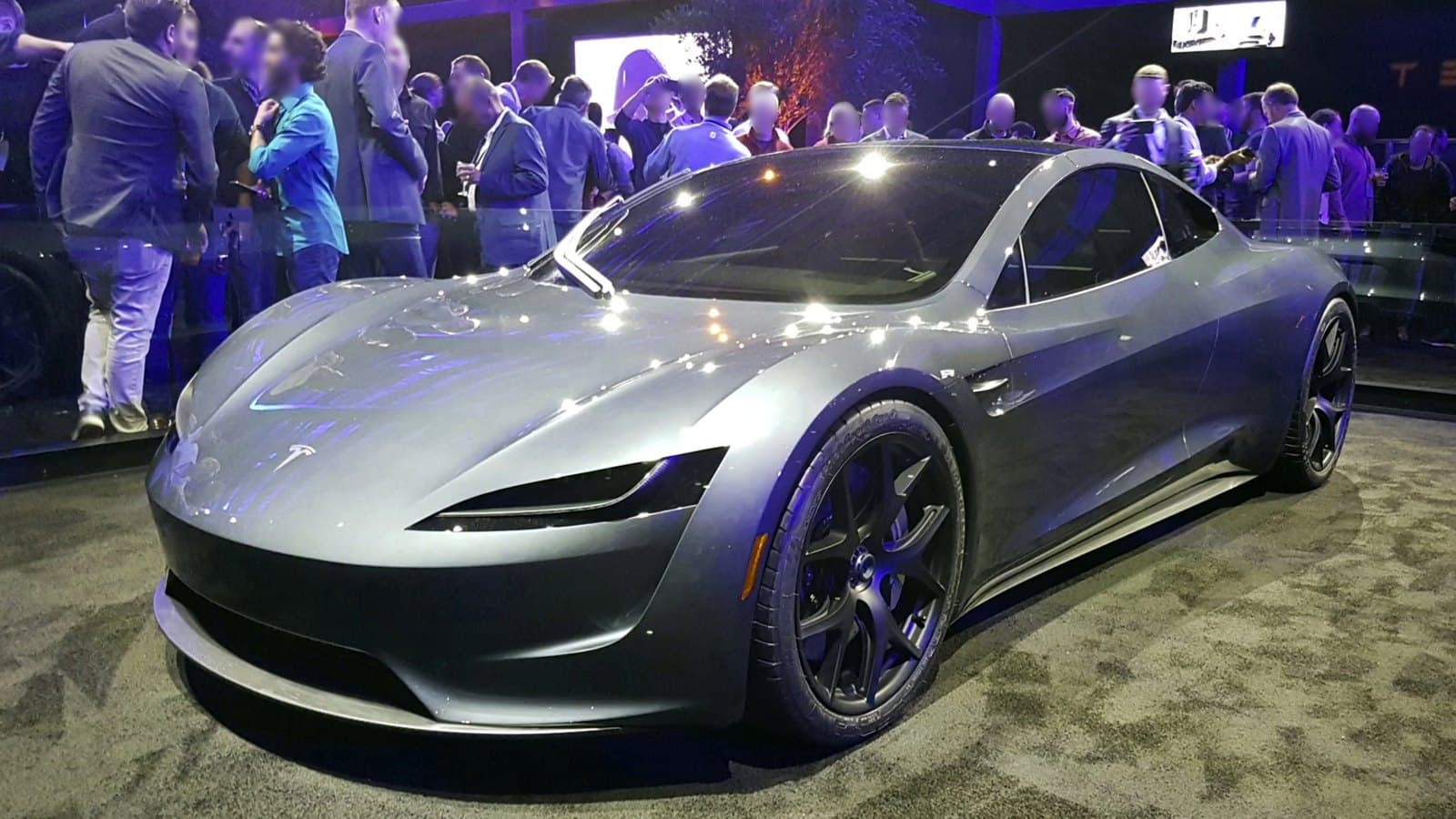
Cover image: Tesla roadster 2020 prototype.jpg by Smnt via Wikimedia Commons, CC BY-SA 4.0 (photograph of the prototype at the November 2017 launch event).
Tags
Frequently asked questions
- When will the Tesla Roadster 2 go into production?
- Tesla says production will begin in 2028. The car was first announced in 2017 and Tesla initially promised it would ship in 2020, so the date is one of several Tesla-stated targets that have moved before.
- Can the Tesla Roadster 2 actually fly?
- Tesla demonstrated the car lifting off the ground using four thrusters at its October 2026 event in Texas. Only the one-seat Rocket variant is billed as air ready; the road-going Performance version has no thrusters.
- How fast is the Tesla Roadster 2?
- Tesla executives said it can accelerate from 0 to 60 mph in one second. Engineering head Lars Moravy said the production car would 'hopefully' reach 230 mph, while Musk said he hoped to reach around 385 mph, halfway to the speed of sound. These are company targets, not verified figures.
- How much does the Tesla Roadster 2 cost?
- Tesla did not announce a price. Reservations require $5,000, with an additional $45,000 due within 10 days for the Performance variant and $245,000 for the Thrust variant. The Rocket variant is invite only.

TPW Editorial
Editorial Team
TechPastWeek's editorial team reports and edits every story we publish. We research each piece against primary and credible secondary sources, and a human editor reviews and signs off before it goes live.