Citroën's Electric 2CV Concept Targets a Sub-€15,000 City Car for 2028
The all-electric Citroën 2CV Concept at the 2026 Paris Motor Show previews a sub-€15,000 city car the French brand targets for 2028 production in Italy.

On this page
Key takeaways
- Citroën unveiled the all-electric 2CV Concept at the 2026 Paris Motor Show on October 12, with public days running from October 13 to 18.
- Citroën targets production in 2028 in Italy, on Stellantis' new small-EV "E-Car" platform, shared with related Fiat and Opel models.
- The company is targeting a starting price under €15,000, or about £13,000, but the price is not final and no specification has been published.
- The 2CV Concept is about 3.76 metres long and around one tonne, and keeps cues such as round headlights and a roll-top fabric roof.
- The original Citroën 2CV was built from 1948 to 1990; the revival arrives as European makers compete on smaller, cheaper electric cars.
Citroën unveiled the 2CV Concept at the 2026 Paris Motor Show (Mondial de l'Auto) on October 12, an all-electric reinterpretation of the car that put postwar France on wheels, and one the brand says it wants to sell for less than €15,000 by 2028. The show car is a concept. The price, the production date and the platform beneath it are targets, not settled product facts, and Citroën did not disclose range, power or battery size at the show.
Related reading: Tesla Unveils a Flying Roadster 2 in Texas, With Production Set for 2028 · Google and Constellation Add 890 MW of Nuclear Power Through Reactor Uprates.
The pitch is a small, light, affordable electric car for European cities, the kind of machine the industry spent the past decade not building while it chased bigger, heavier and more expensive models. Citroën's bet is that the mood has turned, and that the cheapest end of the market is where the next fight will be.
A 2CV revival has been discussed for years, and the company has spent much of that time explaining why the numbers did not work. The model that made its name selling simple, cheap transport in the 1950s does not map cleanly onto a market where the same badge is expected to carry modern safety equipment, a battery and a screen. What has changed, on Citroën's account, is the arrival of a small-EV platform it can share across several brands, which spreads the engineering bill over more cars than a single model could justify.
What Citroën put on the stand
The 2CV Concept measures 3.76 metres long and weighs around one tonne, according to the photo captions that ran with the Independent's report. That makes it shorter than the original 2CV and shorter than the new Renault Twingo, and it slots between Citroën's Ami quadricycle and the e-C3 supermini in the company's line-up.
The styling leans on the original's signatures: a V-shaped bonnet, an upright windscreen, standalone round headlights and a roll-top fabric roof. New Atlas reports that the design lead, Antoine Gaillot-Drevon, said costs were cut with flat steel panels and glass, bumpers that detach for cheap repair after low-speed dents, and a tailgate whose black finish is moulded into the composite rather than painted. The cabin is deliberately bare, with a small screen on the steering column and most controls grouped there.
Positioning matters to the plan. The Ami is not a conventional car but a quadricycle with a limited top speed, and the e-C3 is a full supermini. Setting the 2CV between them, with the stance and proportions of a normal car, puts it in the A-segment space where European buyers once found the Fiat Panda, the Volkswagen Up and the original 2CV itself. It is also a segment where European makers have found it hard to match the prices of imported Chinese models, which is the pressure the whole concept is meant to answer.
Underneath, the concept uses Stellantis' new small-EV “E-Car” platform, the same architecture intended to carry related Fiat and Opel models. Production is targeted for 2028 in Italy, Autocar reports. Citroën also hinted at a commercial van variant, a revival of the 2CV Fourgonnette, and showed the Elo, a small electric minivan concept, alongside it.
What is confirmed, and what is not
Confirmed: Citroën unveiled an all-electric 2CV Concept at the Paris Motor Show on October 12, 2026, and describes it as close to a production design. Not confirmed: the price, the range, the battery, the power output and the exact production timeline. Treat the €15,000 figure and the 2028 date as the company's targets until a final specification is published.
The price is the argument
The headline number is a starting price under €15,000. Auto Express quotes Citroën saying the car will cost from as little as €15,000, or about £12,700, and Electrek reports a target of “around €15,000”. An AFP caption carried by the Detroit News described a car “priced below 15,000 euros”. None of those is a final price. Stellantis has published no specification, and the commercial case for a concept can change a lot between a show stand and a factory order book.
If the number holds, the 2CV would land among the cheapest new electric cars on sale in Europe. That is the point. The original 2CV was designed as affordable transport for the masses, and Xavier Chardon, Citroën's chief executive, has said the new one has exactly the same purpose.
“exactly the same purpose” — Xavier Chardon, Citroën chief executive, comparing the new 2CV with the postwar original
The comparison to the postwar car is marketing; the price is the substance. Citroën is not the only manufacturer chasing this ground, and the concept's real test is whether a carmaker with European cost structures can build a credible electric vehicle at a price that undercuts the field.
Why light matters more than fast
The weight target is not a styling choice. Every kilogram a car carries costs battery cells, and cells are the single largest cost in an electric vehicle. Citroën is aiming to hold the 2CV Concept at around one tonne, which is light for any modern car and unusually light for an EV. A lighter body needs a smaller battery to reach a given range, and a smaller battery is both cheaper to buy and less energy-intensive to build.
This is the engineering logic behind the exercise. Small, light cars are also cheaper to insure, cheaper to run and easier to park, which is why they sell well in dense cities. The trouble is that they earn thinner margins per unit than the bigger, heavier crossovers that have dominated European showrooms for a decade. Building one profitably under €15,000 is the hard problem, and the difficulty sits in supply chains and battery costs.
Auto Express ties the model to the EU's incoming “e-car” regulations, a simpler and cheaper class of vehicle being negotiated between Brussels and European manufacturers. If that framework lands as described, it could lower the cost of the kind of car Citroën is proposing. As with everything else about this story, the rules are not final.
None of this is unique to Citroën. Every volume carmaker in Europe is trying to work out how to build a profitable small electric car, and the options usually come down to a shared platform, a cheaper battery chemistry, or both. The 2CV Concept is Stellantis' attempt to square that circle. Whether the arithmetic works will not be clear until the company publishes a specification and a price, and a concept car is under no obligation to do either.
Charging looks different for a car this size. A small battery fills more slowly in absolute terms, but a city driver who plugs in at home overnight may never notice. The design trade-offs shift with the use case: outright range matters less, while cost, footprint and weight matter more. Citroën has not said which trade-offs it chose. Electrek notes that comparable small urban EVs tend to carry roughly 30 kWh and about 250 kilometres of range, and suggests that as a loose ballpark, but the company has confirmed nothing of the kind.
A show built around cheaper EVs
The 2CV was not the only small, affordable electric car in Paris. The show's centre of gravity has moved toward lower prices and smaller footprints: Autocar's round-up lists the new Smart #2 city car, the reborn Audi A2, Dacia's second-generation Spring supermini and concepts from Renault, Fiat and Peugeot. Volkswagen showed the ID. Polo, Cupra brought the Raval, and Renault had the Twingo and the R5 Turbo 3E. Chinese brands, among them BYD, Geely and Xpeng, were present in force, Motor1 noted in its show preview.
Euronews frames the revival as arriving almost forty years after the 2CV disappeared from the market. The original was built from 1948 to 1990, sold in the millions and became one of the most recognisable cars in Europe. Reviving it as a cheap electric car says something about where Citroën thinks the demand is.
Citroën is presenting the 2CV Concept as close to the final car rather than as a flight of fancy. Autocar reports that it first revealed the revival plans early last year, and that the production version is expected at the 2028 Paris show. That gives the project a public timeline, even if the specifications attached to it are still unwritten, and it sets up a comparison the company will have to meet: the car that arrives in 2028 against the one on the stand in 2026.
Caveats
Several things about this story are still open, and they matter for anyone reading the price target as a promise.
- The 2CV Concept is a concept, not a production car. Citroën has not committed publicly to a final specification.
- The 2028 production date, the sub-€15,000 price and the plan to build in Italy alongside Fiat and Opel models are targets, not final facts.
- Range, power and battery size were not disclosed at the show.
- Some concept details are unlikely to survive to production. New Atlas notes the 19-inch wheels, and the show car's vivid colour and hanging interior lights are styling for the stand.
- Both the pricing and the EU “e-car” rules depend on decisions outside Citroën's control, including battery costs and regulation that is still being negotiated.
What to watch
Three things will decide whether this becomes a car rather than a well-received show stand. The first is whether a sub-€15,000 price survives contact with battery economics. A light body helps, but cell prices and European manufacturing costs set the floor. The second is whether the EU's “e-car” rules land in a form that lowers costs for small vehicles, because Auto Express ties the model's pricing promise to that framework. The third is the first real specification: range, battery size and charging speed, none of which Citroën has published.
Autocar notes that the production version is expected at the 2028 Paris motor show, which falls on the 80th anniversary of the original 2CV's debut in 1948. Citroën has set a date and a price target. Neither is final.
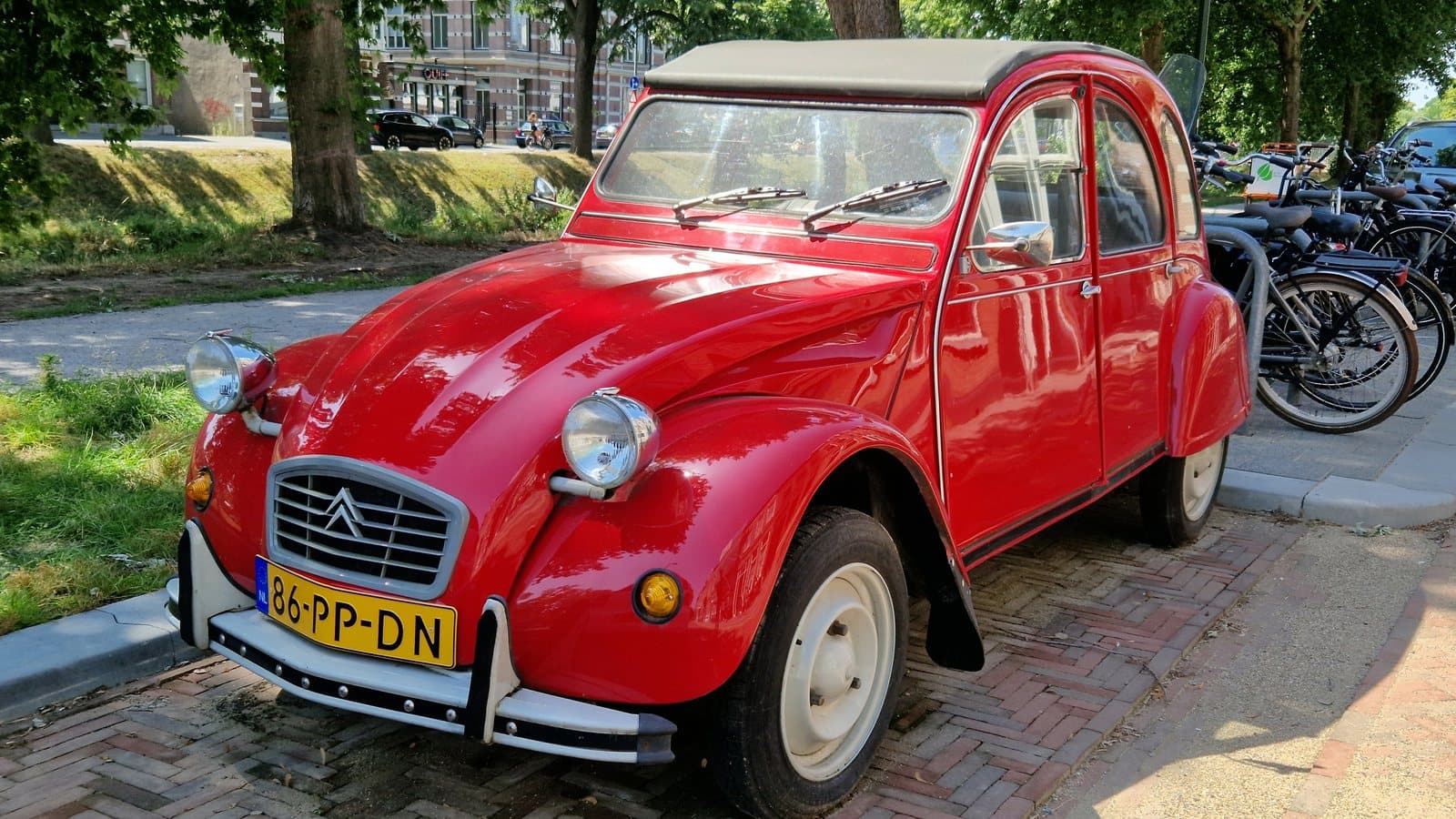
Cover image: "Red Citroën 2CV three-quarter front view.jpg" by Renée Kools, CC BY 4.0, via Wikimedia Commons.
Tags
Frequently asked questions
- Is the Citroën 2CV coming back as an electric car?
- Citroën showed the all-electric 2CV Concept at the 2026 Paris Motor Show. It is a concept rather than a production car, and Citroën is targeting production in 2028 in Italy.
- How much will the electric Citroën 2CV cost?
- Citroën is targeting a starting price under €15,000, or about £13,000. That figure is a target, not a final price, and Stellantis has not published a specification for the car.
- When will the electric Citroën 2CV go on sale?
- Citroën has targeted 2028 for production, in Italy. The date is a target, and Autocar reports the production version is expected at the 2028 Paris motor show, which falls on the original 2CV's 80th anniversary.
- What range and battery will the electric Citroën 2CV have?
- Citroën did not disclose range, power or battery size at the 2026 Paris Motor Show. The concept uses Stellantis' small-EV "E-Car" platform, but no technical specifications have been released.

TPW Editorial
Editorial Team
TechPastWeek's editorial team reports and edits every story we publish. We research each piece against primary and credible secondary sources, and a human editor reviews and signs off before it goes live.