Tesla's Semi Finally Has a Factory Built for It, and a 2,500-Truck Order
Tesla opened a Semi plant in Sparks, Nevada built for 50,000 trucks a year, as a shipper alliance placed the largest electric Class 8 order in history.

On this page
Key takeaways
- Tesla opened a dedicated Semi factory in Sparks, Nevada on September 24, 2026, a plant of about 1.7 million square feet designed for up to 50,000 trucks a year, or roughly 1,000 a week.
- Dan Priestley, Tesla's director of Semi engineering, said the site is expected to bring more than 3,000 jobs to Nevada during the production ramp.
- The plant builds the Standard Range (about 325 miles), Long Range (about 500 miles) and European-specification Semis on a single line, and the first truck came off the high-volume line in April 2026.
- The ZET SCALE alliance, run by Catalyst Mobility and the Smart Freight Centre with founding shippers including Microsoft and PepsiCo, ordered 2,500 battery-electric Class 8 trucks, naming Tesla primary manufacturer; the trucks go to ten freight hubs and the alliance targets 10,000 or more.
- The Semi was unveiled in November 2017 with production promised for 2019, first customer deliveries went to PepsiCo in 2022, and pricing is reported at roughly $260,000 for the 325-mile version and up to $300,000 for the 500-mile version.
On September 24, 2026, Tesla held an invite-only opening for a factory in Sparks, Nevada built for one product: the Semi, its battery-electric Class 8 truck. The plant sits next to Gigafactory Nevada, covers about 1.7 million square feet and is designed for up to 50,000 trucks a year. Quartz put the weekly figure at roughly 1,000 trucks, and reported that Dan Priestley, Tesla's director of Semi engineering, expects the site to bring more than 3,000 jobs to Nevada as output ramps.
Related reading: LG Energy Solution Opens a 35 GWh LFP Plant in Michigan, Betting on Grid Storage · Tesla Unveils a Flying Roadster 2 in Texas, With Production Set for 2028.
The plant is the end of a long argument with the calendar. Tesla unveiled the Semi in November 2017 and promised production in 2019. It built a small number of trucks by hand and delivered the first to PepsiCo in 2022. The first truck came off the high-volume line in April 2026, when Tesla posted "First Semi off high volume line," and Musk said on the July 22 second-quarter earnings call that mass production had started. The September event did not start anything. It marked a transition that had already happened, five months earlier.
A plant built for one truck
Electrek and several outlets reported that every Semi variant is built on the same line: the Standard Range, the Long Range and a European specification. Tesla calls it its first factory built for the Semi, which is the point. The Semi is a low-volume, high-configuration vehicle in a company whose factories were designed around Model 3, Model Y and Cybertruck, none of which share its proportions or its axle layout.
The range split is what a fleet buyer is choosing between. Tesla lists the Standard at about 325 miles and the Long Range at about 500, both on an 82,000-pound gross combination weight rating, with three independent motors and up to 1,072 horsepower on the refreshed truck. Charging is the operational argument: Tesla says up to 60 percent of range in 30 minutes at a Semi Charger, and the refreshed design adds support for charging above a megawatt.
Price remains the hurdle that fleet accountants actually weigh. Electrek reported in February that Tesla was quoting $290,000 for the 500-mile Long Range truck, consistent with California's HVIP voucher filings listing roughly $260,000 for the Standard and $300,000 for the Long Range. Those are the numbers to compare against a diesel Class 8 purchase price plus fuel and maintenance over a decade of operation, and the comparison is the only one that has ever made electric trucks look reasonable.
The order book arrived first
The most consequential thing to happen around the Semi factory had nothing to do with Tesla. On September 22 and 23, 2026, the ZET SCALE alliance, short for Zero-Emission Truck Shipper-Carrier Alliance Leading Electrification, placed an order for 2,500 battery-electric Class 8 trucks: the largest such order in US history.
ZET SCALE is run by Catalyst Mobility, the freight nonprofit formerly known as CALSTART, together with the Smart Freight Centre, with Microsoft and PepsiCo among its founding shippers. The mechanism is pooled demand. Big shippers commit to volume, manufacturers compete for the order, and ZET Financial issues the purchase orders through a fair-market-value lease called ZET Lease, which removes the residual-value risk that FreightWaves said had kept carriers and fleets on the sidelines. Every Class 8 truck manufacturer in North America was invited to the tender, and the alliance said it selected Tesla as primary OEM after evaluating price, range, charging capability and production capacity, with Kenworth, Volvo and RIDE as secondary suppliers.
Two details make the order real rather than ceremonial. First, the scale: 2,500 trucks is roughly equal to the entire number of electric Class 8 trucks operating in the United States today, and the alliance intends to double that again, targeting 10,000 or more. Second, the distribution: the trucks go to ten freight hubs, from Los Angeles, Stockton and Bakersfield through Seattle/Tacoma, Houston, Dallas, San Antonio, Chicago and Atlanta to the Newark and New York area, phased over years.
It is also the second-largest order Tesla has announced, and the first was not long ago. Einride disclosed 500 trucks in the week before the factory event, its largest to date, with deployment starting in September and phased over 24 months across five states. WattEV ordered 370 in May at the ACT Expo. DHL confirmed an order beyond the handful of trucks it had already taken, after testing the Semi in Livermore, California.
The lease structure is what turns those numbers into deliveries. A carrier that signs for 2,500 trucks does not want to own 2,500 trucks, because the residual value of a battery-electric tractor in 2032 is a guess, and a bad guess is a business ending. ZET Lease buys the trucks and leases them at fair market value, which is a different risk for the carrier and a financing question for somebody else. It is the same reasoning that turned airline fleets into lease-and-leaseback arrangements, and it is the reason a procurement alliance rather than an individual fleet is the plausible route to volume here.
The pattern matters more than any single number. Tesla spent years selling individual trucks to individual early customers while announcing a 50,000-per-year plant. The large fleet orders arrived after the line existed, which is the reverse of the usual hardware narrative and is a reasonable signal about how fleets buy.
What nine years of pilot production taught
The gap between the 2017 unveiling and the first volume truck is usually told as a delay story, and it is a competition story underneath. The Semi was announced as a 2019 product into a market that had barely begun to exist: no fleet operator had a charging plan, no utility had interconnection queues filed for depot power, and the vehicle class had no credible alternative. Building trucks then would have produced expensive vehicles with nowhere to charge them.
The pilot years solved a different problem, which was whether the truck works at all. Early units went to PepsiCo and a handful of other customers who ran them in real routes, in California heat and on mountain grades, and the fixes that came out of that period are visible in the refreshed vehicle. Car and Driver's reporting, as summarised in industry coverage, described a revised front end, a full-width light bar, a reworked bumper, reworked aerodynamic channels and new camera placement alongside Tesla's claims of better efficiency, improved payload, 500-mile range and charging above a megawatt. Those are the revisions of a truck that has been worked hard by customers who had no reason to be kind about it.
What the pilots could not solve is price, and price is the thing that kept fleets away. At roughly $260,000 for the 325-mile truck and up to $300,000 for the 500-mile version, a Class 8 buyer is being asked to pay several times the price of a diesel tractor upfront and recover it over a decade of lower fuel and maintenance. That arithmetic works for a large shipper with depots, predictable routes and a fuel bill big enough to care about. It does not work for a small carrier running two trucks on a thin margin, which is most of the industry and most of the emissions.
The constraint is the plug, not the truck
Tesla's argument for the Semi has always been that the vehicle was never the hard part. Charging infrastructure is, and it is where the plant opening is least discussed.
The company opened the first public Semi Megacharger site in Los Angeles in July 2026, with more locations under development, and has used a Megawatt-class system to show the truck taking on 70 percent of its range in about half an hour. Each stall is a capital project on a utility timeline, and no factory opening changes that. A fleet that orders 2,500 trucks through a lease still has to route them through chargers that exist, in states where the electricity is available and the interconnection queue has moved.
The economics that pushed ZET SCALE's members to the table are mostly about diesel. CNBC's reporting on the factory opening noted that soaring diesel costs present an opening for electric trucks in commercial trucking even as Tesla's core vehicle business faces more competition. A fuel-cost argument is much easier for a shipper to make internally than a technology argument, and it is the reason an order can be justified at $260,000 a truck.
What could still go wrong
Nameplate capacity is not output. Priestley has been clear that deliveries in 2026 will be lower as the line scales, and the ramp is where a programme like this historically breaks. At the plant's full design rate of 50,000 trucks a year, the four-day-equivalent order DHL reported is a rounding error, which tells you how much spare capacity Tesla thinks the market will eventually need.
Three other things are worth watching. The charging build-out is the binding constraint, and it is outside Tesla's control. The pricing leaves no margin for error at the current truck cost, and any of the standard range, price, or support changes that would make a $260,000 truck work for a small carrier will be watched closely by competitors. And autonomy keeps moving independently of the truck: CNBC noted that Aurora Innovation and Kodiak AI are already running driverless tests and hauling cargo for partners, and a driverless Class 8 fleet would change the arithmetic for a truck whose value depends on a human being willing to sit in it.
The date that matters is not the one Tesla celebrated in Sparks. The Semi has been announced three times: in 2017, in April 2026, and again on September 24. Only the third one came with a factory sized for the demand and an order book filled by somebody other than the company. That is the difference between a demonstration and a product, and it took nine years.
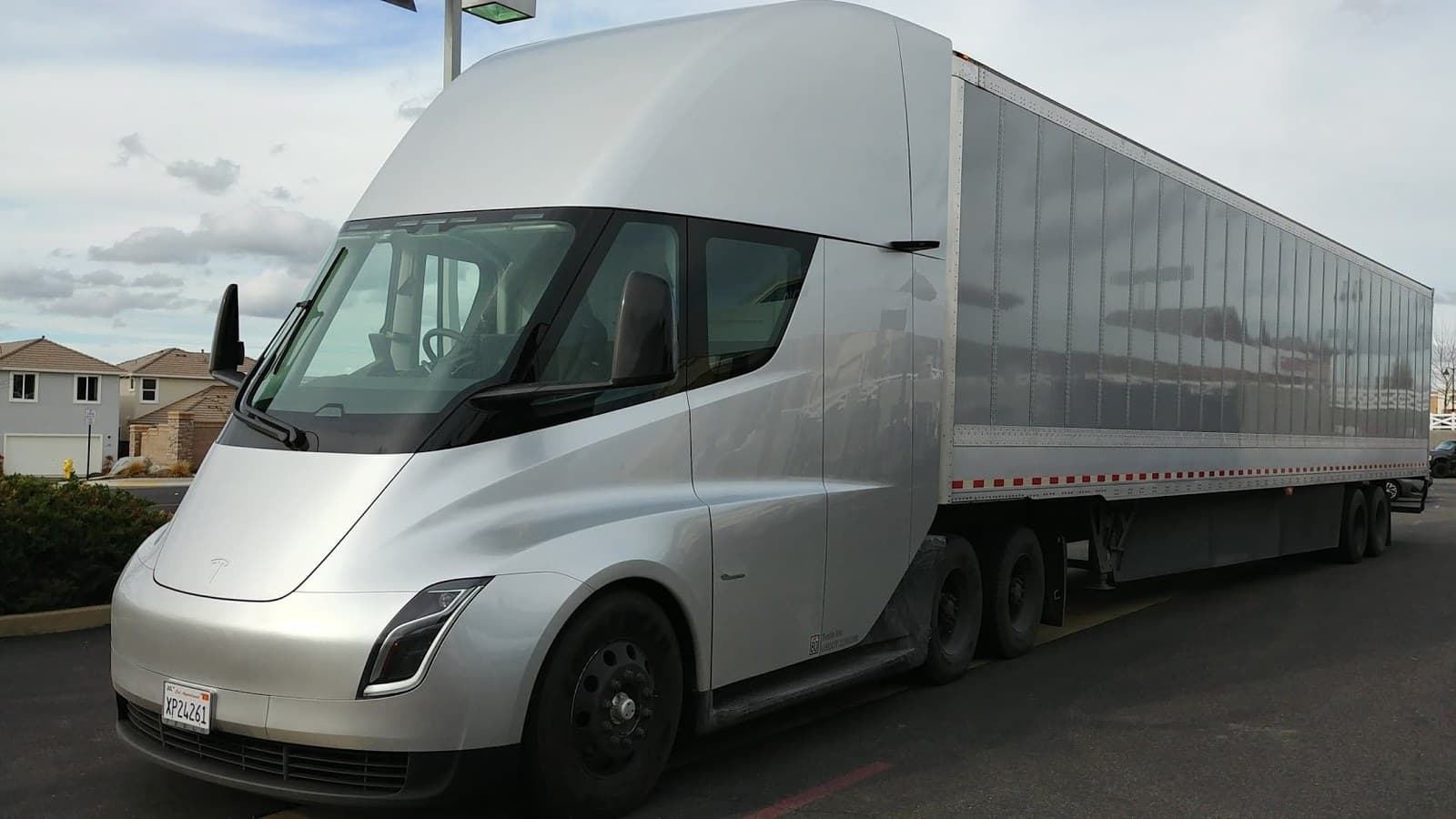
Cover photograph: a Tesla Semi, by Korbitr, in the public domain, via Wikimedia Commons.
Tags
Frequently asked questions
- When did Tesla Semi production start?
- Tesla said the first Semi came off the high-volume line in April 2026, and on July 22, 2026 chief executive Elon Musk said on the second-quarter earnings call that mass production had begun. The September 24, 2026 event in Sparks, Nevada marked the plant's official opening, months after the line was already running.
- What is the largest electric truck order in US history?
- It is the 2,500 battery-electric Class 8 trucks ordered through ZET SCALE, an alliance run by Catalyst Mobility and the Smart Freight Centre whose founding shippers include Microsoft and PepsiCo. Tesla was selected as primary manufacturer, with Kenworth, Volvo and RIDE as secondary suppliers, and the trucks will be distributed across ten freight hubs.
- How much does a Tesla Semi cost and how far does it go?
- Reported pricing is roughly $260,000 for the Standard Range version with about 325 miles of range and up to $300,000 for the Long Range version with about 500 miles, far above the $150,000 and $180,000 Tesla advertised at the 2017 unveiling. Both have an 82,000-pound gross combination weight rating, and Tesla says the trucks recover up to 60 percent of range in 30 minutes at its Semi Chargers.
- Will Tesla actually build 50,000 Semis in 2026?
- Almost certainly not. The 50,000 figure is the plant's design capacity, not an output forecast, and Dan Priestley said 2026 deliveries are expected to be lower as the line scales. At full capacity the plant's 50,000 trucks a year would be under four days of DHL's reported order, which is the scale the ramp is being built for.

TPW Editorial
Editorial Team
TechPastWeek's editorial team reports and edits every story we publish. We research each piece against primary and credible secondary sources, and a human editor reviews and signs off before it goes live.