LG Energy Solution's JF2 AC Link Qualifies as an NVIDIA DSX Ready BESS
LG Energy Solution said its LFP-based JF2 AC Link qualified as an NVIDIA DSX Ready BESS, the only Korean battery maker picked for the AI data-centre program.

On this page
Key takeaways
- LG Energy Solution announced on 22 September 2026 that its battery energy storage system qualified as an NVIDIA DSX Ready BESS, making it one of three BESS partners worldwide and the only Korean battery maker in the program.
- The qualified product is the JF2 AC Link, an LFP-based AC-coupled system built from modular 2.5 MW / 5.1 MWh battery blocks with grid-forming capability, fast response and AI load smoothing.
- NVIDIA's DSX Ready program qualifies partner products that meet its DSX AI Factory Platform reference designs, initially covering power and cooling infrastructure.
- LG Electronics separately qualified a 2.5 MW coolant distribution unit, after earlier 600 kW and 1 MW approvals.
- LG Energy Solution operates five ESS production sites in North America and aims for more than 50 GWh of annual ESS capacity there by the end of 2026.
LG Energy Solution said on 22 September 2026 that its battery energy storage system has qualified as an NVIDIA DSX Ready BESS, a designation that places the Korean manufacturer inside NVIDIA's programme for standardising the infrastructure around AI data centres.
Related reading: Google and Nvidia Want Data Centers to Give the Grid a Break · Google and Constellation Add 890 MW of Nuclear Power Through Reactor Uprates.
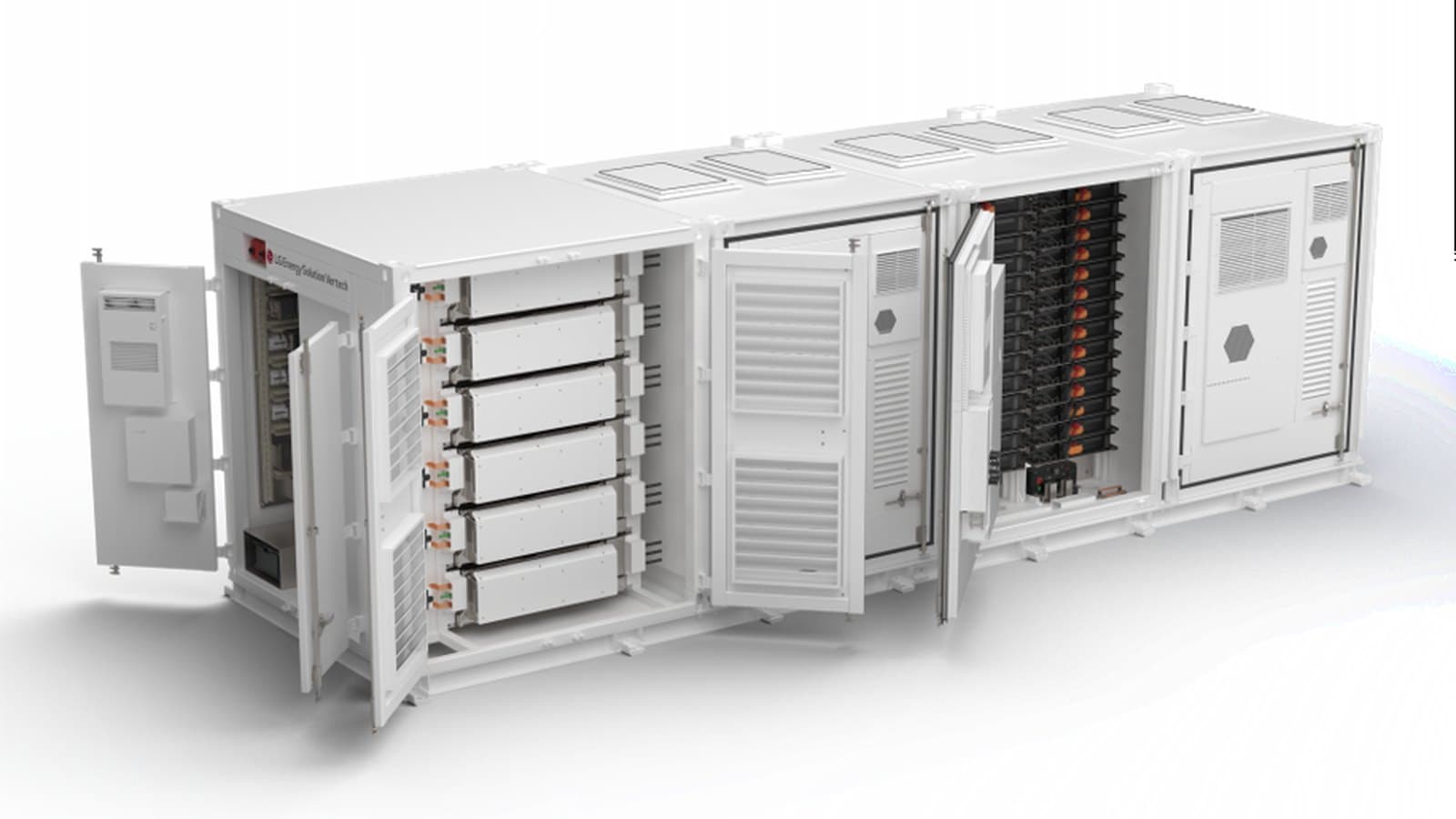
The qualified product is the JF2 AC Link, an AC-coupled system built on lithium iron phosphate (LFP) cells. According to LG Energy Solution's announcement, the JF2 AC Link is assembled from modular 2.5 MW / 5.1 MWh battery blocks, which the company says allows capacity to be added as a data centre expands rather than sized once at construction. It includes grid-forming capability, fast response times, voltage ride-through and a feature LGES calls AI load smoothing, which charges and discharges in response to swings in server power consumption.
NVIDIA selected three battery storage partners globally for the programme's first cohort, and LGES is the only Korean battery maker among them. The Korea Herald reported that the other qualified providers are Tesla and Hitachi Energy. "Being selected as a partner for NVIDIA's first-ever DSX Ready program validates the strength and competitiveness of our BESS products," said Chang Beom Kang, head of LG Energy Solution's ESS battery division.
What NVIDIA's DSX Ready programme is
NVIDIA introduced DSX Ready as a qualification programme for partner products and solutions that meet the requirements of its DSX AI Factory Platform reference designs. The DSX platform is meant to unify the design and operation of an AI factory across compute, networking, power, cooling, facilities and software, so that operators can assemble data centres from components that are known to work together.
The programme initially covers power and cooling, the two areas that become hardest to manage as AI data centres grow larger and more power-dense. GPUs draw enormous and rapidly changing loads, and the electrical and thermal systems around them have to absorb those swings without destabilising the grid connection or overheating the racks. Qualifying a battery system means NVIDIA has checked it against its reference designs for that job.
LGES said its system meets the DSX Ready requirements for AC energy storage solutions. The company framed the qualification around "time-to-power", the idea that AI operators need to bring capacity online quickly and cannot wait for long construction cycles. A modular, factory-built battery system is faster to deploy than building generation or grid upgrades from scratch.
The product: the JF2 AC Link is an LFP-based, AC-coupled battery storage system made of 2.5 MW / 5.1 MWh modular blocks. LGES lists grid-forming capability, fast response, voltage ride-through and AI load smoothing among its functions, and says the architecture is designed to meet applicable UL and NFPA requirements.
Power is becoming the constraint on AI
The deal reflects a shift in where the AI buildout is bottlenecked. For the past few years the constraint has been chips, then data-centre space. Increasingly it is electricity: the ability to connect enough power, and to do it fast enough, in the regions where operators want to build. Battery storage helps by smoothing load, providing backup and supporting grid stability, which lets a site draw a more predictable amount from the grid.
Cooling is the other half of the equation, and LG affiliates are involved there too. LG Electronics previously received NVIDIA specification approvals for 600 kW and 1 MW coolant distribution units in July and September, and it has now qualified a 2.5 MW model under the DSX Ready programme. Research firm TrendForce projects that liquid cooling adoption in AI data centres will rise from 14% in 2024 to 60% in 2027, which explains why the cooling lineup matters as much as the batteries.
For LGES, the qualification is a route into a market adjacent to its core electric-vehicle business. The company has been building out energy storage as EV demand growth has slowed, and data centres offer a large, fast-growing customer base with high willingness to pay for reliability. It has already signed a 6 GWh contract with DTE Energy in May and a Google and Cypress Creek project in July.
North American manufacturing is the selling point
LGES is leaning on local production as its differentiator. The company operates five ESS production sites in North America and says it manufactures cells, packs and system integration within the region. By the end of 2026 it aims to secure more than 50 GWh of annual ESS production capacity there. It also plans to produce LFP cells at its Ontario, Canada site, which would bring the chemistry it uses for the JF2 AC Link closer to its customers.
Local manufacturing matters for two reasons. The first is logistics: large battery systems are heavy and expensive to ship, so building near the data centres reduces cost and lead time. The second is policy: US incentives under the Inflation Reduction Act favour domestically produced clean-energy components, and LGES has said it is eligible to benefit from them.
The North American focus also positions LGES against Chinese battery makers that dominate global LFP supply but face higher barriers to selling into the US market. By building a fully local value chain, LGES can pitch itself as a lower-risk supplier for operators who care about tariffs and supply-chain security as much as price.
Why data centres need batteries
AI data centres are unusual electricity customers. Their load is large and spiky, rising and falling as training jobs and inference traffic change, and the spikes can be severe enough to strain a local grid connection. A battery system sits between the site and the grid, absorbing those swings so the operator draws a smoother, more predictable amount of power. That is the function LGES calls AI load smoothing, and it is the main reason storage is appearing in AI infrastructure plans.
There is a second reason: speed. Connecting a large data centre to the grid can take years, and in some regions the queue for new capacity is the longest part of a project. On-site batteries can bridge part of that gap by shifting when power is drawn and by providing backup, which helps operators bring capacity online sooner. The industry calls this time-to-power, and it is the constraint NVIDIA's DSX programme is trying to address by qualifying components that are known to work together.
A third reason is reliability. Grid-forming batteries can hold up voltage and frequency when the supply is unstable, and voltage ride-through lets a site keep operating through brief dips and spikes that would otherwise trip equipment. For a data centre running expensive AI accelerators, an unplanned shutdown is costly, so power quality is worth paying for.
The market for data-centre batteries is still small next to the EV business that dominates LGES's order book, but it is growing quickly and carries higher margins because reliability matters more than unit cost. That is why battery makers, including LGES, Tesla and Hitachi Energy, are competing to be qualified in NVIDIA's reference architecture rather than treating AI data centres as a niche. The DSX Ready badge is a way to be specified in projects before they are tendered.
Why it matters: AI data centres need storage to smooth large, fast-changing power loads, to bridge grid-connection delays and to protect equipment from voltage swings. NVIDIA's DSX Ready programme qualifies components that meet its reference designs for those systems.
What to watch
The first question is how much the DSX Ready badge is worth in contracts. Qualification puts LGES on a shortlist, but data-centre operators still run their own procurement, and NVIDIA's programme is new enough that its commercial pull has not been tested at scale. The three BESS partners will compete for the same projects.
The second is whether AI load smoothing works as advertised on real workloads. The pitch is that the battery can absorb the sharp power swings of GPU clusters, which would otherwise stress the grid connection and require oversized infrastructure. That is a technical claim that will be proven in operation, and operators will watch the data closely.
The third is the pace of the AI power buildout itself. If data-centre demand keeps growing, battery storage and cooling become critical-path equipment, and suppliers that qualify early stand to benefit. If the buildout slows, the market becomes more crowded and price competition will intensify. For now, LGES has secured a place in the reference architecture NVIDIA is trying to make standard, which is a useful position regardless of how the cycle turns.
Cover: official LG Energy Solution render of the JF2 AC Link battery energy storage system, company-distributed product image used for news coverage.
Tags
Frequently asked questions
- What is the LG Energy Solution JF2 AC Link?
- It is an LFP-based, AC-coupled battery energy storage system built from modular 2.5 MW / 5.1 MWh blocks. It is designed for grid-forming operation, fast response, voltage ride-through and AI load smoothing, and to meet applicable UL and NFPA requirements.
- What does NVIDIA DSX Ready mean?
- DSX Ready is a qualification program for partner products that meet NVIDIA's DSX AI Factory Platform reference designs, covering areas such as power and cooling for AI data centers. NVIDIA introduced the program in September 2026.
- Which companies are NVIDIA's BESS partners?
- NVIDIA selected three battery storage partners globally, including LG Energy Solution, Tesla and Hitachi Energy. LG Energy Solution is the only Korean battery maker among them.
- How much battery storage capacity does LG Energy Solution have in North America?
- It operates five ESS production sites in North America and aims to secure more than 50 GWh of annual ESS production capacity there by the end of 2026. It also plans LFP cell production at its Ontario, Canada site.

TPW Editorial
Editorial Team
TechPastWeek's editorial team reports and edits every story we publish. We research each piece against primary and credible secondary sources, and a human editor reviews and signs off before it goes live.