US Data Centers Could Burn More Natural Gas Than Germany and Japan Combined by 2035
A BloombergNEF outlook projects US data-center natural gas use will grow by 15 billion cubic feet a day by 2035, more than double its forecast nine months ago.

On this page
Key takeaways
- BloombergNEF expects natural gas consumption for US data centers to grow by 15 billion cubic feet per day in the decade to 2035, more than double its December forecast of 6.9 billion.
- Total US data-center gas use would reach about 18 billion cubic feet per day by 2035, more than Germany and Japan consume together today.
- On-site generation at data centers could consume 2.9 to 3.4 billion cubic feet per day by 2035 and require about 48 gigawatts of gas capacity if grid connection delays persist.
- The added demand would produce roughly 1 million metric tons of greenhouse gas emissions per day, about 12% of current US emissions, if the forecast holds.
The race to build artificial-intelligence data centers is colliding with the physics of the US power grid, and the collision is being settled with natural gas. In a new outlook published on September 14, the research firm BloombergNEF projected that natural gas consumption for electricity generation at US data centers will grow by 15 billion cubic feet per day in the decade ending in 2035, even after discounting the many announced projects that will never be built.
Related reading: Google and Constellation Add 890 MW of Nuclear Power Through Reactor Uprates · LG Energy Solution's JF2 AC Link Qualifies as an NVIDIA DSX Ready BESS.
That growth is more than double BloombergNEF's own forecast from nine months earlier, when it put the increase at 6.9 billion cubic feet per day. Total US data-center gas consumption would reach roughly 18 billion cubic feet per day by 2035, according to the outlook, first reported by Bloomberg and TechCrunch. For scale, that is more gas than every country on Earth consumes today except China, Russia, Iran and the United States itself, based on data from the US Energy Information Administration. Germany and Japan, two of the world's largest industrial economies, do not use that much gas together.
What BloombergNEF actually projects
The numbers describe a shift in how the US produces electricity, not a single project. The main findings:
- Gas used to generate power for data centers will rise by 15 billion cubic feet per day by 2035. The figure already assumes that a meaningful share of announced data-center projects is canceled or delayed.
- Natural gas is expected to supply 69% of the power needed by new grid-connected data-center facilities in the forecast.
- Data centers become the second-largest driver of US gas demand growth over the decade, trailing only the new liquefied natural gas export terminals coming online along the Gulf Coast.
- On-site generation, where a data center builds its own gas plant instead of waiting for the grid, accounts for 2.9 billion to 3.4 billion cubic feet per day by 2035. That is roughly as much gas as every US data center consumes today, including the gas burned on the grid to serve them.
- If grid connections do not speed up, the country may need about 48 gigawatts of on-site gas generation capacity by 2035.
The power sector as a whole would consume about 54 billion cubic feet per day by 2035, up 18 billion from 2025, while LNG exports add another 21 billion. US producers are projected to increase output by 35 billion cubic feet per day over the same period, leaving a gap of about 11 billion cubic feet per day that the forecast assumes will be filled.
One cubic foot of natural gas releases the equivalent of about 60 grams of carbon dioxide when extraction, processing and distribution are included, according to the International Energy Agency. On that basis, the additional data-center demand would add roughly 1 million metric tons of greenhouse gas emissions per day, about 12% of total current US emissions.
Why gas, and why now
The forecast is not a bet that gas is cheap forever. It is a bet that gas is the only technology that can be deployed at the required speed.
Traditional data centers connected to the grid. The largest AI campuses now need hundreds of megawatts to multiple gigawatts, and utilities in many regions have years-long interconnection queues. As eeNews Europe put it, operators are seeking faster access to firm electricity, and gas plants can be permitted, financed and built in a fraction of the time, even when the equipment itself is in short supply.
That preference has already produced some of the largest private power deals of the past year. Chevron and Microsoft agreed to develop Project Kilby in West Texas, a co-located gas facility designed to deliver about 2.67 gigawatts to a Microsoft-operated data center, with first power expected in 2028. Meta, Google and Amazon have announced similar behind-the-meter generation. One planned Amazon campus has been described as a candidate to become the largest single climate polluter in the United States.
The on-site plants are also a hedge against a second bottleneck: gas turbines are sold out for years. BloombergNEF has argued that engines, rather than large turbines, are winning the on-site market because they can be delivered faster and matched to a project's interim load. That is a costly trade-off on efficiency and emissions, but it keeps construction on schedule.
The scale of the underlying buildout explains why the gas forecast keeps rising. BloombergNEF has separately projected 194 gigawatts of data-center power demand by 2035, and it notes that if every project in the current pipeline were built, they would need the output of roughly 100 nuclear plants. Some of that demand will be met by renewables, batteries and, eventually, advanced nuclear, but all of those options face their own delays. Solar and wind need new transmission lines, batteries cover hours rather than days of load, and small modular reactors remain years from commercial scale. Gas is the only dispatchable source that can be ordered, permitted and switched on inside the window that AI developers care about.
The gas plants being built are not all the same. A utility-scale combined-cycle plant takes years and thousands of skilled workers. A cluster of reciprocating engines, which BloombergNEF's technology team has described as the cheaper and faster on-site option, can be trucked to a site and assembled in months. The difference shows up in efficiency, emissions and fuel cost per megawatt-hour, and it means the on-site share of the forecast could shift between the two technologies without changing the total gas demand very much.
The bill and the emissions
Two costs sit downstream of the demand curve. The first is price. The report's lead author, BloombergNEF gas market analyst Henry Eaton, told Investing.com that the data-center estimate carries "fairly large" error bars "both to the upside and the downside." Even so, analysts at the research firm Noreva have warned that data-center demand and rising LNG exports together could push US gas prices sharply higher. Tech companies can absorb higher fuel costs more easily than the households and small businesses that share the same grid. A portion of the increase shows up on utility bills, which is why data-center rate disputes have become a live political issue in several states.
The second cost is carbon. The forecast lands as the climate math of the AI buildout becomes harder to square with US emissions goals. Burning the projected volumes would make the power sector's contribution to data-center emissions alone comparable to a mid-sized economy, and it would lock in decades of gas plant operation and pipeline infrastructure. Supporters describe gas as a bridge fuel; critics note that a bridge built to carry AI-scale load for 15 years looks a lot like a destination.
The forecast could be wrong in both directions
BloombergNEF is explicit that the outlook is uncertain. A wave of state and local pushback has put data-center projects on pause in several jurisdictions, and electricity prices have become a campaign issue ahead of the November midterm elections. If the AI capital cycle cools, the gas demand cools with it. If it accelerates, the numbers could again be revised upward, as they were this time.
There is also the question of who pays for the pipelines, plants and transmission that the forecast implies. US gas output is expected to rise by 35 billion cubic feet per day through 2035, but the forecast requires about 11 billion more than producers currently plan. That gap would have to be closed by new drilling, new gathering lines and new export-linked infrastructure, each with its own permitting timeline.
The political environment is another variable. BloombergNEF has tracked a wave of local and state actions that pause or restrict data-center construction, driven by concerns about electricity prices, water use and land. Large-load tariffs and cost-allocation fights are moving through utility commissions in several states. If that pushback slows development, the gas demand curve flattens. If it pushes operators to bring their own generation instead, the on-site share rises, which changes where the emissions land but not their total.
What to watch
Three signals will show whether the forecast holds. First, turbine and engine order books, which are the clearest leading indicator of on-site gas construction. Second, utility interconnection reform, since faster grid connections would reduce the incentive to build behind the meter. Third, the price of US gas itself, because the entire financial case for the buildout assumes it stays cheap.
For now, the direction is clear. The AI industry's demand for power has outrun the grid's ability to supply it, and the default answer in the United States is a gas plant. The only open question is how many of them get built.
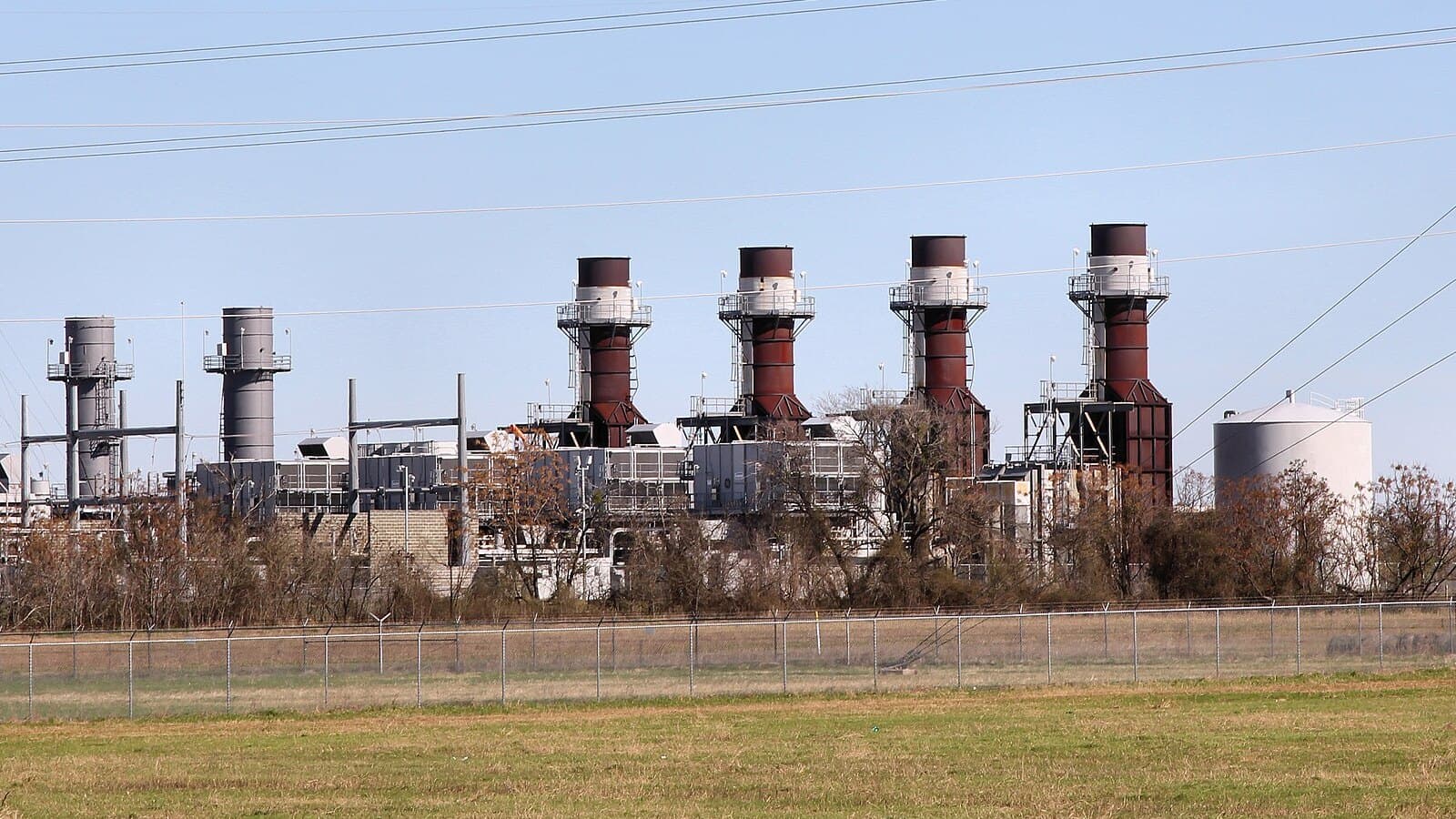
Cover image: the Sand Hill Energy Center, a natural-gas-fired power plant in Austin, Texas, by Larry D. Moore, licensed under CC BY 4.0 via Wikimedia Commons.
Tags
Frequently asked questions
- Why are data centers turning to natural gas?
- Grid connections can take years, and data-center operators want power sooner. US gas is abundant and cheap, and gas plants can ramp up and down quickly, so developers are building on-site generation while they wait for grid capacity.
- How much natural gas will US data centers use by 2035?
- BloombergNEF projects about 18 billion cubic feet per day of natural gas consumption for data centers by 2035, an increase of roughly 15 billion cubic feet per day from today.
- Will data-center gas demand raise electricity prices?
- Analysts, including BloombergNEF and the research firm Noreva, warn that adding data-center demand on top of record LNG exports could push US natural gas prices higher and pass part of that cost to utility ratepayers.

TPW Editorial
Editorial Team
TechPastWeek's editorial team reports and edits every story we publish. We research each piece against primary and credible secondary sources, and a human editor reviews and signs off before it goes live.