Tesla Energy and Zhero Sign a 3 GWh Megapack Framework for Italy
Tesla Energy will supply Megapack batteries for about 3 GWh of Italian grid storage under a framework deal with Zhero and H1 Holdings, starting with 200 MW.

On this page
For years, the surest way to get an Italian battery project financed was to win a slot in a state auction. The framework agreement announced this month by Tesla Energy, the Italian developer Zhero and the South African independent power producer H1 Holdings points somewhere else. It covers roughly 3 GWh of battery energy storage in Italy, starting with 200 MW of projects that are already authorised and ready to build.
Related reading: Tesla Finally Lets the Cybertruck and Powerwall 3 Back Up a Home Together · Grid-Scale Energy Storage, Explained: How the Grid Banks Power.
Il Sole 24 Ore reported the agreement on 1 September 2026, and Zhero and Tesla Energy confirmed the details to pv magazine Italia, whose account ESS News carried on 10 September. The first plants are expected to enter service in early 2028. Il Sole 24 Ore calls it the first agreement of its kind in Italy.
What the framework actually covers
The word framework carries weight here. This is not one signed, fully financed plant. It is an agreement that sets terms for a series of projects to be developed over several years.
- Capacity: about 3 GWh of battery energy storage systems, or BESS. EnergyTrend and Shanghai Metals Market report the same figure.
- First phase: roughly 200 MW of shovel-ready, fully authorised projects in central and southern Italy, developed with H1 Holdings, described by Il Sole 24 Ore as one of South Africa's leading independent power producers and developers.
- Tesla's role: supply Megapack batteries and take part in construction through engineering, procurement and construction (EPC) contracts. The partners say that should shorten commissioning and make timelines and costs more predictable.
- Revenue model: the projects will be backed by long-term purchase agreements, giving Zhero a route to market that reduces its reliance on Italy's regulated support scheme, MACSE.
A supply order on its own is routine. What makes this one worth reading closely is the finance structure behind it, and the market it is aimed at.
Why Italy is the storage market to watch
Italy is adding solar faster than it is adding flexibility. In the middle of a sunny day, wholesale prices collapse; in the evening they spike. A battery earns its keep by moving energy across that gap, and by selling grid services. The north is industrial and increasingly hosts data-center demand, while the south and the islands hold the country's best solar resource and its weakest grid, which is where the transmission operator Terna expects storage to arrive first.
The regulated route has been MACSE, a mechanism that pays winning projects a fixed annual premium over 15 years. Its first auction, in October 2025, procured 10 GWh for 2028 delivery. A second round is set for 24 November 2026, when Terna aims to contract 16 GWh for 2029. North and centre-north Italy are excluded from the scheme, leaving the capacity market as the only regulated option there. Terna's working target of about 42 GWh of utility-scale storage by 2030, analyzed by Timera Energy, frames how much is still to be built.
The pressure is not unique to Italy. As European grids absorb more wind and solar, the hours when renewables flood the system and the hours when demand peaks drift further apart. Batteries are the cheapest fast fix for that mismatch, and the European Union has begun to treat them as essential infrastructure rather than an optional add-on, adopting a 45 GW storage target in June 2026. Italy sits near the centre of that build-out because its solar fleet is large, its grid is congested and its southern regions have the most room to add capacity.
State auctions, then, are no longer the only path to revenue. That shift is the real subject of the Zhero deal.
How private contracts change the maths
Storage projects earn money in several ways: arbitrage between cheap and expensive hours, grid-balancing services and capacity payments. Which layer dominates changes the asset and its financing.
MACSE offers long revenue certainty but constrains how the battery is dispatched, and it claws back most of the money a project makes in the ancillary services market, according to a Solarplaza summary of the rules. A long-term purchase agreement with a creditworthy buyer can serve a similar purpose for a lender, putting a floor under cash flow, while leaving the owner more room to trade around it. That is the trade-off Zhero is making.
The phrase the companies use is route to market, and the choice of words is deliberate. A developer that can point to signed offtake contracts is easier to finance than one that depends on an auction it may not win, and easier to pitch to investors as an owner-operator rather than a seller of development rights. Daniele Moriconi, who runs Zhero's battery storage division, put the ambition plainly: “This marks a pivotal step in the transformation we have anticipated from the start: evolving from mere developers into true owners and operators.”
Alessandra Pasini, the chief executive of Zhero Europe, tied the storage plan to the company's wider bet on importing power. “We are proud that Tesla has chosen Zhero as its partner for the Megapack battery and energy management projects for the Italian market and businesses,” she said. “This initiative, combined with interconnection projects to import energy such as Medlink, will make a significant contribution to reducing energy costs for Italian businesses and households.”
That framing matters because batteries alone do not explain the strategy. Zhero is developing more than 1.5 GW of utility-scale storage across the north, centre-south, south and the islands, and it is also moving into commercial and industrial flexibility, with an additional 250 MW aimed at industrial and commercial customers, per Il Sole 24 Ore.
What the deal says about Tesla Energy
For Tesla, the Italian framework is one entry in a lengthening order book. Its Megapack business has become a fast-growing side of the company, and Europe is one of its strongest regions. The units for this deal could ship from California or from China. Tesla's Shanghai Megafactory, its first energy storage plant outside the United States, began production in February 2025 and turned out more than 2,000 Megapacks in 2025, most of them bound for Europe and Australia. At full output the site is designed to build 10,000 units a year, close to 40 GWh.
The Italian agreement is not Tesla's first in the country. In June 2026, NatPower and Tesla agreed to develop more than 25 GWh of storage across Europe, starting with five projects in Italy and the United Kingdom, including a site in Sicily. Read together, the two deals show a company attaching itself to Southern European developers just as the region's storage market moves from pilot projects to a genuine pipeline.
The commercial logic is hard to miss. Storage gives Tesla a line of business that is less exposed to the pricing fights and demand swings of its car division, and one where the buyer is a utility or a developer signing multi-year contracts rather than a consumer deciding this month. Industry watchers who track Tesla's order intake, including the analyst Sawyer Merritt, have claimed that new Megapack orders crossed $9 billion and 43 GWh in a six-week stretch in mid-2026, a figure that, like the Italian order value, should be read as a reported total rather than audited revenue. What is undisputed is the direction: the hardware is being ordered faster than Tesla can point to completed installations.
What 3 GWh looks like
Three gigawatt-hours is roughly the energy a mid-sized power plant produces in an hour, or enough to shift a city's afternoon solar surplus into the evening peak. For scale, Tesla's Shanghai factory is designed to make about 40 GWh of Megapacks a year. The Italian framework would take a meaningful slice of one year's output, but it will arrive project by project, not as a single delivery.
The caveats worth keeping in view
The enthusiasm is understandable, but the deal is earlier and softer than the headline number suggests.
- It is a framework, not a completed order. The 3 GWh is a target across multiple projects. Each one still needs a grid connection, an offtake agreement and a final investment decision before it is built.
- Delivery is phased. Only the first 200 MW is described as authorised and ready. The rest depends on permits and on the projects Zhero expects to bring forward in the coming months.
- The dollar value is reported, not confirmed. Some outlets, including Shanghai Metals Market, and a widely shared post by the Tesla watcher Sawyer Merritt put the order at around $800 million. The primary trade coverage confirms the 3 GWh capacity and the Zhero-H1 structure, but does not publish a dollar figure. Treat the valuation as an estimate.
- The route-to-market claim depends on contracts not yet signed. Publicly disclosed offtake terms are thin, so how far the projects truly escape MACSE remains open.
What to watch
- The November MACSE auction. If developers keep signing private deals, watch whether bidding at Terna's 16 GWh auction is as competitive as the first round, which cleared at about €13,000/MWh a year against a reserve price of €37,000.
- Project-level announcements from Zhero. Site locations, capacities and grid-connection dates will show whether the 200 MW phase is moving on schedule toward early 2028.
- Tesla's quarterly deployment number. A contract this size only matters once Megapacks ship, and Tesla Energy's reported deployment figure is where it will surface.
- How Shanghai ramps. European demand is a direct test of how quickly the Shanghai Megafactory can scale, and of whether Chinese-built Megapacks keep their cost advantage in Europe.
- Whether other Italian developers copy the structure. If long-term offtake becomes a standard route to bankability, MACSE could shift from the default option to one of several.
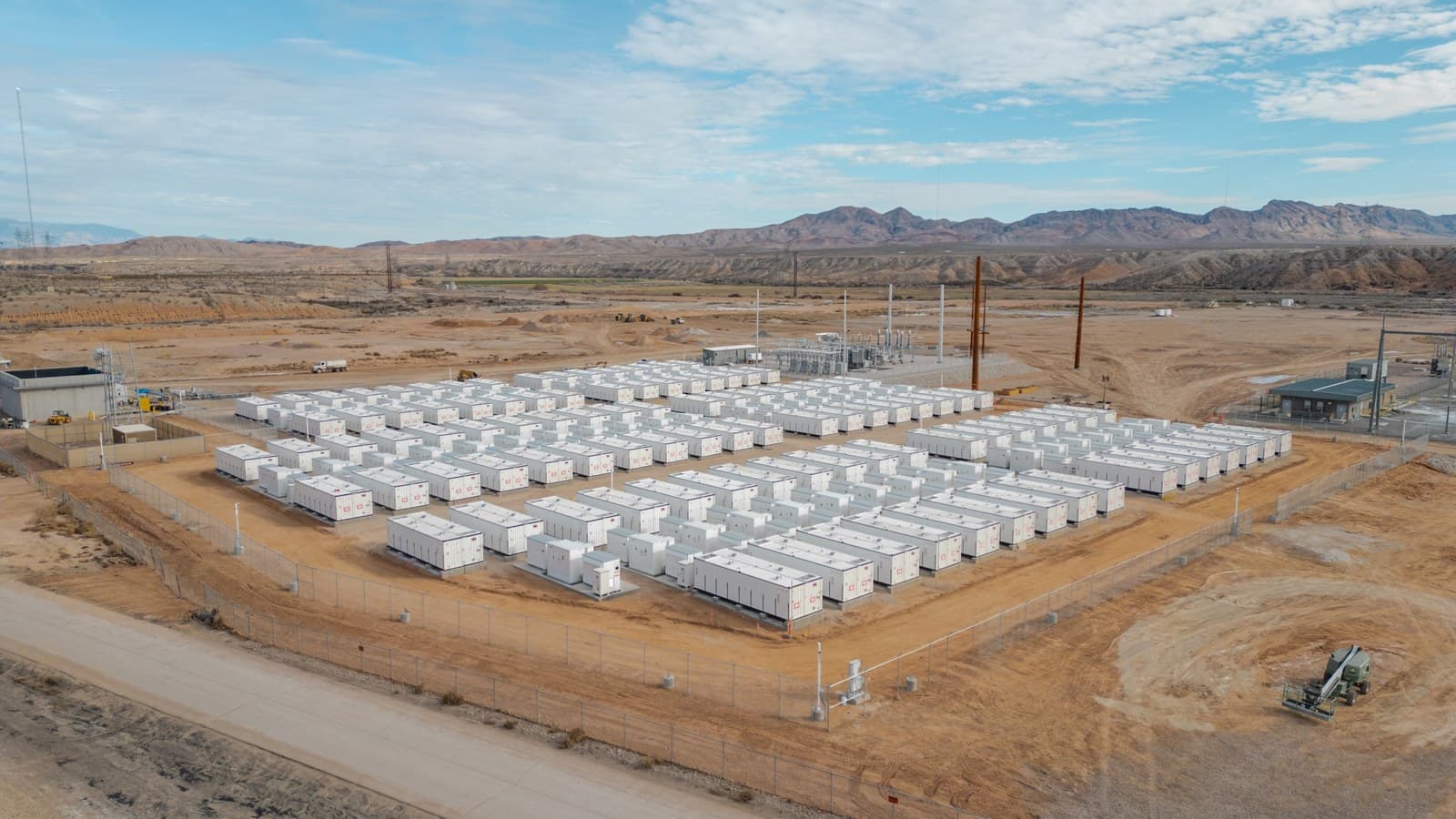
Cover image: “Reid Gardner BESS” by Sig. Chiocciola, Wikimedia Commons, CC0.
Tags

TPW Editorial
Editorial Team
TechPastWeek's editorial team reports and edits every story we publish. We research each piece against primary and credible secondary sources, and a human editor reviews and signs off before it goes live.