Tesla Finally Lets the Cybertruck and Powerwall 3 Back Up a Home Together
Nearly three years after launch, Tesla enabled Cybertruck Powershare alongside a Powerwall 3, extending home backup past three days; Powerwall 2 support is still to come.

On this page
For nearly three years, the Cybertruck's most touted party trick came with an asterisk that frustrated exactly the customers Tesla most wanted to please. The electric pickup could back up a house through Powershare, unless that house already had a Powerwall. Owners with Tesla's home battery had to choose one system or the other, which meant the truck was close to useless as backup for the people already invested in Tesla Energy. On September 10, 2026, that limitation ended.
Related reading: Tesla Energy and Zhero Sign a 3 GWh Megapack Framework for Italy · Tesla Unveils a Flying Roadster 2 in Texas, With Production Set for 2028.
Tesla's official Cybertruck account announced that Powershare can now work alongside a Powerwall 3 to keep a home running during an outage. "Powerwall 3 & I can now power your house together," the account posted, adding that the pairing "extends your home backup by over 3 days, equivalent to 9 additional Powerwalls." Cybertruck lead engineer Wes Morrill confirmed the rollout separately, describing a feature where the vehicle and the home battery coordinate as one system. It is a genuine milestone, and a case study in how long Tesla's most ambitious energy promises can take to become shipping products.
The gap that just closed
Until this week, Powershare and Powerwall were mutually exclusive sources of home backup. A Cybertruck owner could use a dedicated Powershare Gateway and Universal Wall Connector to run a house directly, with no battery involved. A Powerwall owner could run the house off the battery. But installing both created a conflict: two grid-forming devices, each capable of deciding how the home is energized during an outage, with no defined hierarchy between them.
That incompatibility landed hardest on Tesla's most committed customers. Someone who had already bought a Powerwall (the product most likely to make them want a Cybertruck's giant battery as backup) was precisely the person locked out of the feature. The Notebookcheck report frames the new mode as a stricter setup than the standalone version: it requires a Powerwall 3, and explicitly forbids a Powershare Gateway on the same system. Only one gateway may manage islanding.
Instead, the existing home energy gateway and a compatible Wall Connector or Universal Wall Connector do the work. That is a meaningful simplification. Owners who already have a Powerwall 3 and a Tesla connector do not need to buy a second, standalone backup gateway; the feature arrives as software. When the grid drops, the Powerwall discharges first, the truck waits as reserve capacity, and the Cybertruck can even top the Powerwall back up while the grid is down.
What "9 additional Powerwalls" actually means
Tesla's framing is a storage comparison, not a power comparison, and the distinction matters for what the system can and cannot do.
- A single Powerwall 3 stores 13.5 kWh of energy.
- The Cybertruck's battery pack holds about 123 kWh.
- Nine Powerwalls at 13.5 kWh comes to roughly 121.5 kWh, close enough to the truck's pack that Tesla's claim checks out on paper.
But the combined system keeps a ceiling of 11.5 kW of continuous output, and that cap applies to the two devices together, not to each one. The truck adds runtime, not more simultaneous power. Notebookcheck's example is blunt: running central air conditioning and the EV charger at the same time during an outage is not possible on an 11.5 kW combined budget. What the truck buys is duration, more hours of the loads the system can already carry.
The "over three days" figure also depends on Tesla's own assumption of roughly 30 kWh of daily household use, as Notebookcheck notes. A heavier household, or a heat wave, will burn through the reservoir faster. So the correct reading is not "the truck is nine Powerwalls you can run at once," but "the truck is nine Powerwalls' worth of reserve energy added to the runtime clock."
Runtime, not wattage
The Cybertruck does not make a home backup system more powerful. Combined output stays capped at 11.5 kW. Its 123 kWh pack extends how long the house can run, which is exactly the constraint that matters during a multi-day outage, but it will not let you run every large load at once.
Why two grid-forming devices took years to agree
The feature was promised when the Cybertruck launched in November 2023. Tesla told owners in October 2024 that Powerwall integration was coming "sometime in 2025." That window passed. In December 2025, Tesla moved the target to mid-2026, a slip the company acknowledged was nearly a full calendar year later than owners had been told. As recently as late August 2026, Morrill had no firm date, telling owners only that he would share an update "when there is something new," per Electrek's account.
The engineering problem explains much of the delay. Two grid-forming devices had to agree on which one manages the home during an outage, and do it without a network connection, across multiple generations of Powerwall hardware, while satisfying grid-safety certification. Morrill described the challenge as involving "a few different microgrid stability challenges," with the hardest part being "robust communication and coordination to react to load changes in real time." The energy team and the vehicle team ultimately worked together to ship it.
It is a subtle but important point for anyone judging the delay. A single backup source only has to detect an outage and energize a panel. Two sources have to negotiate in real time: which inverter is forming the grid, how the other behaves when it is not, and what happens when a refrigerator compressor or an air conditioner suddenly kicks on. Getting that wrong risks a system that trips offline exactly when it is needed.
What you need, and who gets it first
The rollout is deliberately narrow, and it is worth being precise about what is shipping versus what is still promised.
- Powerwall 3 only, for now. Tesla says Powerwall 2 and Powerwall+ compatibility is "coming later this year", meaning 2026.
- No standalone Powershare Gateway. The pairing uses the existing home gateway (a Gateway 3, Backup Gateway 2, or Backup Switch) plus a Wall Connector or Universal Wall Connector. A Powershare Gateway cannot coexist on the same system.
- An opt-in gate, according to one outlet. Notebookcheck reports that the feature is initially scoped to Powerwall 3 owners who fill out a survey to opt in. Tesla's own announcement does not detail an opt-in step, so treat that detail as single-source for now.
- For qualified owners, it is a software update. If you already have a Powerwall 3 and a compatible connector, there is no new hardware to buy; the capability arrives through the Tesla app and vehicle software.
That last point is the real payoff of eliminating the second gateway. The people who paid the most into Tesla's ecosystem are the ones who get the upgrade with the least friction.
Powershare has been arriving in pieces
Seen from a distance, this week's update is the latest tile in a mosaic that Tesla has been assembling for years. Understanding the pieces makes the new capability easier to place.
- 2023: Powershare debuts with the Cybertruck, powering tools, appliances, or another EV through the truck's bed outlets, vehicle-to-load, not whole-home backup.
- 2024: Whole-home backup arrives via the Powershare Gateway and Universal Wall Connector. Electrek reported the hardware bundle at around $4,000 installed at launch, with some owners quoted far more, one said they were told over $30,000.
- 2025: Tesla extends that support to homes with solar.
- February 2026: Tesla launches a Cybertruck vehicle-to-grid program in Texas, letting the truck send power back to the grid during high-demand events.
- April 2026: The Cybertruck becomes the first AC vehicle-to-grid asset in California through a program with PG&E, per Electrek.
- September 10, 2026: Powershare finally runs alongside a Powerwall 3.
The cost picture now splits by ownership. For a home starting from scratch, the standalone Powershare bundle runs around $1,970 before installation, while a Powerwall 3 kit runs around $16,000 installed. For an owner who already has the battery and a compatible connector, the new capability is free over the air, which is precisely why the wait felt so long to that group.
The bigger picture: turning parked batteries into grid assets
The Powerwall pairing lands in the middle of a broader shift: the same battery that protects one home is increasingly valuable to the grid as a whole. TeslaNorth notes that California's Virtual Power Plant recently dispatched roughly 69,000 Powerwalls delivering more than 500 MW into the grid during a heatwave. That is the logic behind Tesla's Texas and California vehicle-to-grid programs, too: a Cybertruck is a 123 kWh battery that sits idle most of the day, and idle capacity is wasted capacity.
This is why the "runtime, not power" caveat matters less than it might seem. A home battery is already sized to cover a typical day; the truck's role is to be the deep reserve for the long outage. The same architecture that lets a truck and a Powerwall share a microgrid is a step toward treating every parked EV as a dispatchable grid resource, the vehicle-to-home foundation for vehicle-to-grid at scale. Morrill framed the integration as a first of its kind, and the pattern it establishes may end up mattering more than the feature itself.
It is also a reminder that "shipping" in Tesla's energy business is rarely one event. Powershare has arrived in layers for three years, and this is one more layer, an important one for owners, but not the last.
What to watch
- Whether Powerwall 2 and Powerwall+ support actually lands in 2026. Tesla promised it "later this year," but that promise has slipped before, and the older hardware is the harder integration.
- Whether the opt-in survey becomes a broad rollout or a slow one. If Notebookcheck's single-source detail holds, watch how quickly Tesla opens it up to all Powerwall 3 owners.
- The real-world backup duration. Tesla's "over three days" assumes about 30 kWh per day. Real households, especially in extreme weather, will test that number.
- How vehicle-to-grid expands. The same truck-and-battery coordination that made home backup possible is the building block for compensating owners for grid services. Watch the Texas, California, and PG&E programs next.
- Whether the 11.5 kW cap loosens. The ceiling keeps the system honest but also rules out running the biggest loads together. Any future Powerwall or vehicle hardware that raises it would change what "whole-home backup" means.
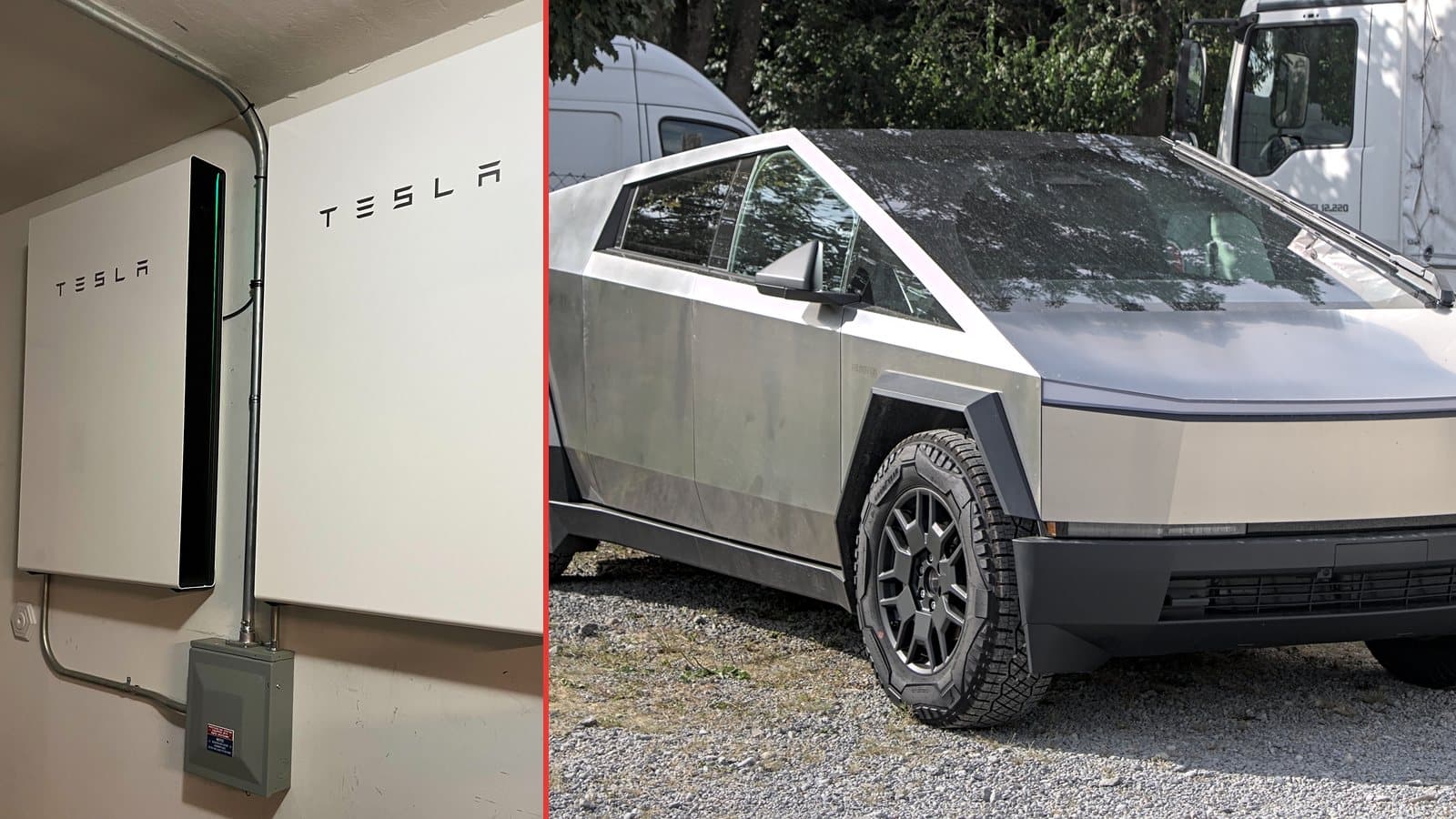
Cover image: a composite of two Tesla Powerwall 3 home batteries photographed by Rsparks3 (Wikimedia Commons, CC0) and a Tesla Cybertruck photographed by Alexander-93 (Wikimedia Commons, CC BY-SA 4.0); cropped to 16:9.
Tags

TPW Editorial
Editorial Team
TechPastWeek's editorial team reports and edits every story we publish. We research each piece against primary and credible secondary sources, and a human editor reviews and signs off before it goes live.