Amazon's AWS Grew 39% While Free Cash Flow Fell to -$42.4 Billion
AWS grew 39% and Amazon's operating income rose 61%, but trailing free cash flow fell to -$42.4bn after $77.3bn of capex in the quarter, and shares slipped.

On this page
Key takeaways
- Amazon reported third-quarter 2026 net sales of $201.9bn on 29 October, up 12%, and operating income of $28.076bn, up 61%, at a 13.9% margin the company calls its highest ever.
- AWS revenue rose 39% to $45.984bn, the fastest growth in nearly five years, with operating income of $17.773bn at a 38.7% margin.
- Trailing-twelve-month free cash flow was -$42.357bn, against positive $14.788bn a year earlier, after net purchases of property and equipment reached $210.657bn.
- Third-quarter gross capex was $77.259bn, against $35.095bn a year earlier, and Amazon still expects about $220bn of cash capex for 2026.
- The stock fell more than 7% in after-hours trading on 29 October, then closed 1.41% lower on Friday 30 October after winning back most of the loss.
Amazon reported third-quarter 2026 results after the US close on 29 October, and the first reaction was a selloff. The shares fell more than 7% in extended trading, CNBC reported, and Deadline put the after-hours decline at as much as 9%. By the close on Friday 30 October the stock was down 1.41%, having won back most of the loss, according to StockTitan's market log.
Related reading: Meta's Free Cash Flow Turned Negative for the First Time Since 2012 · Alphabet's Free Cash Flow Hit -$9 Billion and the Stock Had Its Worst Day.
Both moves came from the same release, which showed a business growing faster and spending more to do it.
Net sales were $201.9bn, up 12%, or 13% excluding a $0.9bn unfavorable currency effect. Operating income rose 61% to $28.076bn from $17.422bn a year earlier, and the 13.9% operating margin was the highest Amazon has reported, according to its results release. AWS did most of the work: revenue of $45.984bn, up 39%, the fastest growth in nearly five years, and operating income of $17.773bn at a 38.7% margin, against $11.434bn a year earlier.
Then the cash. Trailing-twelve-month free cash flow was -$42.357bn, against positive $14.788bn a year earlier. Amazon attributes the swing primarily to a $94.8bn year-on-year increase in purchases of property and equipment, net of proceeds and incentives, mainly for AI. In the quarter alone, gross capex was $77.259bn, up from $35.095bn.
The gap between a 39% cloud quarter and -$42bn of cash
Operating cash flow for the trailing year was $168.3bn, up 29%. Net capital purchases were $210.657bn, up 82%. The business produced $168bn of cash and spent $211bn on property and equipment, and the gap was funded from the balance sheet.
The debt line reflects that. Long-term debt was $173.125bn at 30 September, against $65.648bn at 31 December 2025. Cash and equivalents were $55.783bn, with another $58.443bn in marketable securities.
AWS profit covers only part of the bill. Its $17.773bn of quarterly operating income is about 23% of the quarter's $75.878bn of net capex. Company-wide operating income of $28.076bn is a little over a third of it. The build is ahead of the revenue it is meant to serve, and the argument for it is the one Jassy makes in the release.
"Our AWS investment in functionality and infrastructure is working, with over 39% year-over-year revenue growth in Q3 ($184 billion revenue run rate) and projected revenue growth rates of over 40% both in 2027 and in 2028." — Andy Jassy, Amazon CEO, third-quarter 2026 results release, 29 October 2026
The 2027 and 2028 figures are projections rather than reported results. What is measurable is the current quarter: AWS added $12.9bn of revenue year on year, and its operating income rose 55% on that revenue. That combination is the case for the spending. A cloud business growing at 39% with a 38.7% margin earns enough to justify more capacity, if the growth holds.
Retail and advertising slowed underneath the cloud
North America net sales were $112.9bn, up 6%. International was $43.1bn, up 5% as reported and 8% excluding currency. Online stores brought in $68.470bn, up 2%, against 8% growth a year earlier. Advertising was $19.637bn, up 11% and 12% excluding currency, but below the $20.82bn analysts expected, according to CNBC. Online stores also missed, at $68.47bn against a $69.68bn estimate. Third-party seller services rose 9% to $46.492bn, subscriptions rose 11% to $14.006bn, and physical stores rose 2% to $5.710bn.
Part of the retail comparison is a calendar effect. Prime Day fell in the second quarter this year for most large countries, while in 2025 it sat entirely in the third. Amazon says that excluding the shift, third-quarter growth would have been about 400 basis points higher. The shift moved promotion revenue into the second quarter, so the third-quarter comparison starts from a higher base. That explains a gap in the comparison. It does not explain why online stores grew 2% while AWS grew 39%.
Free cash flow here is Amazon's own measure
Amazon defines free cash flow as operating cash flow minus purchases of property and equipment, net of proceeds and incentives. It is not a GAAP figure, and the capex half is lumpy: equipment delivery, payment timing and incentives can move it by billions between quarters. The capex figure also excludes finance leases. A single quarter or a trailing-twelve-month snapshot is a reading, not a forecast.
The fourth-quarter guide is the next checkpoint. Amazon expects net sales of $240.0bn to $247.0bn, up 12% to 16% with roughly 60 basis points of currency headwind, and operating income of $28.5bn to $33.5bn against $25.0bn a year earlier. The revenue midpoint of $243.5bn sits $1bn below the $244.5bn LSEG consensus that CNBC cited, though the range straddles it. Advertising growth is guided to the high teens, up from 12% excluding currency in the third quarter.
What a $220bn capex year implies
Amazon still expects about $220bn of cash capex for 2026. That figure is a plan, not a commitment, and the company has raised it before. One quarter at $75.878bn net is roughly 35% of the full-year plan, which means the other three quarters together account for about $144bn. Capex at this scale does not arrive evenly, and a single quarter's figure says more about delivery schedules than about the shape of the year.
The plan also sets the test for 2027. If AWS keeps growing above 40%, as Jassy projects, the capacity being built has a buyer. If growth settles closer to the 20s while depreciation from this equipment lands on the income statement, the margin that impressed in the third quarter becomes the number to defend. Amazon does not break out how much of AWS revenue comes from AI workloads, so the split between AI and traditional cloud demand is not visible in the filing.
Jassy also wrote in the release: "There has never been a trillion dollar revenue business, and we may have two of them in the next 5-10 years." The AWS section of the same release reports a $184bn annualized run rate.
Alphabet and Microsoft set the comparison
Amazon reported last of the three, after Alphabet and Microsoft on 28 October. Alphabet posted negative free cash flow of -$9.1bn and its shares fell about 13%, their worst day since the 2004 IPO, as TechPastWeek covered. Microsoft reported free cash flow of $18.6bn with Azure growth of 48%. Amazon's trailing cash deficit is the largest of the three, and its cloud growth is the slowest: 39% at AWS against 48% at Azure and 103% at Google Cloud.
The first session traded them together. Reuters reported that Amazon and Intel were set to wipe out about $300bn in combined market value if their premarket losses held, and that Nasdaq futures fell more than 2% before the open on 30 October. By the close, the Nasdaq had fallen 2.9% and recorded its worst month since March 2025, according to the Wall Street Journal. Intel fell 29% that day.
Amazon's recovery during Friday's session separates the two verdicts. The 7% after-hours drop and the 1.41% close came from the same set of numbers; the second followed a full session of reading them. The stock still ended lower, and the cash flow numbers did not change.
What to watch in the fourth quarter
- Operating margin. Guidance of $28.5bn to $33.5bn implies a midpoint of $31.0bn, above the third quarter's $28.076bn. Against the revenue midpoint, that is a margin near 12.7%, below the 13.9% Amazon just reported. Watch whether AWS holds near its 38.7% margin as new capacity depreciates, and whether retail margins absorb higher fulfillment costs.
- Backlog conversion. Jassy said on the call that the AWS backlog was $578bn and growing at a triple-digit rate, according to CNBC's account. A backlog is contracted work, not revenue. Amazon has not disclosed its duration or cancellation terms, so the useful test is whether AWS revenue growth tracks it through 2027.
- Capex discipline. The $220bn plan has been raised before. Watch whether the fourth-quarter call raises it again, and how much of the increase is funded with debt. Long-term debt more than doubled in nine months.
Caveats
- Free cash flow is non-GAAP and volatile. Amazon defines it, and capex timing moves it by billions between quarters without any change in the underlying business.
- The $220bn is a plan, not committed spend. Amazon has raised the figure before and can raise it again.
- The fourth-quarter revenue midpoint missed consensus, but the range straddles it. The $243.5bn midpoint against $244.5bn expected is a $1bn gap on a $240bn to $247bn range.
- AWS growth mixes AI and non-AI workloads. Amazon does not disclose AI revenue, so the composition of the 39% is not public.
- The $578bn backlog is a company figure. It is not revenue, and the timing and cancellation terms are undisclosed.
- The stock moves are 29 and 30 October snapshots. They can change with later trading.
- Net income fell for an accounting reason. It was $20.685bn, or $1.89 per diluted share, against $21.187bn and $1.95 a year earlier, mainly because the prior-year quarter included $9.5bn of pre-tax gains on Anthropic investments. Operating income still rose 61%.
The quarter produced $28.076bn of operating income and consumed $75.878bn of net capital spending. Amazon's case is that the second number buys the capacity behind the first, and 39% AWS growth with a 38.7% margin is the evidence it has. The fourth-quarter call will show whether the plan holds at $220bn and whether the margin survives the depreciation that comes with it.
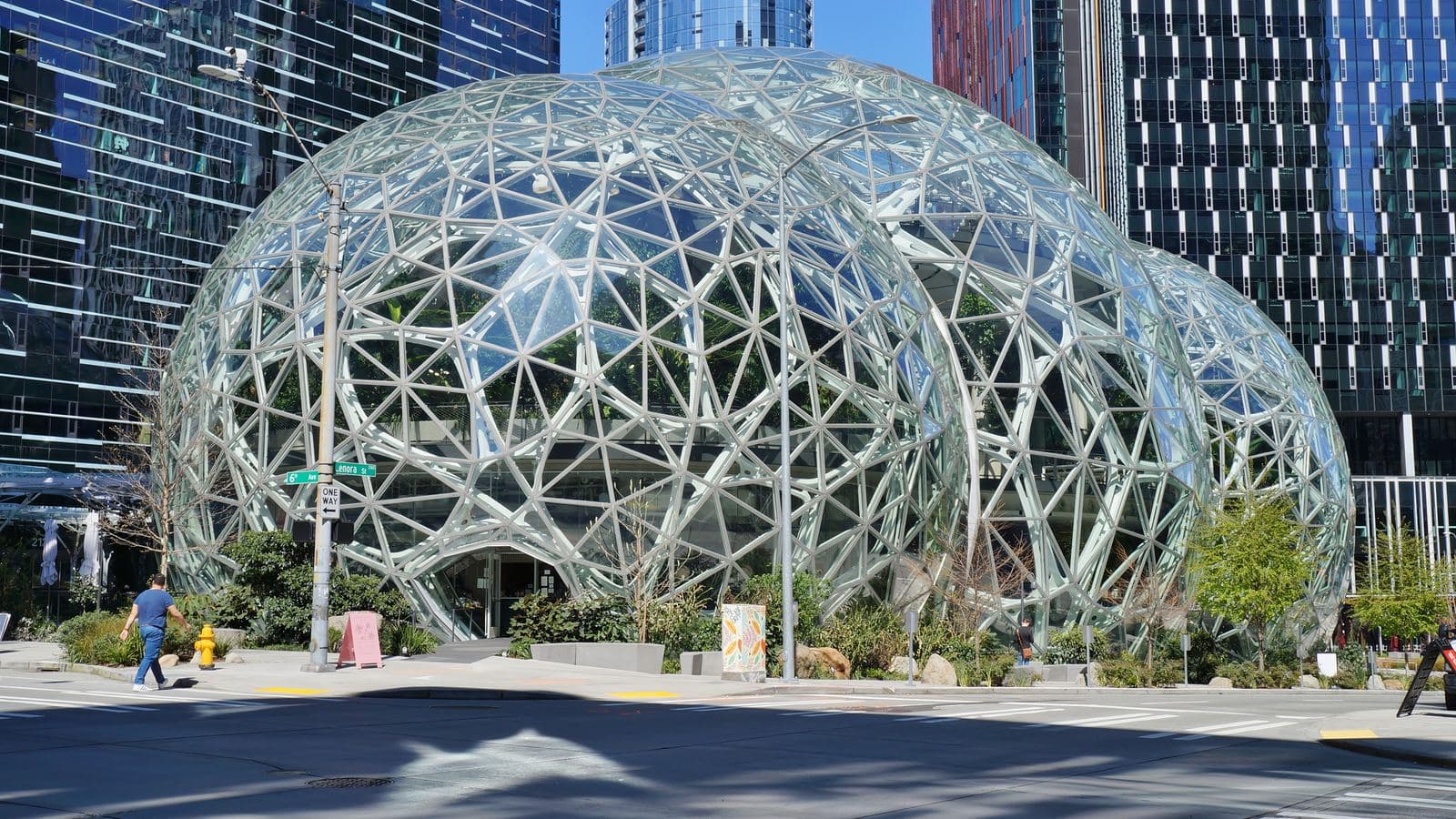
Cover: The Amazon Spheres in Seattle, by Sea Cow, CC BY-SA 4.0, via Wikimedia Commons, cropped 16:9.
Tags
Frequently asked questions
- Why did Amazon stock fall after its Q3 2026 earnings?
- The shares fell more than 7% after hours on 29 October as investors focused on $77.259bn of quarterly capex, negative trailing free cash flow and misses in advertising and online store revenue. Amazon closed 1.41% lower on Friday 30 October after recovering most of the premarket decline.
- How much did Amazon spend on capex in Q3 2026?
- Amazon spent $77.259bn on purchases of property and equipment in the third quarter, or $75.878bn net of proceeds and incentives, against $35.095bn a year earlier. The company still expects about $220bn of cash capex for the full year 2026.
- Is Amazon's free cash flow negative?
- Yes. Trailing-twelve-month free cash flow was -$42.357bn at 30 September 2026, against positive $14.788bn a year earlier. It is a non-GAAP measure that Amazon defines as operating cash flow minus net purchases of property and equipment, and capex timing moves it by billions between quarters.
- What is Amazon's AWS backlog?
- Andy Jassy said on the third-quarter earnings call that the AWS backlog was $578bn and growing at a triple-digit rate year on year, according to CNBC. A backlog is contracted work that has not yet been recognized as revenue, and Amazon has not disclosed its timing or cancellation terms.

TPW Editorial
Editorial Team
TechPastWeek's editorial team reports and edits every story we publish. We research each piece against primary and credible secondary sources, and a human editor reviews and signs off before it goes live.