Meta's Free Cash Flow Turned Negative for the First Time Since 2012
Meta's Q3 2026 revenue rose 26% to $64.60 billion, but free cash flow turned negative at -$2.12 billion as AI capex climbed and shares fell almost 7%.

On this page
Key takeaways
- Meta's Q3 2026 revenue rose 26% to $64.60 billion, while free cash flow fell to -$2.12 billion from +$10.63 billion a year earlier.
- The quarter included a $9.89 billion legal charge tied to the teen mental health settlement with 52 state attorneys general; excluding it, operating income would have been $22.88 billion and earnings per share $7.40.
- Capital expenditure including finance-lease principal payments reached $34.91 billion in Q3, and Meta raised the low end of its 2026 capex range to $135-145 billion.
- Meta shares fell almost 7% on 22 October and the spread on its five-year credit default swaps hit an all-time high, CNBC reported.
- Meta announced a Class C non-voting stock effective 19 January 2027, with a one-for-one stock dividend and an expected two-for-one split of its Class A shares.
Meta reported third-quarter 2026 revenue of $64.60 billion on 21 October, up 26% from $51.24 billion a year earlier. The same release showed free cash flow of -$2.12 billion, against +$10.63 billion in the third quarter of 2025. By the calculation of 24/7 Wall St and Six Sigma Research, it is the first negative free-cash-flow quarter since Meta's 2012 initial public offering.
Related reading: Amazon's AWS Grew 39% While Free Cash Flow Fell to -$42.4 Billion · Alphabet's Free Cash Flow Hit -$9 Billion and the Stock Had Its Worst Day.
The advertising business did not collapse. Family daily active people across Meta's apps reached 3.64 billion, ad impressions rose 10% and the average price per ad rose 14%. Both levers moved at once: Meta sold more ad units and charged more for each one. What changed is the cost of the infrastructure it is building for AI.
A profitable company with a cash problem
Net income was $9.86 billion, up 264% from $2.71 billion, and diluted earnings per share were $3.83 against $1.05. Those numbers sit oddly beside a 37% fall in operating income to $12.99 billion and an operating margin that halved to 20% from 40%. Costs and expenses rose 68% to $51.61 billion, TradingKey reported.
The fall in operating income is largely a $9.89 billion charge tied to Meta's August 2026 agreement with 52 US state attorneys general over teen mental health and social media. The agreement provides for payments of up to about $18.59 billion. Strip the charge out and operating income would have been $22.88 billion, earnings per share $7.40, and the effective tax rate 17% instead of 24%, Meta said in its release.
That is the first thing to separate. Meta did not have a bad advertising quarter. It had a quarter in which a legal settlement and a capital-spending programme arrived together, and the settlement is the smaller of the two forces weighing on the numbers.
Why the charge is not the cash story
The $9.89 billion legal charge is non-cash in the third quarter; the payments come later. Free cash flow is a non-GAAP measure that Meta defines as operating cash flow minus capital expenditures and principal payments on finance leases. The negative figure was driven mainly by capex, not by the settlement.
What $34.9 billion of capex does to a cash flow statement
Meta spent $34.91 billion on capital expenditures, including principal payments on finance leases, in the three months to 30 September. Operating cash flow was $32.79 billion. Take one from the other and you get -$2.12 billion. Capex exceeded operating cash flow by about 6%.
Free cash flow is the money left for dividends, buybacks and debt repayment once the assets are paid for. A negative figure means the quarter's buildout was funded from the cash balance or from financing rather than from current operations.
The company also raised the low end of its 2026 capex range to $135-145 billion, from $130-145 billion. Benzinga calculated that the guidance implies $49-59 billion of capex in the fourth quarter alone. That is a figure built from the full-year range, not company guidance for the quarter, and Meta can still land anywhere inside it.
The balance sheet gives the company room. Cash, cash equivalents and marketable securities stood at $82.45 billion at the end of September, more than twice the quarter's capex, and Meta paid $1.36 billion in dividends and dividend equivalents during the quarter. One negative quarter does not put the payout at risk. The question is what happens if the capex line keeps rising faster than operating cash flow for several quarters. Depreciation from this spending will reach the income statement over several years, so the earnings cost of the buildout has only started to appear.
“Our investments are paying off, the core business is strong, and we're seeing velocity across the board.” — Mark Zuckerberg, Meta founder and CEO, Q3 2026 results, 21 October 2026
Zuckerberg is describing returns that the quarterly figures do not yet measure. Meta's AI spending appears first as capex and later as depreciation, before it appears in a revenue line that can be separated from advertising. The company launched two models in the quarter, Muse and Muse Wonder, and Zuckerberg described Muse as its first frontier model. Those are products with users and costs; they are not a profit-and-loss account for the buildout.
The Class C share is a financing tool too
Alongside the results, Meta announced a new Class C non-voting common stock, effective 19 January 2027. The plan includes a one-time stock dividend of one Class C share for each Class A and Class B share. After payment, Meta expects the market price of its Class A shares to reflect a two-for-one stock split.
The company's stated reasons are practical: the class will let it raise capital, pay employees and make acquisitions while preserving founder control. The filing also discloses that chief executive Mark Zuckerberg could face a multi-billion-dollar California wealth tax liability, and that he was persuaded to stay in California by the new stock plan. Record and payment dates for the dividend have not been set.
The stock dividend itself raises no money. It creates a second class of shares that Meta can later issue to investors or use to pay staff without adding votes. For a company that plans to spend $135-145 billion on capex this year, that is a financing tool as much as a governance one. Existing holders keep the same economic stake when the dividend is paid; the dilution comes later, from whatever Meta issues out of the new class.
Non-voting stock also has a cost that does not show up in the capex line. Outside holders carry an economic claim without a say in how the company is run. Meta has not disclosed how repurchases will be split between the two classes, which matters because buybacks spread across two share types affect the per-share maths.
Credit markets marked the shift
Meta shares fell almost 7% on 22 October, CNBC reported, and the spread on the company's five-year credit default swaps hit an all-time high. A CDS spread is the annual cost of insuring against a default, so a record level means bond investors wanted more compensation to hold Meta's credit risk.
Equity and credit investors were reacting to different parts of the same statement. Shareholders saw net income rise 264% and asked when AI spending starts producing revenue. Credit investors saw a company committing tens of billions of dollars a quarter to long-lived assets and asked what that does to the balance sheet if the returns arrive late.
Meta was not alone. Alphabet, Amazon and Microsoft fell between 2.2% and 4.6% the same day as investors sold large-cap technology on AI spending concerns, Trefis noted. The sector-wide move suggests a repricing of AI capex rather than a verdict on Meta alone. The free-cash-flow turn was Meta's own.
Both the share price and the CDS level are 22 October snapshots. They will move again with the next set of results.
What the quarter does not settle
Several parts of the story are less firm than the headline numbers.
- Free cash flow is non-GAAP. The -$2.12 billion is real under Meta's definition, but it is not a statutory measure, and comparisons with companies that define it differently need care.
- The claim that this is the first negative quarter since the 2012 IPO is an external calculation by 24/7 Wall St and Six Sigma Research, not a statement from Meta.
- The $18.59 billion settlement figure is a maximum. The timing of payments and the share covered by insurance are not fully public.
- The $135-145 billion capex range is a forecast. Meta raised only the low end, from $130 billion, so the top of the range is unchanged.
- The Class C stock is approved but not yet effective, and the dividend's record and payment dates are unset.
The one claim the quarter does not support is that Meta is losing money. It reported $9.86 billion of net income. The issue is the cash left after infrastructure spending. Advertising revenue is still growing.
What to watch in the fourth quarter
Meta guided fourth-quarter revenue to $73-76 billion and full-year 2026 total expenses to $175-179 billion. It expects Reality Labs losses of $18-19 billion this year and around $15 billion next year, a smaller loss than in 2026 but still a drag on operating income.
The first number to watch is fourth-quarter capex. If Benzinga's $49-59 billion implication is close, the company will spend more in three months than it did in the third quarter, and free cash flow could stay negative even with revenue in the guided $73-76 billion range. If capex lands near the low end of that range and operating cash flow rises with fourth-quarter revenue, the quarter may look like a one-off.
The second test is the Class C timetable. Record and payment dates, and any statement about how the shares will be used for acquisitions or employee pay, will show whether the class is mainly a governance fix or a funding mechanism.
Credit spreads and the settlement schedule are the other two tests. A CDS spread that stays at record levels would suggest investors see the capex programme as a lasting balance-sheet risk rather than a quarterly blip; a spread that narrows would suggest the 22 October move was a reaction to the earnings surprise. Meta has agreed to pay up to about $18.59 billion, but the schedule is not public. When the cash starts leaving, it will compete with capex for the same operating cash flow, and the free-cash-flow line will show it.
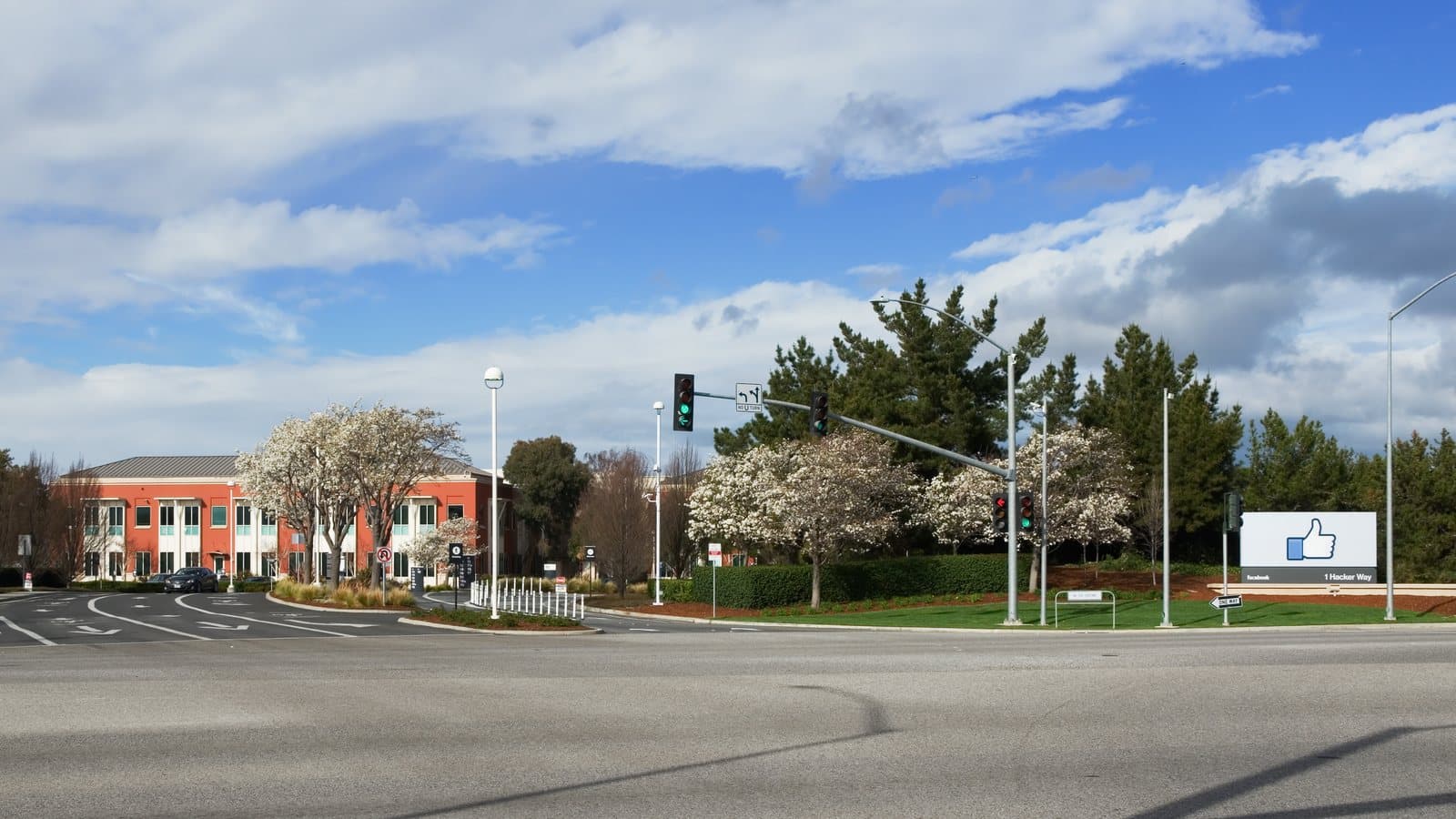
Cover image: "Facebook Headquarters 1 Hacker Way Menlo Park.jpg" by LPS.1, CC0, via Wikimedia Commons. The photograph shows Meta's Menlo Park campus (then the Facebook campus) in 2014.
Tags
Frequently asked questions
- Why did Meta's free cash flow turn negative in Q3 2026?
- Capital expenditure of $34.91 billion, including finance-lease principal payments, exceeded operating cash flow of $32.79 billion, leaving free cash flow at -$2.12 billion. The $9.89 billion legal charge in the quarter was non-cash and did not drive the negative figure.
- How much did Meta spend on AI in the third quarter of 2026?
- Meta reported $34.91 billion of capital expenditure including finance-lease principal payments, but it does not break out how much of that went to AI specifically. The company has raised the low end of its full-year 2026 capex range to $135-145 billion.
- Is Meta losing money?
- No. Meta reported net income of $9.86 billion and diluted earnings per share of $3.83 in Q3 2026. The negative free cash flow reflects capital spending after operating cash flow, not a net loss.
- What is Meta's new Class C stock?
- It is a non-voting common stock effective 19 January 2027. Meta plans a one-time stock dividend of one Class C share for each Class A and Class B share, after which the Class A price is expected to reflect a two-for-one split, and says the class will let it raise capital and pay employees while preserving founder control.

TPW Editorial
Editorial Team
TechPastWeek's editorial team reports and edits every story we publish. We research each piece against primary and credible secondary sources, and a human editor reviews and signs off before it goes live.