Microsoft Opens Voluntary Exit Offer to 60,000 Eligible Employees
Microsoft's Voluntary Exit Offer covers 60,000 eligible employees in four countries at level 70 or below. Decisions in early December, exits on 31 December.

On this page
Key takeaways
- Microsoft announced a Voluntary Exit Offer on 26 October 2026 to employees in Canada, India, the United Kingdom and the United States at internal level 70 and below.
- About 60,000 employees are eligible, roughly 27% of Microsoft's 223,000 headcount at the end of June 2026, according to a person familiar cited by CNBC.
- Eligible employees must decide in early December 2026, and those who accept leave on 31 December 2026; Microsoft has set no target for take-up.
- The Verge reports that marketing, commercial business, discovery and quantum, and security teams are not participating, while Cloud + AI, Microsoft AI and legal affairs participate only partially.
- Microsoft's capital expenditure for the September 2026 quarter was expected to exceed $50 billion, against $34.9 billion a year earlier, and quarterly results land on 28 October 2026.
On Monday, 26 October 2026, Microsoft opened a time-limited Voluntary Exit Offer to employees in Canada, India, the United Kingdom and the United States at internal level 70 and below. Chief People Officer Amy Coleman announced it in a memo on the Official Microsoft Blog that morning, and eligible employees were told to expect an email with the details within hours.
Related reading: Microsoft Borrows $25 Billion as the AI Buildout Moves Onto the Bond Market · Amazon's AWS Grew 39% While Free Cash Flow Fell to -$42.4 Billion.
About 60,000 people are eligible, according to a person familiar with the matter cited by CNBC. Measured against the 223,000 headcount Microsoft reported at the end of June 2026, that is roughly 27% of the company. The figure describes who may apply, not who will leave. Microsoft has set no target for take-up, and its own memo carries no number at all.
A buyout of this size is the softest instrument a company of Microsoft's scale has for shrinking, and the ambiguity about how many people will use it is deliberate. Nothing in the memo commits the company to a departure figure. The only hard numbers will arrive twice: in early December, when the acceptance window closes, and on 28 October, when Microsoft reports results for the September quarter and the cost of its AI build-out sits next to the headcount it is trying to trim.
What the offer says, and what it leaves out
The mechanics are narrow. The memo names four countries, sets a ceiling at level 70, and makes participation a matter for each organisation rather than a company-wide entitlement. Some groups are taking part, some are not, and Microsoft says the split reflects "business priorities, customer commitments and workforce needs" without publishing which is which.
Employees who accept have to decide in early December 2026 and leave on 31 December 2026. According to CNBC, Business Insider and AFP, the terms track standard severance and include career-planning resources. None of the three describes a sweetened package, which matters for judging how attractive the offer is. A buyout that pays what a layoff would pay asks employees to volunteer for a decision the company would otherwise have to make and defend.
Eligible is not the same as leaving
The 60,000 figure is a headcount of people who may apply, not a forecast of departures. Microsoft has set no target, and the number comes from a single person familiar with the matter as reported by CNBC, not from the company. At the April 2026 retirement programme, more than 30% of eligible US employees accepted. Applied to this pool, that rate would imply around 18,000 departures, but the two programmes differ in scope, geography and seniority, so the comparison is a reference point rather than a projection.
Level 70 is higher than it sounds
The level ceiling is easy to misread outside Microsoft. Internal levels at the company run well past 70, and the bands near the top of the eligible range are not junior. Levels.fyi, the salary-tracking site, maps levels 65 to 67 to principal roles and 68 to 70 to partner and distinguished level. The offer therefore reaches people who run organisations as well as people who staff them, and it extends to vice-president level.
That has two consequences. The first is cost: senior staff carry larger salaries, so each acceptance removes more spending than the raw headcount suggests. The second is knowledge. A company can hire back a mid-level engineer in a quarter; it cannot easily replace someone who has spent fifteen years inside a platform group and knows why a decision was made in 2019. Microsoft has not said how much of that work it expects AI tools to absorb, so the trade is being made without a published estimate.
Which teams are in, and which are not
The Verge, citing sources, reported that eligibility runs across much of the company, with a carve-out list that is more revealing than the inclusion list.
- Fully participating, per The Verge: AI experiences, Copilot, CoreAI, Windows + Devices, Xbox, finance and HR.
- Partly participating: Cloud + AI, Microsoft AI, and corporate, external and legal affairs.
- Not participating: marketing, commercial business, discovery and quantum, and security.
CNBC adds that some marketing, sales and engineering teams opted out, and that the offer does not target commercial sales teams. Commercial sales is the exception worth naming: those teams absorbed much of the July reduction and are being left out of this one.
Two explanations fit, and the sources do not settle between them. One is that the excluded groups are the ones Microsoft wants to keep growing. The other is that the exclusions follow revenue commitments, since a team carrying a quarterly number cannot afford to lose people mid-contract. Microsoft has not published a full list, and the reporting comes from people rather than from the company, so the boundaries could move before December.
A year of shrinking, in three steps
The Voluntary Exit Offer is the third stage of a sequence that has run since spring, and the earlier stages set the expectations for this one.
In April 2026, Microsoft ran its first-ever voluntary retirement programme, offered to about 7% of US employees, roughly 8,750 people. Microsoft said in July that more than 30% of those eligible accepted, CNBC reported. In July 2026, the company announced 4,800 layoffs, about 2.1% of staff, mainly in Xbox and commercial sales; Ars Technica put the Xbox portion at 3,200 roles, about 20% of the gaming division. In October 2026, Xbox chief executive Asha Sharma is reportedly planning further cuts, according to Fortune reporting cited by The Verge.
Headcount points the same way: 223,000 at the end of June 2026, down from 228,000 at the end of 2025. Losing 5,000 people across six months that included a 4,800-person layoff and a retirement round only works if Microsoft kept hiring in the parts of the business it wanted to grow.
Timing matters for the accounting. Microsoft's fiscal year ends on 30 June, so departures on 31 December fall in the second quarter of fiscal 2027 and the salary saving accrues from January.
Voluntary programmes do a different job from layoffs, and the difference shows up in who ends up leaving. A layoff is chosen by managers against a plan; a buyout is chosen by employees against their own alternatives. The people most likely to accept are often those with the strongest outside options, which is the opposite of the selection a manager would make. Microsoft is buying a quieter reduction and accepting that it does not fully control who walks out.
The AI bill arrives before the AI revenue
The reason a company with $19.64 billion of quarterly free cash flow is trimming staff is visible in the capital budget. Microsoft said in July that capital expenditure for the September 2026 quarter should exceed $50 billion. A year earlier, capital spending and finance leases came to $34.9 billion. The company is building data centres to serve demand from Anthropic, OpenAI and its own cloud customers, and the spending is front-loaded.
Free cash flow in the June quarter was $19.64 billion, down 23% year on year. Alphabet and Amazon both reported negative free cash flow in the same period, so Microsoft is not the outlier in the group, but it is the one with the largest headcount to defend. The business model is also shifting toward charging clients for how much AI they actually consume, a change that moves revenue with usage rather than with seat count, and Microsoft has given programmers, sellers and supply-chain workers AI tools that reduce the labour each task requires.
The arithmetic points one way. If software revenue decouples from the number of people Microsoft employs, then the number of people Microsoft employs becomes a variable rather than a fixed asset. The buyout is the mechanism for adjusting it without a layoff announcement, and the absence of a target is what allows the adjustment to stop wherever it stops.
A layoff is chosen by managers against a plan; a buyout is chosen by employees against their own alternatives.
Caveats
- 60,000 is eligible, not leaving. No target has been set, no acceptances have been reported, and take-up could land well below the April programme's 30% rate.
- The offer is voluntary. It is not a layoff notice, though it reduces headcount and sits alongside the involuntary cuts of July 2026.
- Team participation is reported, not published. The Verge and CNBC sourced the in-and-out lists to people familiar with the plans. Microsoft has not released a list.
- Severance terms are described, not disclosed. Reports call them standard, with career-planning support. The actual formula has not been published.
- Capex and free cash flow are prior-period figures. The September quarter numbers arrive with earnings on 28 October 2026, and they may not match the July guidance.
What to watch
- Wednesday, 28 October. Microsoft reports September quarter results two days after the memo. Capital expenditure against the $50 billion guide, free cash flow against the 23% decline, and headcount against 223,000 are the three figures that turn this from a personnel story into a financial one.
- Early December. The acceptance window closes. A high take-up rate would give Microsoft most of a reduction without a single involuntary departure; a low one would leave the headcount target unmet and put the question back to managers in the new year.
- The exclusion list. Security and the commercial teams are out for now. If they are added in a second wave, the first list was about sequencing rather than strategy.
- Whether a second offer follows. A Microsoft spokesperson told Business Insider there are no plans for another buyout at this time, a formulation that leaves room for one later. The April programme was also described as a one-off before October arrived.
None of this makes the buyout irrational. The spending on AI infrastructure is real, customers pay for the capacity, and a company that raises revenue per employee can carry fewer people per dollar of sales. Microsoft has now run three reduction exercises in seven months and described none of them as a retreat. Wednesday's capital spending line, and December's acceptance number, will show whether the description holds.
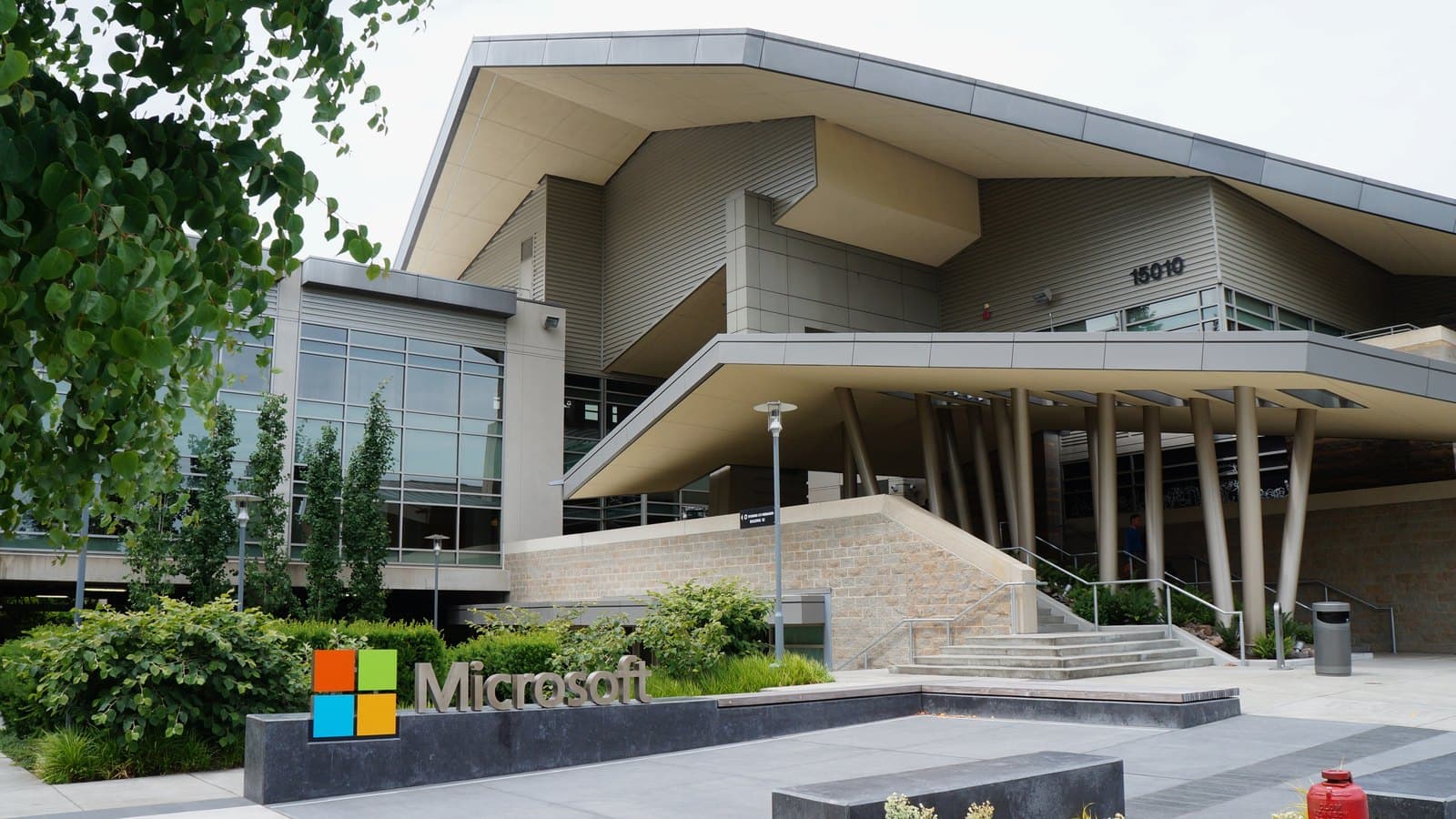
Cover image: "Building 92 of Microsoft Redmond Campus" by Jiaqian AirplaneFan, CC BY 3.0, via Wikimedia Commons.
Tags
Frequently asked questions
- How many Microsoft employees are taking the voluntary exit offer?
- No acceptances have been reported yet, and no total has been set. About 60,000 employees are eligible according to CNBC's source, but Microsoft has not published a target for how many will accept, and the window closes in early December 2026. The April 2026 retirement programme drew more than 30% of eligible US staff, which is a precedent rather than a forecast.
- Who is eligible for Microsoft's Voluntary Exit Offer?
- Employees in Canada, India, the United Kingdom and the United States at internal level 70 or below can apply, subject to whether their organisation is taking part. Participation varies by team, and several groups including marketing, security, and parts of Cloud + AI are excluded or only partly involved.
- Is this a layoff?
- No. The offer is voluntary: employees choose whether to accept, and those who do leave on 31 December 2026 with terms similar to standard severance. It reduces headcount, and it follows involuntary cuts in July 2026, but nobody is being selected for redundancy by this programme.
- When does Microsoft report earnings?
- Microsoft reports results for the September 2026 quarter on Wednesday, 28 October 2026, two days after the memo. Capital expenditure, free cash flow and headcount in that report are the first hard numbers attached to the cost-cutting story.

TPW Editorial
Editorial Team
TechPastWeek's editorial team reports and edits every story we publish. We research each piece against primary and credible secondary sources, and a human editor reviews and signs off before it goes live.