Ambarella X7 Adds a Standalone 2-5W CVflow Accelerator for Edge AI
Ambarella launched X7, its first standalone AI accelerator: a 2-5W CVflow co-processor bringing physical AI to existing Arm and x86 systems, sampling now.

On this page
Key takeaways
- Ambarella announced the X7 on September 15, 2026, its first dedicated CVflow AI accelerator chip, sampling now with XCalibur evaluation kits for qualified customers.
- In current customer designs X7 runs in a 2 to 5 watt envelope and connects over one lane of PCIe Gen 3 or USB 3.2 to Arm or x86 hosts, with no board redesign required.
- XCalibur, the M.2 2280 reference design, pairs X7 with LPDDR5 memory and delivers PCIe throughput above 840 MB/s for simultaneous video streams and models.
- The same day brought a Developer Zone expansion on Google Cloud with live-silicon cloud sessions and Gemini Enterprise tooling, plus Ultralytics YOLO support and a ZEDEDA platform port.
- Ambarella sells X7 direct and through Capgemini and Macnica under September 3 agreements; Rosenblatt reiterated a Buy rating with a $120 target on the launch.
On September 15, 2026, Ambarella announced the X7 edge AI accelerator, its first dedicated CVflow AI accelerator chip. The Santa Clara company, traded on NASDAQ as AMBA, framed the launch as a way to add physical AI to any host processor. X7 works as a co-processor for Arm and x86 hosts, adding or expanding inference capability without a redesign of the underlying platform.
Related reading: Intel's Data Center Revenue Rose 78% and the Stock Fell 28.58% · Samsung's Profit Topped 100 Trillion Won for the First Time on AI Memory.
The move changes what Ambarella sells. Until now the company sold integrated systems on chip that combined its CVflow neural engine with image processing, CPU cores and I/O. X7 unbundles the AI engine. Any team with a shipped camera, gateway, robot or industrial controller and a free PCIe or USB port can add Ambarella inference to it.
What X7 is: a co-processor, not a system on chip
X7 carries the third-generation CVflow engine, the same architecture Ambarella integrates into its SoC portfolio. It handles convolutional neural networks, vision transformers, multimodal transformers and hybrid networks through the CVflow vision and deep learning processor. Ambarella has built neural processing into its silicon since 2015, and says more than 50 million of its AI processors are operating in the field.
The physical interface is deliberately plain. X7 connects over a single lane of PCIe Gen 3 or over USB 3.2 and shows up to the host as a standard PCIe device. The host can even be one of Ambarella's own SoCs, which gives customers shipping Ambarella-based products a path to more AI performance without touching the board layout. In current customer designs, the company says, X7 stays inside a 2 to 5 watt power envelope, so it fits the existing thermal budget and enclosure.
X7 at a glance
Third-generation CVflow AI engine as a standalone co-processor for Arm and x86 hosts. Host link: one lane of PCIe Gen 3 or USB 3.2, enumerated as a standard PCIe device. Power: 2 to 5 watts in current customer designs. Software: Cooper Developer Platform with compiler, quantization and profiling tools plus C++ and Python runtimes. Reference hardware: XCalibur, a 2280 M.2 card with LPDDR5 and PCIe throughput above 840 MB/s. Status: sampling now, with evaluation kits for qualified customers.
Software is where Ambarella wants to keep its edge. X7 runs under the Cooper Developer Platform, the same environment that serves every Ambarella AI SoC. That includes the compiler, quantization and profiling tools, the C++ and Python runtime APIs, and the scheduling and memory management that multi-model pipelines need. Models from the Cooper Model Garden are designed to run on X7 as well. Because the accelerator shares the CVflow architecture with the SoC line, a model or perception pipeline built for an Ambarella SoC is designed to carry over to X7 without a software rewrite.
XCalibur is the reference design and development platform. It is a standard 2280 M.2 card with LPDDR5 memory and PCIe throughput above 840 MB/s, built to process several video streams and AI models at once. Ambarella intends to publish the complete XCalibur design files so an OEM or ODM can move from evaluation to a production module on the same design.
Why a standalone part matters: the installed base is old
Cameras, gateways and industrial controllers often stay in service for years with little AI capability or none at all, while the operators who own them now ask for features that did not exist when the hardware was built. X7 addresses the OEMs and system builders responsible for that installed base.
"Many of our customers' systems in the field were designed before the AI workloads their end users now expect were possible," said Fermi Wang, president and CEO of Ambarella, in the announcement.
The same logic covers new designs. Teams validating AI features can prototype on X7 before committing to a full next-generation redesign, and products built around another vendor's host processor can now use Ambarella acceleration without adopting its SoC. "X7 brings the same third-generation CVflow engine that runs in more than 50 million of our AI SoCs to platforms our customers have already deployed at scale. Our integrated SoCs remain the strongest choice when a team is designing the entire system around AI, while X7 extends the same engine to every other scenario, whether the platform is already in the field or still being prototyped."
Ambarella names retail and physical security, industrial inspection and manufacturing, mobile robots and drones, intelligent transportation and critical infrastructure, plus enterprise edge boxes such as kiosks, point-of-sale terminals, gateways and on-premise AI appliances. The release stresses that X7 is not camera-specific and handles varied digital and physical data modalities, which suits both edge-infrastructure inference and endpoints such as robots. That wording matters. It places X7 away from the datacenter GPU lane that dominates headlines and squarely in the low-power endpoint market, a different contest with different buyers.
The developer story: live silicon in the cloud
Hardware was only half of Ambarella's September 15 output. The company also expanded its Developer Zone with a cloud-hosted IDE, remote sessions on cloud-connected fleets of Ambarella devices, and agentic coding assistance powered by Gemini Enterprise, all delivered on Google Cloud Platform. From the same environment, developers can request time on live silicon and run their build on target hardware, with latency, throughput and power measured under real operating conditions. Access is in early stages now, with developers onboarded as the device fleet grows, and general availability is expected in Q1 2027.
Two partnerships fill out the workflow. Ambarella and Ultralytics announced a collaboration to support Ultralytics YOLO models on CVflow-powered edge devices, which gives developers a familiar vision starting point on silicon built for tight power and thermal limits. Separately, Ambarella and ZEDEDA announced a partnership under which the ZEDEDA Edge Intelligence Platform runs on Ambarella edge AI SoCs, letting enterprises deploy and operate models across distributed fleets from one control plane. ZEDEDA's open-source EVE-OS now runs on Ambarella's N1 family, and validated blueprints with optimized models in the ZEDEDA Model Hub are expected in Q4 2026.
Ambarella's 12 edge AI SoC families already support more than 200 AI model architectures in customer production, according to the company, and the DevZone expansion tries to turn that installed knowledge into a repeatable pipeline: pick a model, test on live silicon from a browser, ship through a fleet manager.
Business context: channels, design wins and the analyst view
Ambarella is sending X7 to market through direct sales and through two indirect channels set up on September 3, 2026. Capgemini brings engineering and systems integration for large enterprise deployments, including a planned global Edge and Physical AI Center of Excellence. Macnica, appointed as a non-exclusive authorized distributor across the Americas and EMEA, covers small and midsize customers, ISVs, OEMs, ODMs and systems integrators. The earnings release describes both as seven-year agreements aimed at building the indirect channel. The division of labor is clear enough: Capgemini for complex enterprise rollouts, Macnica for breadth.
On traction, Ambarella says only that leading OEMs in several key verticals are creating designs with X7. No names, no volumes, no timeline to production. That is normal for a sampling-stage part, and it leaves the revenue question open. Sampling and evaluation kits seed design wins, design wins become pilots, and pilots become volume orders across one or more product cycles.
The early analyst reaction was positive. Rosenblatt reiterated a Buy rating with a $120 price target after the X7 launch. For context on the company's scale, Ambarella reported second-quarter fiscal 2027 revenue of $108.1 million, up 13.2 percent year on year, and guided third-quarter revenue to a range of $115 million to $124 million in its September 3 results. The same earnings statement flagged the X7 introduction and the channel agreements as markers of the next growth phase.
Competition deserves a careful note. X7 enters a low-power edge AI field that already includes Nvidia's Jetson modules, Hailo accelerators and the USB-stick class of add-on AI, typified by Google's Coral line. Ambarella's differentiator, as stated, is the combination of a 2 to 5 watt envelope with software portability across its 50-million-unit SoC base. The company has published no TOPS figure, no benchmark score and no price for X7, so direct performance comparisons cannot be made from the launch materials.
Caveats: what the release does not say
Three gaps stand out. First, performance. Without a TOPS number or a model-level benchmark, buyers cannot place X7 against rival accelerators except on the stated watt envelope and interface. Second, price and packaging beyond the M.2 reference. Edge programs live or die on unit economics, and Ambarella has disclosed neither. Third, the OEM designs themselves. "Leading OEMs in several key verticals" is a directional signal, not a backlog, and edge programs sometimes take a year or more from evaluation kit to purchase order.
None of these gaps is unusual at this stage. They do set the terms for judging the launch: X7 should be treated as an announced, sampling product with early customer engagement, not as shipping volume.
What to watch
The near-term calendar is full. Ambarella detailed X7 at the AI Infrastructure Summit in Santa Clara, where it holds diamond sponsorship, so partner reaction from that floor is the first signal. The second is the DevZone rollout, with early-access onboarding now and general availability targeted for Q1 2027, alongside ZEDEDA blueprints expected in Q4 2026. The third is conversion: named OEMs, production modules derived from XCalibur files, and any disclosure of volume timing in coming earnings calls.
The strategic question runs longer. If brownfield upgrades prove to be a repeatable motion, with X7 attached to installed Arm and x86 platforms across security, industry and robotics, Ambarella gains a revenue path that does not wait for full SoC refresh cycles. If evaluation kits sit on lab benches, X7 stays a neat option in a crowded catalog. The silicon is real, the software story is coherent, and the channel is signed. What remains is the part no press release can supply: customers, in public, at volume.
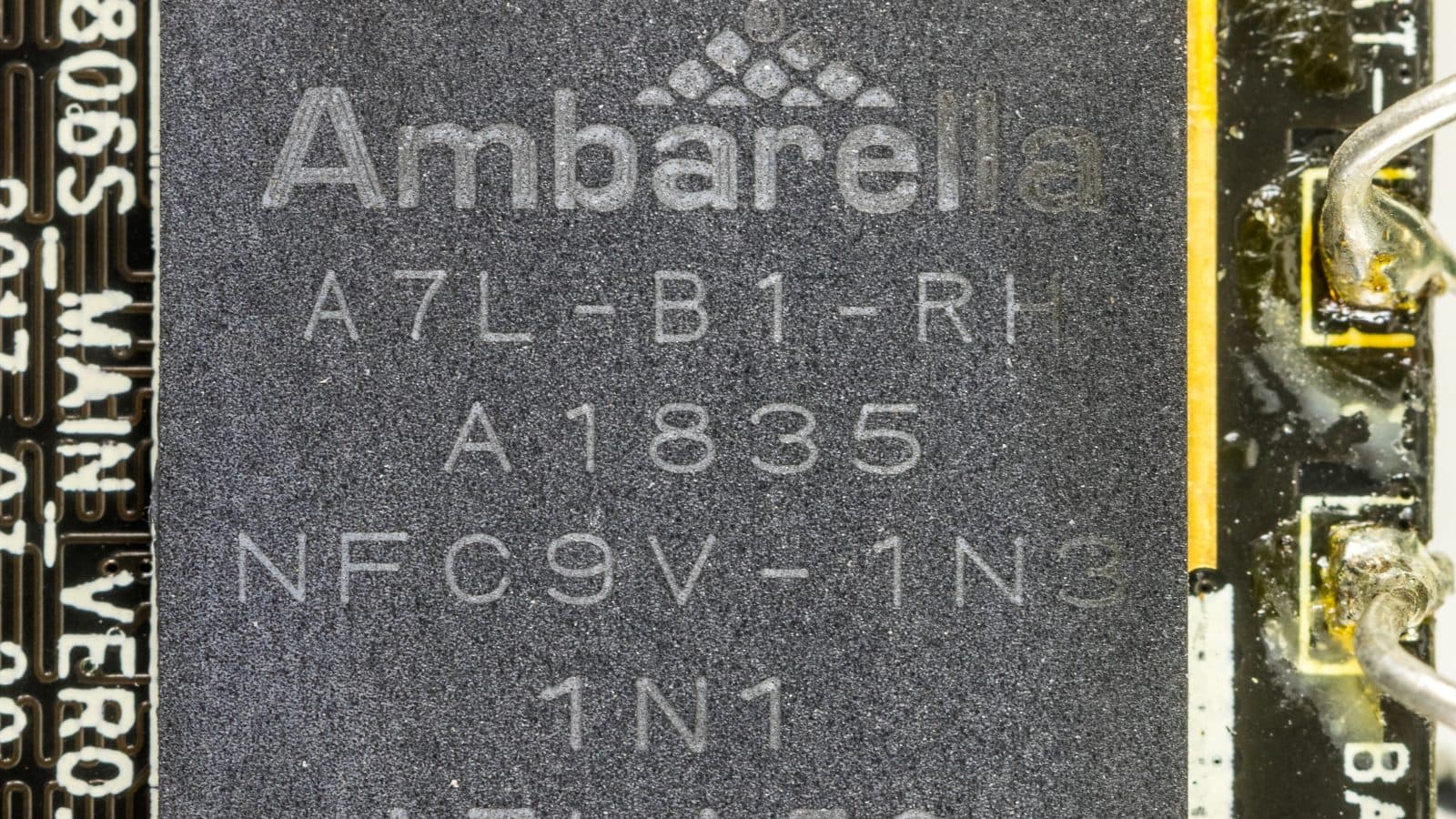
Cover photo: Raimond Spekking via Wikimedia Commons, CC BY-SA 4.0. The image shows an earlier Ambarella A7L processor on a device board, not the new X7.
Tags
Frequently asked questions
- What is the Ambarella X7?
- The X7 is Ambarella's first standalone AI accelerator chip, announced September 15, 2026. It is a co-processor that adds the company's third-generation CVflow AI engine to systems built around Arm or x86 host processors.
- How much power does the X7 use and how does it connect?
- Ambarella says X7 operates in a 2 to 5 watt envelope in current customer designs. It links to the host over a single lane of PCIe Gen 3 or over USB 3.2 and appears to the system as a standard PCIe device.
- Is the X7 shipping yet?
- X7 is sampling now and XCalibur evaluation kits are available to qualified customers. Ambarella has not named the OEMs designing with X7 or given volume pricing, so revenue timing depends on those design wins converting.

TPW Editorial
Editorial Team
TechPastWeek's editorial team reports and edits every story we publish. We research each piece against primary and credible secondary sources, and a human editor reviews and signs off before it goes live.