A San Diego Jury Says Apple Owes Taction $5.7 Billion Over Haptic Patents
A jury found Apple's Taptic Engine infringed two Taction haptic patents and awarded $5.72 billion on September 25, 2026, a record verdict Apple will appeal.

On this page
Key takeaways
- On September 25, 2026, a federal jury in San Diego found Apple's Taptic Engine infringed two Taction Technology patents covering vibration-based tactile transducers used in iPhones and Apple Watches.
- The jury awarded Taction $5,721,961,750, which Law360 described as the largest patent verdict in United States history.
- Jurors found the infringement was not willful, removing one route for Taction to seek damages tripled by the judge.
- The patents, U.S. Patent Nos. 10,659,885 and 10,820,117, cover damped, planar electromagnetic transducers that generate bass-frequency vibrations.
- Apple said its Taptic Engine is fundamentally different and that it will appeal; a 2023 summary judgment win for Apple was revived by the Federal Circuit in August 2025.
A federal jury in San Diego found on September 25, 2026 that Apple's Taptic Engine, the haptic feedback hardware inside iPhones and Apple Watches, infringed two patents owned by Taction Technology Inc., and ordered Apple to pay $5,721,961,750. Law360 described the award as the largest patent verdict in United States history.
Related reading: Apple Ships Siri AI, Its Rebuilt Assistant, in Beta and Without the EU · Tim Cook Steps Down as Apple CEO as John Ternus Takes Over.
The seven jurors began hearing the case on September 14 before U.S. District Judge Todd W. Robinson, deliberated for parts of two days, and returned their verdict at 1:15 p.m. Pacific time on Friday. They found Apple infringed two claims in one Taction patent and one claim in the other. They also found the infringement was not willful. That finding matters under U.S. patent law, which lets a judge increase damages by as much as three times for sufficiently serious infringement; without willfulness, Taction cannot pursue an enhanced award on that basis.
Apple said it would appeal. "While we thank the jury for their consideration, we strongly disagree with today's verdict and the damages awarded, which are entirely unsupported by the facts," the company said in a statement shared with CNBC and AppleInsider. "Apple's Taptic Engine is fundamentally different from Taction's technology, which Taction's own testing of Apple's products confirmed during trial. Apple does not use Taction's technology, and we will appeal."
What the two patents cover
Both patents, U.S. Patent No. 10,659,885 and U.S. Patent No. 10,820,117, carry the same title: "Systems and methods for generating damped electromagnetically actuated planar motion for audio-frequency vibrations." Both list Silmon James Biggs as the inventor, both are assigned to Taction Technology, and both claim a priority date of September 24, 2014. The '885 patent was granted on May 19, 2020, and the '117 patent on October 27, 2020.
The patents describe tactile transducers that produce bass-frequency vibrations for perception by touch. Taction's design moves a magnet and a mass sideways within a flat module instead of driving a mass along the axis of the ear cup, and it damps the motion with flexures and, in some versions, a layer of magnetic ferrofluid. The company says that approach produces deep bass without the extra acoustic noise that older shaker designs introduced. Taction commercialised the work as the Taction Transporter, a transducer that powered its Kannon headphone and later Corsair's HS60 Haptic gaming headset.
Biggs's route to the invention ran through biology and touch research. According to the company, he studied human biology at Stanford and did postdoctoral work at the MIT Touch Lab, including research for DARPA on man-machine interfaces, before developing the transducer that became the Taction Transporter. The company's pitch is that people feel deep bass as vibration more than they hear it, and that a dedicated transducer can deliver that sensation when a conventional headphone driver cannot move enough air.
What the Taptic Engine does
Apple's Taptic Engine is the system that produces the taps, buzzes and other physical feedback users feel when they press a key or receive a notification. Apple introduced it with the Apple Watch in 2014, replacing a traditional vibration motor with a linear resonant actuator that gives the company finer control over a moving mass. The engine was later built into the iPhone, where it underpins much of the interface.
Taction's original 2021 complaint accused Apple of incorporating the patented transducer approach, including the use of ferrofluid damping, and said Apple had bought and reverse-engineered two Kannon headsets. Apple denies infringement, calls its design fundamentally different, and has said Taction's own testing during trial supports Apple's position.
How the case reached a jury
Taction filed its suit on April 26, 2021, in the U.S. District Court for the Southern District of California, in Case No. 3:21-cv-00812. Apple answered and counterclaimed, arguing the patents were invalid and not infringed.
In 2023, Judge Robinson granted summary judgment of non-infringement for Apple, resolving the case before a jury could hear it. Taction appealed, and in August 2025 the U.S. Court of Appeals for the Federal Circuit revived the lawsuit. The appeals court found the district court abused its discretion by excluding portions of Taction's expert testimony, and also erred in how it interpreted the patent claims. That decision restored disputed facts and sent the case back to San Diego for trial.
Reuters, which reported the verdict, described Taction as San Diego-based and noted the company uses its technology in headphones and gaming headsets. Taction's lead counsel, Lance Yang of Quinn Emanuel, said after the verdict: "We're happy the jury found for Taction and vindicated its patent rights. Taction waited five and a half years for this case to get to trial, so it was a long time coming."
How a jury arrives at a number
Patent damages usually take one of two forms: lost profits, when the patent holder can show it would have made the sales itself, or a reasonable royalty, a hypothetical licence fee charged against infringing sales. None of the reporting on the verdict discloses which theory Taction presented, how the jury built the $5,721,961,750 figure, or how it apportioned the award across products. NeoTeo noted that the verdict did not include a product-by-product damages breakdown.
Taction did not sell phones or watches that competed with Apple's devices, so its case could not rest on sales it lost at the same scale as Apple's. Apple's argument that the number is untethered from the evidence in the record is central to its promised challenge.
A verdict is not yet a judgment
The $5.72 billion figure is a jury award, not a final, collectible judgment. Apple can ask Judge Robinson to set the verdict aside, order a new trial on damages, or reduce the amount, and it can then appeal to the Federal Circuit.
The gap between a headline verdict and money changing hands is wide, particularly in patent cases. A judge can overturn a jury's infringement finding on judgment as a matter of law, cut a damages award as excessive, or order a retrial. The Federal Circuit, which hears appeals in patent cases, has repeatedly narrowed or thrown out large awards. The previous record patent verdict, a $2.54 billion award for Merck's Idenix unit against Gilead Sciences in 2016, was wiped out by the trial judge in 2018 on the ground that the patent was not adequately enabled.
That history is why the size of the San Diego number and its staying power are separate questions. If the verdict holds, it would be far larger than any patent award that has survived to final judgment. If it does not, it becomes one more entry in a long line of blockbuster verdicts that shrank on review.
What Apple's appeal would look like
Apple said it will appeal, but an appeal cannot begin until the trial court has finished with the case. Apple is expected to file post-trial motions asking Judge Robinson to overturn the verdict or reduce the award. Once he rules and a final judgment is entered, either side can take the case to the Federal Circuit.
That court reviews legal questions fresh and weighs factual findings for substantial evidence, a standard that is hard to overcome. It is also the same court that sent the case back to San Diego in 2025, so an appeal would return the dispute to judges who have already once sided with Taction on the question of whether the case should reach a jury.
Who is Taction, and who is paying
Taction is a small California haptics company; Reuters describes it as San Diego-based, and its website says the company is based in California. It is not a large manufacturer: its most visible product, the Corsair HS60 Haptic headset, shipped in 2020 with a manufacturer's suggested retail price of $129.99, and its own Kannon headphone sold for several hundred dollars.
Court proceedings in the case have identified Gronostaj Investments LLC and Kenosha Investments LP as outside funders of Taction's litigation, and Kenosha has been identified in separate litigation as an indirect subsidiary of the litigation finance company Burford Capital. Litigation funding is common in patent disputes, because it lets a smaller company sustain a fight against a much larger opponent, and it is also a frequent target of criticism from companies that say such money encourages aggressive claims. Both descriptions apply here, and neither decides the merits of the verdict.
Why the verdict matters beyond Apple
Haptic feedback is now standard across phones, watches, controllers and headsets, so a verdict of this size raises the stakes for any company that ships the technology. Taction asserted its patents against a broad set of Apple devices, and the disputes over how the technology works and how it should be valued are not unique to Apple.
The case also tests how much deference trial courts get when they exclude expert testimony. The Federal Circuit's 2025 decision found the San Diego court went too far in excluding Taction's expert, which is part of why the case reached a jury at all.
The wider pattern is ambiguous. As Law360 observed when a Texas jury ordered Intel to pay $2.18 billion in a separate patent case in 2021, awards above $500 million had become more frequent over the previous decade, but many were later lowered, wiped out or settled. The Taction verdict sits at the top of that trend, and it will be tested by the same machinery that trimmed the awards before it.
What to watch next
Apple's first move will be in the district court, where post-trial motions can change the number or erase the verdict entirely. If the verdict survives that stage, an appeal returns the case to the Federal Circuit, the same court that revived it.
Taction has said the ruling vindicates its patents, and other companies that license or ship haptic technology will be watching how courts value it. For now, the record stands as a jury finding, not a final outcome. Apple continues to sell iPhones and Apple Watches with the Taptic Engine, and its statement makes clear it intends to keep fighting.
The verdict does not stop Apple selling the devices at issue, and the company can fund the award if it has to. The open question is whether the number survives contact with the appeals court, and that answer is likely years away.
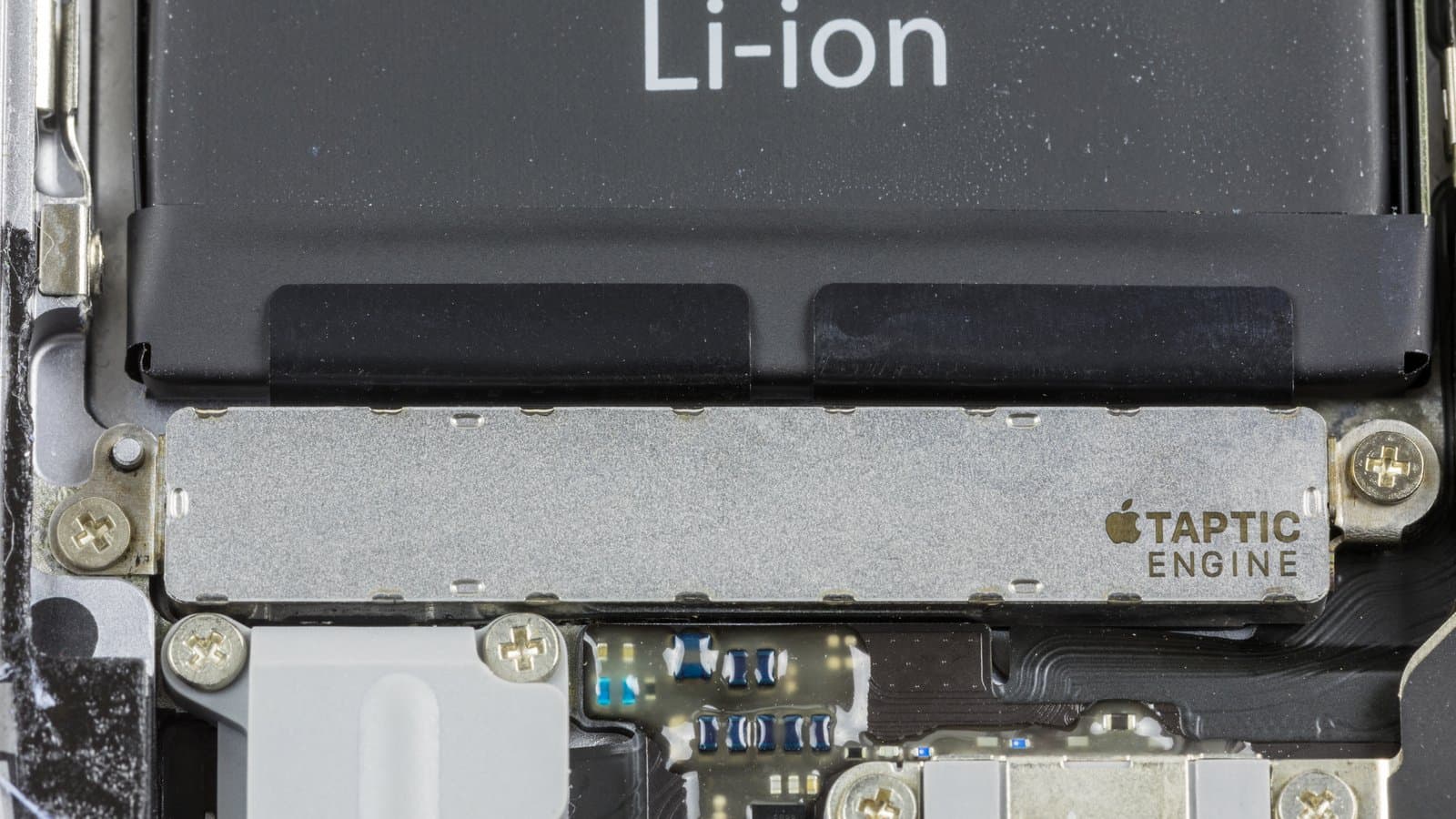
Cover image: the Taptic Engine module inside an opened iPhone 6s. Photo by Raimond Spekking via Wikimedia Commons (CC BY-SA 4.0).
Tags
Frequently asked questions
- How much does Apple owe Taction Technology?
- A federal jury in San Diego awarded Taction $5,721,961,750 on September 25, 2026. The figure is a jury award, not a final judgment, and Apple disputes it.
- What did the jury find Apple infringed?
- The jury found that Apple's Taptic Engine, used in iPhones and Apple Watches, infringed claims in two Taction patents covering tactile transducers: U.S. Patent Nos. 10,659,885 and 10,820,117.
- Will Apple actually pay the $5.7 billion?
- Not soon, if ever. Apple can challenge the verdict in post-trial motions before U.S. District Judge Todd W. Robinson and then appeal to the Federal Circuit, which often narrows or overturns large patent awards.
- What is Apple's Taptic Engine?
- It is Apple's haptic feedback system, introduced with the Apple Watch in 2014, that uses a linear resonant actuator instead of a traditional vibration motor to produce taps and other tactile feedback in iPhones and Apple Watches.

TPW Editorial
Editorial Team
TechPastWeek's editorial team reports and edits every story we publish. We research each piece against primary and credible secondary sources, and a human editor reviews and signs off before it goes live.