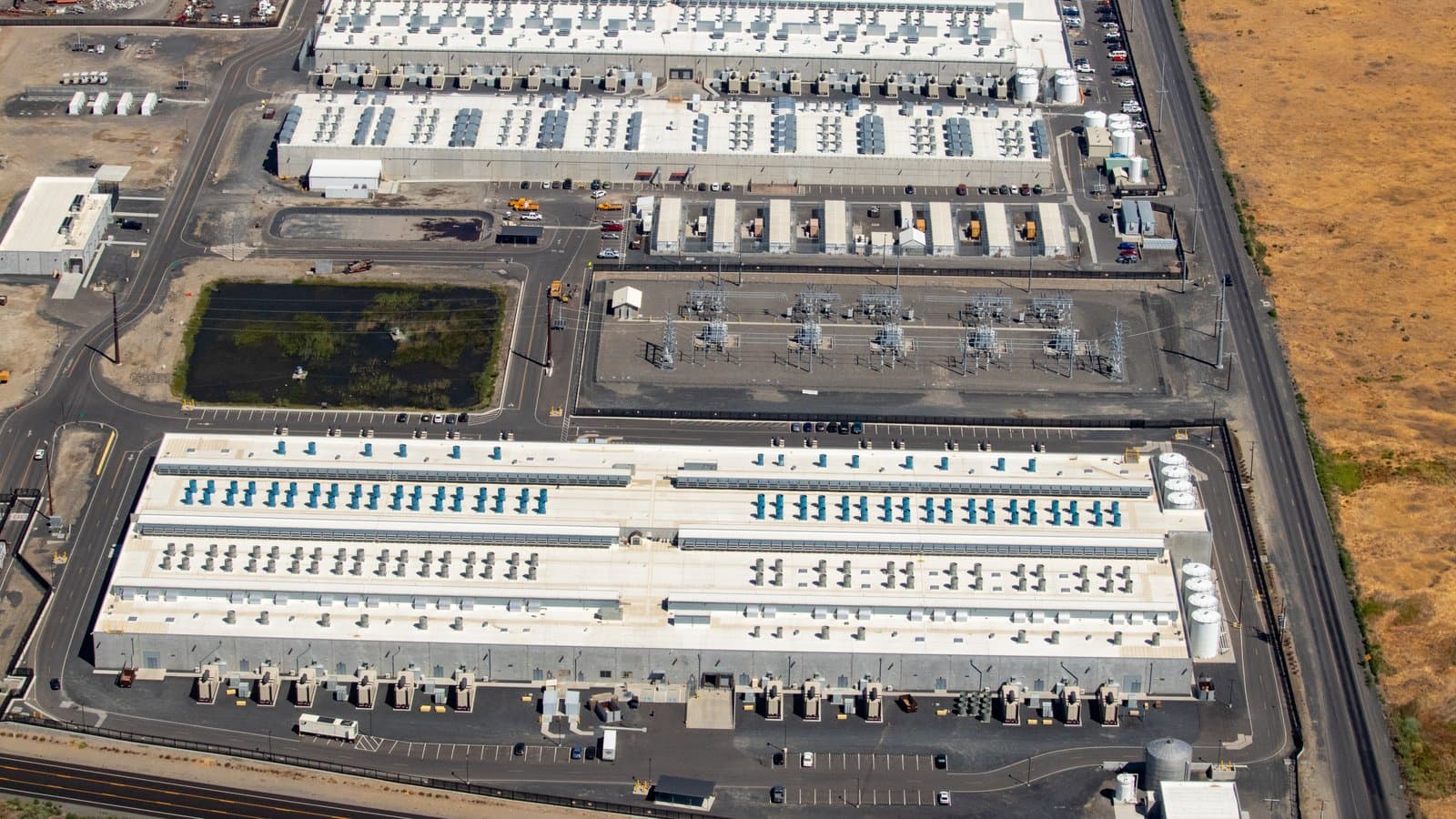
Data Center Cooling, Explained: PUE, Liquid Cooling, and the Water Bill
Nearly all the electricity a data center uses becomes heat. How air and liquid cooling work, what PUE and WUE measure, and why water is the new constraint.

On this page
Key takeaways
- Uptime Institute's 2025 global survey put the average annual power usage effectiveness (PUE) of surveyed data centers at 1.54, and the headline number has barely moved for six years.
- Air cooling loses effectiveness above roughly 20 kW per rack. Nvidia's GB200 NVL72 rack draws about 120 kW and is liquid cooled by design.
- Water usage effectiveness (WUE) varies widely: Microsoft reported a fleet average of 0.27 liters per kWh in FY25, against an industry average near 1.8 L/kWh, and its arid-region sites run far higher.
- The IEA estimates data centers consumed about 415 TWh of electricity in 2024, roughly 1.5% of global use, with cooling accounting for 7% to more than 30% of a facility's power.
- Waste heat is already reused: Meta's Odense campus supplies up to 165,000 MWh a year to the city's district heating network.
Every watt of electricity that flows into a data center eventually leaves as heat. That is not a design flaw but a consequence of thermodynamics: energy is conserved, and computation does not store it. A server turns electricity into work, and the work ends up as low-grade heat that has to be pushed into the outside air. Fans, pumps, and power conversion add more.
Related reading: Microsoft Plans to Triple Its Data Centres to 38 Gigawatts by 2032 · Ukraine Hits Two Yandex Data Centres, Reaching Russia's AI Compute.
That single fact explains why a building full of computers is really a building full of cooling equipment, and why heat removal has become one of the main constraints on how much artificial-intelligence (AI) compute the industry can build. This explainer covers how cooling works, why rack densities broke the air-cooled model, what the headline metrics measure, and why water is now part of the engineering.
A building full of servers is a building full of heat
The International Energy Agency (IEA) estimates that data centers consumed about 415 terawatt-hours (TWh) of electricity in 2024, roughly 1.5 percent of global consumption, growing around 12 percent a year. Its breakdown of where that power goes is the key to the cooling problem: cooling and environmental control account for about 7 percent of electricity in the most efficient hyperscale sites and more than 30 percent in older, less efficient enterprise rooms. Servers, storage, networking, and power conversion take the rest, and nearly all of that energy also becomes heat.
So the energy story and the cooling story are the same story. The IEA projects data center electricity use will more than double to around 945 TWh by 2030, slightly more than Japan's entire consumption today. Removing that heat efficiently is now a first-order engineering problem, not a facilities afterthought.
How air cooling worked for decades
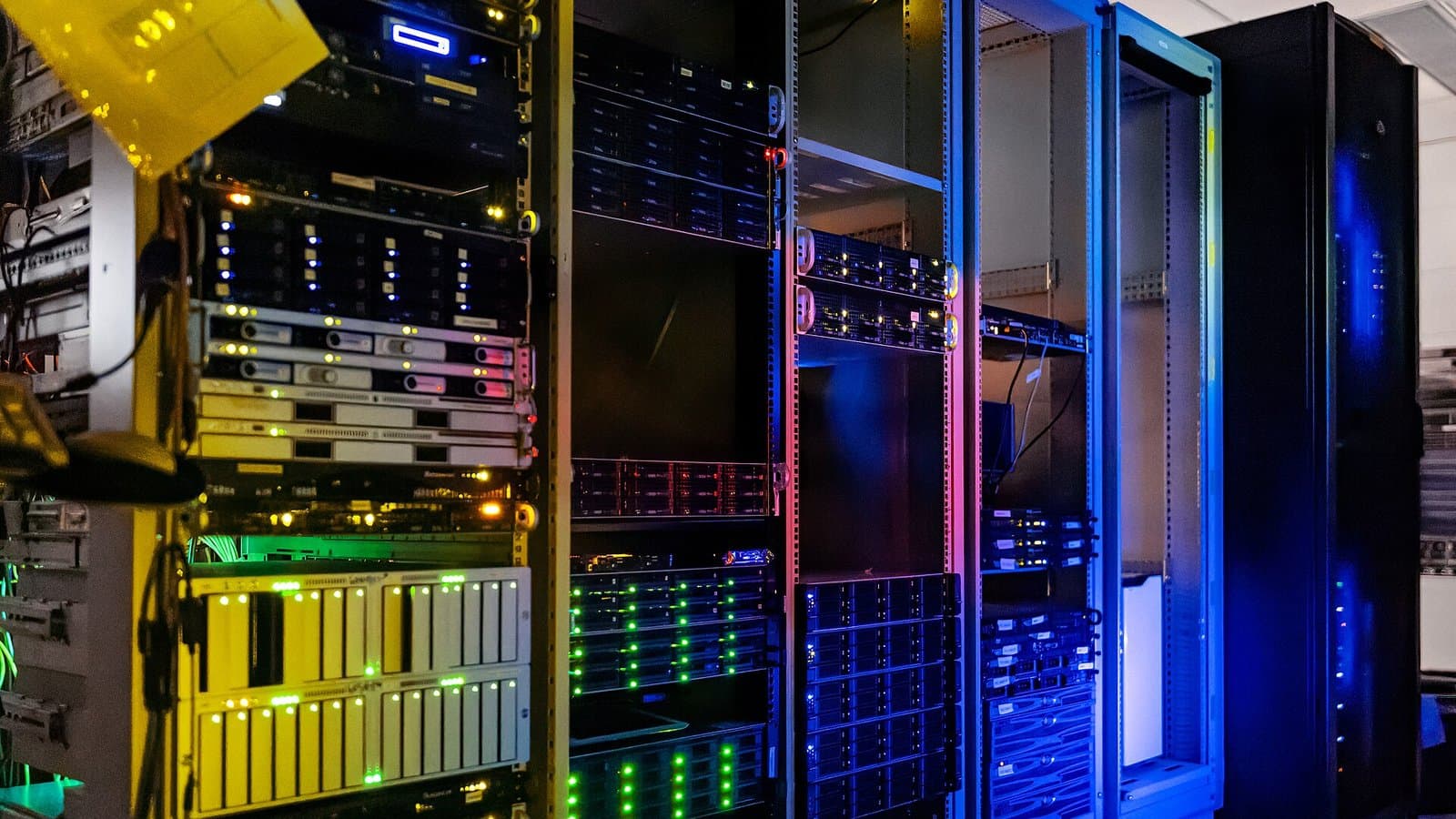
The classic data hall arranges racks in rows, front to front and back to back. Servers draw in conditioned air from a cold aisle and exhaust warm air into a hot aisle. Physical containment, such as doors and roofs over an aisle, keeps the two streams from mixing. Many halls use a raised floor with perforated tiles to feed cold air from below; others deliver it overhead.
Air is moved and cooled by computer room air conditioners (CRACs) or computer room air handlers (CRAHs). The difference matters. A CRAC contains its own compressor and refrigerant loop, like a large domestic air conditioner, so it can run standalone and suits smaller rooms. A CRAH has no compressor: it pulls warm air over coils supplied with chilled water from a central plant. Larger facilities generally prefer CRAHs because the plant can be optimised once and shared, and because there is less complex machinery inside the secure hall.
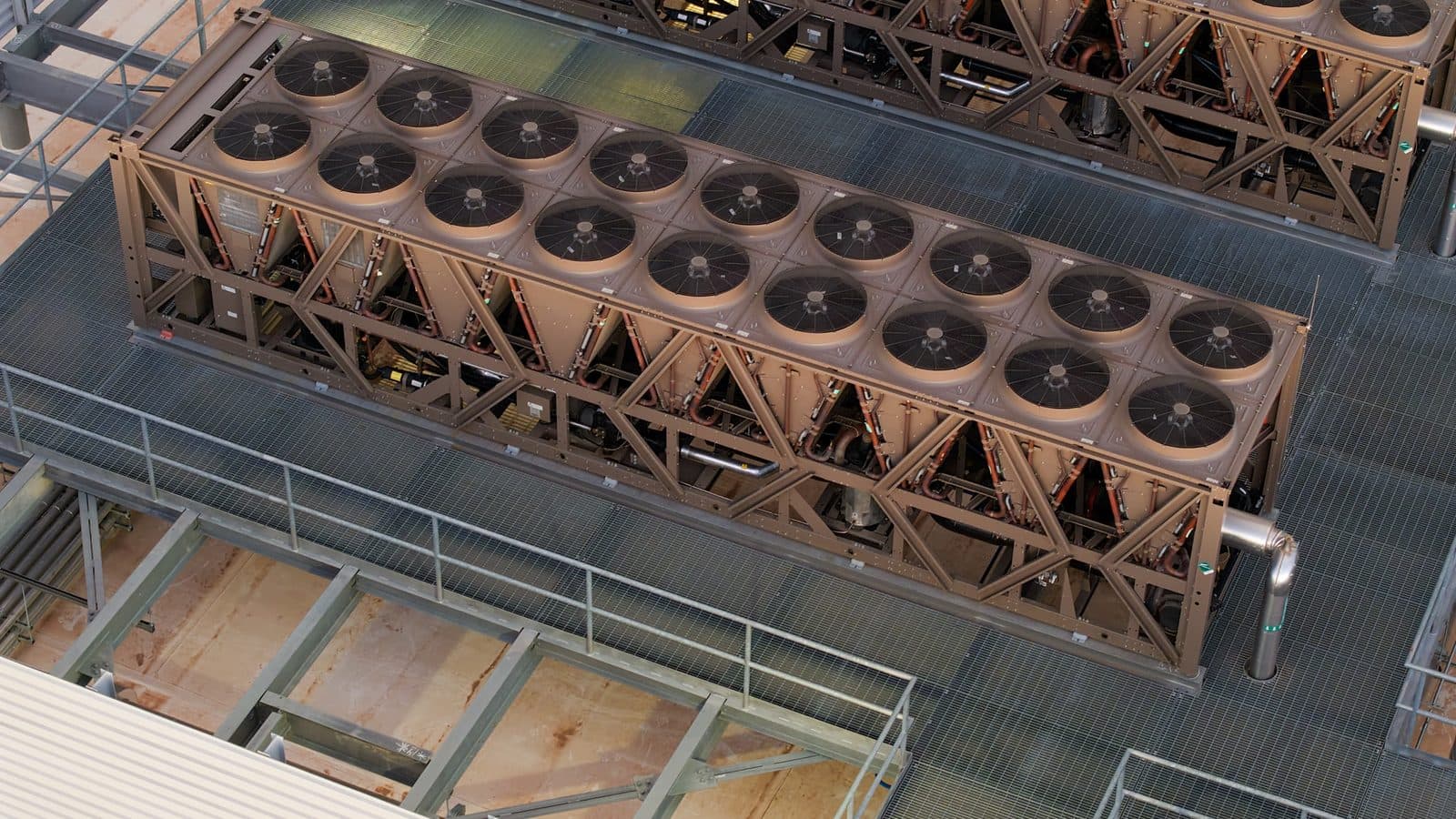
Rejecting the heat outdoors is where energy is won or lost. A chiller is a refrigeration machine that makes cold water; it is the biggest single power draw in a conventional cooling plant. An economizer bypasses it when the weather is cool enough. Water-side economizers transfer heat to a cooling tower, while air-side economizers bring in filtered outside air directly. In cool climates this free cooling can run for most of the year.
For years, this architecture was good enough. In its 2024 survey, Uptime Institute found the most common rack density was 7 to 9 kilowatts (kW), with an average near 7.1 kW once extreme outliers were excluded. That was comfortably inside air's capability.
What changed: AI racks blew past air's limits
Air is a poor heat-transfer medium. Removing more heat with air means moving much larger volumes of it, which raises fan power until the fans themselves become a meaningful load. Vertiv, a major cooling vendor, puts the practical crossover at about 20 kW per rack: above that, air-based cooling loses its effectiveness. ASHRAE, the engineering body that sets thermal guidelines, notes that some advanced air-cooled servers have reached 40 to 50 kW, but at steep cost in airflow and fan power.
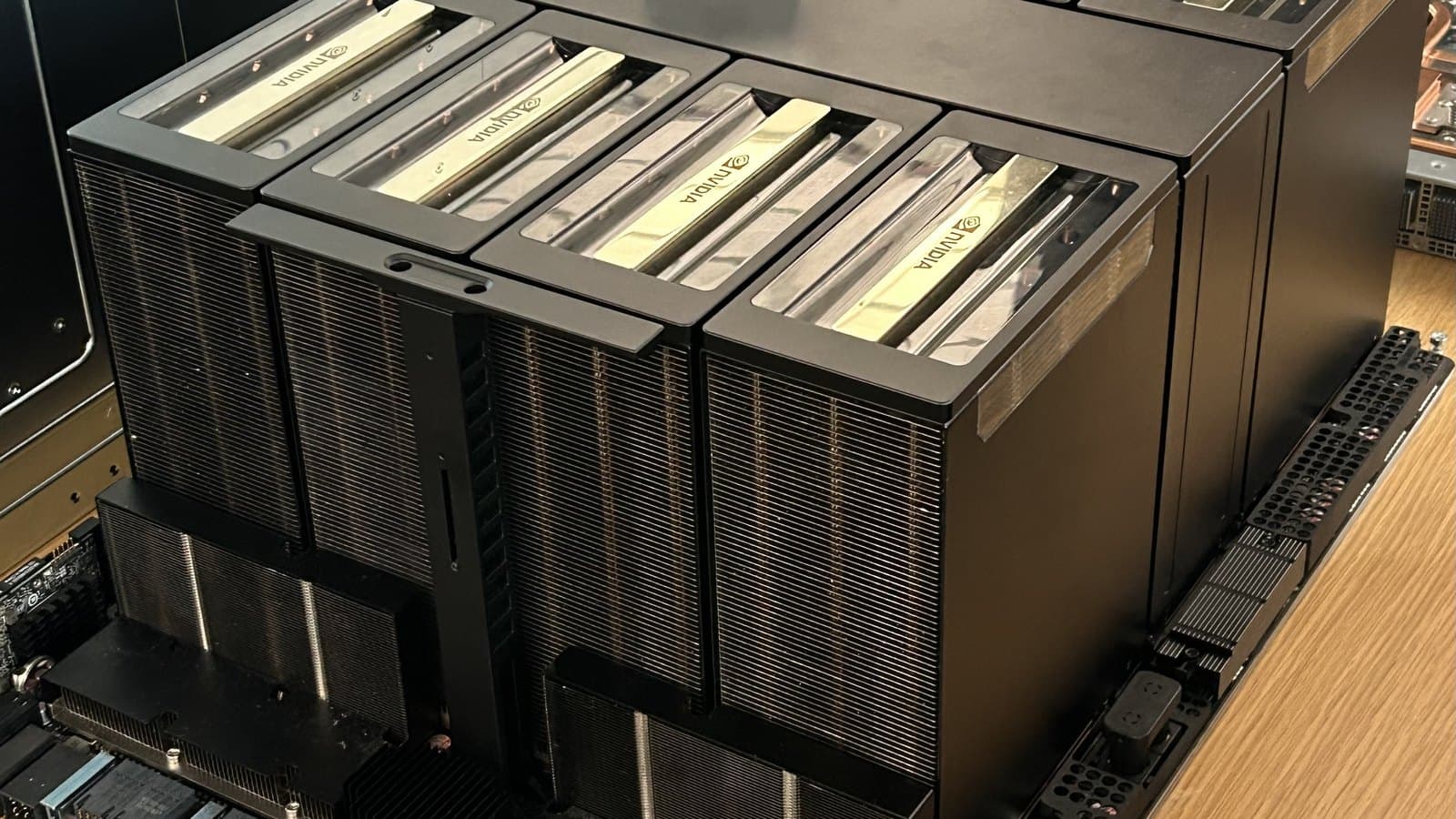
AI accelerators went further. Nvidia's GB200 NVL72 places 72 Blackwell GPUs and 36 Grace CPUs in a single rack-scale system rated at about 120 kW, an order of magnitude above a typical enterprise rack. Nvidia describes it as liquid cooled by design. A Hewlett Packard Enterprise data sheet for the same system puts the rack at 132 kW, of which 115 kW is liquid cooled and 17 kW is air cooled. That split is important: even the most aggressive liquid cooling still leaves some heat for the room.
Uptime's 2025 survey found densities still rising, with wider adoption of 10 to 30 kW racks but few above 30 kW.
“Global electricity demand from data centres is set to more than double over the next five years, consuming as much electricity by 2030 as the whole of Japan does today.” — Fatih Birol, IEA executive director, April 2025
The liquid cooling toolkit
Liquid cooling is not one technology. It is a family, and the members differ in how close the fluid gets to the chip and whether the fluid boils.
- Rear-door heat exchangers (RDHx). A liquid-filled coil replaces the rack's rear door. Server fans push hot exhaust air through it before the air returns to the room. Passive units rely on the server fans; active units add their own. RDHx extends air cooling to higher densities and can be retrofitted to existing racks, which makes it a common bridge technology.
- Direct-to-chip cold plates. Metal plates with internal microchannels are bolted directly onto the hottest components, typically GPUs and CPUs. Coolant flows through and carries heat away. In single-phase systems the fluid stays liquid; in two-phase systems it boils inside the plate and condenses elsewhere.
- Immersion cooling. Entire servers are submerged in a dielectric fluid that does not conduct electricity. In single-phase immersion the fluid is pumped to a heat exchanger; in two-phase immersion it boils and the vapour condenses on coils above the tank. Densities are the highest available, but tanks, fluids, and service procedures all change.
These loops need plumbing: a coolant distribution unit (CDU) isolates the facility water from the fluid that reaches the servers, and manifolds distribute it across a rack. ASHRAE classifies facility water temperatures with classes named for their upper limit, from W17 and W27 up to W40, W45, and W+. Warmer allowed water means less chiller work, and it is what makes heat reuse and dry cooling practical. At the National Renewable Energy Laboratory (NREL), a warm-water system at its Energy Systems Integration Facility operated at a PUE of 1.034 and a WUE of 0.7 liters per kWh.
The important caveat is that liquid and air coexist. Most deployments cool the accelerators with liquid and the memory, storage, networking, and power supplies with air, which is why the GB200 rack still sends 17 kW to the room.
PUE and WUE: what they actually measure
Power usage effectiveness (PUE), introduced by the industry consortium The Green Grid in 2007, is total facility power divided by IT power. A perfect PUE is 1.0; everything above that is overhead. At a PUE of 1.5, the facility burns half a watt of cooling, distribution, and lighting for every watt delivered to servers. At 1.1, the overhead is about a tenth.
The gap between design targets and measured reality is the number to watch. Uptime Institute's 2025 survey reported a weighted average annual PUE of 1.54, effectively unchanged for a sixth straight year. The best operators do much better: Google reported a fleet-wide PUE of 1.09 in 2025, its first year below 1.10 in six years, and Microsoft reported 1.17 in FY25. Those are measured, all-seasons figures for mature sites. New-build design targets commonly sit near 1.1 to 1.2.
Water usage effectiveness (WUE), defined by The Green Grid in a 2011 white paper, is annual water consumption divided by IT energy, expressed in liters per kilowatt-hour (L/kWh). Lower is better, and zero is the ideal. The industry average runs near 1.8 L/kWh. Microsoft's fleet averaged 0.27 L/kWh in FY25, down from 0.30 the year before, while its arid Arizona sites have run above 2 L/kWh because they rely on evaporative cooling much of the year. Amazon has said its AWS data centers use about 0.15 L/kWh.
A word of caution on both metrics. PUE measures infrastructure efficiency, not whether the IT equipment is doing useful work, and it can be flattered by boundary choices. WUE depends heavily on climate: a site in Singapore can hit 0.02 L/kWh partly because the humid air makes evaporative cooling impractical. Neither number captures the full picture.
The water tradeoff
Evaporative cooling works by spraying water into a tower so that it evaporates and absorbs heat. The energy saving is real, but the evaporated water is consumed, not returned, and the remaining water becomes concentrated “blowdown” that must be treated. Evaporative cooling therefore lowers PUE while raising WUE. Microsoft has been explicit that replacing evaporation with closed-loop, chip-level mechanical cooling slightly increases PUE while avoiding more than 125 million liters of water a year per data center.
Scale makes the water question unavoidable. The IEA estimated that data centers worldwide consumed roughly 560 billion litres of water in 2024, a figure it expects to more than double by 2030. Lawrence Berkeley National Laboratory found that United States data centers directly consumed about 17 billion gallons (66 billion liters) in 2023, with far more used indirectly at power plants. The Congressional Research Service notes that a 100-megawatt US data center may consume directly about as much water as 2,600 households. Roughly a fifth of US data centers draw from watersheds under moderate to high stress, mostly in the West, according to research led by LBNL's Arman Shehabi and reported by NPR. That has produced local opposition and, in some jurisdictions, limits on evaporative cooling.
Heat reuse: from waste to district heating
The heat leaving a data center is low-grade, often 30 to 45 degrees Celsius, so it usually needs a heat pump to be raised to the 70 to 75 C useful for district heating. Where a campus sits next to an existing network, that conversion can work at scale. Meta's Odense data center in Denmark delivers up to 165,000 MWh of surplus heat a year to Fjernvarme Fyn, enough for roughly 9,000 homes. Stockholm's Open District Heating programme had partnered with 20 heat suppliers by 2022, recovering enough heat to warm 30,000 apartments.
Reuse is not universal. It needs a nearby district network, a buyer, and a temperature high enough for the heat pump economics to work. The EU's recast Energy Efficiency Directive pushes operators to report energy and water use and to consider recovering waste heat.
The cost and retrofit problem
Air-cooled halls are the industry's stranded asset. Adding direct-to-chip liquid cooling to an existing room means new pipework, CDUs, floor-loading checks, leak detection, service retraining, and the risk that comes with working in a live hall. New builds increasingly design for liquid from the start.
Cost is the backdrop to all of it. Uptime's 2025 survey found that cost issues remained the top concern for digital-infrastructure teams, ahead of forecasting future capacity, with power constraints and supply-chain delays close behind. Efficiency upgrades compete for capital against simply building more capacity, which is why the measured industry average has improved so slowly.
What to watch
Four things will determine where this goes.
- Warm-water and zero-water designs. Running loops at 40 to 45 C cuts chiller use sharply and makes dry cooling possible almost anywhere. Microsoft's zero-evaporation design is the clearest signal of the direction, even if it trades a little PUE for much less water.
- Heat-reuse rules. If regulators require large facilities to capture or assess waste heat, siting will tilt toward places with district heating networks.
- Hybrid racks and standards. As air and liquid systems share a hall, CDU and manifold standards, such as those developed through the Open Compute Project, will decide how quickly operators can mix vendors.
- Beyond PUE. Energy reuse, water, and carbon metrics are increasingly reported alongside PUE because PUE alone can reward choices that consume more water.
The bottom line is physical. AI density has outrun what air can carry, liquid cooling is now the default for the densest racks, and the constraint has moved from the chip to the facility and the watershed it draws from. A PUE near 1.1 is a target for the best new sites, not the industry norm; the measured global average is still about 1.5.
The one-sentence version
Data centers turn electricity into heat, so cooling is the real limit on AI density: air cooling works below about 20 kW per rack, dense AI racks need liquid, and the choice between electricity and water now shows up in the PUE and WUE numbers.
Tags
Frequently asked questions
- What is a good PUE for a data center?
- A perfect PUE is 1.0, meaning no overhead beyond the computing load. New hyperscale designs target roughly 1.1 to 1.2, and the best fleets approach that: Google reported 1.09 in 2025 and Microsoft 1.17 in FY25, while the measured industry average is about 1.54.
- Does liquid cooling use water?
- Not necessarily. Direct-to-chip and immersion systems are usually closed loops that reject heat to dry coolers or chillers, so they can consume almost no water on site. The water-heavy approach is evaporative cooling in towers, which can be used with either air or liquid cooling.
- What is the difference between a CRAC and a CRAH?
- A computer room air conditioner (CRAC) has its own compressor and refrigerant loop, like a large domestic air conditioner, so it works standalone. A computer room air handler (CRAH) has no compressor and instead passes room air over coils filled with chilled water from a central plant, which is generally more efficient at scale.
- What is the difference between PUE and WUE?
- PUE measures energy overhead: total facility power divided by IT power. WUE measures water intensity: liters of water consumed per kilowatt-hour of IT energy. A site can improve one while worsening the other, because evaporative cooling saves electricity but consumes water.

TPW Editorial
Editorial Team
TechPastWeek's editorial team reports and edits every story we publish. We research each piece against primary and credible secondary sources, and a human editor reviews and signs off before it goes live.