Nvidia and IREN's $5.5 Billion AI Cloud Deal Draws a JPMorgan Double Upgrade
Nvidia and IREN's roughly $5.5 billion AI cloud partnership is a $3.4 billion cloud contract plus a $2.1 billion equity right. JPMorgan just doubled down.

On this page
Key takeaways
- JPMorgan analyst Richard Choe double-upgraded IREN to Overweight from Underweight on September 14, 2026, raising his price target to $65 from $46.
- The roughly $5.5 billion Nvidia figure combines a five-year, $3.4 billion AI cloud contract IREN disclosed on May 7, 2026 with a Nvidia right to buy up to 30 million IREN shares at $70, worth up to $2.1 billion.
- IREN closed a $3.65 billion investment-grade GPU financing facility on June 1, 2026 at a blended 6.0% cost of debt, funding about 96% of the $5.81 billion GPU capex for its Microsoft contract.
- IREN targets about 480 MW of AI Cloud capacity by the end of 2026 and reported in late August roughly $4 billion of contracted ARR for 2026 capacity against about $1 billion operating.
- IREN is winding down Bitcoin mining and aims to have mining effectively decommissioned by the end of December 2026, after a $638.8 million impairment in fiscal 2026.
JPMorgan handed IREN Limited a rare double upgrade on September 14, 2026, moving the Nasdaq-listed data center operator straight to Overweight from Underweight and lifting its price target to $65 from $46. The reason analyst Richard Choe gave came down to one word: Nvidia. The CNBC report on the call framed IREN as a top-tier "neocloud" riding its strategic partnership with the chipmaker.
Related reading: Ukraine Hits Two Yandex Data Centres, Reaching Russia's AI Compute · Oracle Sends Force Majeure Notice on $18 Billion New Mexico Stargate Campus.
The market did not celebrate. IREN shares fell early that Monday and stayed under pressure, TipRanks noted, as investors weighed a company that is spending far more than it earns against contracts that have not yet turned into cash. The upgrade put a spotlight back on a deal most coverage describes as being worth about $5.5 billion, and on what that number actually contains.
The bank was also moving in the other direction on a peer. On the same day it raised IREN, Choe cut MARA Holdings to Underweight from Overweight, a reminder that this is a call about which former miners can convert their power and land into AI compute, not about crypto broadly.
The $5.5 billion is two different things
Financial media and analysts routinely call the Nvidia arrangement a roughly $5.5 billion partnership. That total does not appear in the companies' own announcements. It is the sum of a signed contract and a conditional equity right.
On May 7, 2026, IREN said it had signed a five-year AI infrastructure cloud services contract with Nvidia worth approximately $3.4 billion. Under it, IREN provides managed GPU cloud services for Nvidia's internal AI and research workloads, including orchestration and cluster management software built with Mirantis. The capacity uses air-cooled Blackwell systems deployed within existing data centers at Childress, Texas, with ramp-up targeted from early 2027.
On the same day, the two companies announced a broader strategic partnership to support deployment of up to 5 gigawatts of Nvidia DSX-aligned AI infrastructure across IREN's global pipeline over time. As part of that, IREN issued Nvidia a five-year right to purchase up to 30 million ordinary shares at $70 each, a right to invest up to $2.1 billion subject to conditions that include regulatory approval. Add the contract to the equity right and you get the $5.5 billion headline. Nvidia's contribution is a right to buy stock, not revenue for IREN.
IREN's annual filing adds a further condition. Startup Fortune reported that the right is tied to delivery of up to 600,000 GPUs alongside the regulatory conditions, which is a useful reminder that a warrant-style right is not cash in the bank.
The Microsoft contract is the bigger anchor
The $3.4 billion Nvidia contract is smaller than the cloud deal IREN signed six months earlier. In November 2025, IREN announced a five-year, roughly $9.7 billion GPU cloud services contract with Microsoft, including a 20 percent prepayment. It covers access to Nvidia GB300 GPUs across four 50 MW liquid-cooled deployments, known as Horizon 1 through 4, at the 750 MW Childress campus.
That contract moved into delivery in August 2026. IREN said Horizon 1 had been delivered to and accepted by Microsoft, the first of the four phases, and that the GB300 NVL72 deployment had achieved Nvidia Exemplar Cloud status. Horizon 2 was in commissioning, with Horizon 3 and 4 in late-stage construction and targeted for the December quarter. To supply the hardware, IREN agreed in November 2025 to buy roughly $5.8 billion of GPUs and ancillary equipment from Dell Technologies, a purchase its 8-K filing ties to the Microsoft contract.
Financing a build that outruns revenue
IREN closed a $3.65 billion investment-grade GPU financing facility on June 1, 2026 to fund the Microsoft build. The package pairs a $2.10 billion US private placement at a fixed rate equivalent to SOFR plus 2.13 percent with a $1.55 billion delayed draw term loan at SOFR plus 2.25 percent, for a blended cost of debt of 6.0 percent. Fitch rated it A and DBRS A (low), which IREN described as the highest publicly rated investment-grade GPU financing and the first in the US private placement market.
The facility, combined with Microsoft's prepayments, funds $5.59 billion of the $5.81 billion, about 96 percent, of GPU capital expenditure under the Microsoft contract. IREN said the structure supports its expansion to about 480 MW of AI Cloud capacity by the end of 2026. Goldman Sachs and J.P. Morgan arranged the deal.
Fiscal 2026: a $4 billion backlog, $1 billion live
IREN's fiscal year 2026 results, reported on August 27, 2026, show both the scale of the pivot and its cost. The company said it had $4 billion of contracted annualized run-rate revenue for its 2026 capacity, of which about $1 billion was operating as of August 26. It disclosed a new multi-year contract with an unnamed leading frontier AI lab, alongside signings including Cohere, Prometheus, Perplexity, Figure AI, Fal AI and Higgsfield AI.
What ARR means here
IREN's annualized run-rate revenue is an operating metric, not US GAAP revenue. It multiplies contracted GPU-hour pricing by 8,760 hours a year, and the company says recognized revenue may be materially lower. The $4 billion figure also depends on capacity that had not yet been commissioned as of the August update.
The same release set out $2.8 billion of new GPU financings for non-investment-grade customers, including a $2.4 billion facility led by Blue Owl and PIMCO at a 9.0 percent fixed rate for the Mackenzie air-cooled expansion. Combined with the Microsoft facility, IREN said it arranged $6.5 billion of GPU financing in three months.
The reported numbers were harder. Total fiscal 2026 revenue was $707.0 million, up from $501.0 million, with AI Cloud Services revenue of $128.8 million against $578.2 million from Bitcoin mining. Q4 was the first quarter in which AI cloud revenue, at $70.5 million, passed mining revenue of $66.7 million. The company posted a full-year net loss of $702.6 million, including $638.8 million of non-cash impairments tied to decommissioning mining hardware.
The mining exit
IREN expects crypto mining to be effectively decommissioned by the end of December 2026 as power and halls are redirected to GPUs. The transition is not unique to IREN. In Michigan, Hyperscale Data ceased Bitcoin mining at its Dowagiac facility on September 1, 2026 and said it would convert the site into an AI data center.
Vendor, customer and shareholder at once
The IREN arrangement compresses several roles into one counterparty. Nvidia supplies the chips, buys cloud capacity from IREN, and holds a right to own part of the company. That structure is the strongest version of the circular-financing question hanging over the AI buildout, because it blurs the line between a customer validating demand and a supplier underwriting it.
The $5.5 billion headline is half contract and half claim: the equity right is future dilution rather than income, and the up-to-5 GW deployment target is an intention, not contracted revenue. JPMorgan's own argument rests on pricing rather than the headline. Choe told clients that neocloud contracts now fetch $15 to $20 per watt or more, up from $10 to $15, and that any 2027 capacity signed above $15 per watt would be accretive. IREN told investors on its earnings call that recent three-year contracts exceeded $20 million of revenue per megawatt of IT load with roughly a two-year payback, and that recent customer prepayments covered 45 to 55 percent of GPU capital costs.
Those prepayments matter because the spending plan is enormous. IREN guided to $25 billion to $30 billion of capital expenditure for fiscal 2027, several times what it spent in fiscal 2026 and far above its current revenue base.
IREN is not alone in making this trade. CoreWeave and Nebius are pursuing similar neocloud builds, and all three are competing for the same GPUs, the same power and the same limited pool of customers willing to prepay. What separates IREN is that it owns its land, its grid interconnections and its data center shells, a legacy of the mining business it is retiring. That ownership is why lenders were willing to underwrite GPU-backed debt at investment-grade ratings for the Microsoft contract, and it is also why Nvidia brought IREN into its DSX architecture rather than simply selling chips to it.
What to watch
The distance between contracted and operating revenue is the whole investment case in one line: about $4 billion signed for 2026 capacity, about $1 billion actually running. The next proof points are the delivery of Horizon 2 through 4 to Microsoft by year-end, whether the 2027 capacity IREN is negotiating gets signed at the higher prices management describes, and whether the accompanying prepayments hold.
Power is the other constraint. IREN said on September 8 that its 2 GW Sweetwater Hub in Texas had been conditionally included as base load in ERCOT's Batch Zero process, a milestone for grid connection that remains subject to further approvals, with the first 300 MW there targeted for late 2027.
None of that settles the $5.5 billion question. On the record, Nvidia committed to a $3.4 billion cloud contract and a conditional right to buy up to $2.1 billion of IREN stock. The combined figure is an analyst framing, useful as shorthand but not a single signed obligation.
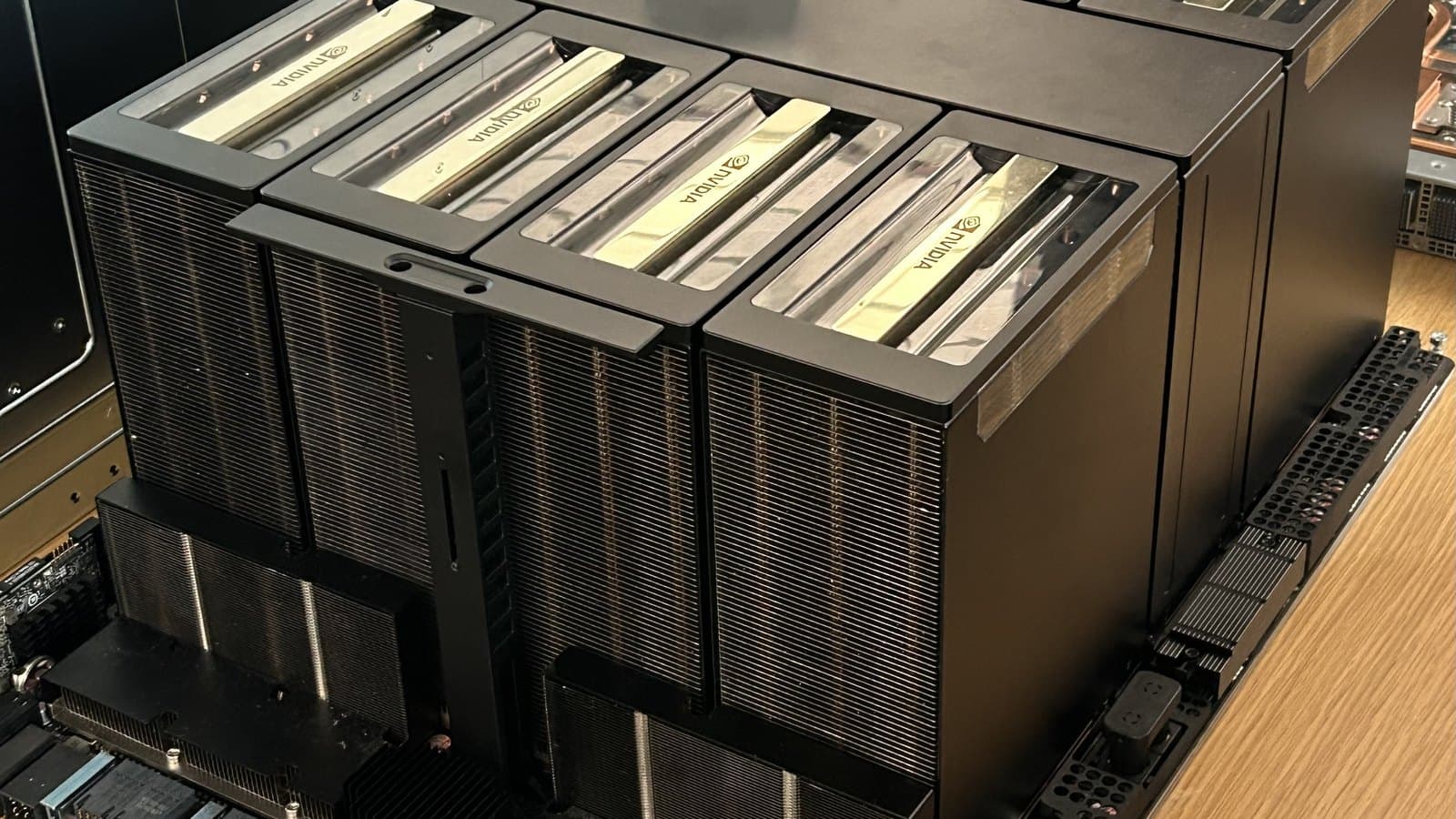
Cover: Eight NVIDIA GPU boards in an HGX B200 NVL8 server chassis, by Pokiiri (CC BY-SA 4.0) via Wikimedia Commons.
Tags
Frequently asked questions
- Is Nvidia's $5.5 billion IREN deal a single contract?
- No. The $5.5 billion figure combines a $3.4 billion, five-year AI cloud contract that IREN announced on May 7, 2026 with a Nvidia right to buy up to 30 million IREN shares at $70, worth up to $2.1 billion. The companies' own releases state the two amounts separately.
- Why did JPMorgan double-upgrade IREN?
- Analyst Richard Choe moved IREN to Overweight from Underweight on September 14, 2026, skipping the neutral rating, and lifted his price target to $65 from $46. He cited the Nvidia partnership, momentum in signing AI cloud customers and compute pricing that has risen to $15 to $20 per watt or higher from an earlier $10 to $15 range.
- What is IREN's AI Cloud capacity target?
- IREN targets about 480 MW of gross AI Cloud capacity by the end of 2026 and 1.2 GW in 2027. It had delivered Horizon 1 for Microsoft in August 2026, with Horizon 2 through 4 targeted for the December 2026 quarter.
- How much of IREN's Nvidia partnership is guaranteed?
- The $3.4 billion cloud contract is signed. The up-to-$2.1 billion equity right is conditional, and IREN's annual filing ties it to conditions that include regulatory approval and delivery of up to 600,000 GPUs.

TPW Editorial
Editorial Team
TechPastWeek's editorial team reports and edits every story we publish. We research each piece against primary and credible secondary sources, and a human editor reviews and signs off before it goes live.