Crux AI Reportedly Lines Up $22 Billion in Bank Debt to Buy Google TPUs
Ten banks are reportedly arranging a $22 billion loan for Crux AI, the Google-Blackstone TPU cloud venture, as AI infrastructure shifts deeper into debt.

On this page
Key takeaways
- Bloomberg reported on September 16, 2026 that about ten banks are arranging a $22 billion loan for Crux AI, the Google-Blackstone TPU cloud venture.
- The debt would buy Google Tensor Processing Units and be secured by the value of those chips plus Crux AI's customer contracts, with a reported $1 billion revolving credit line alongside it.
- No company or bank has confirmed the facility has closed, committed or been drawn; Crux AI, Blackstone and Goldman Sachs declined to comment, so the figure is a reported arrangement.
- Crux AI launched publicly on September 9, 2026 with a $5 billion Blackstone equity commitment and a target of bringing its first 500 MW of TPU capacity online in 2027.
- The venture hired Meta's head of data center engineering and construction, Alan Duong, as chief development officer on September 10, and plans a hiring ramp toward a 2 GW scaling roadmap.
Crux AI has reportedly lined up $22 billion in debt from a group of about ten banks to buy Google's Tensor Processing Units, roughly four months after the company was unveiled as a joint venture between Blackstone and Alphabet. Bloomberg first reported the financing on September 16, and Reuters described the same arrangement the next day through a source familiar with it.
Related reading: SK Hyper Puts the First 5 Gigawatts of Its AI Buildout at $350 Billion · Oracle Sends Force Majeure Notice on $18 Billion New Mexico Stargate Campus.
The debt would be secured by the value of the chips and by Crux AI's customer contracts, according to the reports. No bank or company involved has confirmed that the facility is signed, let alone drawn, so the number is best read as a reported arrangement rather than a closed deal. That distinction matters for a venture that did not exist publicly until eleven days before the loan story broke.
A new company built around someone else's chips
Crux AI launched publicly on September 9 as a U.S.-based AI infrastructure company promising dedicated compute at industrial scale. The venture behind it was announced on May 18 by Blackstone, which committed an initial $5 billion in equity capital from funds it manages. Google agreed to supply TPUs, software and services.
The structure is unusual. Crux AI does not design chips or write the model software at the center of its product. Google provides both. Crux AI handles power, data center capacity, networking, orchestration and operations, and sells the result as a single compute-as-a-service offering. The company frames the integration as its differentiator, promising customers one accountable partner rather than a stack of vendors.
The public numbers are modest next to the reported loan. Crux AI says it plans to bring its first 500 MW of TPU capacity online in 2027 as the initial phase of a multi-gigawatt roadmap. Data Center Dynamics reported that the company's site cites a target of scaling to 2 GW.
Benjamin Treynor Sloss, a two-decade Google veteran who created the Site Reliability Engineering discipline, leads Crux AI as chief executive. "AI presents a generational technological shift and, with it, the opportunity to reimagine the infrastructure powering it from the ground up," Sloss said in the launch release, adding that the company aims to be "trusted with the workloads that matter most."
The $22 billion facility is reported, not confirmed
The financing described by Bloomberg involves about ten banks. The lenders named most often are Goldman Sachs, Sumitomo Mitsui Banking Corp, Barclays, BNP Paribas and Bank of Nova Scotia. At least some of them are also extending a separate $1 billion revolving credit line, which Investing.com and Markets Insider, citing Bloomberg and TipRanks, reported.
Several details remain unresolved. The banking group is said to be syndicating a portion of the loan to spread the exposure, which suggests the facility was still being placed when it was reported. The debt could later be replaced with long-term financing from institutional investors in the investment-grade bond market. And the reports attribute everything to people familiar with the matter, with Crux AI, Blackstone and Goldman Sachs declining to comment and the other named banks not responding.
RuntimeWire, in a September 16 write-up, noted that the accessible reports do not establish whether the facility has closed, is committed, or remains under discussion. It also pointed to earlier coverage by the credit research firm 9fin, which described roughly $23 billion of debt and said the facility would likely be structured as a bridge loan. The gap between a reported arrangement and a signed credit agreement is where the real news sits.
Why chips are becoming collateral
Lenders financing AI infrastructure have been moving toward structures in which the hardware itself, plus the contracts that will use it, anchor the credit. Nvidia GPUs already back several large neocloud financings, and Crux AI's reported facility repeats the pattern with Google silicon instead.
That design has appeal and risk. It lets lenders recover value without a parent-company guarantee, because the chips can in principle be re-leased or sold if a borrower stumbles. It also ties repayment to assets whose value depends on how fast the next generation arrives. TPUs are less liquid than the GPUs of Nvidia's broad commercial ecosystem, since a would-be reseller needs a customer who runs Google's software stack. Crux AI's signed contracts are what bridge that gap, which is why the loan is reported to lean on them as much as on the hardware.
The reported $22 billion is also large relative to the equity behind it. Blackstone's $5 billion initial commitment is the only disclosed equity, so the financing would make Crux AI debt-heavy from its first year of operation. Supporters of the model note that the borrowing buys revenue-producing assets rather than covering operating losses. Skeptics note that the asset class has never been tested through a full AI spending downturn.
This is not an isolated deal. Bloomberg reported in August that an Anthropic-linked data center in Texas had drawn a $1.3 billion private credit loan inside a larger project-finance package, another example of specialized compute capacity being financed off balance sheet.
Google's real objective: turning TPUs into a standalone cloud
The financing is as much a Google story as a Crux AI story. Google's TPUs are custom chips built for AI training and inference and deployed internally for more than a decade, where they power Gemini and many of the company's consumer products. For years the only way to rent one was through Google Cloud.
Crux AI changes that. It gives customers access to TPUs through a company that is not Google, and it gives Google a route to make its silicon a platform rather than a captive internal advantage. Google Cloud chief executive Thomas Kurian made the case in May, saying the venture would help meet demand for TPUs and give organizations more options for accelerated compute. The unspoken target is Nvidia, whose GPUs remain the default for AI training and much of inference.
The comparison with Nvidia is where the loan's structure becomes strategically interesting. Debt markets have grown comfortable lending against Nvidia hardware because a secondary market exists for it. By arranging its own bank financing, Crux AI is trying to build a comparable credit story for TPUs, complete with collateral and customer contracts that lenders can evaluate. If that works, Google gains a financing channel for its silicon that does not run through its own balance sheet.
Execution risk sits between now and 2027
The venture's schedule has already wobbled. Bloomberg reported on September 8 that Crux AI, known internally as Project Braid, had hit delays at major data-center locations meant to run Google's chips. One site in Cheyenne, Wyoming, was being developed by Crusoe; Google reportedly lost confidence in the developer, took over the project and scaled it down. Another site was deemed unsuitable because it had the wrong transformers. A freeze on new data-center projects ordered by Texas Governor Greg Abbott added another obstacle.
The delays are partly a sector-wide problem. Bloomberg cited a JPMorgan report estimating that more than 60% of the capacity planned for completion in 2027 had not started construction, with shortages of switchgear and skilled labor compounding the bottleneck. Data Center Dynamics reported that the venture had identified some 29 potential locations and had not independently verified the reason for the Cheyenne change.
Sloss pushed back on the idea that the schedule is slipping. "We are making strong progress building out our infrastructure and are fully on track to deliver on our 500MW target in 2027," he said in an emailed statement, adding that higher-than-expected demand had led the company to evaluate a broader pool of sites. He has kept the 2027 target even as individual projects move at different speeds.
Hiring for a multi-gigawatt build
Crux AI is staffing up for the build. On September 10, Data Center Dynamics reported that the company had hired Alan Duong, Meta's vice president and head of data center engineering and construction, as chief development officer. Duong spent more than 12 years at Meta and led the redesign of its data centers for AI workloads after the company paused projects in 2023.
In a statement, Duong described construction as an end-to-end chain in which any weak link sinks the rest. "That end-to-end view is what I'm bringing to Crux AI, and what we'll build the organization around as we scale," he said. He will be responsible for delivering multiple gigawatts of capacity over the coming years.
The company has also brought in Jessica Fischer, the chief financial officer of Charter Communications, and listed 17 open roles spanning data center construction, energy management, operations, supply negotiation and a VP of capital markets. The composition of that list, heavy on construction and capital markets, tracks the two things the venture most needs to prove: that it can build, and that it can keep financing the building.
What to watch
Three questions will determine whether the reported $22 billion becomes a template or a cautionary tale. The first is whether the facility actually closes on the described terms, and whether the syndication succeeds. A loan that cannot be distributed to other lenders would tell a different story than one that is oversubscribed.
The second is customers. Crux AI's launch materials described the platform but did not name a single tenant, and the credit case rests on contracts that have not been disclosed. Until those names and terms surface, the collateral is hard for outsiders to assess.
The third is residual value. The loan is secured by TPUs whose worth will be set by a secondhand market that barely exists today. Every new TPU generation shortens the economic life of the last one. If that depreciation curve turns out to be steeper than lenders assumed, the structure that made the debt possible is also the thing that makes it fragile.
For now, the deal is a marker of how far AI infrastructure finance has traveled. A company with no disclosed revenue, a handful of announced partners and a 2027 construction target has reportedly lined up bank debt larger than the market capitalizations of most public companies, all to buy chips from one of its own investors.
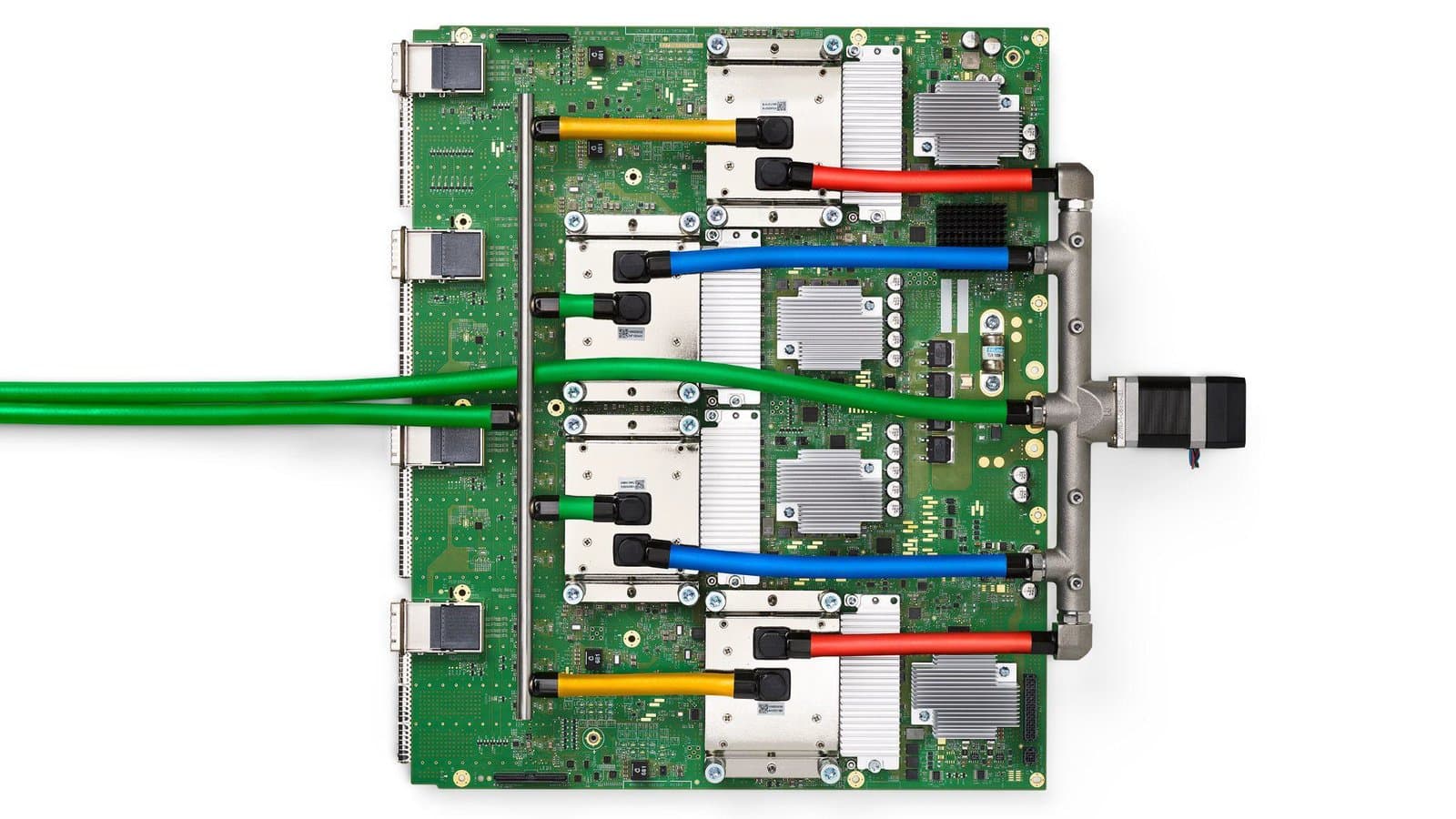
Image: Norman P. Jouppi et al. / Wikimedia Commons, CC BY 4.0.
Tags
Frequently asked questions
- How much is Crux AI's reported bank loan?
- Bloomberg reported on September 16, 2026 that a group of about ten banks is arranging a $22 billion loan for Crux AI. The debt would be used to buy Google TPUs and would be backed by the value of those chips and by Crux AI's customer contracts. None of the parties has confirmed the facility has closed.
- Which banks are involved in the Crux AI financing?
- The top lenders named in the reports include Goldman Sachs, Sumitomo Mitsui Banking Corp, Barclays, BNP Paribas and Bank of Nova Scotia. The banking group is also reported to be syndicating part of the loan to additional lenders and arranging a separate $1 billion revolving credit line.
- What is Crux AI?
- Crux AI is a U.S.-based AI infrastructure company formed by Blackstone and Google, announced as a joint venture in May 2026 and launched publicly on September 9, 2026. It rents out Google Tensor Processing Units as a compute-as-a-service platform, with Blackstone committing $5 billion in initial equity and Google supplying TPUs, software and services.
- Why would banks lend against AI chips like Google TPUs?
- The loan is reported to be secured by the market value of the TPUs and by Crux AI's signed customer contracts, rather than by a parent-company guarantee. That structure lets lenders recover value by re-leasing or selling the chips if a borrower defaults, but it depends on how well TPUs hold their resale and re-lease value.

TPW Editorial
Editorial Team
TechPastWeek's editorial team reports and edits every story we publish. We research each piece against primary and credible secondary sources, and a human editor reviews and signs off before it goes live.