Retroid's Pocket Duo Packs Two 120Hz OLED Screens Into a Clamshell Handheld
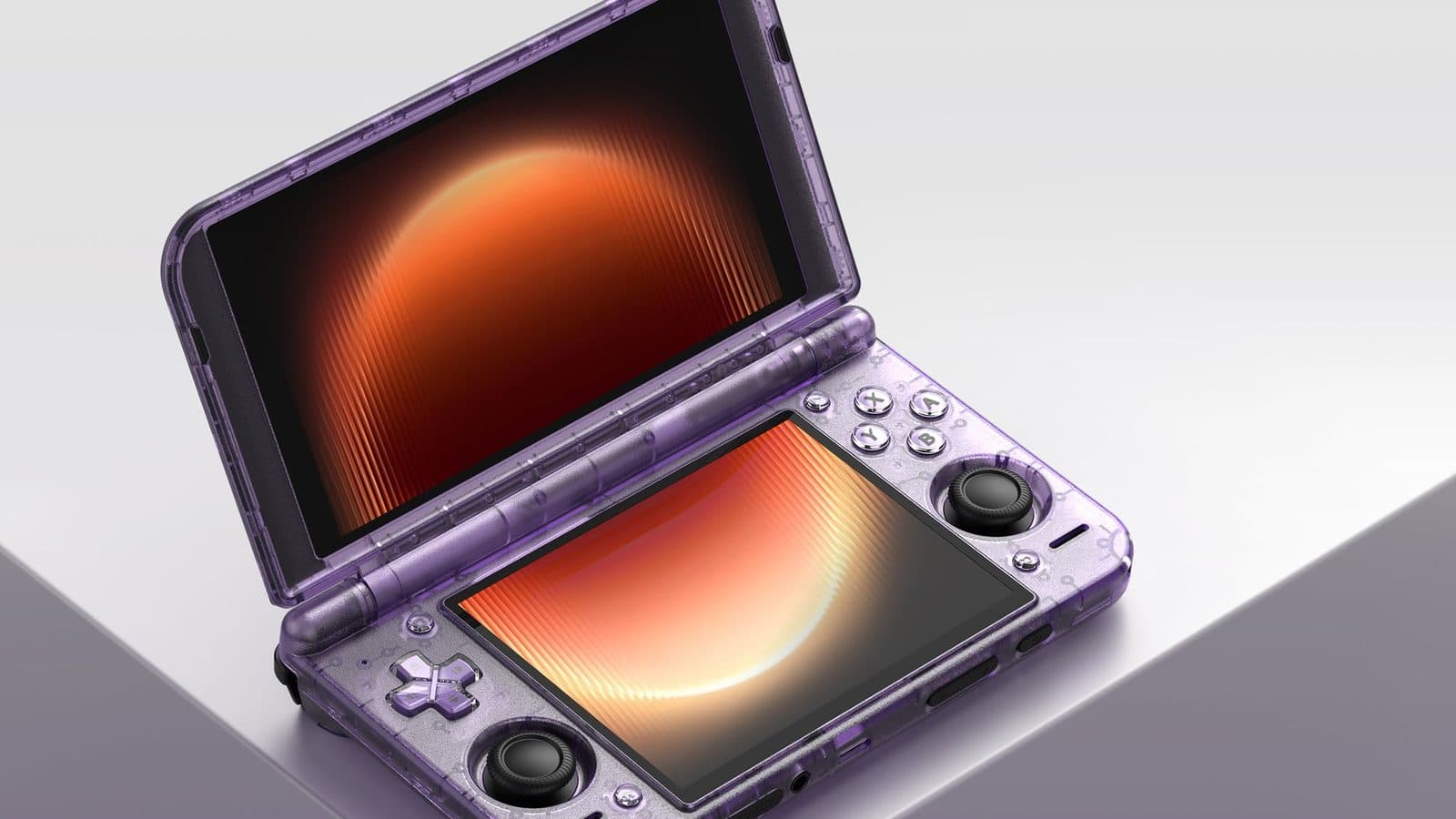
Retroid's Pocket Duo is a clamshell Android handheld with two 120Hz OLED screens, a Qualcomm Dragonwing Q-7790 chip and a Nintendo DS-style dual-screen layout.

On this page
Retroid Interactive has built its reputation on small, pocketable Android handhelds that run decades of emulated games. On September 7, 2026, the company teased its next device with a deliberately minimal slogan: "No Clips. No Cables." The product was the Pocket Duo, and the message was that this time the second screen would be part of the machine, not something bolted onto it.
Related reading: Sony Brings Back See-Through Plastic With the Prism PS5 Collection · PS5 Sales Rose 22% in September as the Rest of the US Market Fell.
A day later Retroid began filling in the details. The Pocket Duo, the company confirmed, will carry two 120Hz OLED displays: a 5.5-inch 16:9 AMOLED panel at 1920x1080 up top, and a smaller 4.5-inch 4:3 AMOLED panel rated at 960p below. On the same day it named the silicon, Qualcomm's Dragonwing Q-7790, an IoT and edge-focused part based on the Snapdragon 7 Gen 4, paired with Adreno 722 graphics.
By September 8 the device's shape and intent were clear. This is a clamshell handheld whose entire design premise is the kind of game that has always asked for two screens.
What Retroid has confirmed
- Top display: 5.5-inch 16:9 AMOLED, 1920x1080, 120Hz
- Bottom display: 4.5-inch 4:3 AMOLED, 960p, 120Hz
- SoC: Qualcomm Dragonwing Q-7790 with Adreno 722 graphics
- Memory/storage: 8GB + 128GB
- OS: Android 16, with official OTA support
- Battery: 6000mAh, active cooling
- Connectivity: Wi-Fi 6E, Bluetooth 5.4
- Controls: Hall-effect sticks, analog L2/R2 triggers
- Hinge: 180-degree free-stop, so the two screens can hold different angles
- Weight: roughly 350g, according to Yanko Design
Two screens, one device
Retroid is not new to dual-screen gaming. Its previous answer was an accessory: a second display that clipped onto an existing handheld and needed its own connection. That approach works, but it is clumsy in the ways clip-on accessories usually are, extra parts, extra cables, and a rig that is awkward to carry. The teaser's two-word promise was a direct attack on that friction.
The Pocket Duo folds that idea into the product itself. Both panels are AMOLED and both run at 120Hz, which is unusual even among premium handhelds. The top screen is the familiar widescreen shape used by modern Android games and widescreen emulation; the lower 4:3 panel is the squarer, more compact format that older consoles and handhelds were built around. A 180-degree free-stop hinge lets the two halves hold different angles, so the setup can be tilted like a small laptop rather than fixed open like a book.
That geometry is not arbitrary. It is the shape of a Nintendo DS or 3DS.
Why a dual-screen handheld exists
The Nintendo DS and 3DS families sold in the hundreds of millions on a simple idea: give players two views at once. One screen showed the action; the other held a map, an inventory, a status bar, or a touch control surface. Games were designed around that split, and many of them do not translate cleanly to a single screen. Emulating them on one display usually forces a compromise, stack both images and shrink each one, or park one in a small picture-in-picture window that covers the very content you are trying to see.
Two physical panels solve that directly. Each screen can run at a resolution well above the original hardware, and the layout matches what the games expect. Retroid's own framing points at DS and 3DS emulation as the headline use case, with melonDS cited as an example of a modern emulator that can push those titles to higher resolutions. The 4:3 lower panel lines up with the aspect ratio the DS and 3DS used for their bottom screens, while the 16:9 top panel is better suited to widescreen content and to native Android games.
Touch input is the other half of that equation. The DS and 3DS relied on the lower screen for stylus and finger controls, from menus to puzzle games, and a second physical panel is the only way to reproduce that control relationship faithfully. On a single-screen emulator the touch layer has to share space with the game image, which is workable but never quite right.
It is worth being precise about what the Pocket Duo is and is not. It is an Android device, not a dedicated emulation box. That means it can run other systems and native Android games, and the two-screen layout is a capability rather than a restriction. But it also means the dual-display experience depends on software that knows how to use it, a theme worth returning to.
The chip question
The reveal's most interesting technical detail is the processor. Qualcomm's Dragonwing line is aimed at IoT and edge computing rather than flagship phones, and the Q-7790 is described as being based on the Snapdragon 7 Gen 4. That places it in the upper-mid tier of the mobile lineage rather than at the very top.
For DS and 3DS emulation, that is likely a sensible match. DS emulation is not especially demanding on modern hardware, and the more capable 3DS emulators lean on both CPU and GPU in ways a Snapdragon 7-class part can generally handle at elevated resolution. The Pocket Duo pairs the chip with 8GB of RAM and 128GB of storage, and it includes active cooling, a sign Retroid expects sustained load rather than short bursts.
Where the ceiling sits is an open question. Heavier emulation targets and the most demanding native Android titles will test the Adreno 722 more than a DS game ever would, and the actual performance in independent testing will matter more than the spec sheet. For a device sold on two 120Hz screens, though, the panel choice may matter more than the peak frame rate: smooth scrolling and touch response on the lower display are part of the appeal.
Retroid has not published detailed performance figures, and independent benchmarks are the only way to judge whether those trade-offs land well. What the company has signaled is intent: active cooling and a modern memory standard suggest a design meant to stay comfortable under sustained load rather than throttle after a few minutes of play.
A crowded, fast-growing niche
The Pocket Duo is arriving into a category that barely existed a few years ago and is now visibly competitive. Dual-screen retro handhelds have multiplied: AYN Thor, AYANEO Pocket DS, Anbernic RG DS Plus and Yoniq Duo all occupy some version of the same idea. Each makes a different bet on screens, chips, size and price, and together they suggest the demand is real enough to support several products rather than one curiosity.
That matters for how the Pocket Duo should be judged. A single dual-screen handheld could be dismissed as an experiment. A field of them starts to look like a product category, with the usual pressures that come with one: buyers compare specs, reviewers test hinges and thermals, and manufacturers iterate. Retroid's decision to integrate the second screen rather than sell it as an add-on is itself a statement that the company thinks the category is durable enough to justify designing a whole device around it.
Price is doing a lot of work in that comparison, which is why the missing figure matters so much. The same set of specs can read as a bargain or an overreach depending on where the number lands, and the dual-screen field already spans a wide range from budget to premium.
The timing reinforces that reading. Retro and emulation handhelds are multiplying across the board, from budget single-screen devices to premium Android machines, and the dual-screen segment is the newest front. Nintendo's own dual-screen era ended with the 3DS, so there is no modern first-party hardware serving that library. Third-party Android handhelds are, for now, the only way to play those games on hardware shaped like the originals, and that is a genuine gap, not a marketing one.
What is still unknown
Retroid had not announced a price or a firm release date for the Pocket Duo at the time of writing. Both will shape how the device is received: the dual-screen field already spans a wide range, and a handheld is only a bargain or a reach relative to what sits next to it on the shelf. Treat any figure circulating before an official announcement as unconfirmed.
The open questions
Price and release date. These are the two facts that will decide whether the Pocket Duo is a mainstream recommendation or an enthusiast indulgence. Until Retroid names them, the device's competitive position is theoretical.
Software polish. Android is not natively a two-screen operating system, and a handheld that depends on the second display lives or dies by how gracefully the software assigns apps, emulators and touch input to each panel. Retroid's official OTA support is encouraging (it means the experience can improve after launch) but the day-one state is what buyers will judge.
How useful the second screen is outside emulation. The DS and 3DS libraries are the clear justification. Whether native Android games, streaming apps or multitasking make good use of a 4:3 lower panel is a separate question, and one that no spec sheet answers.
Battery life. Two 120Hz AMOLED panels and a 6000mAh battery is a reasonable starting point, but screen-on time with both displays active is the kind of thing only testing reveals.
Ergonomics and weight. At roughly 350g the Pocket Duo is on the heavier side for a pocket handheld, and a clamshell with a hinge adds another mechanical point of failure. How the hinge feels after months of use is exactly what early adopters will report.
Performance headroom. The Dragonwing Q-7790 should handle the headline use case, but the device's long-term appeal depends on whether it can stretch to heavier systems and demanding Android titles without compromise.
What to watch
The next real signal is not another spec drop but a price and a ship date. After that, the story moves to independent testing: hinge durability, panel calibration, thermals under sustained load, and (most importantly), whether the dual-screen software actually delivers on the promise the hardware makes.
It is also worth watching how the rest of the field responds. If dual-screen handhelds keep arriving through the fall, the Pocket Duo will be remembered less as a novelty than as one of the devices that made two screens normal. If the niche stalls, it will be judged on its own. Either way, Retroid has now committed to the idea that two screens in one pocket is a category worth building for, and the company has to ship the software to prove it.
Tags

TPW Editorial
Editorial Team
TechPastWeek's editorial team reports and edits every story we publish. We research each piece against primary and credible secondary sources, and a human editor reviews and signs off before it goes live.