Valve Prices the Steam Frame at $1,059, Betting PC Players Will Pay for Wireless VR
Valve opened lottery-style reservations for the Steam Frame on September 14, pricing its first new VR headset since 2019 at $1,059 after a memory-driven delay.

On this page
Valve opened reservations for the Steam Frame on September 14, ending a wait that stretched back to the headset's first tease last fall and setting a starting price of $1,059 for the 256GB model and $1,299 for a 1TB version. The device is Valve's first new VR headset since the Index in 2019, and it arrives into a hardware market where the cost of memory has rewritten the arithmetic for almost everything with a chip inside.
Related reading: Palit and Sapphire Turn to Character Art to Sell Mid-Range Graphics Cards · Nvidia says DLSS 5 is coming to RTX 40-series GPUs after a modding-fueled reversal.
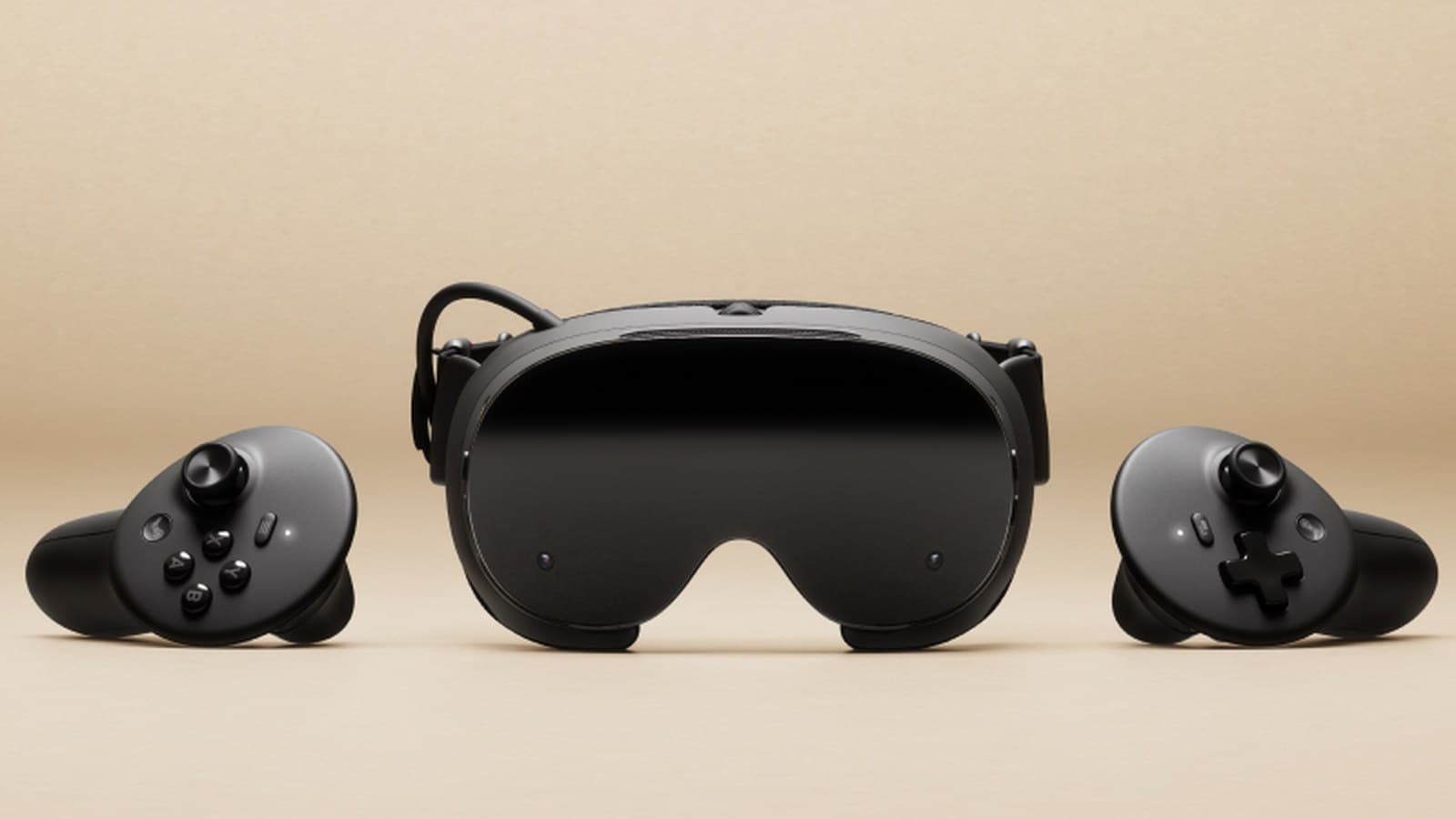
The headset is now less of a mystery than the price. Valve built the Steam Frame as a hybrid: a standalone headset that runs games on its own ARM processor, and a streaming client that pulls a PC's library over a dedicated wireless link. Both halves matter, because Valve is not chasing the mass market that Meta owns so much as the audience that already has a large Steam library and a gaming PC to feed it.
What $1,059 buys
The 256GB configuration costs $1,059 in the United States, with regional pricing at €1,049 in the eurozone, £889 in the United Kingdom, CA$1,529, A$1,609 and 4,539 Polish złoty, according to figures Road to VR compiled from Valve's announcement. The 1TB model is $1,299, €1,279, £1,089, CA$1,859, A$1,969 or 5,549 złoty. Prices include value-added tax where it applies.
Each kit ships with two Steam Frame controllers, a Wi-Fi 6E adapter for PC streaming, and a copy of Half-Life: Alyx. Valve rebuilt Alyx to run natively on the headset's ARM chip, Digital Foundry reported, rather than relying on translation from x86. A power supply is not in the box. Valve sells a 45W unit for $29, and the company notes that a Steam Deck charger or any 45W USB-C adapter will also work.
The internals read like a 2026 flagship phone grafted onto a pair of displays. A 4-nanometer Qualcomm Snapdragon 8 Gen 3 sits at the center, paired with 16GB of unified LPDDR5X memory, a microSD slot, and the choice of 256GB or 1TB of UFS storage. Each eye gets a 2,160 by 2,160 LCD with a 72 to 144Hz refresh rate, the top end marked experimental. There is eye tracking for foveated streaming, which sends the sharpest part of a video stream wherever the wearer is looking, plus inside-out tracking from four monochrome cameras with infrared illuminators. Connectivity covers Wi-Fi 7 and Bluetooth 5.4 on the headset, with the bundled dongle handling a separate 6GHz link to a PC.
Valve has been careful about weight. The front box is 185 grams, and the whole assembly with the battery strap lands around 440 grams, lighter than the 515-gram Meta Quest 3 that the Frame will inevitably be measured against.
A lottery instead of a checkout
Valve is not taking conventional preorders. Buyers register interest for one model on the Steam Frame product page between September 14 and September 17 at 10:00 AM Pacific, then Valve randomizes the list once and emails everyone a result on September 17. Some applicants get a reservation; the rest join a waitlist. Purchase emails begin going out on September 18, and each buyer has 72 hours to complete the order before the reservation moves to the next person in line. People who sign up after the cutoff go to the back of the waitlist.
The rules are tighter than a normal retail launch. Valve requires a Steam account in good standing that made at least one purchase before April 27, 2026, and allows one signup per household, using payment method, shipping address and other signals to catch duplicates. The company said the system worked well enough on the Steam Machine to reuse it.
"We found the reservation system to be helpful with the launch of Steam Machine by improving the purchase experience and limiting resellers, and are implementing it once again for Steam Frame," Valve said in its launch materials, as quoted by Game Informer.
The headset goes on sale in the United States, Canada, Europe and Australia. Buyers in Japan, Taiwan and Hong Kong order through Komodo, Valve's regional distributor.
The memory bill came due
Valve originally expected the Steam Frame in early 2026. It slipped, and by the company's own account the culprit was the cost and scarcity of memory. The Verge noted that the delay was driven in part by the component crunch the industry has taken to calling RAMageddon. The pattern is visible across Valve's hardware line: the Steam Machine shipped at $1,049 in June after DDR5 contract prices climbed more than 170 percent year over year, a figure VR.org tracks as central to the company's pricing.
Against that backdrop, the Frame's sticker looks less like a premium grab and more like the current floor for a device with 16GB of RAM and a modern display stack. The 2019 Valve Index sold as a $999 complete kit. Digital Foundry points out that the Frame is now more expensive than the Index in the United States, though slightly cheaper in the United Kingdom. It is also $10 more than the cheapest Steam Machine.
The missing box contents
Half-Life: Alyx is included, but the power supply is not, and neither is the $149 Arcturus Vision Camera that adds color passthrough. The Frame ships with monochrome passthrough only. Buyers who already own Alyx cannot transfer the extra copy to a friend, Valve has said.
Standalone, but built to stream
Valve's pitch leans on the PC. The included Wi-Fi 6E dongle creates a dedicated 6GHz link to a desktop or laptop, and the software stacks several tricks on top. Foveated streaming concentrates bandwidth on the part of the image the eye tracker says you are looking at. Multi-link streaming spreads the load. Valve calls the Frame a standalone headset that happens to stream extremely well, and reviewers largely agree with that ordering.
Tom's Hardware came away describing it as "competent as a standalone VR" while arguing that wireless streaming remains the main event. The same review summed up the product as "good looks, good performance, and a debilitating price," and placed the $1,059 starting point in the context of gamers already absorbing higher memory, storage and graphics-card costs. That is the central tension of the launch: the Frame is technically sound, and the number attached to it is the part most likely to decide its fate.
Software support matters for a standalone headset, and Valve says more than 100 games carry a Steam Frame Standalone Verified badge at launch. Because the headset runs SteamOS 3, it leans on Proton 11.0 for Windows and Linux titles, FEX for x86 translation and Lepton for Android packages. Most of the verified catalog is smaller VR-native software rather than the large games people associate with a gaming PC.
The wider VR picture
The Steam Frame enters a market shaped by Meta's dominance at the low end and a long retreat from the high-end PC VR niche. The Quest 3 launched in 2023 at $499 and has kept pressure on headset pricing ever since. The Index, by contrast, was always an enthusiast product: expensive, tethered, and dependent on a powerful PC. The Frame tries to sit between those poles by removing the cable while keeping the PC library central.
Whether that position is worth $1,059 depends on how many Steam users treat their living room as an extension of their desktop. Valve does not need the Frame to outsell a mainstream console. It needs enough PC players with large libraries to value untethered streaming and open software to pay an enthusiast price. The reservation lottery will give the company an early and unusually clean measure of how many of those people exist, since every participant has already cleared the account-purchase bar.
There is also a longer tail of accessories to consider. Beyond the ergonomic kit and the replacement kit, Valve designers told The Verge they plan an enthusiast bundle that swaps the strap, battery and audio for a stackable second battery, Index-style off-ear speakers and extra lens spacers. No date or price has been given. Zenni prescription inserts and the Arcturus camera round out the add-on list.
What to watch
The first signals arrive quickly. Reservation and waitlist emails go out September 17, purchase emails start September 18, and units ship as they become available. How deep the reservation queue runs, and how fast Valve clears it, will say as much about demand as any sales figure the company releases.
The second variable is memory. If DRAM and NAND prices ease, Valve has room to adjust pricing or bundle the power supply, and the Frame's value proposition improves without a single firmware update. If prices climb further, the $1,059 entry point will look like the good old days. For now, Valve is selling a capable headset at a price set largely by a supply chain it does not control, and asking its most committed customers to enter a lottery for the privilege.
Cover image: Valve’s official Steam Frame product image, courtesy of Valve.
Tags

TPW Editorial
Editorial Team
TechPastWeek's editorial team reports and edits every story we publish. We research each piece against primary and credible secondary sources, and a human editor reviews and signs off before it goes live.