Valheim Leaves Early Access After Five and a Half Years With the Deep North
Iron Gate shipped Valheim 1.0 on September 9, 2026, adding the Deep North biome and bringing the survival hit to PS5 and Switch 2 after five and a half years.

On this page
On September 9, 2026, exactly 2,045 days after it first appeared on Steam, Valheim left Early Access. Developer Iron Gate and publisher Coffee Stain Publishing released version 1.0 across PC, PlayStation, Xbox, Nintendo Switch 2, Linux and Mac, capping a five-and-a-half-year run that turned a small Swedish studio's debut into one of the best-selling survival games ever made. The headline addition is the Deep North, the game's eighth and final biome. The headline change to the business is that Valheim now costs more, and no longer carries the "Early Access" label that defined its rise.
Related reading: WARDOGS Sells Two Million Copies in Five Days, and Its Studio Says the Quiet Part Out Loud · Valve's Cancelled Portal Prequel F-Stop Surfaces as a Playable Build.
The studio framed the moment plainly in its launch release: "As of today, Valheim is officially released and offers a fully fleshed out, complete survival experience intended by the team at Iron Gate." The press release says the game "has sold more than 17 million copies."
It is a milestone few independent games reach, and it arrives on the back of an unusually long tail. Valheim hit Early Access in February 2021 and sold millions in its first weeks. Rather than rush to a 1.0 label, Iron Gate kept shipping large, free content updates (Hearth & Home, Mistlands, Hildir's Request, The Bog Witch, Ashlands and Call to Arms) each adding biomes, systems and enemies. The result is a game that grew in public, patch by patch, while its community argued over every balance change.
What the Deep North actually adds
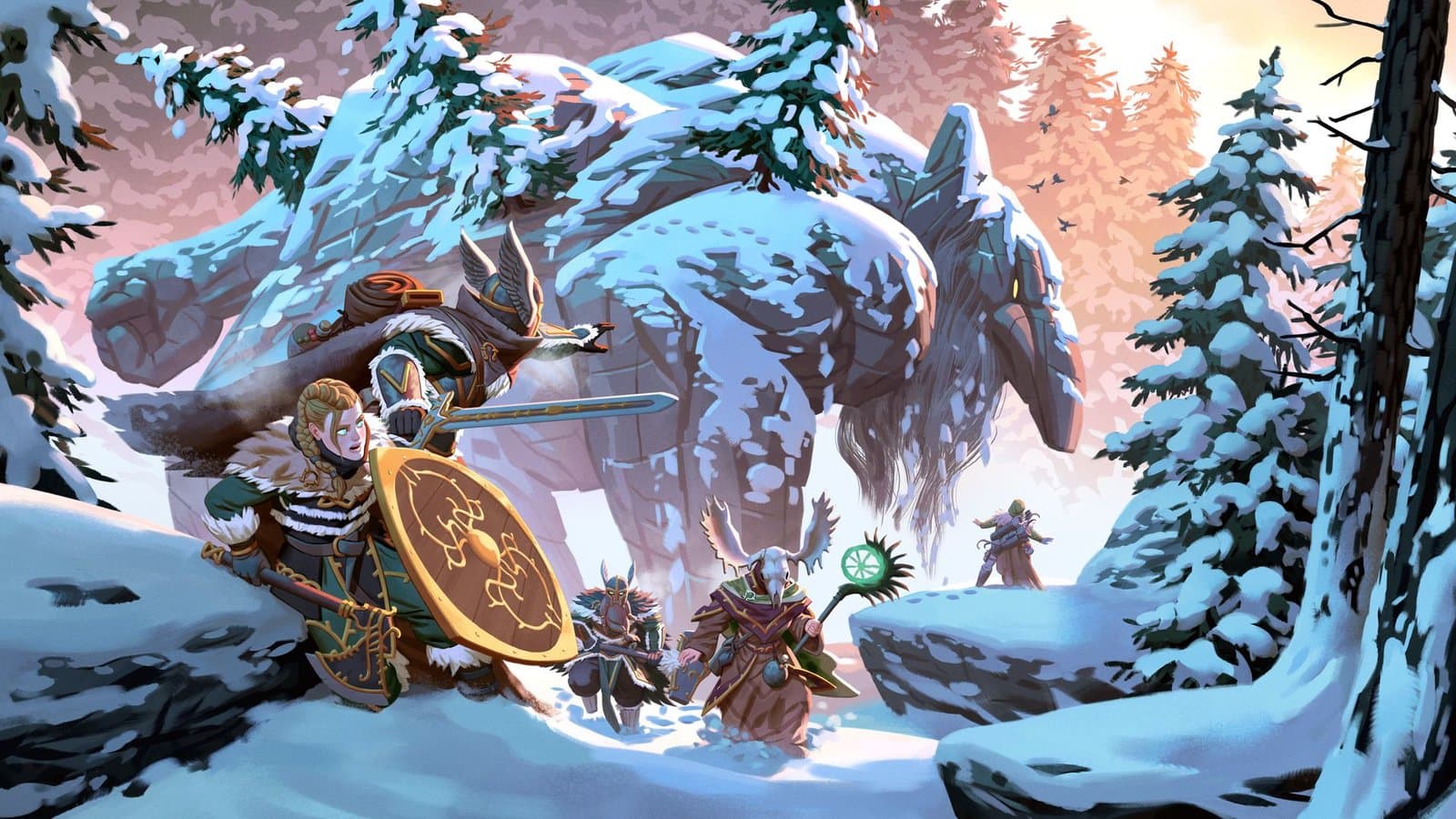
The Deep North is the centerpiece of 1.0 and, by Iron Gate's own description, the biggest region the game has produced. The press release states it is "approximately 2.5 times bigger than any of the previous Valheim biomes, and not just in size." It is a frozen, hostile landscape of icy mesas and frozen seas that was once home to the first Vikings to reach the tenth realm, and it is now populated by ancient threats: the gammeltroll, the elakingar and the barka, plus something older buried underground.
The patch notes for 1.0 list a genuinely large content drop, including more than 40 new weapons, four new armor sets, two new capes, two trinkets, more than 10 new creatures, more than 80 buildable pieces, more than 30 crafting materials and more than 20 food items. New mechanics include a grappling hook for traversal, snow that must be cleared before building, and slippery frozen surfaces. Iron Gate also worked with Brikk Animation on a new intro cinematic, and additional story cinematics now play after key boss fights.
The update is also an attempt to make the whole game feel like one story rather than a stack of expansions. The new cinematic introduces the world through Norse mythology, and the added cutscenes reward players for defeating the game's bosses. Iron Gate has hinted that one more secret cinematic may be hidden somewhere in the Deep North, a small piece of deliberate mystery aimed at the explorers who have spent years poking at the edges of the map.
A full-price game now
Valheim's move out of Early Access comes with a new list price of $29.99, up from the $19.99 it charged during Early Access. The FAQ notes that anyone who already owns the game keeps it at no extra cost, and consoles list it at $29.99.
The practical details for existing players
The 1.0 update is designed to roll into existing worlds rather than require a fresh start. According to the 1.0 FAQ, "Your old saves will still be where you last left them, and you can continue to play with them if you like," and new content appears in areas that have not yet been explored. The studio still recommends starting over, but it is a suggestion, not a requirement.
The update also brings a proper achievement system, with 53 achievements on Steam. Those achievements begin tracking from the moment a player downloads 1.0, which means long-time players may have to re-earn milestones they already completed. The FAQ is blunt that using most developer commands will permanently flag a character and world as "cheated" and lock them out of achievements, with a few exceptions such as freefly.
Mods are the more disruptive issue. Valheim has no official mod support, and the FAQ warns that "Since we have no mod support on PC, there will also be no mod support for consoles for 1.0, and there will be no Steam Workshop featured." Popular mods are likely to break until their authors update them, and there was no public test branch ahead of launch, a deliberate choice so that "everyone gets to experience 1.0 at the same time."
Download sizes vary by storefront: about 4.3 GiB on most platforms, roughly 3.0 GiB on Xbox One, and about 6.5 GiB for the Mac App Store and Microsoft Store builds. Crossplay is supported across all platforms, though cross-platform save progression is limited: only Xbox and Microsoft Store PC players can move saves between devices.
A console debut years in the making
The other structural shift in 1.0 is reach. Until this week, Valheim was available on PC, Mac and Xbox consoles. Version 1.0 brings it to PlayStation 5 and Nintendo Switch 2 simultaneously, with full crossplay between PC, PlayStation 5, Xbox One and Xbox Series X|S, Switch 2, Linux and Mac from day one. PlayStation LifeStyle reported the PS5 version at $29.99 and confirmed the eighth and final biome framing.
The simultaneous launch is notable because console ports for long-running Early Access games often arrive late or in worse shape. Iron Gate committed to a same-day, same-build release for the new platforms, and the release date was confirmed on June 7, 2026 during the PC Gaming Show, with the studio promising no staggered rollout and no public test branch. That promise held.
“Valheim 1.0 will arrive on 9 September, with new enemies to kill, bases to build and weapons to craft.” — Iron Gate, June 7, 2026
For a studio that started development as a solo project in 2017 and only incorporated as Iron Gate in 2019, the console debut is a second commercial life. A 17-million-copy PC and Xbox hit now has access to the PlayStation and Nintendo storefronts, where survival games have found large new audiences in recent years. Rivals in the same genre have shown how quickly that audience can move: Palworld, Enshrouded and others have all competed for the same players, and Valheim's advantage is an unusually loyal base built over five years rather than a single viral moment.
Why it matters
Valheim's long Early Access was a bet that the game's community would reward transparency and steady content over a quick finish. The sales numbers suggest the bet paid off, and the studio's willingness to keep adding free biomes kept the game in the conversation for years rather than weeks. Exiting Early Access is not only a label change: it signals that Iron Gate believes the core experience is finished, and it lets the game be sold at full price and marketed to console audiences on equal footing.
The 1.0 release also closes a loop the studio has been building toward. Two of the game's biggest updates, Mistlands and Ashlands, each ended with a question about what lay further out. The Deep North was always the planned endpoint, and the update's new story cinematics and final boss progression are meant to tie the whole run together into a complete arc. For players who drifted away after the first few months in 2021, the pitch is a finished game with eight biomes rather than an unfinished one with five.
There is a broader industry point, too. Valheim's success came from a small team, a modest budget and a willingness to iterate in public, the opposite of the large, expensive, marketing-driven launches that dominate the console market. Its move to PlayStation and Switch 2 tests whether that approach travels outside the PC-and-Xbox audience that built it.
The caveats
A 1.0 label is not a promise that everything works. The FAQ acknowledges that mods may not function, that the much-requested Ocean biome was not reworked in this update, and that existing large builds will not see much benefit from the optimizations included in 1.0. The studio says it will keep fixing bugs and shipping quality-of-life improvements but that "exactly how long the game will continue to receive updates is currently too soon to say."
Achievements will reset their tracking for veterans, which will annoy some of the most invested players. Console players enter a mature PC game with years of accumulated balancing and an established, often opinionated community, which can be an uneven first experience. And a $10 price increase on the same base game is a real change for newcomers, even if it reflects the completion of the project.
The bigger uncertainty is what comes after. Valheim now has a finished story and a final biome, and Iron Gate has not committed to more content. That leaves 1.0 as either the end of the game's development or the foundation for a longer support period, and the studio has deliberately left both options open.
What to watch
Three signals will show whether 1.0 is a launching point or a victory lap. The first is post-launch stability: how quickly Iron Gate patches the issues that always surface when a large update meets millions of existing saves. The second is console adoption, whether PS5 and Switch 2 players convert a PC phenomenon into a broader franchise. The third is the modding ecosystem, which has no official support and a real chance of fragmenting if authors move on.
A fourth, quieter question is pricing and cadence. If Valheim sells well at $29.99, it strengthens the case that long, iterative Early Access runs can end in a full-price release rather than a quiet fade. If the audience has already moved on after five and a half years, 1.0 may prove to be the game's final headline moment.
Either way, the distance is worth noting. On its first day in Early Access, Valheim was an unknown Viking survival game from a studio most players had never heard of. On September 9, 2026, it shipped a finished game with full crossplay across six platform families, more than 17 million copies sold, and a finale that the community has been waiting years to see.
Tags

TPW Editorial
Editorial Team
TechPastWeek's editorial team reports and edits every story we publish. We research each piece against primary and credible secondary sources, and a human editor reviews and signs off before it goes live.