Waymo Opens Las Vegas Robotaxi Service, Its 15th Market
Waymo began inviting the public to ride its robotaxis in Las Vegas on September 14, its 15th commercial market and first in Nevada, ahead of Tesla and Zoox.

On this page
Waymo began offering public robotaxi rides in Las Vegas on Monday, September 14, opening its 15th commercial market and its first in Nevada. The Alphabet-owned company is starting with a few dozen of its new Ojai minivans and inviting riders on a rolling basis rather than opening the service to everyone at once, the same staged approach it has used in the 14 cities it already serves.
Related reading: Alphabet's Free Cash Flow Hit -$9 Billion and the Stock Had Its Worst Day · Microsoft Borrows $25 Billion as the AI Buildout Moves Onto the Bond Market.
The first service area covers the Las Vegas Strip south of Highway 589 and stretches into Boulder Junction, according to a company spokesperson. Waymo has not said how quickly it will expand the territory or the fleet. In most of its markets, the company shifts from invite-only access to general availability within a month or two of launch.
Las Vegas is not a quiet debut. It is the first market where Waymo, Tesla and Uber all hold approval to run commercial robotaxi services in the same county, and each is licensed for a different scale. Waymo can operate up to 1,000 autonomous vehicles over the next year in Clark County, Tesla is allowed up to 5,000, and Uber up to 1,000, which it plans to run through partnerships with Hyundai's Motional and Amazon's Zoox. Together the permits could put as many as 7,000 robotaxis on county roads over the next 12 months, though none of the three is expected to reach those ceilings soon.
A deliberate start
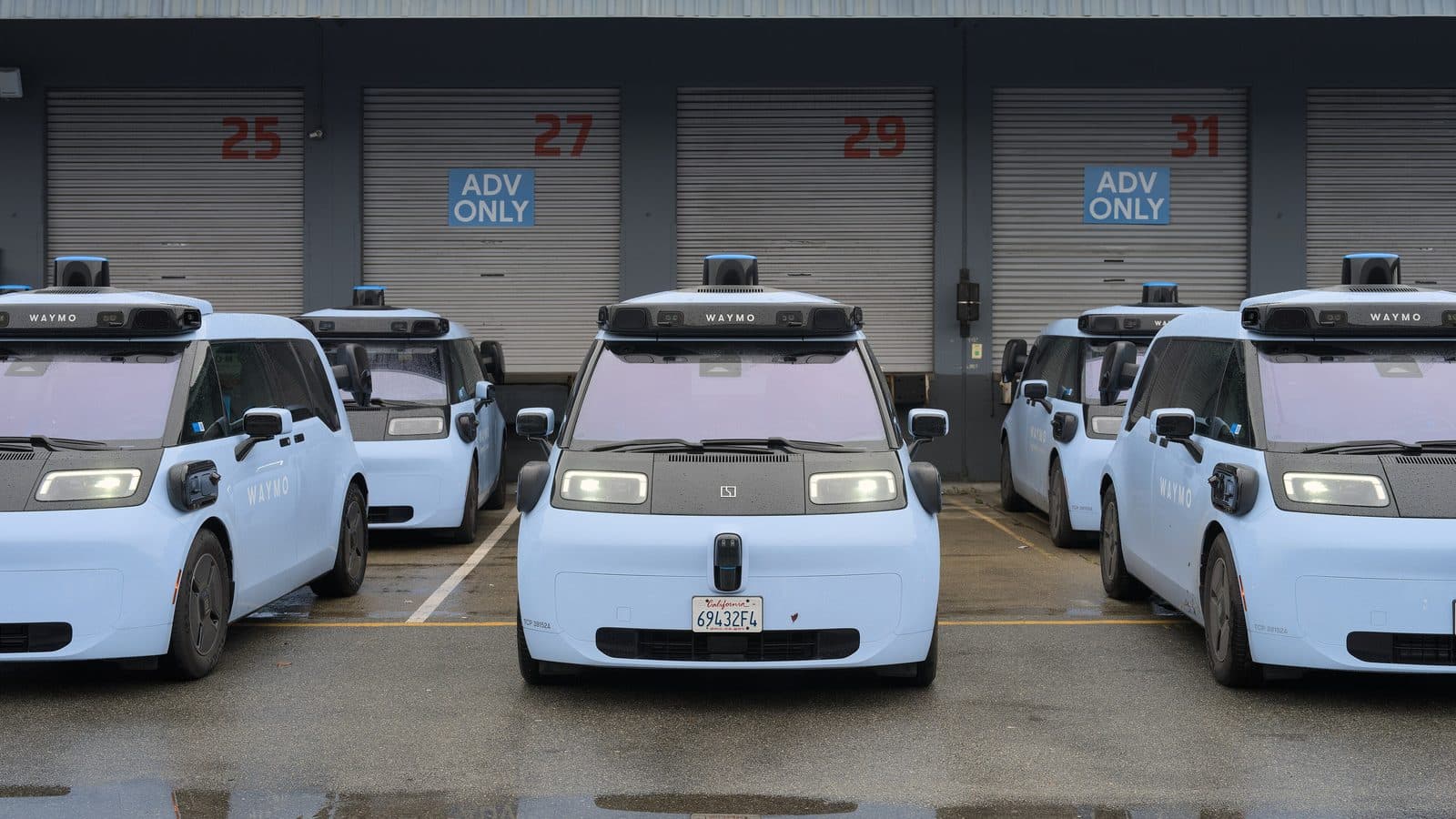
The Las Vegas launch follows final approval from the Nevada Transportation Authority, which cleared commercial robotaxi operations in Clark County earlier this year. Waymo's first phase is deliberately small: a handful of Ojai vans, the boxy, purpose-built minivan it developed with the Chinese automaker Zeekr, running a route that takes in the Strip and the residential-and-industrial pocket around Boulder Junction.
That geography matters more than it first appears. A robotaxi network lives or dies on the density of its service area and the complexity of the streets inside it. The Strip brings constant foot traffic, valet drop-offs, construction zones and event-night surges, while Boulder Junction adds freeway interchanges and truck traffic. If Waymo's mapping and remote-assistance systems hold up across both, the company has a template it can extend outward to the rest of the valley.
The company is also courting a market built for it. Las Vegas draws tens of millions of visitors a year who arrive without cars, use ride-hailing heavily, and are unusually willing to try unfamiliar technology. A robotaxi ride from a casino to a convention center is a low-friction introduction, and Waymo's branded visibility could spread through word of mouth faster than in a commuter city like Phoenix or Austin.
The Ojai itself is a shift for Waymo. Its fleet has been built largely around the Jaguar I-Pace, a premium electric SUV fitted with the company's sensor suite. The Ojai is a purpose-built minivan developed with Zeekr, with a boxier cabin, sliding-door ergonomics and a roof-mounted sensor pod designed from the start for driverless service rather than retrofitted onto a retail vehicle. Riders in Las Vegas will encounter a vehicle that looks less like a modified car and more like a small shuttle, a design choice that also lowers the cost of each unit as Waymo scales production.
The race is already crowded
Waymo's lead is real but no longer unassailable. The company operates more than 4,000 robotaxis across more than a dozen cities, including Austin, Dallas, Houston, Los Angeles, Miami, Nashville, Phoenix and the San Francisco Bay Area, and it added invited public rides in Denver, San Diego and Tampa earlier in September. But Tesla, Zoox and Motional are all preparing to launch commercial service in the same Las Vegas market, and the Nevada permits mean regulators expect all of them to make a serious push.
Tesla's ambitions are the loudest. At an August meeting with state regulators, Cybercab chief engineer Eric Early said the company would be "extremely happy and satisfied if we could get ourselves up to 2,500, maybe a bit higher than that in the next year." That is half of Tesla's permitted ceiling and still more than Waymo has in any single city today. Tesla has been converting a production line for the Cybercab, a two-seat vehicle with no steering wheel, and its progress will shape how quickly Las Vegas fills with robotaxis.
The numbers to watch
- Waymo: more than 4,000 robotaxis across 15 commercial markets; up to 1,000 authorized in Clark County over the next year.
- Tesla: permitted for up to 5,000 vehicles in Clark County; targeting around 2,500 within a year.
- Uber: permitted for up to 1,000 vehicles, to be supplied by Motional and Zoox.
Zoox, which Amazon owns, has taken a different path, designing a purpose-built vehicle with no steering wheel and no reverse gear. It announced plans in March to expand its robotaxi service in San Francisco and Las Vegas, and to begin testing its vehicles in Austin and Miami. Motional, the Hyundai subsidiary, brings a longer history of autonomous testing but a more cautious public posture.
The economics behind the push are straightforward. A driverless vehicle has no driver to pay and can run for most of the day, so once the hardware and remote-support costs fall far enough, the marginal cost of an extra trip drops below that of a human-driven car. That is the bet every operator is making, and it explains why the race is about scale rather than a single profitable route. It also explains the urgency: the company that reaches high utilization first can spread its fixed costs across more rides and undercut the others on price.
For riders in Las Vegas, the practical effect in the near term will be a patchwork. Each operator has its own app, its own service boundaries and its own waitlist, so a visitor who requests a Waymo may still have to open a separate app if the pickup point falls outside the coverage zone. The competition that regulators want, and that advocates say will drive prices down and reliability up, will take a year or more to materialize.
Why the regulatory path was smooth
Nevada has positioned itself as a permissive venue for autonomous vehicles, and the state's Transportation Authority moved quickly to license the three operators. That is a contrast with California, where Waymo has faced more procedural friction, and with the European Union, where Apple and other US technology firms have run into local rules on data and competition.
The state's calculus is partly economic. Las Vegas depends on visitors moving between a compact set of destinations, and a driverless fleet could smooth demand spikes without adding to the labor pool that casinos and hotels already struggle to staff. It also gives Nevada a claim to being a testbed for a technology that other states are still debating.
The federal picture is less settled. Washington has not set binding rules for robotaxi deployment, so operators work state by state and city by city. That patchwork favors companies with the money and legal teams to pursue dozens of permits, and it makes each new market a test of whether a launch playbook forged in California still works in a state with different road rules, weather and insurance requirements.
The safety question that follows the industry
Every robotaxi expansion now lands in a skeptical environment. Regulators, lawmakers and labor groups have spent the past two years pressing for more disclosure about crashes, remote-assistance failures and how companies measure safety. Waymo publishes detailed collision and injury data and has generally fared better than its rivals in that reporting, but Tesla's driver-assistance system remains under federal investigation, and the National Highway Traffic Safety Administration has shown a willingness to scrutinize automated-driving features.
That scrutiny is the backdrop for the Las Vegas launch, not a detail beside it. Waymo's public argument is that a driverless vehicle with a proven safety record can reduce the roughly 40,000 US road deaths a year. Its critics counter that the evidence is gathered by the companies themselves, that service areas are chosen to flatter the numbers, and that remote operators can mask the true rate at which human help is needed.
Neither side can settle that argument in a single market. What Las Vegas offers is a natural experiment: three competing companies, one set of roads, and a public that is unusually exposed to all of them at once. Whatever the safety data show in Clark County over the next year will be read well beyond Nevada.
What to watch
The first test is whether Waymo moves from invites to open access quickly. If the company repeats its usual pattern, general availability arrives within a month or two, and the waitlist stops shaping the story. If it stalls, that will say as much about demand and operations as about regulation.
The second is Tesla. The Cybercab line and the company's willingness to run a steering-wheel-free vehicle on public roads will determine whether Las Vegas becomes the first market where Tesla's robotaxi ambitions are tested at anything close to scale.
The third is the regulatory response if something goes wrong. A serious crash involving any operator would sharpen the debate over who supervises driverless fleets, how quickly incidents are disclosed, and whether states should keep competing for deployments or wait for federal rules. For now, the competition is on, and Las Vegas is the track.
Cover image: Waymo's Zeekr-built Ojai robotaxi at a depot in San Francisco. Photo by Dllu, via Wikimedia Commons, CC BY-SA 4.0.
Tags

TPW Editorial
Editorial Team
TechPastWeek's editorial team reports and edits every story we publish. We research each piece against primary and credible secondary sources, and a human editor reviews and signs off before it goes live.